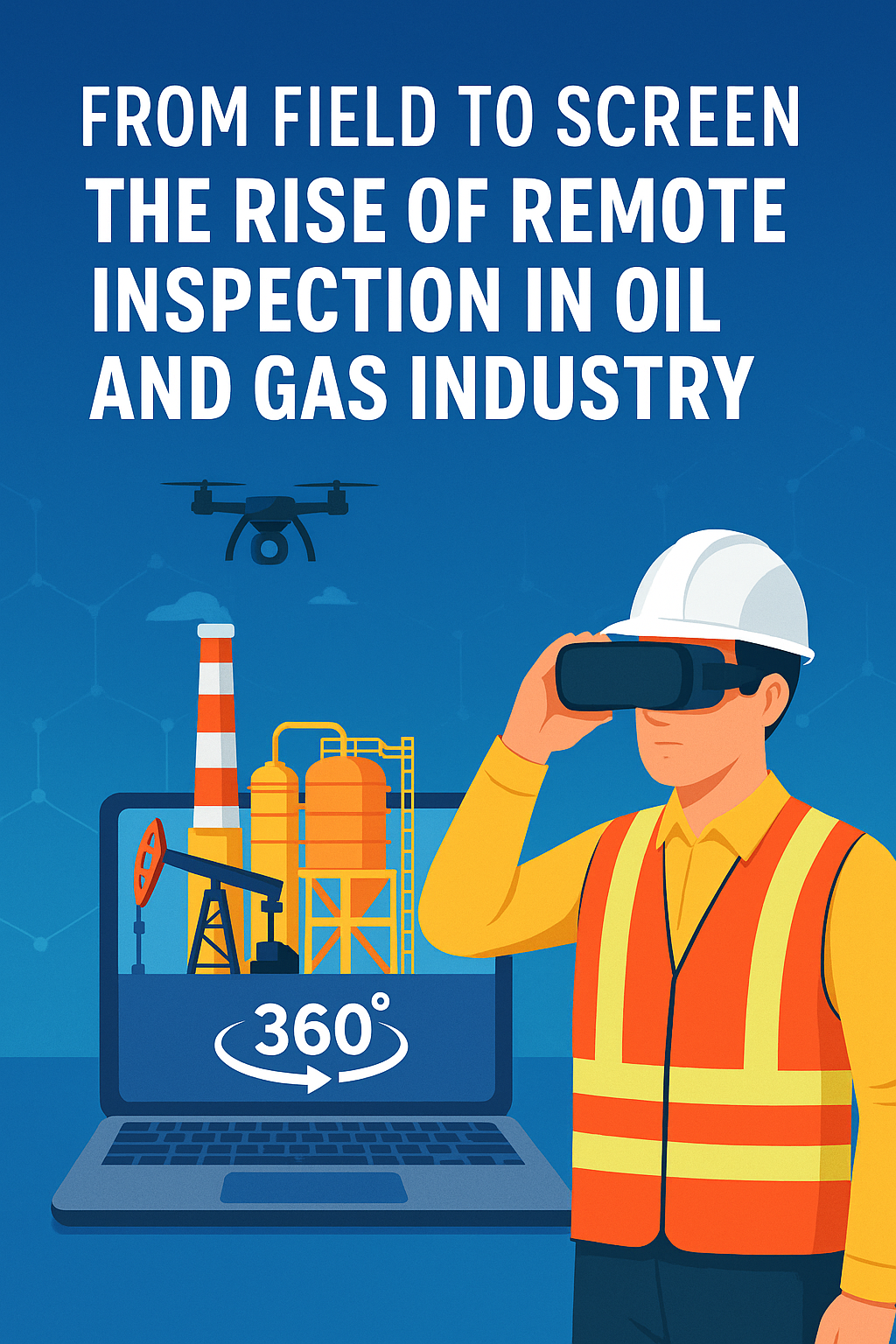
From Field to Screen: The Rise of Remote Inspection in Oil and Gas Industry

Cloudpano
July 24, 2025
5 min read
Share this post

📡 From Field to Screen: The Rise of Remote Inspection in Oil and Gas Industry

The oil and gas sector is no stranger to high-risk environments, logistical challenges, and complex infrastructures spread across remote and hazardous locations. As technology evolves, so does the way we manage these challenges. One of the most significant breakthroughs? Remote inspection technologies 🛰️—particularly 360° virtual tours, drones, and VR-powered documentation tools.

Let’s explore how this digital transformation is changing the game—from field to screen—and making operations smarter, safer, and more cost-effective than ever before.

👀 Why Traditional Site Inspections Are No Longer Enough

Conventional inspections often require on-site visits by experts, engineers, or compliance officers. This process is:

  • ⏱️ Time-consuming
  • 💸 Expensive (think flights, lodging, and downtime)
  • ⚠️ Risky for human safety

In contrast, remote site inspections powered by digital tools eliminate these inefficiencies while enhancing data accuracy and operational speed.

🌍 What Is Remote Inspection in Oil and Gas?

Remote inspection refers to using technology—like drones, 360° cameras, IoT devices, and virtual reality—to assess, monitor, and document facilities without being physically present.

This is particularly powerful in the oil and gas sector, where infrastructure may include:

  • Offshore rigs
  • Remote pipelines
  • High-risk refineries
  • Restricted industrial zones

🔧 Tools Powering the Shift from Field to Screen

Here are the most impactful technologies pushing the industry toward digital-first inspections:

1. 🚁 Drones for Aerial Inspection

Drones offer unparalleled access to difficult or dangerous locations.

Benefits:

  • Real-time footage of flare stacks, pipelines, and offshore platforms
  • Reduced manned inspection requirements
  • Enhanced documentation and repeatable flight paths

📚 Dive deeper in How Drones and 360° Virtual Tours Power Remote Oil and Gas Inspections

2. 🎥 360° Virtual Tours for Complete Site Context

With 360° tours, you can document every angle of a facility—indoors and outdoors—for walkthroughs, maintenance checks, or remote audits.

Use Cases:

  • Virtual team collaboration
  • Remote training sessions
  • Emergency simulations

💡 Related read: Step Into Safety: 360 Virtual Tours for Oil and Gas Emergency Simulations

3. 🧠 AI-Enhanced Hazard Recognition

AI software integrated with camera footage can automatically identify risks such as gas leaks, faulty equipment, or improper safety compliance.

✅ Pair it with VR tools to simulate hazard training. Learn more in Boost Safety in Oil and Gas with VR-Based Hazard Recognition Virtual Tours

4. 🗂️ Smart Documentation Platforms

Gone are the days of paper checklists and handwritten field reports.

Modern documentation platforms allow you to:

  • Upload inspection footage
  • Annotate virtual walkthroughs
  • Track changes over time

This is especially critical for compliance and insurance reporting.

📈 Check out: Digitize Oil and Gas Emergency Protocols with 360 Virtual Tour Software

💡 Why the Oil and Gas Industry Is Going Remote

Here are just a few reasons why remote inspection tools are in high demand:

🧯 1. Improved Emergency Readiness

Emergencies demand rapid situational awareness. A virtual tour gives safety teams a clear layout before stepping on-site.

🔗 Related: Oil and Gas Emergency Preparedness Enhanced: 360 Virtual Tours + Documentation Software

🛠️ 2. Lower Costs and Downtime

Remote inspections reduce travel, labor, and production halts. In many cases, they can be conducted without disrupting active operations.

📊 Dive into: Cut Downtime and Improve Accuracy with Remote Oil & Gas Site Monitoring

🌐 3. Global Access to Local Issues

Remote teams can access inspection data from anywhere in the world. This is game-changing for multinational operations and joint ventures.

🚀 Real-World Success Story

A midstream oil operator adopted 360° virtual tours for monthly pipeline inspections. As a result:

  • Inspection time dropped by 60%
  • Travel costs reduced by 45%
  • Report accuracy increased significantly

🧭 Looking Ahead: What’s Next?

The next generation of remote inspection may include:

  • 🤖 Autonomous drone inspections
  • 🌐 Live multi-user virtual walkthroughs
  • 📱 Mobile AI tools for on-the-go risk detection

✅ Final Thoughts

From field to screen, the rise of remote inspection in oil and gas represents a massive leap forward in safety, efficiency, and insight. Whether you’re a plant manager, safety officer, or inspector, now is the time to adopt these tools.

🔍 Want to explore the full range of inspection innovations? Read Top Benefits of Remote Inspections in Oil and Gas Exploration and Production

Ready to take your oil and gas operations digital? Start creating remote tours, training modules, and inspection workflows with CloudPano today. 🌐

Share this post
Cloudpano

Choose The Right 360° Camera

Insta360 ONE RS 1-Inch 360 Edition

  • Compact, ready to go anywhere

  • Interchangeable lens that’s upgradeable

  • Dual 1-inch sensors for improved clarity and low light performance

  • Dynamic range and 6K 360° capture

  • 360° photo resolution at 21MP

Learn More

Insta360 X4

  • 8K 360° video recording for ultra-detailed visuals.

  • 4K single-lens mode for traditional wide-angle shots.

  • Invisible selfie stick effect for drone-like perspectives.

  • 2.5-inch touchscreen with Gorilla Glass protection.

  • Waterproof up to 33ft for underwater shooting.

Learn More

Ricoh Theta Z1

  • 360° photo resolution in 23MP

  • Slim design at 24 mm thick

  • Built-in image stabilization for smooth video capture.

  • Internal 19GB storage for photo and video storage.

  • Wireless connectivity for remote control and sharing.

Learn More

Ricoh Theta X

  • 60MP 360° still images for high-resolution photography.

  • 5.7K 360° video recording at 30fps.

  • 2.25-inch touchscreen for intuitive control.

  • USB Type-C port for fast charging and data transfer.

  • MicroSD card slot for expandable storage.

Learn More
Property Marketing
Allows potential buyers to explore properties in detail from anywhere, enhancing the real estate marketing process.
Automotive Spins
Create an interactive virtual showroom and engage affluent digital buyers with live 360º video calls, all through the CloudPano mobile app for a complete automotive sales solution.
Interactive Floor Plans
Create 2D and 3D floor plans with measurements in 4 minutes or less, all from your phone. Download the Floor Plan Scanner app and get your first scan free.

360 Virtual Tours With CloudPano.com. Get Started Today.

Try it free. No credit card required. Instant set-up.

Try it free
Latest posts

See our other posts

Interviews, tips, guides, industry best practices, and news.

Property Manager Video Hub: Scaling Rental Visibility with AI Photo-to-Video Workflows

This article explains how property managers can use PhotoAIVideo to build a property manager video hub: a repeatable system for turning rental photos, amenity images, floor plans, exterior shots, and neighborhood visuals into reusable rental marketing videos. The main idea is that property managers do not just need more listing exposure. They need clearer visual answers that help renters decide whether to schedule a tour. PhotoAIVideo is positioned as a practical tool for creating: Unit availability videos Amenity highlight videos Neighborhood videos Tour reminder clips Leasing follow-up videos Owner marketing proof videos Social media rental teasers Application or availability reminder videos Key takeaways: Property managers already have the media they need; the challenge is organizing it and turning it into reusable video assets. A video hub helps teams create consistent videos across units, floor plans, amenities, communities, and owner updates. Rental videos can reduce friction by answering renter questions about layout, condition, amenities, parking, pet features, and community feel. One rental photo set can become multiple video outputs for listings, social media, email, text follow-up, tour reminders, and owner reporting. Photographers can sell AI rental video packages to property managers as an upsell. Brokerages with property management divisions can use the same workflow to standardize leasing content. The article ends with a step-by-step process, video hub framework, mistakes to avoid, visual recommendations, FAQs, and a CTA encouraging readers to use PhotoAIVideo to turn rental photos into a scalable video system for rental visibility.
Read post

YouTube Shorts Listing Teasers: The 3-Scene Structure for Higher Property Clicks

This article explains how real estate agents, photographers, brokerages, and property managers can use YouTube Shorts listing teasers to drive more property clicks and showing requests. The main idea is that a YouTube Short should not try to show the entire house. Instead, it should use a simple 3-scene structure: Scene 1: Hook — stop the scroll with the strongest property feature. Scene 2: Proof — show the visuals that support the hook. Scene 3: Click Path — tell the viewer what to do next. The article positions PhotoAIVideo as a practical tool for turning listing photos into short vertical videos for YouTube Shorts, Reels, open house promotion, and listing campaigns. Key takeaways: YouTube Shorts should create curiosity, not replace the full listing video. The strongest property feature should appear first, not necessarily the front exterior. Agents should build each Short around one click reason, such as backyard, kitchen, layout, neighborhood, open house, or price point. One listing can become multiple Shorts instead of one generic video. Photographers can offer YouTube Shorts teaser packs as a video upsell. Brokerages can standardize the 3-scene structure across agents. Property managers can use the same structure to promote rentals and tours. The article ends with practical scripts, visual recommendations, FAQs, a visual placement guide, and a CTA encouraging readers to use PhotoAIVideo to create YouTube Shorts listing teasers from property photos.
Read post

Video Retargeting for Listings: Turning Photo-Based AI Videos into Appointment Follow-Up

This article explains how Realtors, photographers, brokerages, and property managers can use photo-based AI videos as follow-up assets after someone shows interest in a listing. The main idea is that most real estate marketing focuses on getting the first click, but many buyers and sellers need multiple touchpoints before booking a showing or appointment. Video retargeting helps agents re-engage people who already clicked a listing, watched a Reel, opened an email, attended an open house, asked about a property, or went quiet after showing interest. PhotoAIVideo is positioned as a practical tool for turning listing photos into short follow-up videos, including: Feature reminder videos Layout explainer videos Neighborhood fit videos Open house recap videos Price update videos Seller proof videos Showing request videos Rental tour recovery videos Key takeaways: A first-touch listing video introduces the property, while a retargeting video answers the next likely question. Follow-up videos should be short, usually 10–30 seconds, and focused on one action. Agents should send different videos based on behavior, such as email clicks, open house attendance, listing views, or showing interest. A good video follow-up feels helpful, not pushy. Photographers can package retargeting video clips as an upsell. Brokerages can standardize video retargeting workflows across agents. Property managers can use the same strategy to recover rental leads and book tours. The article ends with a simple retargeting sequence, visual recommendations, FAQs, and a CTA encouraging readers to use PhotoAIVideo to turn listing photos into appointment-driving follow-up videos.
Read post