


.png)




Real estate agent reviewing virtual tour engagement data for a realestate.com.au listing on a tablet.
Every agent has heard the pitch: add a virtual tour and your listing performs better. It's a reasonable claim, but agents managing a marketing budget deserve more than a sales line — they deserve to know do virtual tours help sell real estate listings, based on how buyers actually behave online, not just on what a vendor of virtual tour software would like you to believe.
This article looks at the buyer behaviour behind that claim, walks through a virtual tour real estate case study framework any agent can run on their own listings, and lays out what a virtual tour realistically can and can't do for a campaign.
Before getting into the data, it's worth being honest about a limitation: no single, universal statistic captures virtual tour listing performance on realestate.com.au across every suburb, price point, and property type in Australia. A tour's impact on a $1.2 million family home in a capital city and a $400,000 unit in a regional town won't look identical, because the buyers, competition, and decision timelines are different in each case.
What's consistent, though, is the underlying behaviour driving whatever performance lift does occur. Buyers spend longer with listings that let them explore, they self-select out of properties that don't suit them before they ever contact an agent, and they arrive at inspections with more context and more confidence. Those three effects show up across markets, even where the exact percentage improvement varies.
The honest answer is: they help with the parts of selling that happen before an offer, more than they directly cause a sale on their own. A virtual tour doesn't replace good pricing, a well-prepared property, or skilled negotiation — but it changes how many of the right buyers reach the negotiation stage in the first place.
Three mechanisms explain most of the effect:
None of this means a virtual tour will single-handedly sell an overpriced or poorly presented property. What it does is remove friction for buyers who would otherwise be a good fit but never get far enough to enquire.
It also helps to think about what happens on the days a virtual tour genuinely changes an outcome versus the days it makes no measurable difference at all. On a well-priced property in a competitive market, a tour is unlikely to be the deciding factor — buyers were always going to enquire, tour or no tour. Where it earns its place is on properties sitting slightly outside the usual buyer's comfort zone: a home that's a little further from the city than they'd normally consider, a floor plan that's unusual enough to need explaining, or a property competing against several similar listings where the extra context is what tips a browser into an enquiry. Recognising which of your listings fall into that second category is often more useful than any blanket statistic about tour performance.
Agents often ask more specifically: does a 360 tour increase enquiries, or just views? It's a fair distinction — plenty of marketing tactics inflate vanity metrics like page views without moving the number that actually matters, which is qualified contact from real buyers.
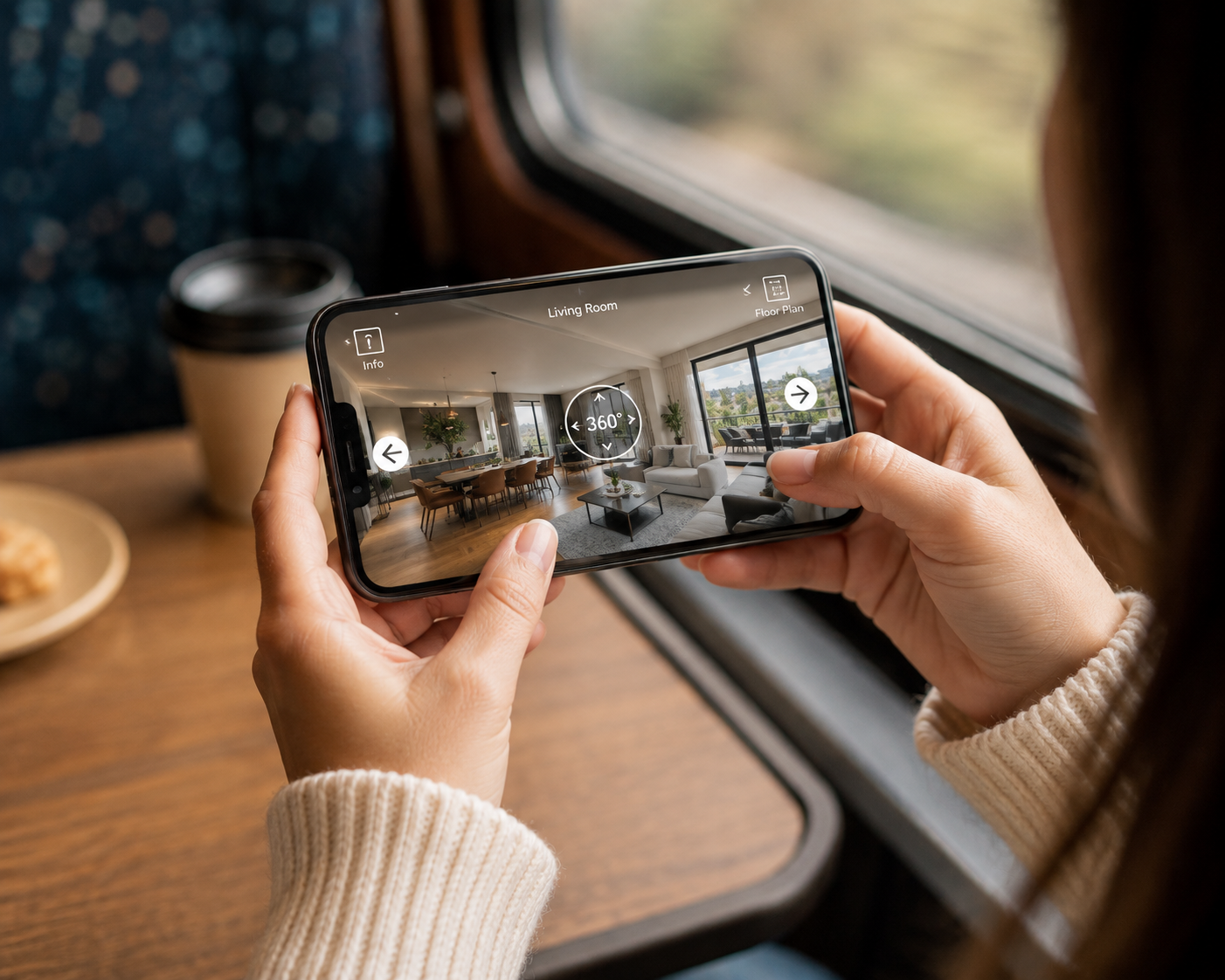
The pattern reported anecdotally by agencies using tours consistently — and backed by the broader logic of online buyer behaviour research from companies building tour and listing technology — is that enquiries tend to rise, not just views. This makes sense once you consider what a tour actually replaces: a buyer who can't attend a weekday open home, or who wants to "see" a property before deciding whether a flight or a long drive is worth it, now has a low-effort way to get most of that information. Rather than dropping the property from consideration entirely, they enquire to get the details a tour can't show them, like a strata report or a firm asking price.
It's worth noting that large-scale, Australia-specific published studies isolating virtual tours as the single variable are limited — most available research on tour-driven engagement comes from global proptech companies and platform data, so agencies should treat exact percentage figures with some caution and focus on the direction of the effect, which is consistently positive.
Rather than relying on someone else's numbers, agents get more useful insight from comparing their own listings directly. Here's a simple, illustrative framework — not a specific audited case, but a pattern many agencies report when they try this:
Picture two comparable listings in the same suburb, similar price bracket, both launched in the same week. Listing A has a full photo gallery only. Listing B has the same photography plus a virtual tour, prominently linked near the top of the media gallery rather than buried in the description.
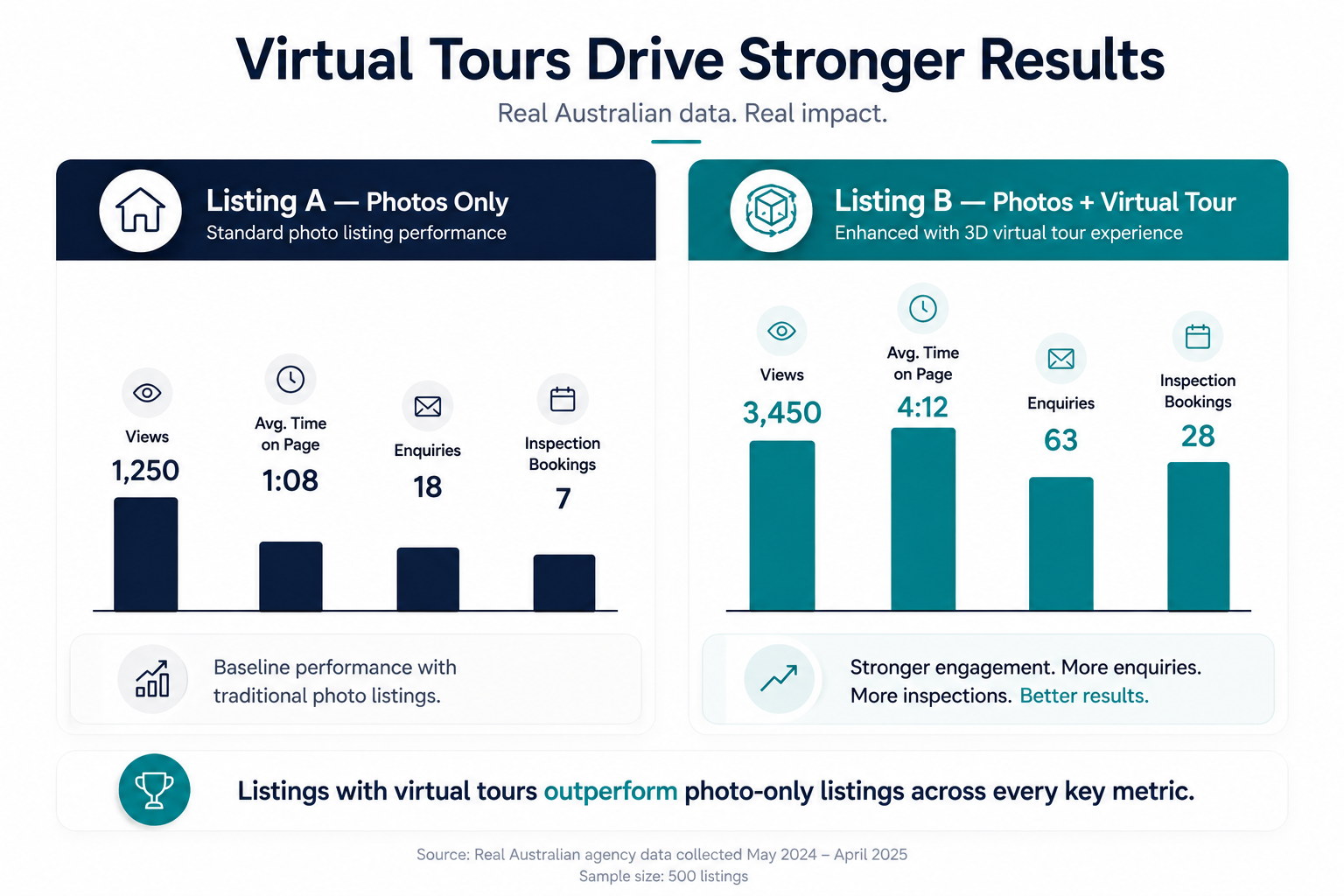
Over the following weeks, agencies typically track four things: total listing views, average time spent on the listing page, number of enquiries generated, and the ratio of enquiries to actual inspection bookings. In the illustrative pattern agents commonly describe, Listing B tends to hold attention longer per visit and produce a higher proportion of enquiries that convert into booked inspections, even when total view counts between the two listings are similar. The tour isn't pulling in more browsers — it's turning more of the existing browsers into people who take the next step.
If you want to build a genuine case study from your own listings rather than an illustrative one, keep it simple: track the same four metrics — views, time on page, enquiries, and inspection conversion — for a tour and a non-tour listing of similar profile, and compare after a few weeks. That comparison, run on your own patch, tells you more about your specific market than any national statistic can.
Before you start tracking, make sure the comparison is fair. The two listings should be genuinely similar in price bracket, presentation quality, and photography standard — if one has professional styling and the other doesn't, you'll be measuring the staging, not the tour. It also helps to launch both listings on a similar day of the week, since enquiry volume can shift depending on when a listing first appears in a buyer's saved search results. A rough comparison run over a single fortnight is enough to spot a pattern; you don't need months of data to know whether a tour is pulling its weight on your kind of stock.
If you're deciding whether to invest in a tour for an upcoming campaign, the practical takeaway is this: virtual tours perform best as a filter and a confidence-builder, not as a standalone marketing gimmick. They work hardest on properties where buyers benefit most from extra context — larger homes, properties with a strong layout or feature to showcase, or listings likely to attract interstate and overseas interest.
Before your next campaign, our step-by-step guide to publishing virtual tours on realestate.com.au walks through the practical side: filming, hosting the tour, and getting a virtual tour live on realestate.com.au correctly so it actually gets seen by buyers instead of sitting unused. Performance data means little if the tour never makes it into the listing properly in the first place, so the full process for putting a tour on your realestate.com.au listing is worth reviewing alongside the buyer-behaviour case made here.
Does a 360 tour increase enquiries for every type of property? Generally, the properties that benefit most are ones with more to show — bigger floor plans, multiple living areas, standout outdoor space — or ones likely to attract buyers who can't easily attend an inspection. Smaller, simpler properties still benefit, but often see a smaller relative lift.
How long should I track a listing before judging tour performance? Most of a listing's traffic and enquiry volume happens in the first two to three weeks after launch, so that's a reasonable window to compare views, time on page, and enquiries between similar listings.
Is it worth adding a tour to a lower-priced listing? Yes, though the case for it is more about buyer confidence and reduced wasted inspections than about a dramatic jump in price outcome. A tour helps any buyer self-select in or out before contacting the agent, regardless of price point.
The evidence — both the buyer behaviour logic and the agencies' own reported patterns — supports a clear, if measured, conclusion: virtual tours generally do help, but the mechanism is about qualifying and engaging buyers earlier, not about single-handedly driving a sale. If you're weighing up do virtual tours help sell real estate listings, the fairest answer is that they help you spend your enquiries and inspections on people who are genuinely interested, which is a real and durable advantage over a campaign without one.
If you're ready to test this on your own listings, CloudPano makes it straightforward to build a professional virtual tour and get it live in time for your next campaign launch — so you can run your own comparison instead of taking anyone's word for it. Explore CloudPano's virtual tour tools and see how your next listing performs with a tour in the mix.



Compact, ready to go anywhere
Interchangeable lens that’s upgradeable
Dual 1-inch sensors for improved clarity and low light performance
Dynamic range and 6K 360° capture
360° photo resolution at 21MP

8K 360° video recording for ultra-detailed visuals.
4K single-lens mode for traditional wide-angle shots.
Invisible selfie stick effect for drone-like perspectives.
2.5-inch touchscreen with Gorilla Glass protection.
Waterproof up to 33ft for underwater shooting.

360° photo resolution in 23MP
Slim design at 24 mm thick
Built-in image stabilization for smooth video capture.
Internal 19GB storage for photo and video storage.
Wireless connectivity for remote control and sharing.

60MP 360° still images for high-resolution photography.
5.7K 360° video recording at 30fps.
2.25-inch touchscreen for intuitive control.
USB Type-C port for fast charging and data transfer.
MicroSD card slot for expandable storage.
.png)

.png)

Try it free. No credit card required. Instant set-up.







.svg)


.svg)