


.png)


The EPIC-KITCHENS license requires careful review before the dataset is used beyond its intended research context. EPIC-KITCHENS describes its core dataset as publicly available for research purposes. Commercial AI teams should therefore verify the specific terms covering videos, annotations, derived datasets, pretrained models, and their intended downstream use before training or deploying a commercial system. EPIC-KITCHENS is extremely useful for egocentric vision research, but commercial teams should not treat its public availability as blanket commercial authorization. The project's official materials characterize the core dataset as publicly available for research purposes. Teams considering commercial training should review the terms applicable to the exact EPIC-KITCHENS asset they intend to use.
EPIC-KITCHENS is an egocentric—or first-person—video dataset designed to support research into how people interact with objects and perform everyday activities.
Instead of recording participants in a controlled laboratory, EPIC-KITCHENS captures unscripted activities in participants' own kitchens using head-mounted cameras.
EPIC-KITCHENS-100 contains approximately 100 hours of Full HD footage across 45 kitchens, representing about 20 million frames and roughly 90,000 action segments. It also includes multilingual narrations and extensive action annotations.
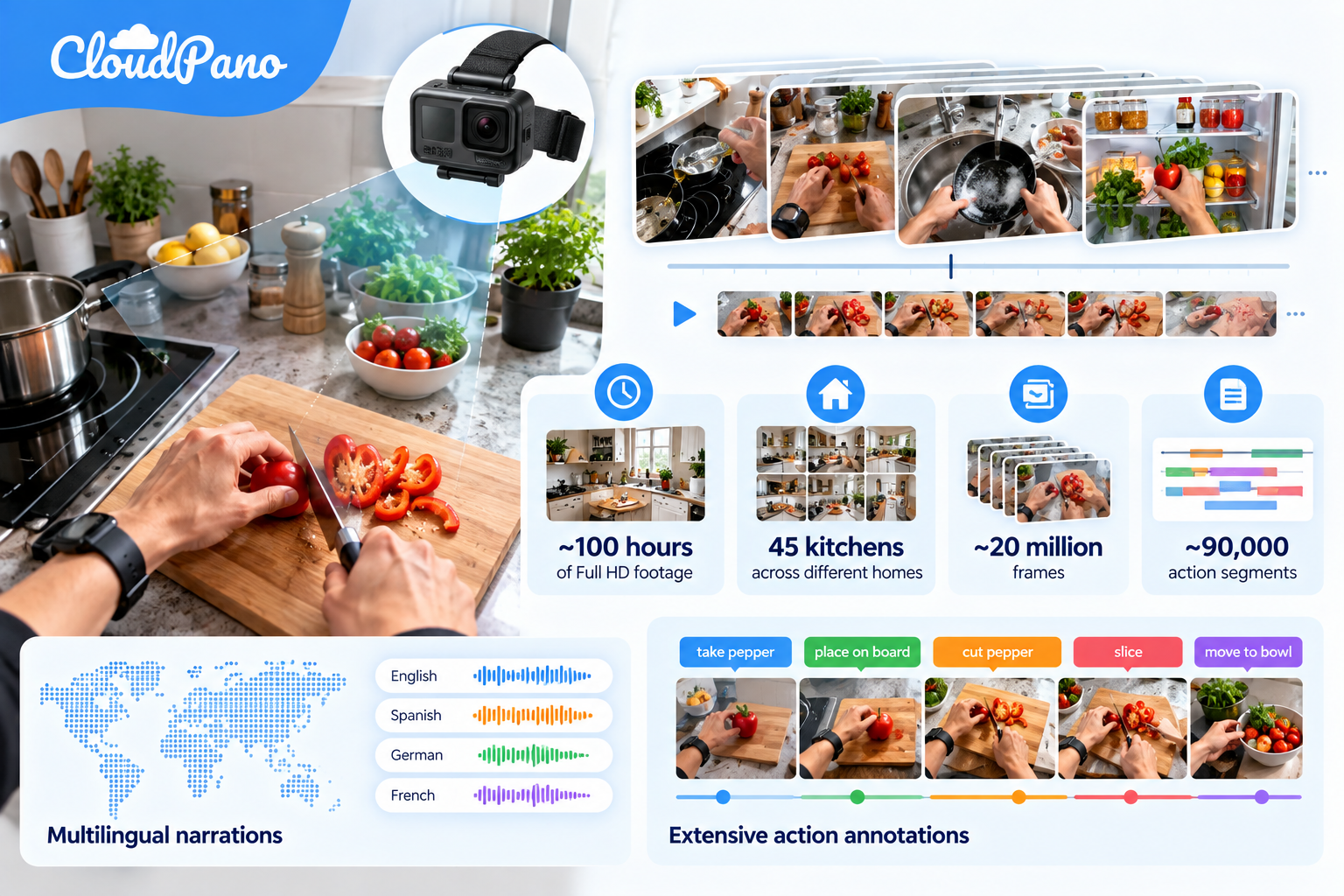
These characteristics make the dataset relevant to research involving areas such as:
The broader EPIC-KITCHENS ecosystem now also includes connected and derived resources such as VISOR, EPIC-Sounds, EPIC-Fields, and HD-EPIC.
That ecosystem is valuable, but it creates an important licensing consideration: do not assume every related resource is governed by exactly the same terms.
The first distinction to understand is between access and permission.
A dataset being downloadable from the internet does not automatically grant unrestricted rights to use it for any purpose.
The official EPIC-KITCHENS materials describe EPIC-KITCHENS-100 as "publicly available for research purposes." The site provides access to original and extended video sequences, frames, sensor data, automatic annotations, and related resources.
For commercial AI developers, that wording is significant.
A company should not reason:
"We can download it, therefore we can use it however we want."
Instead, the relevant question is:
"What rights apply to this particular asset and our particular use?"
That is the safer way to interpret an EPIC-KITCHENS license when evaluating a commercial training pipeline.
This question requires more nuance than a simple yes or no.
The official EPIC-KITCHENS-100 page explicitly describes the dataset as publicly available for research purposes. At the same time, the project's resources include different types of materials—videos, annotations, code, models, and derived datasets—that may involve different terms or permissions.
A commercial organization should therefore establish permission for its specific intended use rather than assuming that research access automatically covers commercial model development.
For example, there is a meaningful difference between:
Academic experimentation → A university research team uses EPIC-KITCHENS to evaluate a new action-recognition architecture.
and:
Commercial development → A company incorporates EPIC-KITCHENS footage into the training pipeline for a model that will become part of a paid robotics or AI product.
Those activities can raise different licensing questions.
This distinction applies well beyond EPIC-KITCHENS.
Dataset licenses may separately control rights to:
This is why simply finding "EPIC-KITCHENS" in a model's training-data documentation is not enough to determine whether a particular commercial use is authorized.
You need to identify the relevant terms.
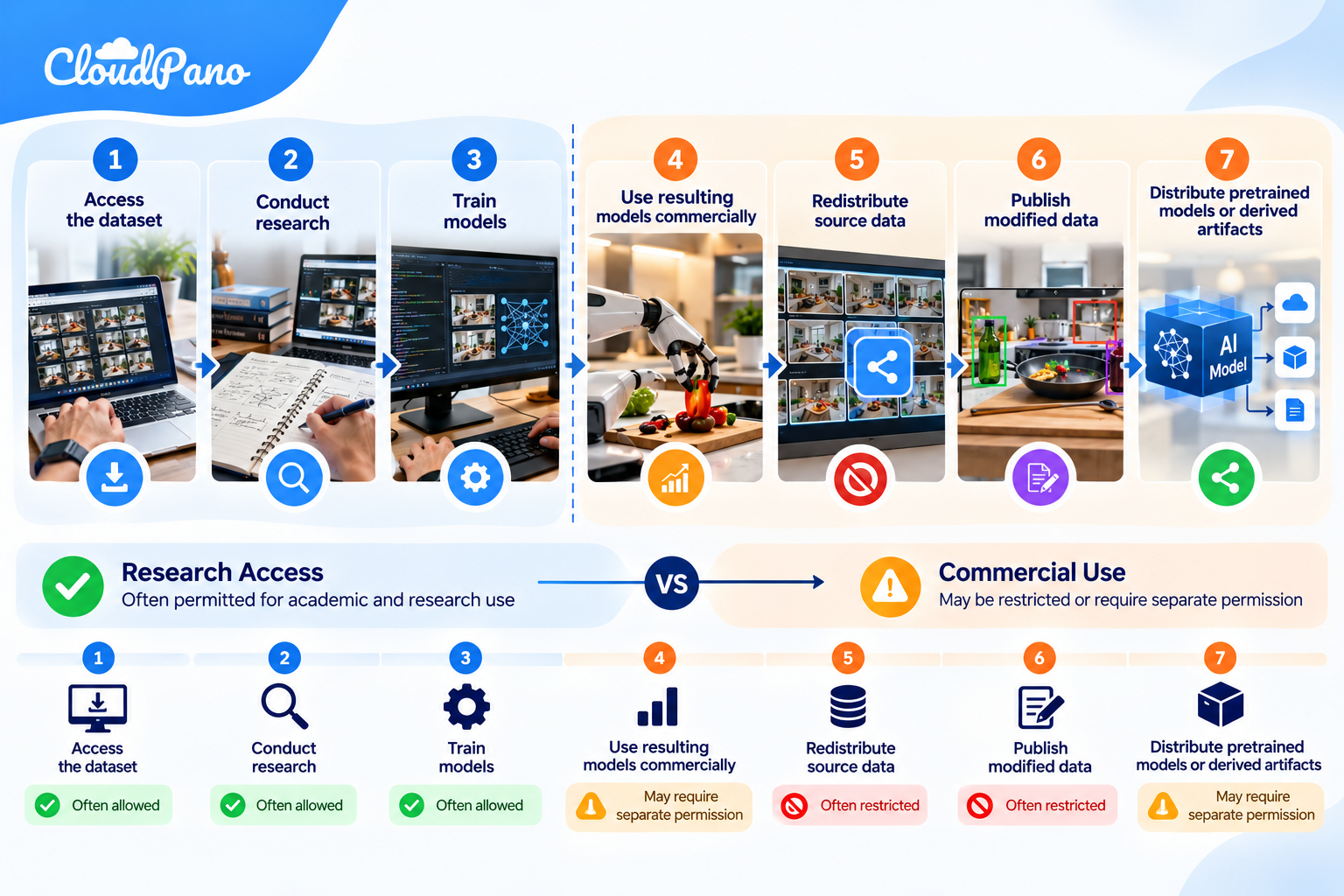
One of the easiest licensing mistakes is treating "the dataset" as a single asset.
In reality, a modern machine-learning dataset can contain multiple components.
EPIC-KITCHENS-100 includes video sequences and frames as well as annotations. Its ecosystem also connects to specialized datasets covering segmentation, audio, 3D information, and more detailed annotations.
Start by determining what terms apply to the actual first-person recordings.
If your model will ingest original video frames, those rights are especially important.
Annotations can be separate intellectual assets from the underlying video.
EPIC-KITCHENS provides action-segment annotations, while related resources provide additional forms of annotation.
Do not assume permission to use video automatically establishes identical rights over every annotation resource.
The EPIC ecosystem has expanded substantially.
The official landing page currently connects EPIC-KITCHENS-100 with resources including VISOR for segmentation, EPIC-Sounds for audio annotations, EPIC-Fields for 3D camera information, and HD-EPIC for highly detailed annotations.
If you combine these resources, review the terms associated with each one.
Open-source code can have its own software license.
The license covering a repository or training script should not automatically be assumed to cover the underlying video dataset.
Pretrained models require another review.
Older EPIC-KITCHENS materials, for example, document the release of pretrained action-recognition and object-detection models.
The fact that a model can be downloaded does not by itself answer whether it may be incorporated into a commercial product.
Egocentric video has become particularly interesting for embodied AI because it captures the world from a human-centered viewpoint.
A first-person camera can observe actions such as reaching for an object, opening a container, preparing food, manipulating tools, or moving through an environment.
That makes egocentric footage potentially useful for teaching AI systems relationships between:
observation → action → object → environment
EPIC-KITCHENS is especially relevant because its footage comes from real environments rather than purely synthetic scenes. The dataset includes naturally occurring activities recorded in people's kitchens.
However, technical usefulness and legal suitability are separate questions.
A dataset can be excellent training material while still being unsuitable for a particular commercial pipeline because of its applicable terms.
Before using EPIC-KITCHENS in a commercial project, build a dataset-rights checklist.
For each asset, record:
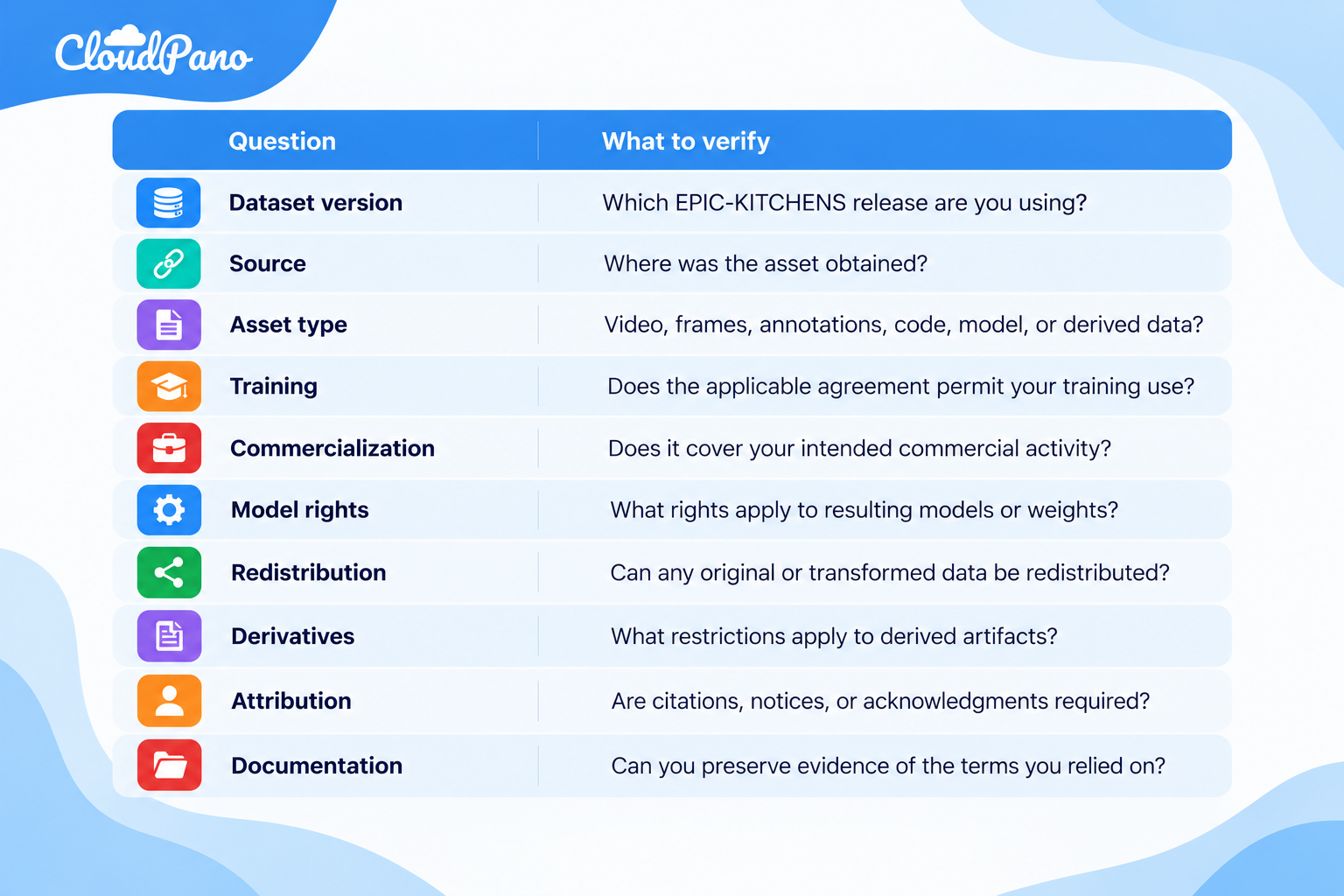
This documentation becomes increasingly important as training pipelines grow.
A single model might eventually combine dozens of datasets. If nobody records which agreement applied when each dataset entered the pipeline, answering licensing questions later becomes much harder.
Do not rely only on a bookmark.
Licensing pages and dataset versions can change over time. Maintain an internal record showing which dataset version was acquired, when it was obtained, and which terms your team reviewed.
Instead of writing:
"EPIC-KITCHENS — approved"
use something more precise:
EPIC-KITCHENS-100 video → reviewed
Action annotations → reviewed
Pretrained model → reviewed separately
Derived dataset → separate review required
This makes dataset governance much easier.
"AI research" is too broad for a serious licensing review.
Describe what the team actually intends to do.
For example:
Train an action-recognition model → fine-tune using proprietary data → deploy model weights inside a commercial robotic system.
That provides legal or compliance reviewers with a much clearer question to evaluate.
A dataset may initially enter a project during exploratory research.
If that experiment later becomes part of a commercial product, revisit the rights before deployment.
The original approval may have been based on a different use case.
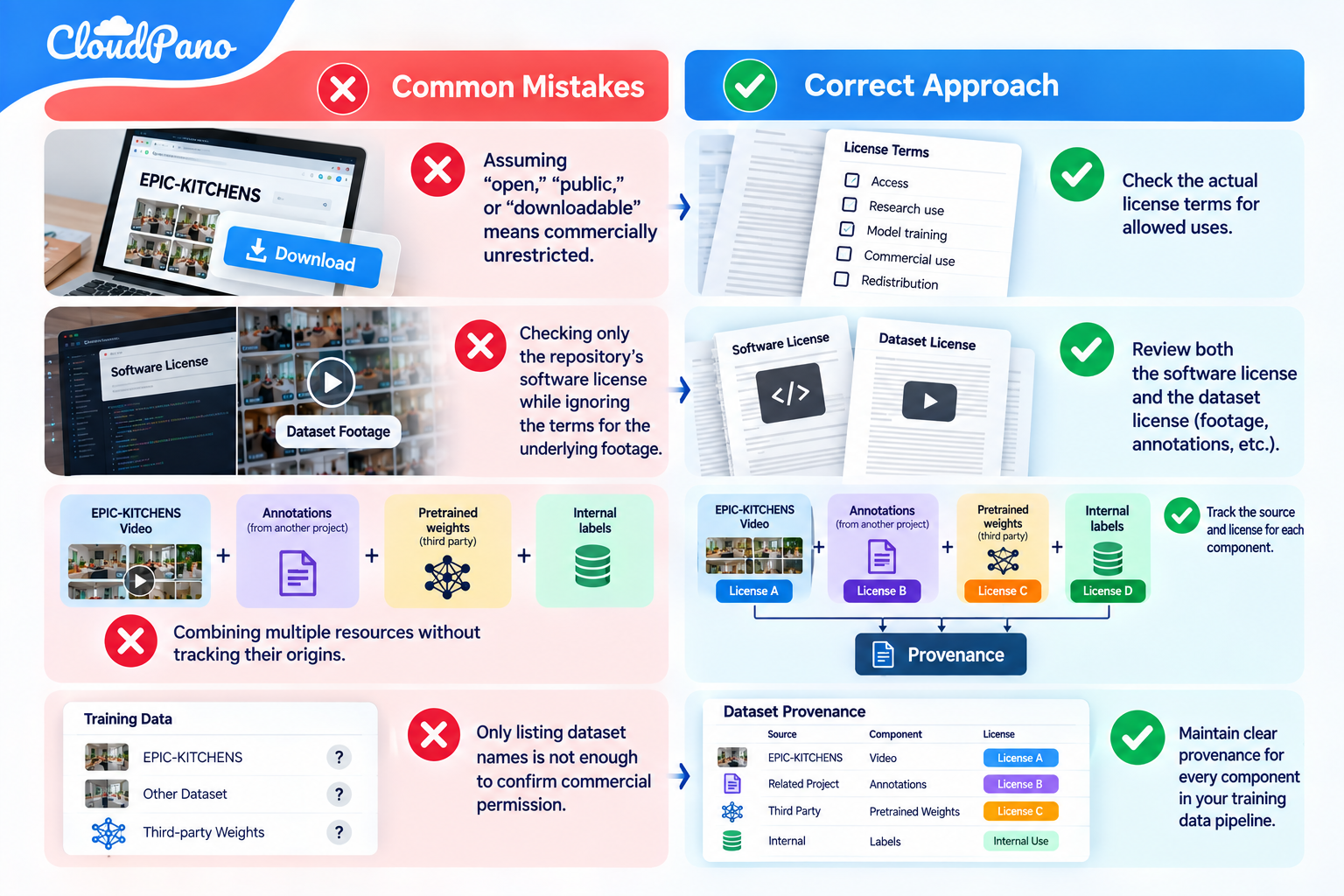
A common mistake is assuming that "open," "public," or "downloadable" means commercially unrestricted.
Another is checking only the repository's software license while ignoring the terms governing the underlying footage.
Teams can also run into problems when they combine multiple resources without tracking their origins. For example, a pipeline might use EPIC-KITCHENS video, annotations from a related project, third-party pretrained weights, and internally generated labels.
Each component can introduce separate rights considerations.
Good dataset governance therefore requires provenance, not merely a list of dataset names.
The most important lesson from the EPIC-KITCHENS license is that dataset availability and commercial permission should never be treated as the same thing.
EPIC-KITCHENS provides a rich source of real-world egocentric video for studying human actions, objects, environments, and first-person perception. EPIC-KITCHENS-100 alone contains 100 hours of footage, around 20 million frames, and approximately 90,000 action segments collected across 45 kitchens.
But commercial AI teams need to evaluate more than technical quality.
Before incorporating EPIC-KITCHENS into a commercial model pipeline, identify exactly which videos, annotations, derived datasets, code, features, or pretrained models you intend to use. Then verify the rights associated with each component and preserve that documentation.
That approach turns dataset licensing from a last-minute legal problem into part of responsible AI data engineering.
EPIC-KITCHENS provides its dataset publicly for research purposes, with official resources for accessing videos, frames, annotations, and other data. However, free or public access should not be interpreted as unrestricted permission for every downstream use. Always review the applicable EPIC-KITCHENS license and terms for the specific assets you need.
Commercial teams should verify authorization for their specific intended use before incorporating EPIC-KITCHENS into a production training pipeline. The official EPIC-KITCHENS-100 page characterizes the dataset as publicly available for research purposes, so research access alone should not be treated as blanket commercial permission.
EPIC-KITCHENS is specifically designed to support machine-learning and computer-vision research, including action recognition, action detection, action anticipation, and related tasks. For commercial model development, however, teams should separately verify that their intended training and downstream use are permitted.
Do not assume so. The broader ecosystem includes the core EPIC-KITCHENS-100 data plus resources such as VISOR, EPIC-Sounds, EPIC-Fields, and HD-EPIC. Check the applicable terms for each dataset, model, codebase, annotation source, or other asset you actually use.
Companies should identify the exact dataset version and assets being used, then verify permissions for training, commercial deployment, derived models, redistribution, annotations, and any pretrained models. Keep a record of the applicable terms and revisit the review if the project's intended use changes.


Compact, ready to go anywhere
Interchangeable lens that’s upgradeable
Dual 1-inch sensors for improved clarity and low light performance
Dynamic range and 6K 360° capture
360° photo resolution at 21MP

8K 360° video recording for ultra-detailed visuals.
4K single-lens mode for traditional wide-angle shots.
Invisible selfie stick effect for drone-like perspectives.
2.5-inch touchscreen with Gorilla Glass protection.
Waterproof up to 33ft for underwater shooting.

360° photo resolution in 23MP
Slim design at 24 mm thick
Built-in image stabilization for smooth video capture.
Internal 19GB storage for photo and video storage.
Wireless connectivity for remote control and sharing.

60MP 360° still images for high-resolution photography.
5.7K 360° video recording at 30fps.
2.25-inch touchscreen for intuitive control.
USB Type-C port for fast charging and data transfer.
MicroSD card slot for expandable storage.
.png)

.png)

Try it free. No credit card required. Instant set-up.




.svg)


.svg)