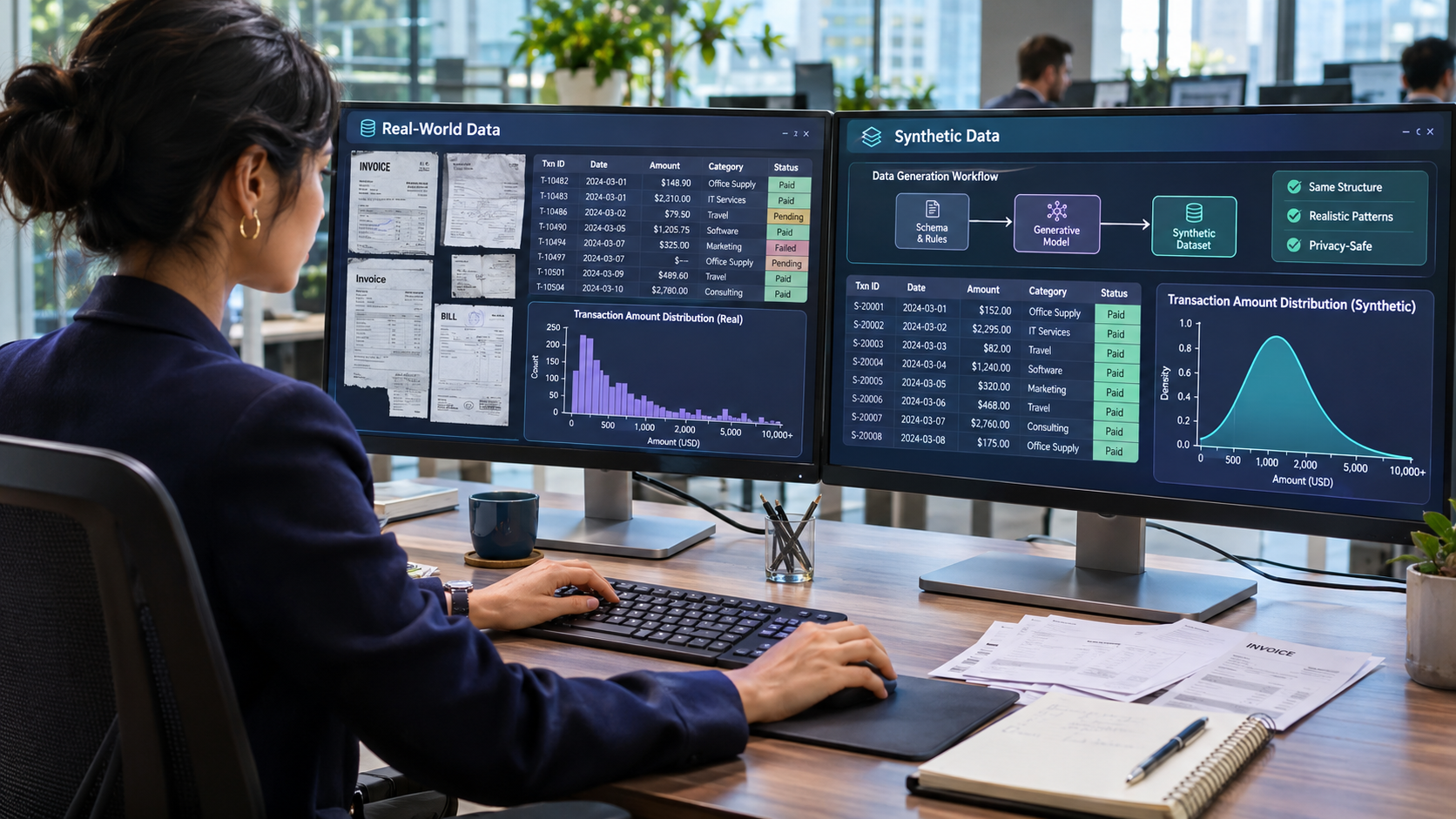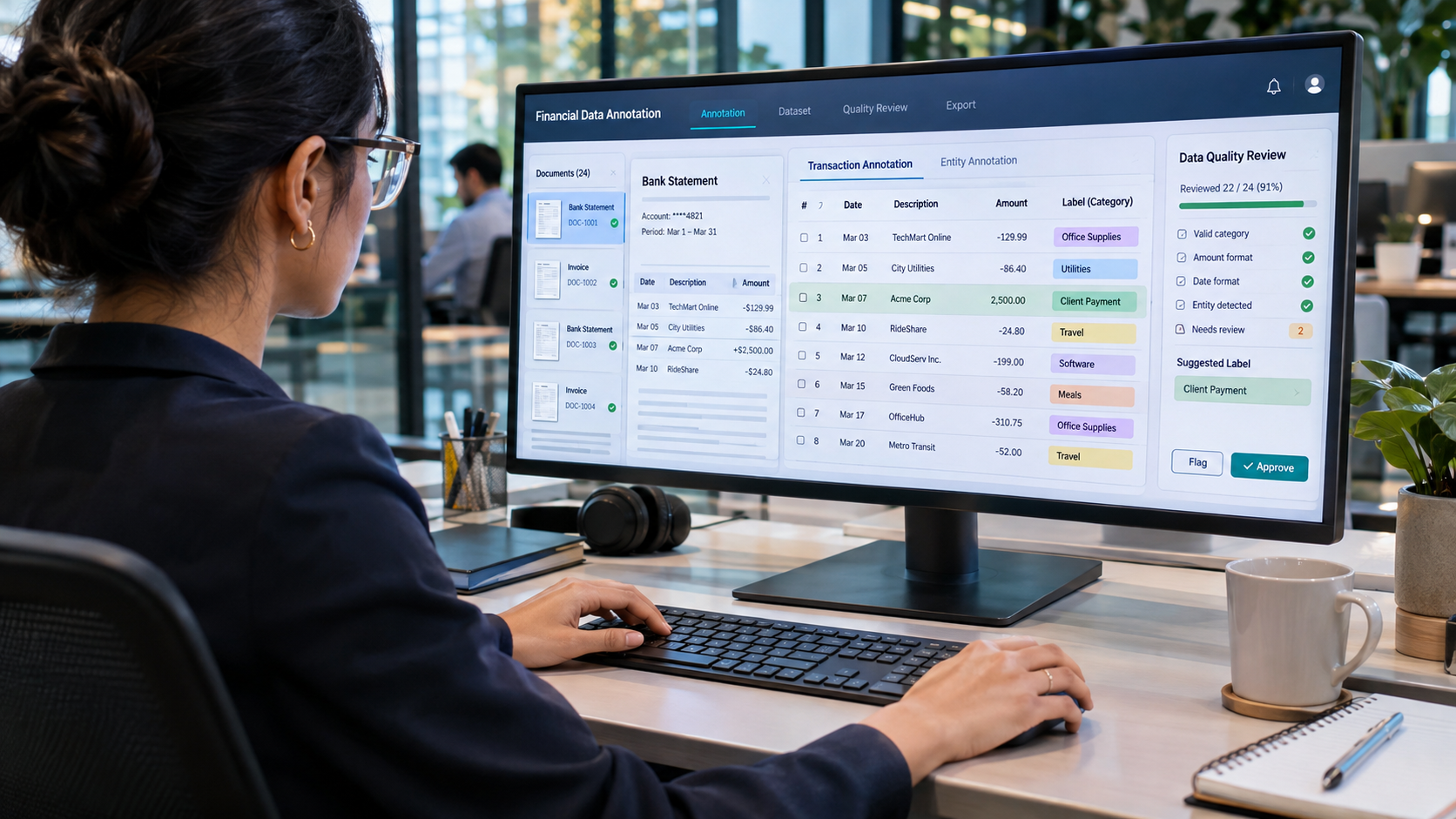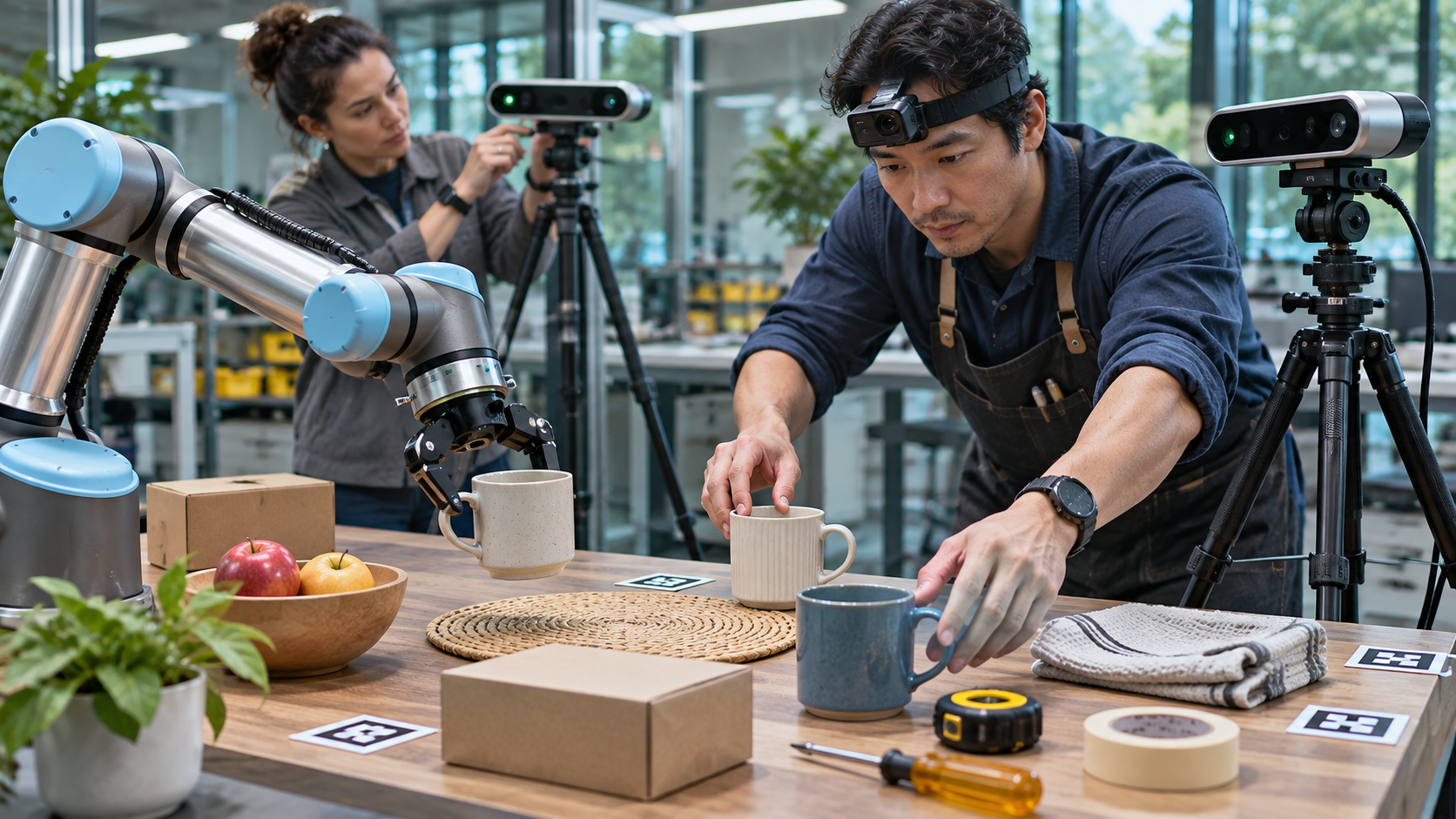
Evaluate an embodied AI training data vendor based on task relevance, environment diversity, sensor quality, synchronization, annotation accuracy, data provenance, usage rights, scalability, and delivery standards. Request representative samples and run a small pilot before committing to a large dataset purchase or collection project.
Embodied artificial intelligence is advancing how robots and intelligent systems interact with physical environments. From robotic manipulation to human-action understanding, these systems need training data that captures movement, perception, and real-world interactions.
However, collecting more data does not automatically produce better AI models.
The quality, diversity, structure, and relevance of training datasets can significantly influence how effectively embodied AI systems learn.
This makes how to evaluate an embodied AI training data vendor an important question for robotics companies, AI researchers, and technology developers.
A suitable vendor should provide more than large collections of video or sensor recordings. Organizations also need to understand how information is captured, how quality is verified, and whether the resulting datasets support their development goals.
This guide explains 10 essential criteria for evaluating embodied AI training data providers, along with practical questions and a vendor comparison framework.
An embodied AI training data vendor collects, prepares, and delivers datasets used to develop AI systems that perceive and interact with the physical world.
Unlike traditional text-based AI applications, embodied systems may need information about physical movement, object relationships, spatial environments, and task execution.
Common types of embodied AI training data include:
These datasets support applications such as robotic manipulation, navigation, action recognition, and vision-language-action models.
Vendors may specialize in existing datasets, custom data collection, annotation, or complete data preparation workflows.
Organizations should identify which services they require before comparing providers.
Embodied AI systems must interpret changing environments and physical interactions.
A robot learning to manipulate household objects, for example, may encounter different object shapes, lighting conditions, surfaces, and movement patterns.
A dataset that contains only controlled demonstrations may not represent these variations adequately.
Research initiatives such as Open X-Embodiment demonstrate the importance of exploring robot learning across different platforms, tasks, and datasets.
For companies developing embodied AI, choosing the right data provider means evaluating whether the collected information represents the intended operating conditions.
The first consideration is whether a vendor can supply data that matches your intended AI application.
Different projects require different information.
A model learning household manipulation may need demonstrations involving containers, utensils, doors, and everyday objects.
A navigation system may require recordings that capture movement through varied physical environments.
Ask potential vendors:
A vendor's ability to understand your project requirements is more valuable than a broad claim of supporting every robotics application.
Embodied AI systems encounter variations in lighting, room layouts, objects, and human behavior.
Training datasets should reflect the conditions most relevant to the intended deployment.
The DROID robot manipulation dataset provides a research example of collecting demonstrations across different scenes and tasks.
When evaluating vendors, consider whether their data includes variation in:
Diversity should be evaluated according to meaningful coverage rather than dataset size alone.
First-person video captures activities from the perspective of the person performing them.
This perspective can provide useful information about hand movements, object interactions, and task sequences.
The Ego4D research initiative demonstrates the value of large-scale first-person video for studying human activities and visual understanding.
When assessing egocentric data vendors, ask about:
For manipulation tasks, a video may be high-resolution yet unusable if important hand-object interactions remain outside the camera's field of view.
Request samples that reflect actual collection conditions.
Some embodied AI projects require more than video.
Developers may need synchronized recordings combining RGB images, depth measurements, motion information, robot states, and actions.
These data streams must correspond to the same moments in time.
Even small timing errors can create problems when the model needs to connect an observed movement with a particular action.
The Hugging Face LeRobot documentation illustrates how standardized robot-learning datasets can organize synchronized video, state, and action information.
Ask vendors whether they can document:
A strong vendor should be able to explain how the recorded information remains interpretable after delivery.
Raw recordings may require labels before they can support a specific AI task.
Annotation can involve identifying objects, marking action boundaries, describing tasks, or labeling successful and unsuccessful demonstrations.
For example, a video showing someone placing a cup on a shelf might require labels for the object, action, start time, end time, and result.
When evaluating annotation capabilities, ask:
Consistent labeling helps developers interpret the dataset and evaluate model behavior.
Data provenance describes where information originated and how it was collected, processed, and delivered.
For embodied AI projects, buyers should understand whether the dataset was recorded directly, obtained from an existing source, or generated synthetically.
Request documentation covering:
Clear documentation helps teams understand what they are receiving and identify potential restrictions before integrating data into their workflows.
This does not need to be framed as a complex compliance exercise. It is a practical part of assessing dataset suitability.
Even carefully designed collection projects can produce unusable recordings.
Common issues include blurred footage, incorrect task execution, obstructed views, missing sensor information, and incomplete demonstrations.
A reliable vendor should have a process for identifying and correcting these problems.
Ask how the provider:
The NIST AI Risk Management Framework offers broader guidance on evaluating trustworthy AI systems and managing risks throughout their lifecycle.
For vendor assessment, the practical lesson is to request evidence of quality rather than accepting general assurances.
Training data must be usable within your existing development pipeline.
A large dataset provides limited value if developers cannot efficiently load, interpret, or process it.
Before selecting a vendor, confirm the required:
Ask for a small sample delivery in the proposed format.
Your engineering team should be able to load the files, inspect the metadata, and confirm that the dataset supports the intended training workflow.
Data requirements often change as AI development progresses.
An initial project may involve a few hundred demonstrations, while later training rounds require broader coverage.
Evaluate whether the provider can expand collection without losing consistency.
Important questions include:
A vendor should also provide realistic expectations for delivery schedules and communication.
For companies exploring custom collection, iFirsthand's data collection solutions provide an example of services covering video, image, audio, multimodal, and custom dataset collection.
The important evaluation step is to match the provider's actual capabilities to your project's technical requirements.
Before committing to a large project, request a representative pilot dataset.
A pilot helps verify whether the vendor can follow your specifications and deliver usable information.
Rather than evaluating only the price per video hour or recorded demonstration, consider the cost of obtaining data that meets your acceptance criteria.
A lower initial price may offer limited value if significant portions of the dataset require correction.
Discuss:
A vendor should make it easy to understand what is included and how issues will be resolved.
The following scorecard can help teams compare providers consistently.
Score each vendor from 1 to 5 in the categories most important to your project.
The resulting comparison should support—not replace—technical review of actual sample data.
A small pilot is one of the most useful ways to evaluate an embodied AI training data vendor.
Begin with a clearly defined task.
For example, an organization developing household manipulation models might request demonstrations of opening containers, moving objects, and placing items on shelves.
Specify the required camera views, recording conditions, metadata, and quality criteria.
After receiving the pilot dataset:
If possible, evaluate whether the data improves performance on a representative held-out test set.
A successful pilot should demonstrate both technical suitability and the vendor's ability to respond to feedback.
Be cautious when a vendor:
These issues do not automatically disqualify a provider, but they should prompt further questions.
Reliable vendors should be willing to discuss limitations and explain how they manage them.
Understanding how to evaluate an embodied AI training data vendor helps organizations make more informed decisions about the information used to develop robotics and physical AI systems.
The best provider is not necessarily the one offering the largest dataset or the lowest price.
Instead, organizations should prioritize task relevance, meaningful diversity, reliable capture methods, consistent annotations, clear provenance, and technical compatibility.
A structured evaluation process—supported by representative samples and pilot testing—can help teams identify providers capable of meeting their development needs.
As embodied AI applications continue to evolve, choosing reliable training data partners will remain an important part of building systems that can learn from and operate in the physical world.
Evaluate the vendor's task relevance, dataset diversity, recording quality, sensor synchronization, annotation consistency, provenance, and delivery capabilities. Request representative samples and run a small pilot before making a larger commitment.
Depending on their specialization, vendors may provide egocentric video, human task demonstrations, robot manipulation recordings, depth information, motion data, object annotations, and synchronized multimodal datasets. Not every provider offers all formats.
Egocentric video captures activities from a first-person perspective. It can provide information about hand movements, object interactions, and task sequences that supports visual understanding and research into embodied behavior.
Teams can review task completion, video clarity, sensor integrity, timestamp consistency, annotation accuracy, and environmental diversity. Testing representative data in the intended AI pipeline provides additional evidence of usefulness.
Existing datasets can support initial research and benchmarking when they match project requirements. Custom collection may be preferable when an application needs specific tasks, environments, sensors, or contributor characteristics that available datasets do not adequately cover.


Compact, ready to go anywhere
Interchangeable lens that’s upgradeable
Dual 1-inch sensors for improved clarity and low light performance
Dynamic range and 6K 360° capture
360° photo resolution at 21MP

8K 360° video recording for ultra-detailed visuals.
4K single-lens mode for traditional wide-angle shots.
Invisible selfie stick effect for drone-like perspectives.
2.5-inch touchscreen with Gorilla Glass protection.
Waterproof up to 33ft for underwater shooting.

360° photo resolution in 23MP
Slim design at 24 mm thick
Built-in image stabilization for smooth video capture.
Internal 19GB storage for photo and video storage.
Wireless connectivity for remote control and sharing.

60MP 360° still images for high-resolution photography.
5.7K 360° video recording at 30fps.
2.25-inch touchscreen for intuitive control.
USB Type-C port for fast charging and data transfer.
MicroSD card slot for expandable storage.


Try it free. No credit card required. Instant set-up.