What Are AI Training Data Services? Complete Guide

Cloudpano
September 19, 2026
5 min read
Share this post
Last updated:
September 20, 2026

What Are AI Training Data Services?

AI training data services help AI companies collect, label, check, and test the data their models need to work well. This includes gathering real-world video, images, audio, or text; having humans label and verify it; and running quality checks before it's used to train or evaluate a model. Most AI teams use these services because building an in-house data pipeline is slower and more expensive than working with a specialized provider.

Key Takeaways

  • AI training data services cover four core steps: collection, annotation, validation, and evaluation.
  • The market is growing fast — from $2.82B in 2024 to a projected $9.58B by 2029 globally (MarketsandMarkets).
  • Better data consistently outperforms bigger, messier datasets for real-world model accuracy.
  • Most providers specialize in either broad, off-the-shelf datasets or narrow, custom-built collection — not both equally well.
  • Human review (human-in-the-loop) is what separates reliable training data from raw, unverified data.
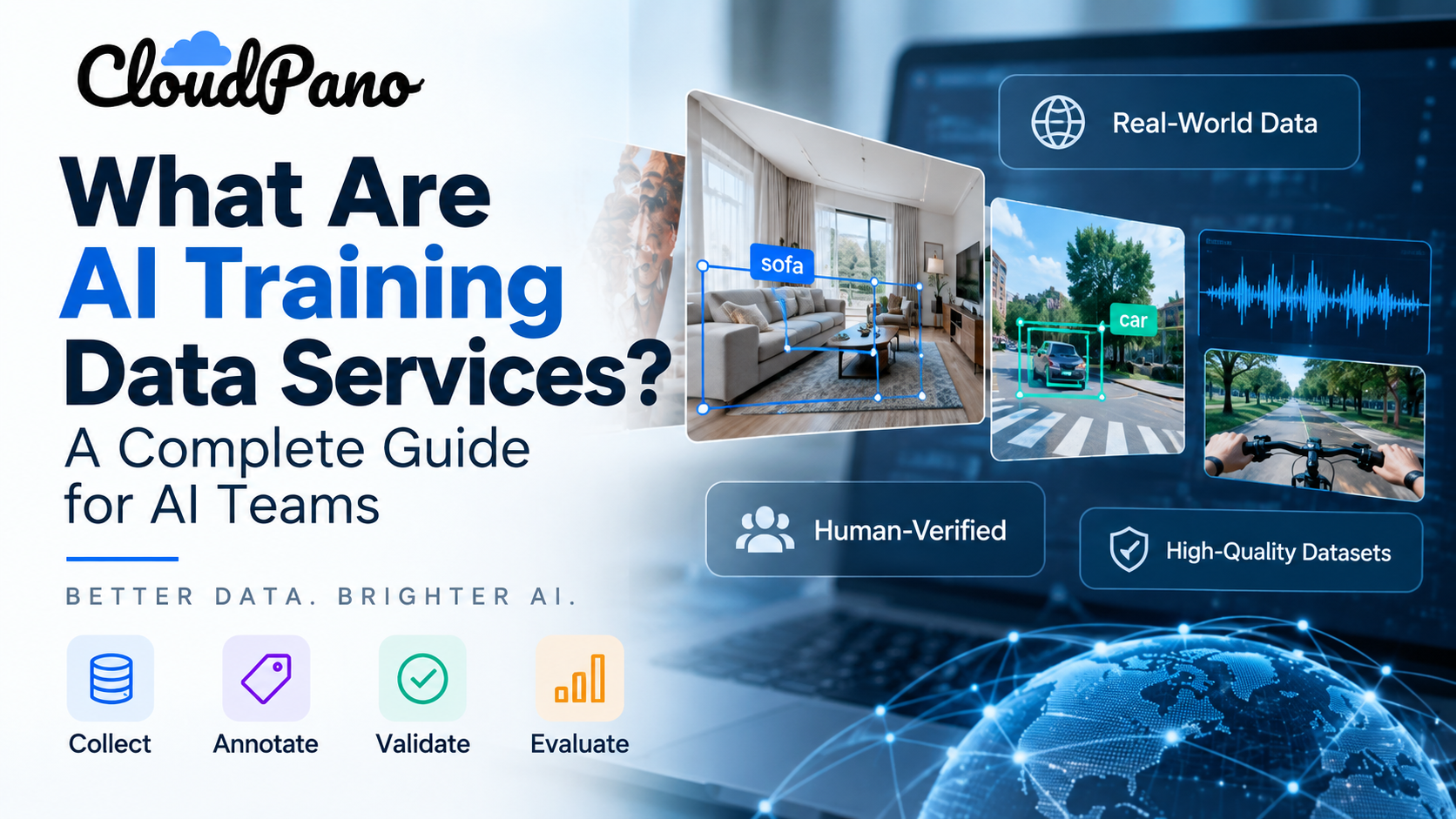
  • What Are AI Training Data Services? A Complete Guide for AI Teams

    If you're building or fine-tuning an AI model, you've probably encountered the same challenge many AI teams face: your model is only as good as the data behind it, and getting that data right is harder than it looks. That's the problem AI training data services are designed to solve.

    What Are AI Training Data Services?

    AI training data services include the collection, annotation, validation, and evaluation processes that turn raw information into usable data for training and improving AI models.

    Depending on the type of model and training method, raw video, images, audio, or text may need to be collected, organized, labeled, validated, or enriched before they can be effectively used. These processes often involve human contributors and reviewers who help ensure the data meets the specifications and quality standards required by the AI team.

    In practice, AI training data services can cover several distinct types of work:
    • Collection — Gathering the raw video, image, audio, text, or multimodal data a model needs, often from real-world environments rather than relying solely on public datasets.
    • Annotation — Labeling raw data, such as drawing bounding boxes around objects, transcribing speech, or tagging categories, so models can learn from structured examples.
    • Validation — Checking that collected data and annotations are accurate, consistent, and meet the project's specifications before they're used for training.
    • Evaluation — Testing a trained model's outputs against defined datasets and real-world scenarios to measure factors such as accuracy, safety, and reliability.

    How Do AI Training Data Services Work?

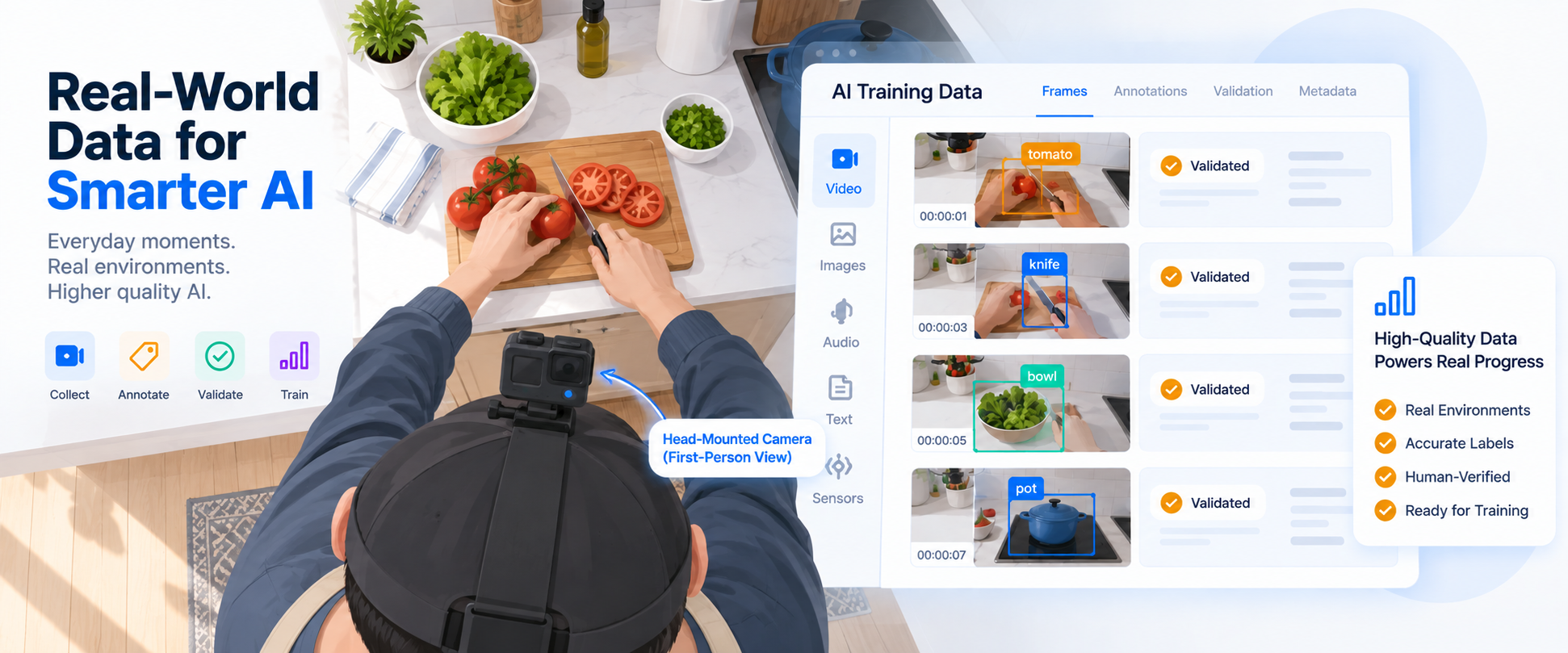
    First-person AI training data collection in a kitchen using a head-mounted camera, alongside annotated and validated video frames.

    Most AI training data providers follow a similar pipeline, although the exact process varies depending on the type of data and project:

    1. Define the specification. The AI team determines what kind of data is needed, including environments, tasks, edge cases, demographics, devices, and the required volume.
    2. Collect or source the data. The provider may use an existing licensed dataset or run a custom data collection project to gather new data that matches the specification.
    3. Annotate the data. Human annotators, sometimes assisted by automated tools, label or enrich the data according to defined guidelines when annotation is required.
    4. Validate and QA the data. A separate review process checks quality and consistency, identifies errors, and removes or recaptures data that doesn't meet the required standards.
    5. Deliver and evaluate. The finished dataset is delivered in the required format. When evaluation services are included, the model's performance can also be tested against defined benchmarks or evaluation datasets.

    What Are the Benefits of AI Training Data Services?

    One of the biggest benefits is access to specialized data collection, annotation, and quality-control capabilities that can be difficult to build in-house. An experienced provider may already have contributor networks, QA processes, and domain expertise that allow an AI team to obtain usable data more efficiently.

    Other potential benefits include:

    • Better data quality. Human-reviewed and carefully validated data can reduce labeling errors and inconsistencies that may affect model performance.
    • Coverage that's difficult to obtain otherwise. Real-world data collection, particularly across specific environments, demographics, devices, languages, or edge cases, can be difficult to organize at scale without a dedicated collection network.
    • Faster iteration. Outsourcing parts of the data pipeline can allow AI teams to spend more time on model development, training, and evaluation rather than managing data collection logistics.

    How Much Do AI Training Data Services Cost?

    Pricing varies widely depending on the type of work involved. Annotation may be priced per hour, task, label, image, or object, while custom data collection projects are often quoted based on factors such as the amount of data required, collection environment, annotation complexity, contributor requirements, and turnaround time.

    Many providers do not publish standardized pricing and instead provide quotes after reviewing a project's requirements.

    How Do You Choose an AI Training Data Provider?

    A few questions are worth asking any provider before committing to a project:

    • Do they offer off-the-shelf datasets, custom collection, or both? If your project requires a specific environment, demographic, device, or task that isn't adequately represented in existing datasets, you may need a provider that offers custom collection rather than only a dataset catalog.
    • What does their QA process actually look like? Ask how collected data and annotations are reviewed, what happens when data fails QA, and how consistency is measured.
    • How transparent is their pricing? Find out whether the provider can give you a clear estimate based on your requirements and what factors could change the final cost.
    • Can they meet your compliance and licensing requirements? If you're working with sensitive or regulated data, ask about consent, data rights, privacy requirements, licensing, and relevant regulatory obligations before committing to a provider.

    How Does Firsthand Help With AI Training Data Services?

    Firsthand provides custom, real-world AI data collection across video, images, audio, text, and multimodal sensor data. Its collection programs are built around a defined specification and use real contributors, documented consent, quality assurance, and commercial licensing.

    Firsthand has a particular focus on egocentric, first-person video for embodied AI, robotics, and multimodal models. Its data collection capabilities also extend to synchronized video, depth, audio, motion, pose, and other sensor data for projects that require multiple aligned data streams.

    For projects where the required training data doesn't already exist in an off-the-shelf dataset, Firsthand can build a custom collection program around specific environments, tasks, devices, languages, demographics, conditions, and edge cases.

    The Bottom Line

    AI training data services exist because good models need good data, and building that data pipeline in-house is rarely the fastest or cheapest path. Whether you need off-the-shelf datasets or a fully custom collection effort, the right provider comes down to fit: do they cover the environments and task types you actually need, and can they prove their data holds up?

    If you're evaluating providers for your next project, browse Firsthand's off-the-shelf datasets or learn about custom collection to see which fits your timeline and budget.

    🚀 Your All‑In‑One Virtual Experience Stack
    🎬
    PhotoAIVideo
    Turn photos into scroll‑stopping AI videos.
    Get Started →
    🏡
    Pictastic
    Instantly stage listings with AI.
    Try Staging →
    🌀
    CloudPano
    Create stunning 360° tours in minutes.
    Launch Tour →
    💰
    VirtualTourProfit
    Build a profitable virtual tour business.
    Learn More →
    🤝
    CloudPano Reseller
    Resell AI visual software without building it.
    Become a Reseller →
    🚗
    Auto CloudPano
    Sell more vehicles with 360° experiences.
    Explore Auto →
    🏗️
    AI Floor Plan Builder
    Generate detailed floor plans with AI.
    Build Now →
    📐
    3D Measure
    Capture accurate floor plans & 3D measurements.
    Measure Now →
    🧠
    AI Training Data
    Custom AI training data services.
    Learn More →

    Frequently Asked Questions

    What's the difference between AI training data services and data annotation?

    Data annotation is one part of AI training data services — specifically the labeling step. AI training data services is the broader category that also includes collecting new data, validating labels, and evaluating a model's performance.

    Do I need a custom data provider, or can I use an off-the-shelf dataset?

    Off-the-shelf datasets work well if your project needs broad coverage, has a tight timeline, or a limited budget. Custom collection makes more sense if you need a specific environment, demographic, or task type that public datasets don't cover.

    How long does it take to get a custom training dataset built?

    It depends heavily on scope — a small, well-defined dataset can take a few weeks, while a large or highly specialized collection effort can take months. Ask any provider for a timeline based on your specific spec before committing.

    Is human review really necessary, or can labeling be fully automated?

    Automated labeling tools help with speed, but human review is still what catches errors, ambiguous cases, and edge cases automated tools miss — especially for anything safety- or compliance-related.

    What industries use AI training data services most?

    Robotics, autonomous vehicles, healthcare AI, retail computer vision, and any company building or fine-tuning large language models are among the heaviest users, since all of them depend on large volumes of accurately labeled real-world data.

    Sources

  • MarketsandMarkets — AI Training Dataset Market — Global AI training dataset market estimated at $2.82 billion in 2024 and projected to reach $9.58 billion by 2029, at a 27.7% CAGR.
  • Grand View Research — U.S. AI Training Dataset Market — U.S. AI training dataset market valued at $496.5 million in 2023 and projected to grow at an 18.0% CAGR from 2024 to 2030.
  • Share this post
    Cloudpano

    Choose The Right 360° Camera

    Insta360 ONE RS 1-Inch 360 Edition

    • Compact, ready to go anywhere

    • Interchangeable lens that’s upgradeable

    • Dual 1-inch sensors for improved clarity and low light performance

    • Dynamic range and 6K 360° capture

    • 360° photo resolution at 21MP

    Learn More

    Insta360 X4

    • 8K 360° video recording for ultra-detailed visuals.

    • 4K single-lens mode for traditional wide-angle shots.

    • Invisible selfie stick effect for drone-like perspectives.

    • 2.5-inch touchscreen with Gorilla Glass protection.

    • Waterproof up to 33ft for underwater shooting.

    Learn More

    Ricoh Theta Z1

    • 360° photo resolution in 23MP

    • Slim design at 24 mm thick

    • Built-in image stabilization for smooth video capture.

    • Internal 19GB storage for photo and video storage.

    • Wireless connectivity for remote control and sharing.

    Learn More

    Ricoh Theta X

    • 60MP 360° still images for high-resolution photography.

    • 5.7K 360° video recording at 30fps.

    • 2.25-inch touchscreen for intuitive control.

    • USB Type-C port for fast charging and data transfer.

    • MicroSD card slot for expandable storage.

    Learn More
    Property Marketing
    Allows potential buyers to explore properties in detail from anywhere, enhancing the real estate marketing process.
    Automotive Spins
    Create an interactive virtual showroom and engage affluent digital buyers with live 360º video calls, all through the CloudPano mobile app for a complete automotive sales solution.
    Interactive Floor Plans
    Create 2D and 3D floor plans with measurements in 4 minutes or less, all from your phone. Download the Floor Plan Scanner app and get your first scan free.

    360 Virtual Tours With CloudPano.com. Get Started Today.

    Try it free. No credit card required. Instant set-up.

    Try it free
    Latest posts

    See our other posts

    Interviews, tips, guides, industry best practices, and news.

    What Are AI Training Data Services? Complete Guide

    AI training data services help AI teams collect, annotate, validate, and evaluate the high-quality data needed to train and improve machine learning models. This guide explains how AI training data services work, their key benefits, typical costs, what to look for when choosing a provider, and how custom real-world data collection can support AI, robotics, and multimodal applications.
    Read post

    How to Deliver Property Photos Professionally and Impress Real Estate Clients

    Learn how to deliver property photos professionally and create a smooth, impressive experience for real estate clients. This guide covers organized photo galleries, easy downloads, professional presentation, fast delivery, and practical ways photographers can build stronger client relationships and encourage repeat business.
    Read post
    CloudPano

    Choosing ADA Compliant Walkthrough Software: What to Look For

    Not all walkthrough software is built with accessibility in mind, and choosing the wrong platform can quietly exclude a meaningful portion of your audience. This guide breaks down exactly what to look for when evaluating ADA compliant walkthrough software — from keyboard navigation and screen reader support to alt text and caption features — plus the key questions to ask vendors before you commit.
    Read post