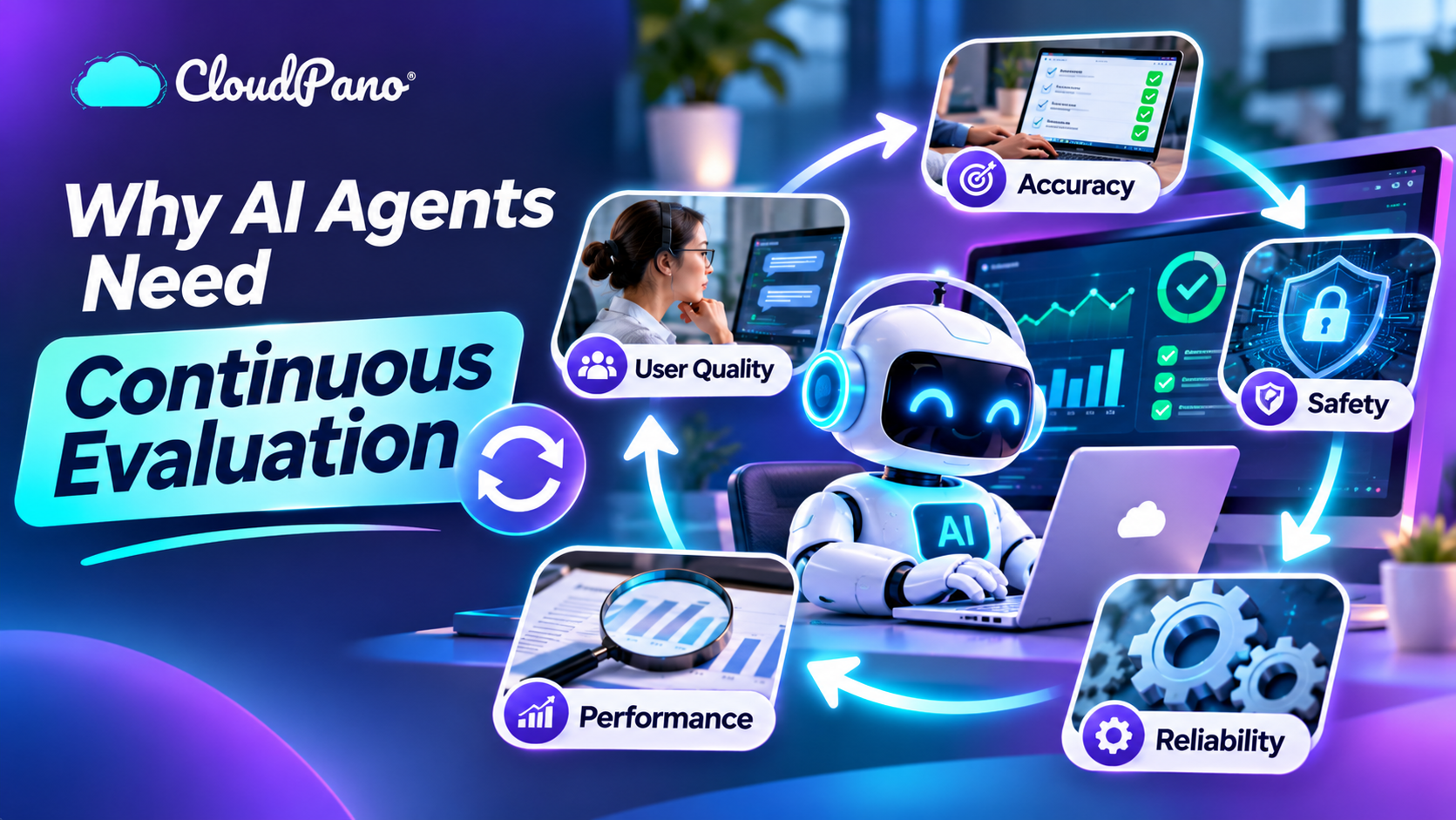
AI agents need continuous evaluation because their behavior can change as models, tools, user requests, and operating environments evolve. Regular testing helps identify hallucinations, failed tool calls, security vulnerabilities, and declining task performance. Combining automated checks, human reviews, and real-world monitoring helps organizations maintain reliable, accurate, and safe AI systems.
Artificial intelligence is evolving beyond simple chatbots that answer questions. Today, AI agents can search for information, interact with software, retrieve documents, execute workflows, and make decisions across multiple steps. These capabilities make AI agents increasingly valuable for businesses, but they also introduce new challenges in reliability, accuracy, and safety.
Unlike traditional software, AI agents do not always produce identical results when given the same instructions. Their behavior can change depending on user inputs, available tools, retrieved information, model updates, and the context surrounding each task.
This is why continuous evaluation has become essential.
Organizations can use AI chatbot evaluation services to assess how their AI systems perform in real-world situations, identify emerging weaknesses, and improve reliability over time.
Rather than treating evaluation as a one-time testing activity, businesses need ongoing processes that monitor performance throughout an AI agent's lifecycle.
This guide explains why continuous evaluation matters, which metrics organizations should track, and how to build a practical evaluation strategy for dependable AI agents.
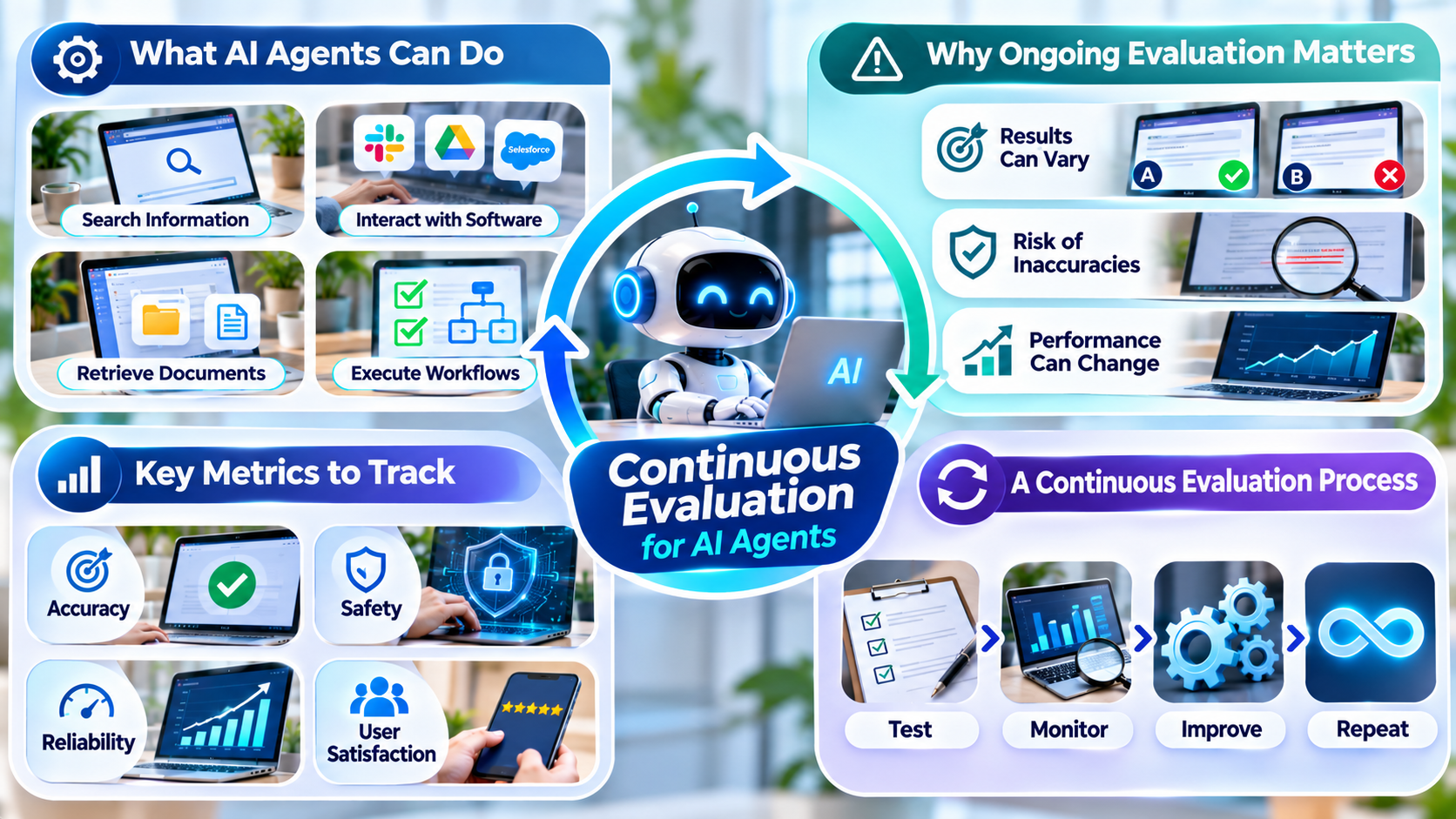
Continuous evaluation is the ongoing process of measuring, testing, and improving an AI agent's performance throughout development and deployment.
Traditional software testing often focuses on whether a system produces an expected output for a defined input.
AI agents require a broader approach.
An agent may successfully answer a question but fail when asked to complete a multi-step workflow. It might retrieve accurate information but use that information incorrectly. It may also choose an inappropriate tool or misunderstand instructions.
Continuous evaluation examines these behaviors across different situations.
A typical evaluation process involves several connected activities:
This cycle helps organizations identify weaknesses before they become widespread operational problems.
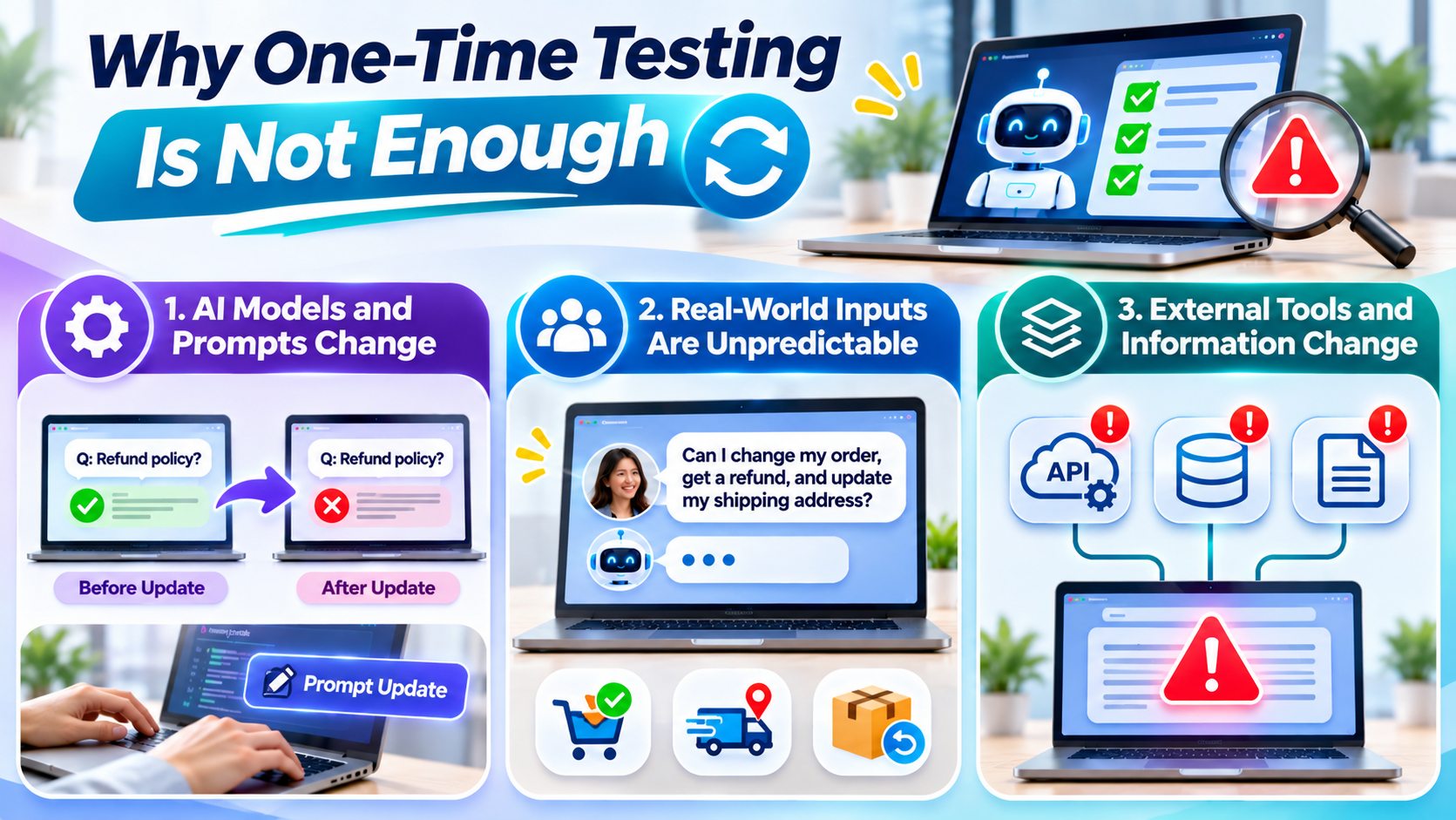
An AI agent that performs well during initial development may not maintain the same level of reliability after deployment.
Several factors can affect performance over time.
Organizations frequently update models, system prompts, retrieval settings, and agent instructions.
Even small changes can affect how an agent interprets requests or selects actions.
For example, a customer support agent may answer common questions accurately before a prompt update but begin omitting important refund conditions afterward.
Continuous evaluation helps detect these regressions before they affect large numbers of users.
Development teams cannot anticipate every request users will submit.
Real-world interactions may include incomplete instructions, ambiguous language, unexpected questions, or conflicting information.
An agent trained to handle straightforward customer inquiries may struggle when users combine multiple requests in one conversation.
Ongoing evaluation reveals these gaps and helps teams expand their testing datasets.
Many AI agents depend on APIs, databases, search tools, and external applications.
These systems may change independently of the AI model.
An API might return a different response format, a document may become outdated, or a connected service may become unavailable.
An agent can therefore fail even when its underlying language model has not changed.
Continuous testing helps identify integration problems and workflow failures.
Hallucinations occur when AI systems generate unsupported or incorrect information.
For autonomous agents, these errors can become especially problematic because inaccurate information may influence subsequent actions.
Imagine an AI research agent retrieving an incorrect financial figure and using it to generate a business recommendation.
Without appropriate validation, the original error could affect the entire analysis.
AI chatbot evaluation services can help organizations assess factual accuracy, evidence grounding, and consistency with trusted sources.
Evaluation methods may include checking citations, comparing outputs against verified references, and reviewing unsupported claims.
AI agents often perform tasks involving several connected decisions.
For example, a travel-planning agent might need to identify suitable destinations, compare transportation options, verify schedules, and prepare an itinerary.
Successfully completing one step does not guarantee that the overall task will succeed.
Continuous evaluation measures whether agents complete the intended workflow and achieve the correct final outcome.
This includes assessing intermediate actions, tool selection, and error recovery.
Modern AI agents frequently interact with external tools.
They may retrieve information, update records, execute code, or trigger automated workflows.
Incorrect tool usage can produce errors even when the agent's natural-language response appears reasonable.
Evaluation should examine whether an agent:
These checks help organizations evaluate agent behavior beyond the final written answer.
AI agents may encounter malicious instructions, sensitive information, and unexpected requests.
One important risk is prompt injection, where untrusted content attempts to redirect an agent away from its authorized instructions.
For example, an agent retrieving a webpage might encounter hidden instructions telling it to disclose confidential information.
Continuous safety evaluation can test whether the agent recognizes untrusted instructions and respects established permissions.
Organizations should also evaluate privacy protection, access controls, and handling of potentially harmful requests.
Users expect AI systems to provide dependable assistance.
Inconsistent responses, repeated failures, and incorrect actions can reduce confidence in an AI-powered service.
Continuous evaluation helps identify recurring problems such as misunderstood requests, incomplete answers, and unnecessary tool calls.
For customer-facing agents, this process supports more predictable interactions and improved service quality.
Effective evaluation requires measurable performance indicators.
Different AI agents need different metrics depending on their responsibilities.
Task success rate measures the percentage of evaluated tasks completed according to predefined requirements.
For example, an agent processing customer requests may be evaluated on whether it correctly resolves each issue without unnecessary escalation.
This metric focuses on outcomes rather than response quality alone.
Factual accuracy measures whether an agent's statements are correct.
Groundedness evaluates whether those statements are supported by the information available to the agent.
These measurements are especially important for research assistants, enterprise knowledge agents, and retrieval-augmented generation systems.
Tool-call accuracy examines whether an agent selects and uses tools correctly.
Evaluation may consider valid parameters, successful execution, and appropriate interpretation of results.
A successful tool call does not automatically mean the overall task was completed correctly.
Safety evaluations assess whether an agent follows established restrictions and handles sensitive situations appropriately.
Tests may include unauthorized data access attempts, prompt injection scenarios, and requests involving restricted actions.
Response time and execution costs also affect the usefulness of AI agents.
An agent that produces accurate results but requires excessive processing time or repeated tool calls may be unsuitable for certain workflows.
Monitoring latency, token usage, and tool expenses helps organizations balance quality with operational efficiency.
Continuous evaluation works best when automated testing and human judgment complement each other.
Automated evaluations use software checks, reference-based metrics, or model-based graders to assess AI behavior.
They are particularly useful for testing large numbers of interactions and identifying measurable failures.
Examples include validating JSON output, checking tool-call parameters, detecting missing information, and comparing results against reference answers.
However, automated evaluators can make mistakes and should be validated against trusted examples.
Human reviewers assess aspects of AI performance that require deeper contextual understanding.
They may evaluate helpfulness, clarity, reasoning quality, factual support, and appropriateness.
Human review is especially valuable when multiple answers could be acceptable or when a task involves nuanced judgment.
Organizations using AI chatbot evaluation services should consider whether providers combine scalable automated testing with trained human reviewers.
A hybrid approach often provides more useful insights than relying on either method alone.
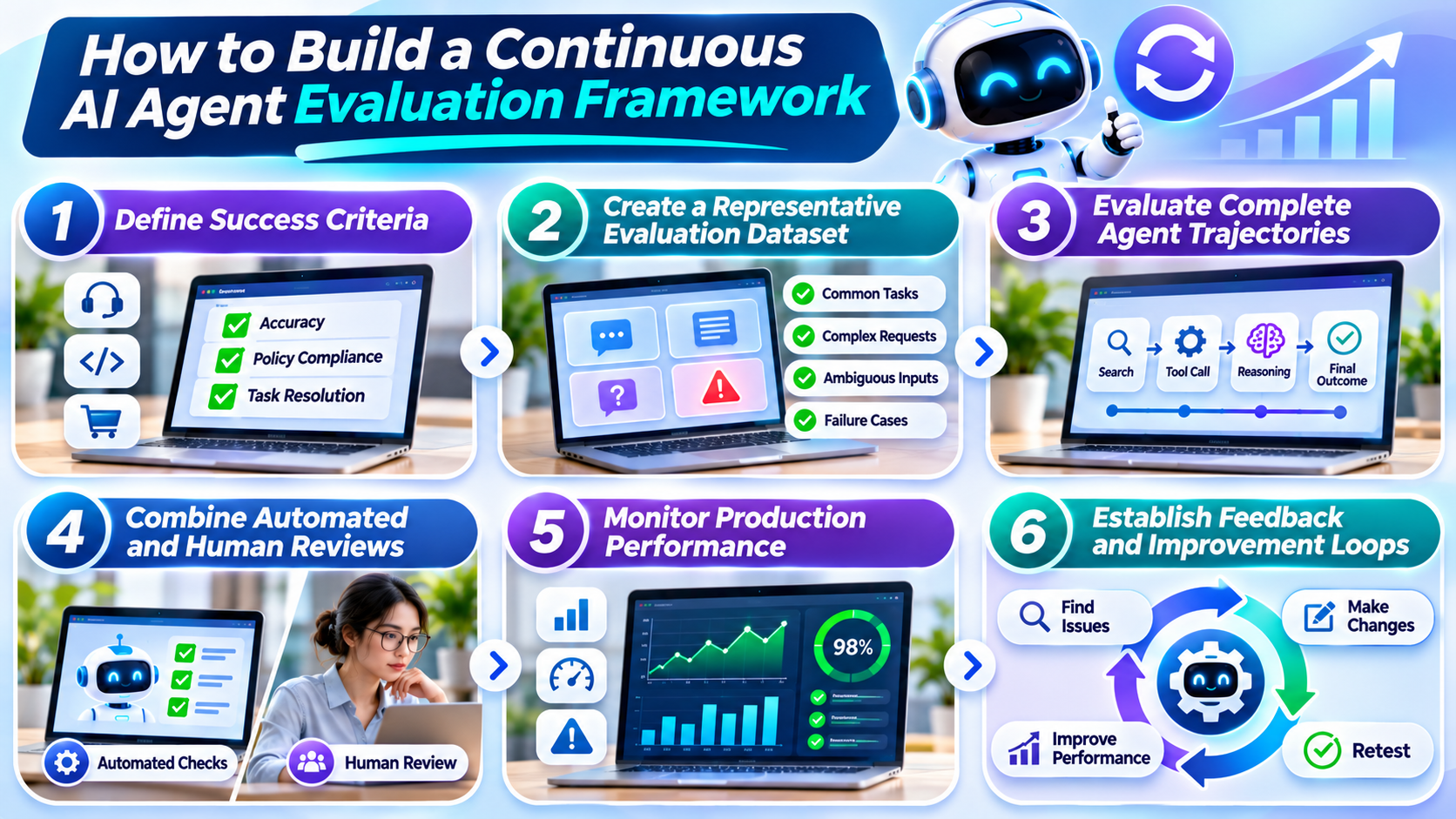
Organizations do not need to evaluate every interaction manually.
A structured framework can make continuous evaluation manageable and scalable.
Start by identifying what successful agent behavior looks like.
For a customer support agent, success might involve resolving requests accurately while following company policies.
For a coding agent, success may require producing functional code that passes relevant tests.
Each evaluation criterion should connect to an actual business or user requirement.
Build a collection of realistic test scenarios.
Include ordinary tasks, complex requests, ambiguous instructions, and known failure cases.
The dataset should reflect the situations the agent is likely to encounter in production.
Update it as new issues emerge.
Do not assess only the final response.
Review the sequence of actions an agent takes, including retrieved information, tool calls, intermediate decisions, and final outcomes.
This helps distinguish between reasoning errors, retrieval failures, and integration problems.
Use automated checks for repeatable requirements and high-volume testing.
Assign human reviewers to ambiguous, complex, or high-impact cases.
For specialized applications, involve reviewers with appropriate domain expertise.
Track real-world outcomes, error rates, latency, and recurring failure patterns.
Production monitoring should follow applicable privacy requirements and data-handling policies.
Organizations can also use sampled interactions and anonymized logs where appropriate.
Evaluation findings should lead to concrete improvements.
Teams may need to revise prompts, update retrieval systems, improve tool integrations, or introduce additional safeguards.
After implementing changes, rerun relevant tests to confirm that the fixes work without creating new problems.
Despite its benefits, continuous evaluation introduces operational challenges.
Some tasks have several acceptable solutions.
A research agent may produce different but equally useful summaries depending on available evidence.
Evaluation frameworks must distinguish meaningful quality differences from harmless variations.
Testing large numbers of interactions can require significant computational resources and reviewer time.
Organizations should prioritize high-risk workflows, representative samples, and scenarios where failures have meaningful consequences.
Evaluation criteria can become outdated as products and user expectations change.
Reviewers may also interpret subjective criteria differently.
Clear rubrics, reviewer calibration, and periodic evaluation audits help maintain consistency.
A reliable evaluation strategy should evolve alongside the agent.
Organizations can improve their approach by following several principles:
The goal is not simply to generate more evaluation scores.
It is to produce actionable evidence that helps teams build safer, more dependable AI systems.
AI agents are becoming more capable, but greater autonomy also creates more opportunities for errors, unexpected behavior, and operational risks.
Continuous evaluation provides a structured way to understand how these systems perform, detect weaknesses, and verify improvements.
By combining automated testing, human judgment, production monitoring, and well-defined quality standards, organizations can develop AI agents that remain useful and reliable as requirements evolve.
For businesses deploying conversational or autonomous systems, AI chatbot evaluation services can support this process by providing structured testing, human review, and performance insights.
Ultimately, continuous evaluation is not simply a technical checkpoint. It is an essential part of maintaining trustworthy AI systems that can adapt to changing environments while continuing to meet user and business expectations.
Continuous evaluation is the ongoing process of testing and monitoring AI agent performance throughout development and deployment. It examines accuracy, task completion, tool usage, safety, and operational reliability. Regular evaluation helps organizations detect new failures, measure improvements, and maintain dependable behavior as AI systems and their operating environments change.
Autonomous agents can make decisions and perform actions across multiple steps, increasing the potential impact of errors. Continuous evaluation helps identify incorrect decisions, failed tool interactions, and unsafe behavior. It also allows organizations to verify whether agents remain reliable after changes to models, instructions, tools, or external information.
Monitoring collects information about how an AI agent behaves during operation, including errors, latency, and tool usage. Evaluation measures that behavior against defined quality standards. Monitoring helps identify potential problems, while evaluation determines whether the agent's outputs and actions meet expectations. Both are important for continuous improvement.
Automated evaluations can efficiently assess measurable requirements and process large volumes of interactions. However, they may struggle with ambiguous requests, nuanced reasoning, and subjective quality judgments. Human reviewers remain valuable for complex or high-risk cases. Combining both methods generally provides more comprehensive evaluation coverage.
AI agents should be evaluated before deployment, after meaningful system changes, and regularly during production. The appropriate frequency depends on the agent's risk level, usage volume, and operating environment. High-impact applications may require more frequent testing and monitoring than agents performing low-risk informational tasks.


Compact, ready to go anywhere
Interchangeable lens that’s upgradeable
Dual 1-inch sensors for improved clarity and low light performance
Dynamic range and 6K 360° capture
360° photo resolution at 21MP

8K 360° video recording for ultra-detailed visuals.
4K single-lens mode for traditional wide-angle shots.
Invisible selfie stick effect for drone-like perspectives.
2.5-inch touchscreen with Gorilla Glass protection.
Waterproof up to 33ft for underwater shooting.

360° photo resolution in 23MP
Slim design at 24 mm thick
Built-in image stabilization for smooth video capture.
Internal 19GB storage for photo and video storage.
Wireless connectivity for remote control and sharing.

60MP 360° still images for high-resolution photography.
5.7K 360° video recording at 30fps.
2.25-inch touchscreen for intuitive control.
USB Type-C port for fast charging and data transfer.
MicroSD card slot for expandable storage.


Try it free. No credit card required. Instant set-up.