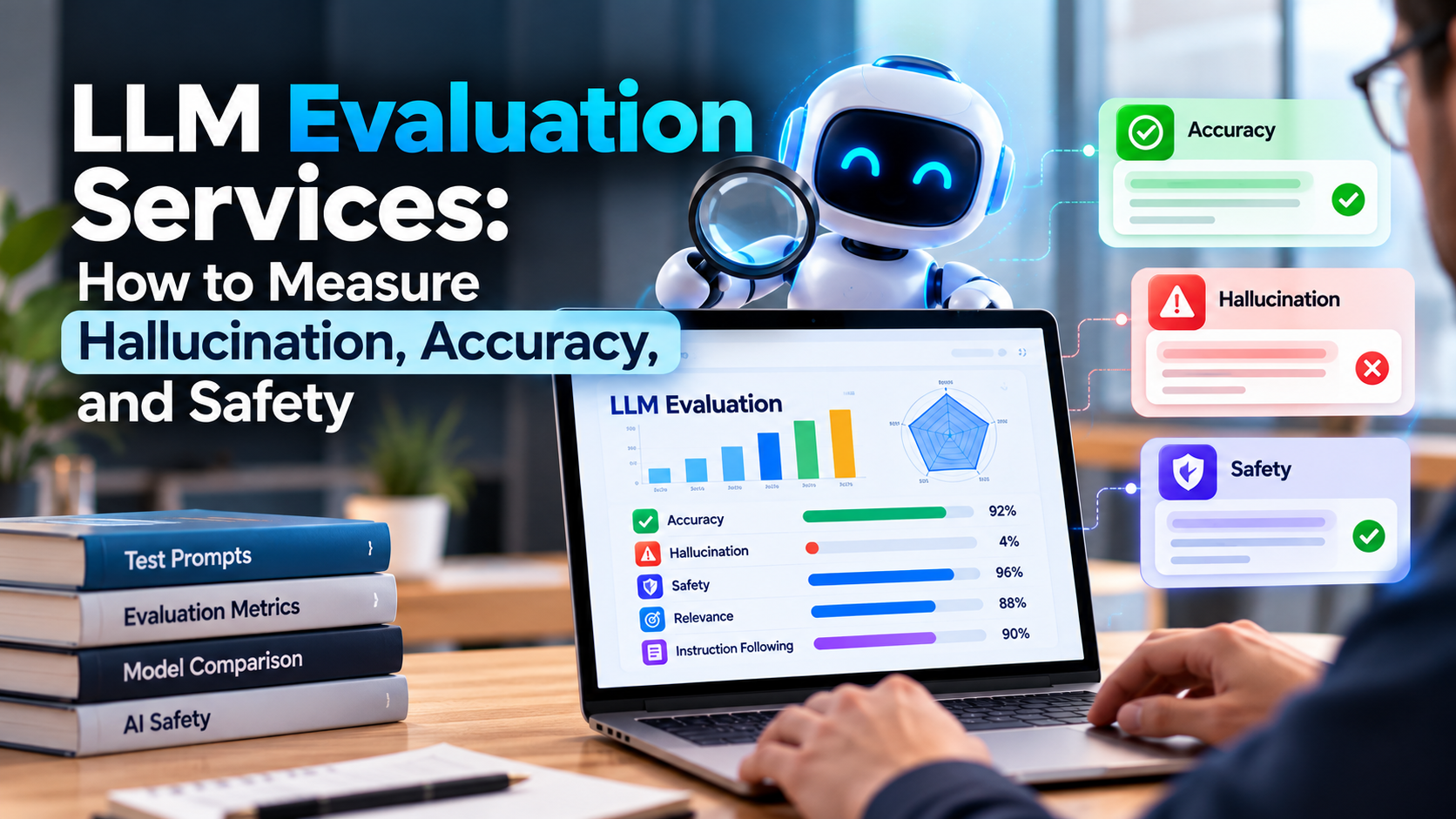
LLM evaluation services help AI teams systematically test language models for accuracy, relevance, reasoning, instruction following, safety, bias, hallucinations, and real-world task performance. The best providers combine automated testing with expert human evaluation, custom rubrics, representative test data, and clear reporting so teams can identify failures before deployment.
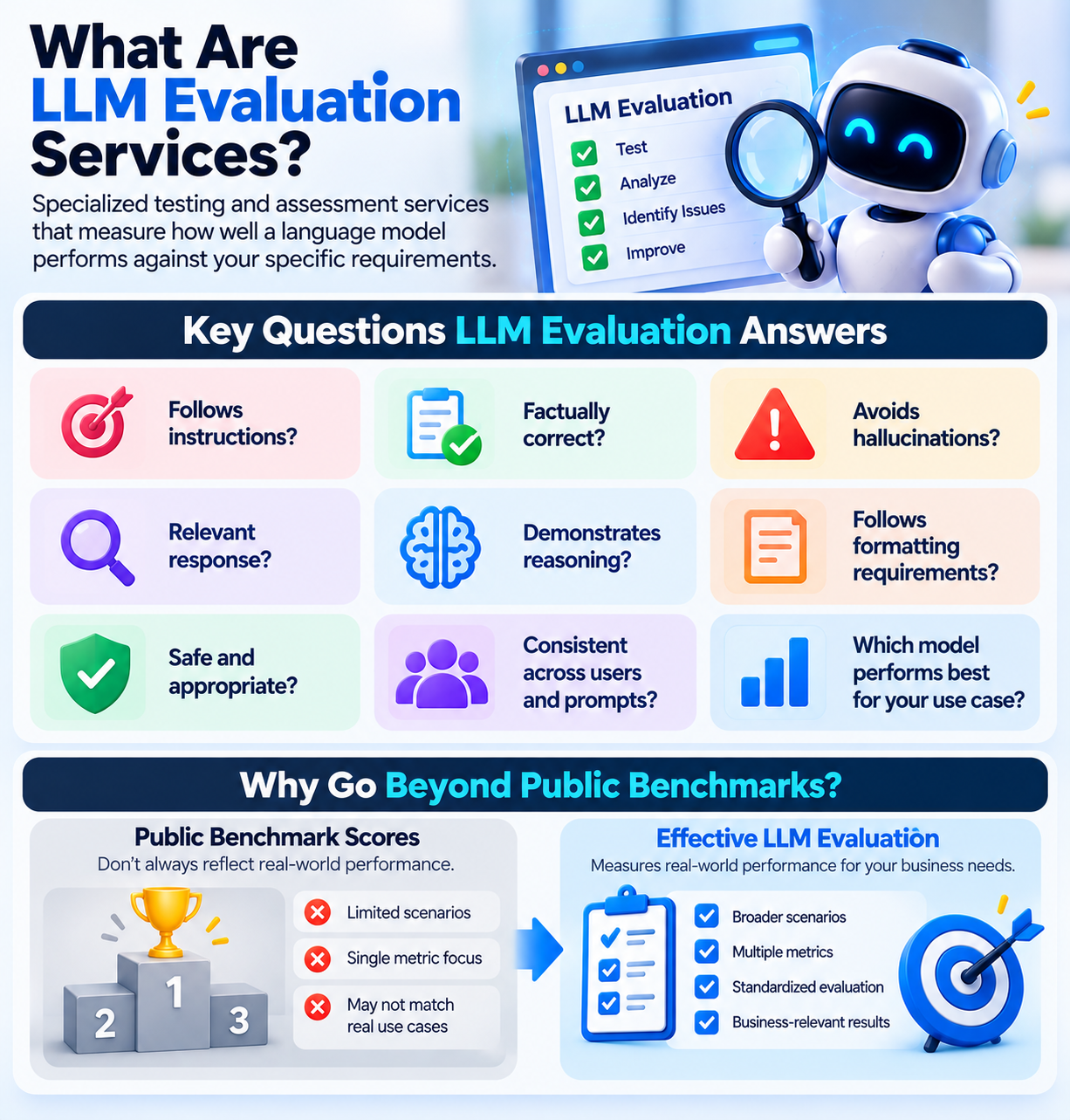
LLM evaluation services are specialized testing and assessment services designed to determine how well a large language model performs against defined requirements.
Instead of asking whether a model is simply "good," an evaluation program asks much more specific questions:
This distinction matters because public benchmark performance does not automatically translate into strong application performance.
Stanford's Holistic Evaluation of Language Models, or HELM, emphasizes broad scenario coverage, multiple metrics, and standardized evaluation rather than relying on one accuracy measurement.
Effective LLM Evaluation therefore moves beyond generic leaderboards and measures whether a model can reliably perform the tasks a business actually needs.
Organizations increasingly have multiple models, prompts, retrieval strategies, fine-tuning approaches, and system configurations to choose from.
That creates an important question:
Which configuration actually works best?
Model evaluation provides evidence for answering it.
For example, imagine a company building an AI customer support assistant. Two models might achieve similar scores on a general knowledge benchmark while performing very differently when handling actual customer questions.
One might produce more accurate responses but struggle to follow company policy. Another might follow instructions reliably but generate unnecessary or overly verbose answers.
A meaningful evaluation would test scenarios such as:
Customer: "Can I receive a refund for an order purchased 45 days ago?"
Evaluators could score the response for:
Policy accuracy → Instruction following → Helpfulness → Tone → Hallucination → Safety
The resulting data gives product and engineering teams far more actionable information than a generic benchmark score.
NIST's Generative AI Profile similarly treats evaluation as part of managing trustworthiness considerations throughout the design, development, use, and evaluation of generative AI systems.
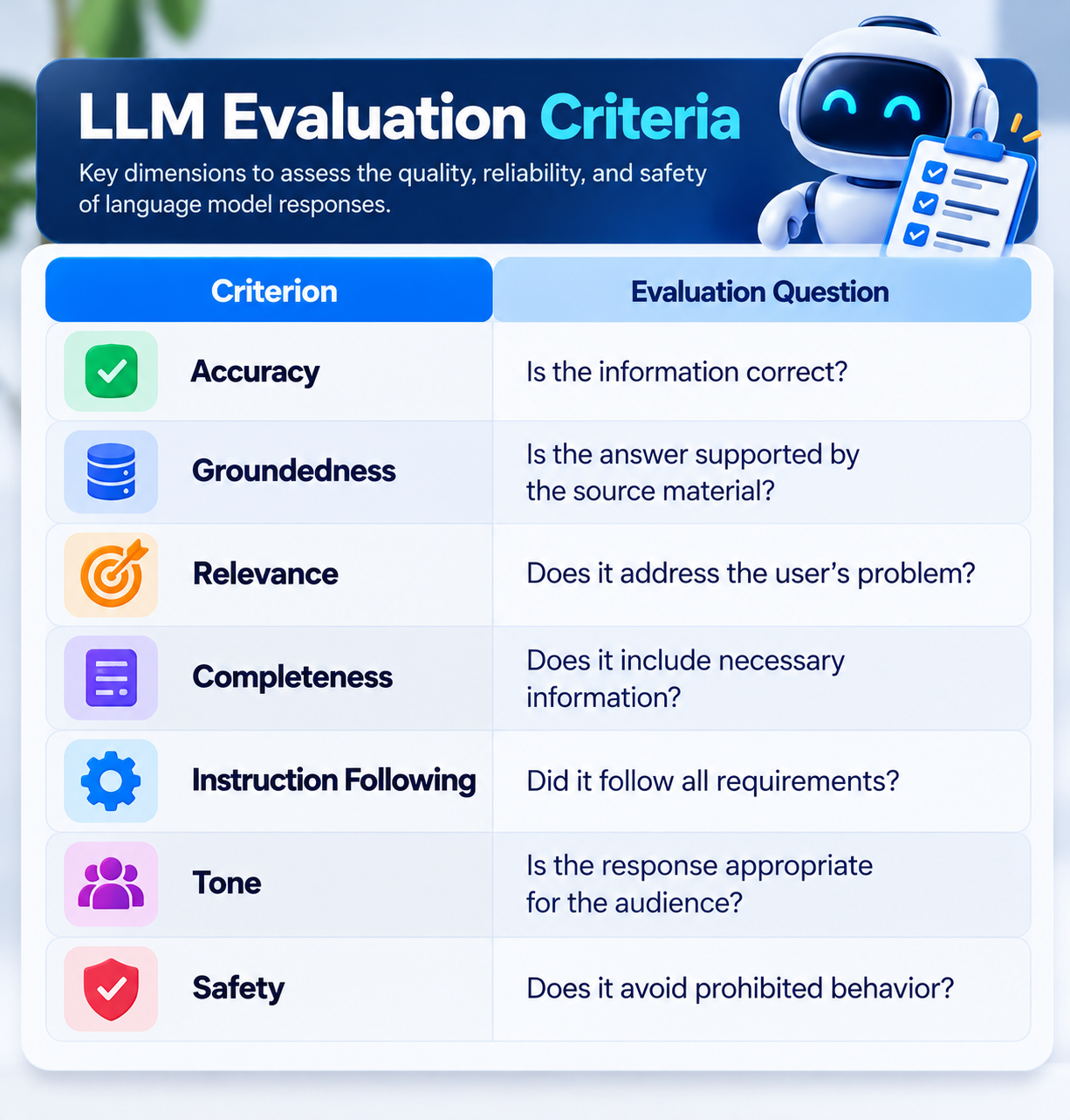
The right metrics depend on the application. However, several dimensions appear repeatedly in strong LLM Evaluation programs.
Does the response contain correct information?
Evaluators may examine individual claims and determine whether they are supported by the provided context, trusted references, or ground-truth answers.
This is particularly important for systems using retrieval-augmented generation (RAG).
Does the response actually answer the question?
An answer can be factually correct while still being unhelpful because it contains irrelevant information or fails to address the user's intent.
Did the model follow all requirements in the prompt?
This can include:
Instruction-following evaluation is increasingly multidimensional. Stanford's HELM Instruct, for example, evaluates criteria including helpfulness, understandability, completeness, conciseness, and harmlessness.
Does the model introduce unsupported claims?
This becomes especially important for enterprise assistants and RAG systems where responses are expected to remain grounded in supplied documents.
Some applications require more than retrieving information.
Models may need to compare options, analyze evidence, follow constraints, perform calculations, or complete multi-step tasks.
Evaluation should therefore test the type of reasoning required by the target application rather than treating reasoning as one universal capability.
Safety testing examines whether a model behaves appropriately when encountering harmful, adversarial, sensitive, or policy-restricted requests.
Testing may include ordinary prompts as well as deliberately difficult edge cases.
NIST's newer ARIA evaluation approach combines model testing, red teaming, and user testing when assessing AI system trustworthiness, demonstrating why evaluation can extend beyond conventional benchmark testing.
A legal assistant, coding copilot, ecommerce chatbot, financial research system, and customer support assistant should not necessarily use identical evaluation criteria.
Domain experts may therefore be necessary when determining whether an answer is genuinely useful and correct.
Neither approach is sufficient for every situation.
The strongest evaluation programs typically combine several methods.
Automated tests work well when answers can be checked using deterministic rules or clearly defined metrics.
They can efficiently test:
Automated evaluation is particularly useful for running thousands of tests repeatedly during development.
But not every quality dimension can be reduced to a simple automatic score.
Another increasingly common approach uses a capable language model to score another model's outputs.
A judge model can evaluate criteria such as relevance, completeness, writing quality, or instruction following using a defined rubric.
This approach can scale far faster than human review.
However, model-based graders can introduce their own biases and inconsistencies. Critical evaluation pipelines should therefore validate automated judges against reliable human judgments rather than assuming their scores represent ground truth.
Human reviewers remain important when judgment requires context, nuance, expertise, or preference.
Humans can assess questions such as:
"Which answer is more useful?"
"Does this response sound natural?"
"Did the assistant fully understand the request?"
"Would this answer satisfy an actual customer?"
Human evaluation is especially valuable for preference data, pairwise comparisons, subjective quality assessments, safety edge cases, and specialized domains.
A strong evaluation project normally begins before reviewers see any model outputs.
The provider first needs to understand what the model is supposed to accomplish.
For example:
Help customers troubleshoot software problems using approved documentation.
That goal is much more useful than simply saying:
Evaluate our chatbot.
The project is converted into measurable dimensions.
For example:
A useful evaluation set should reflect realistic model usage.
That includes common prompts, difficult prompts, ambiguous requests, edge cases, long-context scenarios, multilingual requests when relevant, and adversarial inputs.
Evaluation quality depends heavily on test-set quality.
Reviewers need explicit definitions for each score.
Instead of telling annotators to rate "quality" from 1–5, define what each rating means.
For example:
5 — Fully correct and complete
3 — Mostly correct but contains a meaningful omission
1 — Incorrect, unsupported, or fails the task
Clear rubrics improve consistency between evaluators.
Human and automated evaluations can then be combined.
Quality controls may include:
Raw scores alone are rarely enough.
Teams should understand why failures happen.
Useful categories might include:
Hallucination → Missing context → Reasoning failure → Retrieval failure → Instruction failure → Formatting failure → Safety failure
These patterns help engineering teams prioritize improvements.
Choosing a provider should involve more than asking how many annotators they can supply.
A useful buying checklist includes:
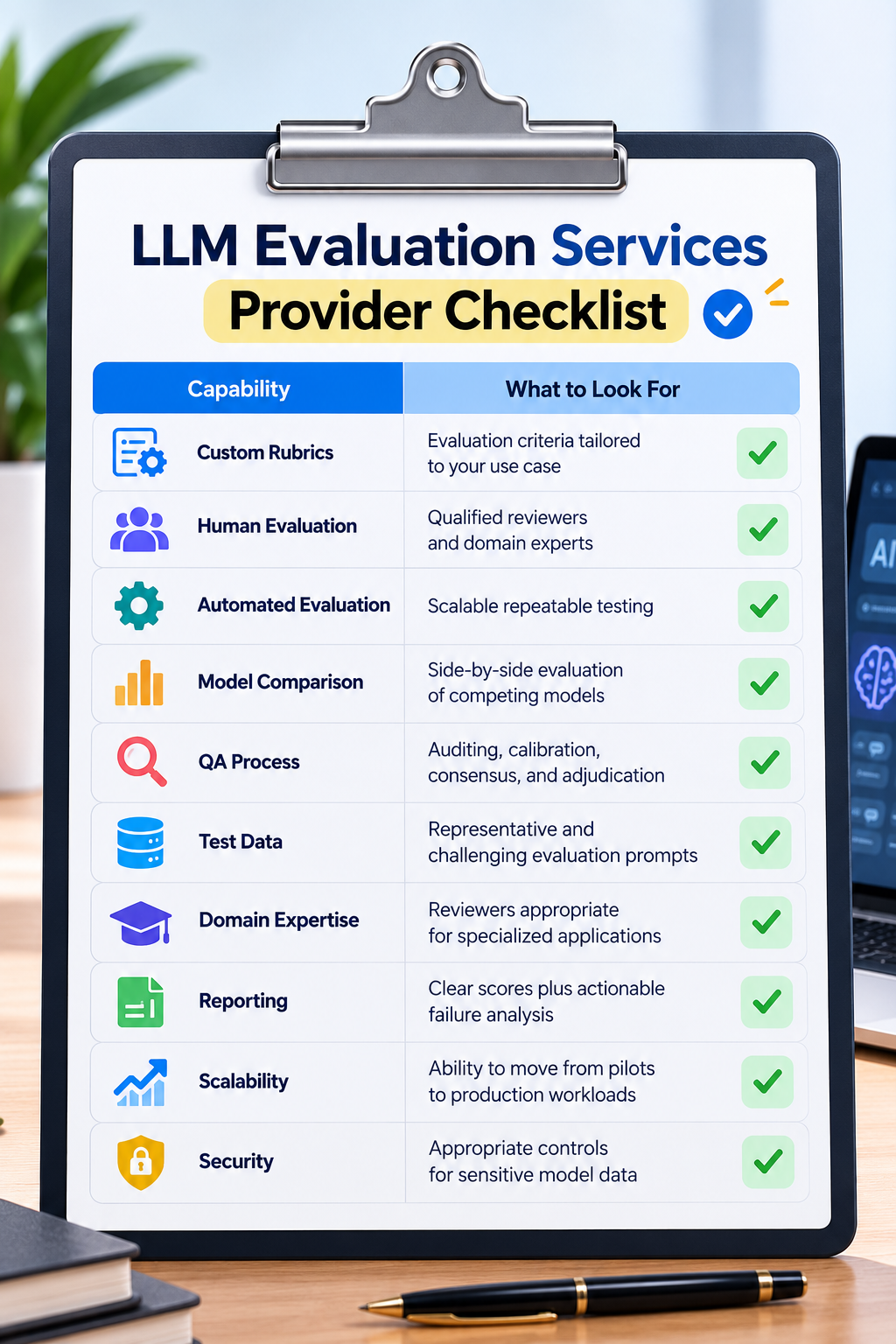
Ask potential vendors to explain their methodology rather than simply promising "high-quality evaluation."
A credible provider should be able to explain how rubrics are created, how reviewers are trained, how disagreements are resolved, and how evaluation quality itself is measured.
Outsourcing becomes especially valuable when internal teams encounter scale, expertise, or operational constraints.
You may benefit from an external evaluation partner when:
External evaluators can also reduce a subtle problem: teams that built a system may unintentionally design tests around assumptions about how that system should behave.
Independent evaluation can introduce additional perspectives and uncover failure modes that internal teams missed.
There is no universal price because evaluation projects vary dramatically in complexity.
Cost is generally influenced by:
Simple binary classification is much cheaper to evaluate than a complex medical or legal reasoning response requiring expert reviewers.
Instead of comparing providers solely on price per annotation, calculate the cost of obtaining a reliable evaluation signal.
Cheap judgments that are inconsistent or poorly calibrated can ultimately cost more because they lead teams toward incorrect product decisions.
Before selecting a provider, ask:
The strongest provider should be able to answer these questions concretely.
Evaluation should not be treated as a one-time test before launch.
Models change.
Prompts change.
Retrieval systems change.
Knowledge bases change.
User behavior changes.
A configuration that performs well today may regress after a seemingly minor update.
This makes LLM Evaluation useful throughout the AI lifecycle:
Baseline → Compare → Deploy → Monitor → Improve → Re-evaluate
NIST maintains an ongoing Generative AI Evaluation Program focused on measurement and testing across generative AI technologies, further illustrating the growing importance of systematic evaluation rather than relying on isolated benchmark results.
The purpose of LLM evaluation is not simply to produce another benchmark score.
It is to generate trustworthy evidence that helps teams make better decisions.
A strong evaluation partner should help answer questions such as:
Which model should we deploy?
Where does our system fail?
Did the latest update improve performance?
Are our responses actually useful to users?
Which failure modes create the greatest business risk?
Look for providers that combine representative evaluation datasets, well-defined rubrics, automated testing, skilled human evaluators, quality assurance, and detailed failure analysis.
The result should be more than a spreadsheet full of scores.
It should give your team a clear roadmap for building a more reliable AI system.
LLM evaluation services systematically test large language models for qualities such as accuracy, relevance, reasoning, instruction following, groundedness, safety, and user preference. Providers may combine automated tests, LLM-based graders, human reviewers, custom datasets, and domain experts to measure how reliably a model performs its intended real-world tasks.
Human evaluation uses trained reviewers or domain experts to assess model responses according to predefined criteria. Reviewers may score individual answers, compare two model responses, identify hallucinations, classify errors, or assess subjective qualities such as helpfulness, tone, completeness, and naturalness.
The right metrics depend on the application. Common dimensions include factual accuracy, relevance, groundedness, instruction following, completeness, reasoning, safety, bias, consistency, latency, and user preference. Effective LLM Evaluation selects metrics based on the intended use case rather than relying on one universal benchmark.
Yes. Evaluation datasets can contain questions specifically designed to reveal unsupported claims, missing citations, incorrect retrieval, and fabricated information. Repeated testing helps teams measure hallucination rates, identify recurring failure patterns, compare mitigation strategies, and determine whether changes to prompts, retrieval systems, or models improve groundedness.
Choose a provider that can create custom evaluation criteria, recruit qualified evaluators, build representative test sets, perform rigorous quality assurance, and provide actionable reporting. Ask how reviewers are calibrated, how disagreements are handled, whether domain experts are available, and whether the provider supports continuous evaluation after deployment.


Compact, ready to go anywhere
Interchangeable lens that’s upgradeable
Dual 1-inch sensors for improved clarity and low light performance
Dynamic range and 6K 360° capture
360° photo resolution at 21MP

8K 360° video recording for ultra-detailed visuals.
4K single-lens mode for traditional wide-angle shots.
Invisible selfie stick effect for drone-like perspectives.
2.5-inch touchscreen with Gorilla Glass protection.
Waterproof up to 33ft for underwater shooting.

360° photo resolution in 23MP
Slim design at 24 mm thick
Built-in image stabilization for smooth video capture.
Internal 19GB storage for photo and video storage.
Wireless connectivity for remote control and sharing.

60MP 360° still images for high-resolution photography.
5.7K 360° video recording at 30fps.
2.25-inch touchscreen for intuitive control.
USB Type-C port for fast charging and data transfer.
MicroSD card slot for expandable storage.


Try it free. No credit card required. Instant set-up.