


.png)


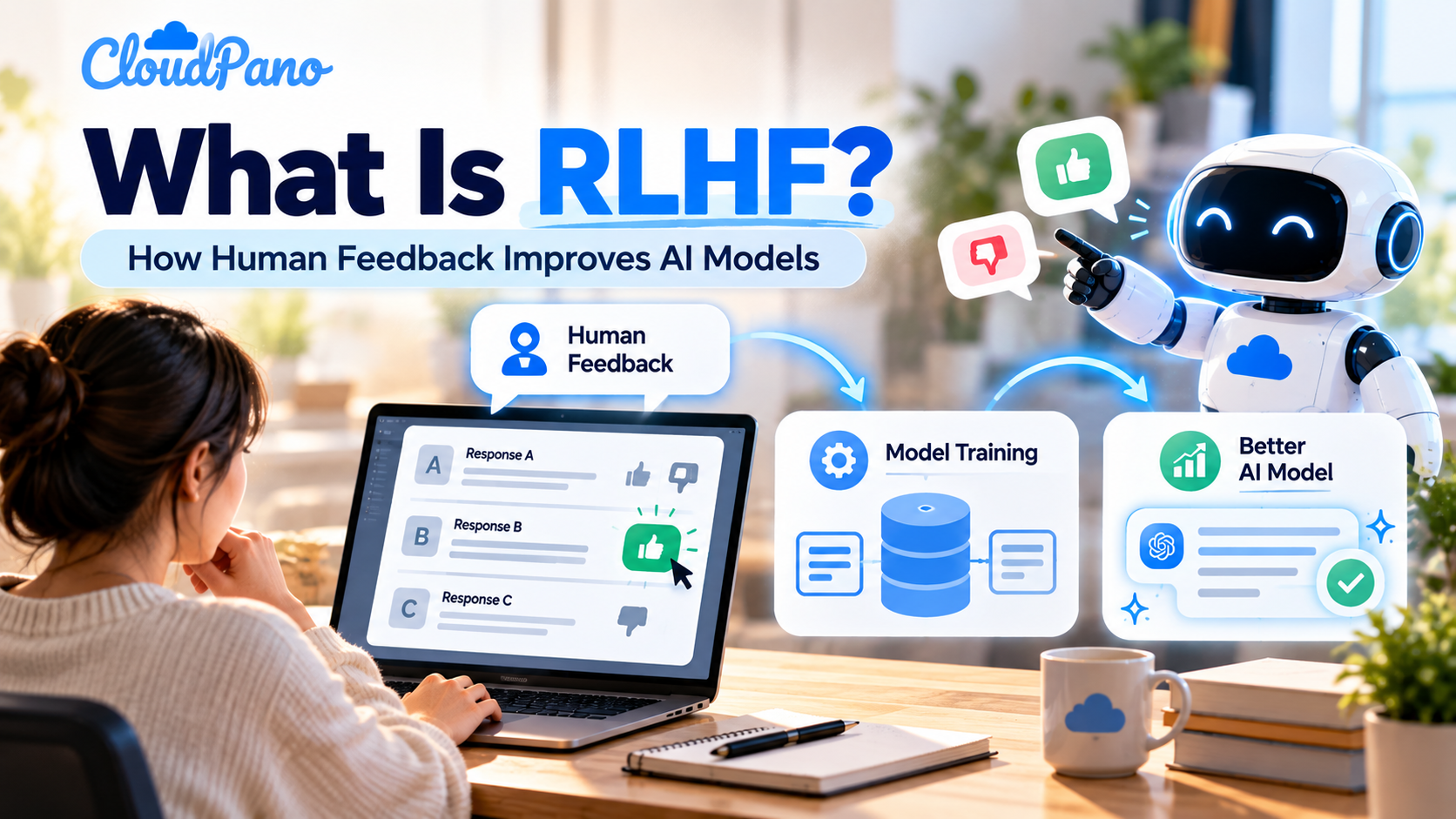
Reinforcement Learning from Human Feedback (RLHF) is a method for improving AI models using human preferences. People review, compare, or rank model responses, and those judgments are converted into training signals. This helps language models produce responses that better follow instructions and reflect desired qualities such as helpfulness, relevance, and safety.
Large language models can learn grammar, facts, patterns, and reasoning behaviors from enormous collections of text, but predicting the next word does not automatically teach a model what people consider helpful, accurate, safe, or appropriate.

That is where Reinforcement Learning from Human Feedback (RLHF) comes in.
RLHF uses judgments from people to help AI systems learn which responses humans prefer. Instead of relying exclusively on a fixed training objective, developers can collect demonstrations, rankings, ratings, and comparisons that provide signals about desirable model behavior.
For organizations developing or evaluating large language models, high-quality RLHF services can provide the human preference data needed to measure and improve instruction following, helpfulness, safety, relevance, and other important qualities.
RLHF stands for Reinforcement Learning from Human Feedback. It is a family of techniques that uses human judgments to help an AI system learn behaviors that are difficult to specify with a simple mathematical rule.
Consider a chatbot asked:
“Explain photosynthesis to a 10-year-old.”
Two answers could both be grammatically correct. However, one might use highly technical scientific terminology, while another provides a simple, accurate explanation appropriate for a child.
A traditional language-model training objective does not necessarily capture that difference.
A human evaluator can.
The evaluator can compare the two responses and indicate which better satisfies the request. When many carefully designed comparisons are collected, they create preference data that can be used to improve the model.
Early research demonstrated that human preferences could be used as a practical training signal for reinforcement-learning systems. In 2017, researchers showed that complex behaviors could be learned from human comparisons rather than relying entirely on a predefined reward function.
This idea later became highly influential in large language model development.
The exact training pipeline varies between organizations and models, but a classic RLHF workflow can be understood in several stages.

Before RLHF begins, an LLM has generally already been pretrained on a large corpus of text.
During pretraining, the model learns statistical relationships between tokens. This gives it broad language capabilities, but the objective of predicting text is not identical to understanding what a user actually wants.
A model may therefore know a great deal while still producing answers that are irrelevant, poorly formatted, overly verbose, misleading, or otherwise undesirable.
RLHF provides an additional signal about preferred behavior.
A common next stage is supervised fine-tuning.
Human annotators may be given prompts and asked to write examples of strong responses. These demonstrations show the model how people expect an assistant to behave across different situations.
For example:
Prompt:
“Summarize this article in three bullet points.”
A human-generated demonstration shows more than factual content. It demonstrates instruction following, appropriate length, formatting, relevance, and communication style.
In the InstructGPT research, researchers collected labeler-written demonstrations and used them for supervised fine-tuning before collecting comparisons between model outputs.
The model can then generate several possible answers to the same prompt.
Imagine the model produces four responses:
Response A — accurate but unnecessarily long
Response B — concise, clear, and accurate
Response C — polished but contains an unsupported claim
Response D — correct but does not follow the requested format
A human evaluator might rank them:
B → A → D → C
This ranking provides information that ordinary next-token prediction does not directly capture.
The model-development team now has evidence about which behavior people prefer.
Human evaluation is one of the most important parts of the pipeline.
Evaluators may be instructed to judge responses according to dimensions such as:
This is where the quality of RLHF services becomes particularly important.
Simply hiring large numbers of annotators does not guarantee useful preference data. Evaluators need clear rubrics, examples, calibration exercises, escalation procedures, and quality checks.
A vague question such as:
“Which answer is better?”
can produce inconsistent labels.
A more carefully designed rubric defines what “better” means and how evaluators should handle tradeoffs between accuracy, relevance, completeness, and safety.
In traditional RLHF pipelines, human preference comparisons can be used to train a reward model.
The reward model attempts to predict which outputs humans would prefer.
Conceptually, the process looks like this:
Prompt → Multiple AI Responses → Human Preference → Reward Model
Once trained, the reward model can assign scores to new responses without requiring a human to manually evaluate every single generation.
This is important for scalability.
Instead of asking a person to review every training example, developers can use the learned preference model as a proxy for human judgment during subsequent optimization.
Research on summarization demonstrated this approach by collecting human comparisons between summaries, training a model to predict human preferences, and using that model as a reward function for further optimization.
The final classic RLHF stage uses reinforcement learning to encourage the language model to produce outputs that receive higher reward scores.
A simplified pipeline is:
Pretrained Model → Supervised Fine-Tuning → Human Preference Data → Reward Model → Reinforcement Learning → Improved Model
The objective is not simply to make the model generate more fluent text.
It is to make its behavior better match the preferences represented in the feedback dataset.
One influential example was InstructGPT. Researchers reported that human evaluators preferred outputs from a 1.3-billion-parameter InstructGPT model over outputs from the much larger 175-billion-parameter GPT-3 baseline on their prompt distribution.
That result illustrates an important point: model size alone does not determine how useful an AI assistant feels to people.
RLHF data does not have to take only one form.
Evaluators compare two responses and select the better one.
Response A vs. Response B → Choose A
This is one of the clearest ways to capture preference.
Evaluators receive several responses and rank them from best to worst.
For example:
C > A > D > B
This produces richer information about relative quality.
Evaluators score responses using numerical or categorical scales.
Examples might include:
Accuracy: 4/5
Relevance: 5/5
Instruction following: 3/5
Evaluators explain what is wrong with an answer and how it could be improved.
These critiques can provide richer supervision than a simple preference label.
Some domains require specialized knowledge.
Medical, legal, mathematical, scientific, financial, and advanced coding responses may require qualified or experienced evaluators rather than general-purpose annotators.
RLHF can influence several important dimensions of model behavior.

One of its clearest benefits is teaching models to pay attention to what users actually request.
If the prompt asks for three bullets, a preferred response should provide three bullets.
If the user asks for a beginner explanation, highly technical language may be penalized even if technically correct.
This teaches the system that satisfying the user's instruction is part of response quality.
Helpfulness can be difficult to represent through a simple automated metric.
Human reviewers can judge whether an answer actually solves the user's problem rather than merely producing related information.
RLHF can therefore provide training signals closer to real user preferences.
Two responses can contain similar information but differ significantly in organization, clarity, conciseness, and tone.
Human feedback can identify those differences.
Preference data can also teach models how to respond to potentially harmful, adversarial, or inappropriate requests.
Research from Anthropic has explored using preference modeling and RLHF to train assistants toward helpful and harmless behavior.
However, RLHF should not be treated as a guarantee of safety. Models can still produce undesirable behavior, particularly in unfamiliar or adversarial situations.
These concepts are closely related but serve different purposes.
LLM evaluation asks:
“How well does this model perform?”
RLHF asks:
“How can human judgments be turned into signals that improve model behavior?”
Evaluation might measure:
Model → Test Prompts → Responses → Human Scores → Performance Report
RLHF can go further:
Model → Responses → Human Preferences → Training Data → Model Improvement
The same human-evaluation infrastructure may support both processes.
This makes RLHF an important part of the broader LLM Evaluation topic cluster.

Large-scale human-feedback programs are operationally complex.
A serious RLHF services provider may need to manage evaluator recruitment, training, calibration, task design, preference collection, expert routing, quality assurance, disagreement analysis, data security, and dataset delivery.
Quality matters because preference data directly influences the behavior the model learns.
If evaluators consistently reward overly confident answers, the resulting preference model may favor confidence over uncertainty.
If evaluation instructions are ambiguous, different annotators may interpret “helpfulness” differently.
If the evaluator pool lacks diversity, the collected preferences may represent a narrow set of expectations.
RLHF therefore has a fundamental principle:
Human feedback is only useful when the feedback process itself is well designed.
RLHF is powerful, but it is not a complete solution to AI alignment or evaluation.
People disagree.
One evaluator may prefer concise answers, while another values additional explanation.
Rubrics and calibration can reduce disagreement, but they cannot eliminate every subjective judgment.
A response can sound convincing while being factually incorrect.
This becomes particularly important for technical domains where evaluating correctness requires expertise.
A reward model learns to approximate human preferences based on the training data it receives.
It is not literally a human evaluator.
Optimizing too aggressively against an imperfect proxy can produce unintended behavior.
Collecting large volumes of high-quality preference data requires people, infrastructure, training, monitoring, and quality control.
Specialist evaluation increases costs further.
A model trained with RLHF should still undergo independent evaluation, red teaming, benchmark testing, domain-specific assessment, and production monitoring.
Human feedback is not the only possible source of preference signals.
RLAIF, or Reinforcement Learning from AI Feedback, uses AI systems to help evaluate outputs.
One example is Constitutional AI, where written principles can guide AI-generated critiques and preferences. Anthropic demonstrated a process that includes supervised self-critique followed by reinforcement learning using AI-generated preference signals.
This can reduce reliance on human labeling for every individual example.
However, humans remain important for defining objectives, developing evaluation criteria, validating results, identifying failures, and determining whether automated judgments actually represent desired behavior.
A likely direction for large-scale evaluation is therefore not simply humans versus AI evaluators, but carefully designed combinations of both.

RLHF helps bridge an important gap between what a language model learns from text and what people actually want from an AI assistant.
By collecting demonstrations, comparisons, rankings, ratings, and other preference signals, developers can teach models to better follow instructions and produce outputs that reflect desired qualities.
But the effectiveness of RLHF depends heavily on the humans and processes behind the data.
High-quality RLHF services therefore require more than simply generating thousands of labels. They require well-designed evaluation rubrics, trained evaluators, quality-control systems, domain expertise where necessary, and careful analysis of disagreements and edge cases.
As LLMs continue to improve, human feedback will increasingly sit alongside automated evaluation, AI-generated feedback, red teaming, and domain-specific testing.
The underlying principle remains straightforward:
If we want AI systems to better reflect human preferences, we need reliable ways to measure those preferences first.
RLHF stands for Reinforcement Learning from Human Feedback. It describes techniques that use human judgments—such as response comparisons, rankings, ratings, or demonstrations—to create signals for improving AI behavior. It is commonly associated with aligning large language models more closely with human instructions and preferences.
Pretraining teaches models to predict language patterns, but that objective does not perfectly represent qualities such as helpfulness, relevance, instruction following, or safety. Human feedback provides additional information about which outputs people actually prefer, helping developers optimize models toward desired behaviors.
Evaluators may write ideal responses, compare two model answers, rank multiple outputs, score responses against a rubric, identify errors, assess safety, or provide written critiques. More specialized tasks may require domain experts who can accurately judge technical correctness.
Not exactly. Fine-tuning is a broad term for adapting a pretrained model using additional training data. RLHF is a more specific family of approaches that incorporates human preference information. Traditional RLHF pipelines can include supervised fine-tuning as one stage before preference modeling and reinforcement learning.
RLHF services provide the human-feedback operations needed to train or evaluate AI systems. They can include preference ranking, response scoring, supervised demonstrations, expert evaluation, red teaming, annotation quality assurance, evaluator calibration, and preparation of human-preference datasets for model development.


Compact, ready to go anywhere
Interchangeable lens that’s upgradeable
Dual 1-inch sensors for improved clarity and low light performance
Dynamic range and 6K 360° capture
360° photo resolution at 21MP

8K 360° video recording for ultra-detailed visuals.
4K single-lens mode for traditional wide-angle shots.
Invisible selfie stick effect for drone-like perspectives.
2.5-inch touchscreen with Gorilla Glass protection.
Waterproof up to 33ft for underwater shooting.

360° photo resolution in 23MP
Slim design at 24 mm thick
Built-in image stabilization for smooth video capture.
Internal 19GB storage for photo and video storage.
Wireless connectivity for remote control and sharing.

60MP 360° still images for high-resolution photography.
5.7K 360° video recording at 30fps.
2.25-inch touchscreen for intuitive control.
USB Type-C port for fast charging and data transfer.
MicroSD card slot for expandable storage.
.png)

.png)

Try it free. No credit card required. Instant set-up.






.svg)


.svg)