


.png)


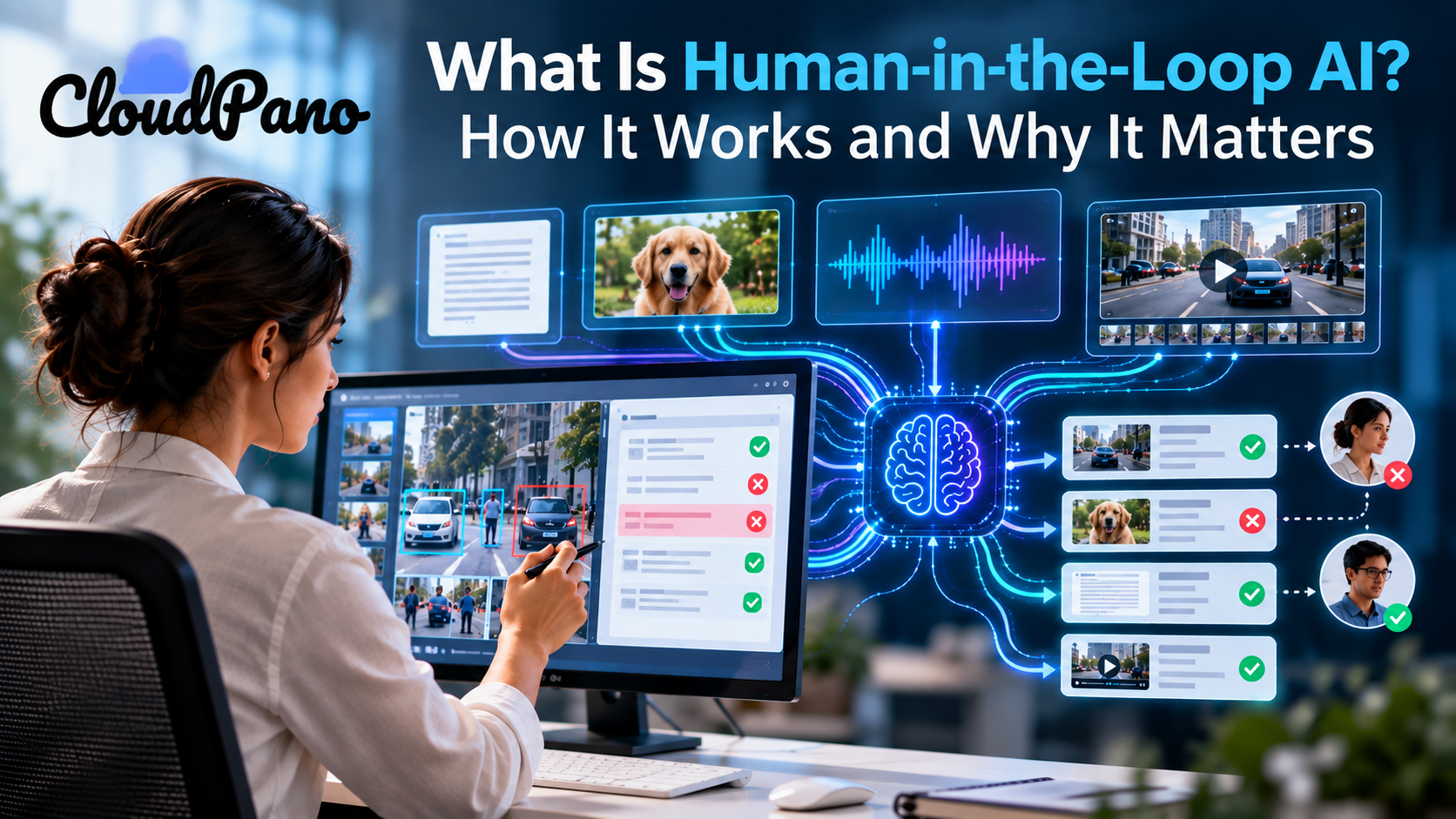
Human-in-the-loop AI (HITL) is a machine learning approach that integrates human feedback, review, and oversight into AI development and operation. Human-in-the-loop AI services support data annotation, model evaluation, error correction, and quality assurance. By combining automated processing with human expertise, organizations can improve data quality, manage complex cases, and build more reliable AI systems. Copy quick answer
Human-in-the-loop AI combines machine learning with human judgment, feedback, and oversight.
HITL services support data annotation, model training, output review, and quality assurance.
Human reviewers help resolve ambiguous cases and identify errors that automated systems may miss.
HITL workflows are useful in healthcare, finance, customer support, e-commerce, and autonomous systems.
Effective human oversight requires clear responsibilities, trained reviewers, and consistent evaluation standards.
The goal is to balance automation and human expertise rather than require manual approval for every AI decision.
Artificial intelligence can process enormous amounts of information, identify patterns, and automate tasks that once required hours of manual work. But even the most advanced AI systems can make mistakes.
A model might misunderstand a customer's request, misclassify an image, or generate an answer that sounds convincing but contains incorrect information.
These limitations become especially important when businesses rely on AI to support real decisions.
That's where human-in-the-loop AI comes in.
Rather than leaving every decision to an automated system, human-in-the-loop AI combines machine learning with human judgment. People review uncertain results, correct mistakes, provide feedback, and help models improve over time.
This approach is increasingly valuable for organizations building AI applications that require accuracy, accountability, and consistent performance.
Human-in-the-loop AI services make this process easier to manage by providing the people, workflows, and quality controls needed to support AI training and evaluation.
Understanding how these services work can help businesses decide when automation is sufficient and when human expertise remains essential.
Human-in-the-loop AI (HITL AI) is an approach to artificial intelligence in which people actively participate in training, evaluating, correcting, or overseeing AI systems.
Instead of allowing a model to operate entirely independently, HITL workflows create opportunities for human input at important stages.
For example, imagine an AI system that automatically categorizes customer support tickets.
The model may correctly identify most requests, but some messages could be unclear or contain multiple issues.
Rather than guessing, the system can flag uncertain cases for a human reviewer.
The reviewer selects the correct category, and that feedback can be used to improve the model or refine the workflow.
Human involvement does not necessarily mean checking every prediction. It means introducing human judgment where it can add the most value.

Human-in-the-loop systems typically follow a repeating process involving machine predictions, human review, and feedback.
AI systems begin with data.
Depending on the application, this might include documents, photographs, customer conversations, audio recordings, or video footage.
Before training, the data must be organized and prepared.
Human reviewers may help identify irrelevant information, correct inconsistencies, and ensure that examples meet established quality standards.
Reliable training data provides the foundation for better model performance.
Many machine learning systems require labeled examples.
For instance, an image recognition model might need thousands of photographs labeled with the objects they contain.
Human annotators examine the images and assign appropriate labels.
In more complex projects, they may identify object boundaries, transcribe speech, classify sentiment, or describe events in videos.
These annotations help models learn the relationships between inputs and expected outputs.
Once the data is prepared, machine learning algorithms use it to identify patterns.
During training, the model adjusts its internal parameters based on the learning objective.
Human involvement can support this process by reviewing training examples, correcting labels, and evaluating model behavior.
However, not every correction automatically changes a model. Feedback must be incorporated through an appropriate training, evaluation, or workflow update process.
After initial training, a model can generate predictions or recommendations.
Some results may be straightforward, while others require additional attention.
A HITL workflow can route selected cases to human reviewers based on uncertainty, risk, or predefined business rules.
For example, a financial document processing system might automatically extract clearly formatted information but send ambiguous entries for manual verification.
Human corrections can reveal recurring problems.
If reviewers repeatedly identify the same classification error, developers can investigate whether the issue comes from training data, model limitations, or unclear instructions.
Validated feedback may then be used to improve the dataset, update model behavior, or adjust review thresholds.
This creates an ongoing improvement cycle in which automation handles suitable tasks while people help resolve difficult cases.
AI systems are useful because they can operate at scale. Human expertise is valuable because it brings context, judgment, and the ability to recognize exceptions.
Combining these strengths can produce more dependable workflows.
Human reviewers can identify errors that automated systems miss.
This is especially useful when inputs are ambiguous, incomplete, or different from the examples used during training.
For instance, a document extraction model may struggle with unusual layouts. A human reviewer can verify the information before it enters a business system.
Poor-quality labels can introduce errors into machine learning systems.
Professional human-in-the-loop AI services can establish annotation guidelines, review processes, and quality checks to improve consistency.
Clear instructions and reviewer calibration are particularly important when a project involves subjective or complicated labeling decisions.
When AI contributes to important decisions, organizations need ways to investigate mistakes and understand how results were handled.
Human oversight can support escalation procedures, audit trails, and decision reviews.
However, simply adding a human reviewer does not guarantee accountability. Reviewers also need appropriate authority, training, information, and time to make meaningful decisions.
Human involvement can help organizations automate routine work without forcing every unusual case through the same automated process.
Instead of choosing between full automation and entirely manual processing, businesses can design workflows that balance speed with appropriate oversight.
Human-in-the-loop AI services can cover several stages of AI development and deployment.
Human annotators prepare labeled datasets for supervised machine learning.
Common tasks include image classification, object detection, text categorization, audio transcription, and video annotation.
The exact annotation process depends on the model's purpose and the complexity of the information.
Reviewers evaluate predictions, generated content, or automated decisions against established criteria.
They may verify factual accuracy, check formatting, identify inappropriate responses, or confirm whether outputs meet business requirements.
This service is useful for applications where incorrect results could affect customers or operational decisions.
Human feedback helps developers understand which model outputs are more useful, accurate, or appropriate.
For example, reviewers might compare two AI-generated responses and indicate which better follows the user's instructions.
In some AI training approaches, this preference information can contribute to improving model behavior.
Quality assurance involves checking whether datasets and model outputs meet defined standards.
This may include independent reviews, sampling, agreement checks between annotators, and evaluation against reference examples.
Quality assurance helps identify inconsistent labeling and systematic errors before they spread through a workflow.
Not every AI decision needs manual intervention.
Human-in-the-loop services can help manage cases that exceed confidence thresholds, involve sensitive information, or require specialized expertise.
Well-designed escalation processes ensure that difficult cases reach appropriate reviewers rather than being handled through unreliable automated guesses.
Human-in-the-loop and fully automated AI systems differ primarily in how decisions are reviewed and controlled.
The right approach depends on the consequences of an incorrect decision.
For a low-risk task such as organizing routine files, extensive human review may be unnecessary.
For applications involving medical information, financial decisions, or sensitive customer records, stronger oversight may be appropriate.
The National Institute of Standards and Technology (NIST) emphasizes that human roles and responsibilities should be clearly defined when managing AI systems.

Human-in-the-loop AI is useful wherever automated systems benefit from expert review or contextual understanding.
Medical AI systems can assist with image analysis, document processing, and identifying patterns in clinical information.
Human healthcare professionals may review AI-generated findings before using them in patient care.
This oversight is particularly important because inaccurate or incomplete information can have serious consequences.
Financial organizations use machine learning for document processing, fraud detection, and transaction monitoring.
A human-in-the-loop workflow can route suspicious transactions or uncertain results to trained specialists.
Reviewers can investigate unusual activity while automated systems continue processing routine cases.
AI-powered customer support tools can categorize requests, suggest responses, and answer common questions.
However, complicated complaints, billing disputes, and sensitive issues may require human judgment.
A hybrid workflow allows AI to assist with routine requests while support agents handle situations requiring additional attention.
Online platforms use AI to categorize products, analyze listings, and identify potentially problematic content.
Human reviewers can investigate ambiguous cases and verify whether automated decisions follow platform policies.
Their feedback can also help improve classification guidelines and model evaluations.
Robotics and autonomous technologies may use human input during training, testing, or exceptional operating conditions.
For example, human reviewers can label difficult visual scenarios or evaluate whether a system responded appropriately during a simulation.
This information supports further testing and development.
Although human oversight offers important advantages, it also introduces operational challenges.
Scalability and cost: Reviewing large volumes of information requires people, training, and management resources. Organizations must decide which tasks genuinely benefit from human intervention.
Reviewer inconsistency: Different reviewers may interpret the same example differently. Clear guidelines, calibration exercises, and independent quality checks can reduce variation.
Processing delays: Manual reviews can slow down workflows, especially when requests arrive faster than reviewers can process them.
Privacy and security: Human reviewers may need access to sensitive information. Appropriate permissions, confidentiality procedures, and data minimization are essential.
Overreliance on AI: Reviewers may accept AI recommendations without sufficient scrutiny. Effective oversight requires meaningful opportunities to challenge or override automated outputs.
These limitations reinforce an important point: human involvement improves a system only when the review process itself is carefully designed.
Organizations planning to introduce HITL workflows should begin by identifying where human input creates measurable value.
Define clear review criteria. Establish which predictions require approval, correction, or escalation. These criteria may depend on uncertainty, business rules, and the potential impact of errors.
Create consistent annotation guidelines. Reviewers need clear definitions, examples, and instructions for handling ambiguous cases.
Measure quality regularly. Track relevant indicators such as review accuracy, disagreement rates, turnaround times, and recurring errors.
Protect sensitive information. Limit data access to authorized personnel and implement appropriate security controls.
Maintain feedback records. Document corrections and reviewer decisions so teams can investigate problems and evaluate improvements.
Evaluate the complete workflow. A model may perform well in isolation while the combined human-AI process introduces delays or mistakes. Assess both technical performance and operational outcomes.
A structured approach helps organizations benefit from automation while maintaining appropriate human control.
Selecting a provider involves more than comparing annotation prices.
Organizations should evaluate whether a potential partner can deliver consistent quality while handling the complexity of their particular use case.
Start by examining the provider's experience with relevant data types and industry requirements.
A team experienced in image labeling may not necessarily have the expertise required for medical document review or specialized language evaluation.
Ask about reviewer training, quality assurance procedures, data security, and how disagreements are resolved.
Scalability also matters. A provider should be able to accommodate changing workloads without sacrificing annotation consistency or review quality.
Finally, consider how feedback will be delivered.
Structured, traceable outputs make it easier for internal teams to incorporate human corrections into training and evaluation pipelines.
The strongest provider relationship is one built around clearly defined outcomes, transparent processes, and measurable quality standards.
As AI becomes more capable, the role of human oversight is likely to evolve.
Routine tasks that once required manual review may become increasingly automated. At the same time, more sophisticated applications will create new demands for expert evaluation, safety testing, and decision oversight.
One important development is the use of active learning, where models identify examples that would benefit most from additional labeling.
Another is the integration of human feedback into generative AI development, helping teams evaluate response quality and improve model behavior.
These approaches suggest that human involvement will become more targeted rather than disappearing entirely.
The long-term objective is not to require a person to approve every AI-generated result.
It is to ensure that people remain involved wherever their expertise, judgment, and accountability are necessary.
Human-in-the-loop AI brings human judgment into machine learning workflows to improve data quality, evaluate predictions, and support more reliable decisions.
For businesses developing or deploying AI, this approach offers a practical way to combine automation with meaningful oversight.
Well-designed human-in-the-loop AI services can support data annotation, model evaluation, quality assurance, and exception handling while helping organizations identify and address recurring errors.
The most effective systems do not assume that humans are always right or that AI is always wrong.
Instead, they recognize that both have strengths and limitations.
By assigning the right responsibilities to people and machines, organizations can build AI workflows that are more useful, accountable, and dependable.
A customer support system that automatically categorizes incoming messages but sends uncertain requests to human agents is an example of human-in-the-loop AI. The agents correct classification errors, and their feedback can help improve future model performance.
Human-in-the-loop AI typically involves people directly reviewing or influencing selected decisions within a workflow. Human-on-the-loop AI generally allows a system to operate more independently while people monitor its behavior and intervene when necessary. The exact distinction can vary by application.
Healthcare, financial services, retail, customer support, manufacturing, and autonomous technology are among the industries that can benefit from human-in-the-loop AI services. These services are particularly valuable when accuracy, contextual judgment, or oversight is important.
Human-in-the-loop AI can improve accuracy by introducing verified labels, correcting predictions, and identifying difficult examples. However, improvements depend on reviewer expertise, feedback quality, workflow design, and whether corrections are effectively incorporated into the system.
Businesses should evaluate providers based on relevant expertise, annotation quality, reviewer training, data security, scalability, and feedback processes. Clear quality standards and measurable performance indicators are essential when comparing service providers.
IBM – What Is Human-in-the-Loop (HITL)?
https://www.ibm.com/think/topics/human-in-the-loop
NIST – AI Risk Management Framework
https://www.nist.gov/itl/ai-risk-management-framework
NIST – AI Risk Management and Human-AI Interaction
https://airc.nist.gov/airmf-resources/airmf/appendices/app-c-ai-risk-management-and-human-ai-interaction/
NIST – AI Risk Management Framework Core
https://airc.nist.gov/airmf-resources/airmf/5-sec-core/
NIST – Generative Artificial Intelligence Profile
https://nvlpubs.nist.gov/nistpubs/ai/NIST.AI.600-1.pdf


Compact, ready to go anywhere
Interchangeable lens that’s upgradeable
Dual 1-inch sensors for improved clarity and low light performance
Dynamic range and 6K 360° capture
360° photo resolution at 21MP

8K 360° video recording for ultra-detailed visuals.
4K single-lens mode for traditional wide-angle shots.
Invisible selfie stick effect for drone-like perspectives.
2.5-inch touchscreen with Gorilla Glass protection.
Waterproof up to 33ft for underwater shooting.

360° photo resolution in 23MP
Slim design at 24 mm thick
Built-in image stabilization for smooth video capture.
Internal 19GB storage for photo and video storage.
Wireless connectivity for remote control and sharing.

60MP 360° still images for high-resolution photography.
5.7K 360° video recording at 30fps.
2.25-inch touchscreen for intuitive control.
USB Type-C port for fast charging and data transfer.
MicroSD card slot for expandable storage.
.png)

.png)

Try it free. No credit card required. Instant set-up.





.svg)


.svg)