


.png)


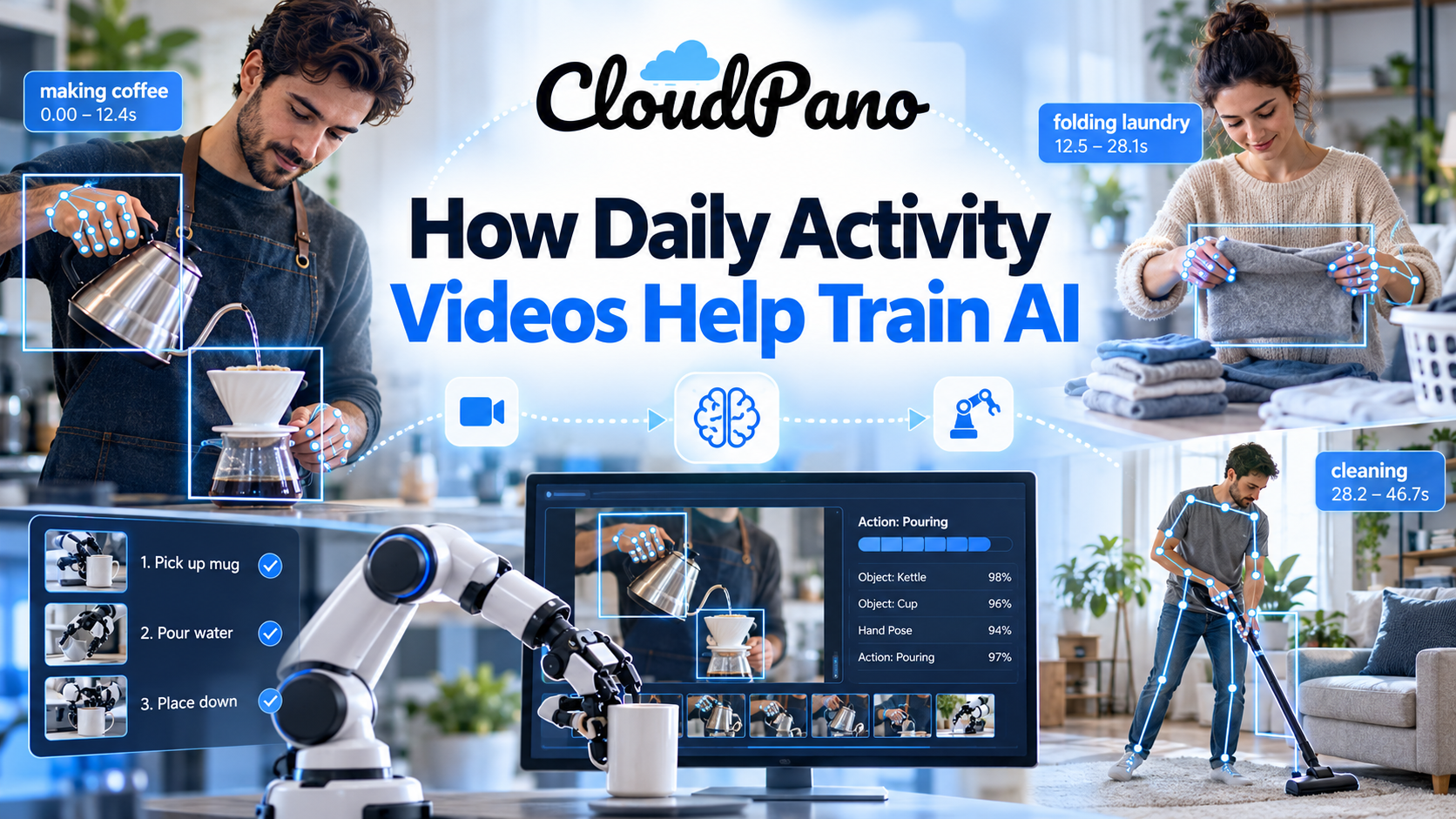

Daily activity videos help train AI by showing real people doing everyday tasks like cooking, cleaning and folding laundry. Vision models learn to recognize actions from them, and robots learn how tasks unfold before practicing on hardware. Public datasets include Ego4D, EPIC-KITCHENS and Charades, but many restrict commercial use.
Daily activity videos show real people doing everyday tasks, labeled with actions, timing and objects.
Vision models use them for human activity recognition; robots use them to learn tasks before practicing on hardware.
In Dyna's Dyna-2 report, robot task scores rose from 20% to 53% as egocentric video pretraining grew from 1,000 to 1,000,000 hours.
Public datasets range from Charades (9,848 home videos) to Ego4D (3,670+ hours in 9 countries).
Charades, Toyota Smarthome and EPIC-KITCHENS all restrict commercial use, so check the license first.
Making coffee looks simple until you try to teach a machine to do it. You find the mug, open the cupboard, grip the handle, pour, and set it down without spilling. Each step is a lesson, which is why AI teams now train on huge amounts of everyday footage. In Dyna Robotics' Dyna-2 report, robot task scores rose from 20% to 53% as egocentric human video pretraining grew from 1,000 to 1,000,000 hours.
This guide explains what a daily activity video dataset is, why ordinary chores make such good training data, which public datasets exist, and what to check before you use one.
A daily activity video dataset is a collection of recordings of people doing everyday tasks, such as cooking, cleaning, doing laundry or tidying up, labeled so an AI model can learn from them. The labels usually say which action happens, when it starts and stops, and which objects are involved.
For example, a coffee-making clip might be split into "open cupboard", "take mug" and "pour coffee", each with its own start and end time and a note of the objects touched.
Most of this footage is shot in homes and other ordinary places. Some is filmed from a fixed camera in the room. More and more is egocentric, recorded from a camera on the person's head or chest so the video shows what they see and what their hands do.
Everyday tasks are valuable because they pack a lot of skill into familiar actions, and they happen everywhere. A model that learns from them sees real hands, real objects and real mess, not a tidy lab.
Take laundry as an example. Picking a shirt from a pile, shaking it out, folding it and stacking it involves:
Apple's EgoDex dataset includes exactly this kind of work: 829 hours of first-person video across 194 tabletop tasks, from tying shoelaces to folding laundry.
Models use daily activity videos in two main ways: to recognize what people are doing, and to learn how to do it themselves. The first is a computer vision problem; the second is a robotics problem.
Human activity recognition. Vision models learn to name the action in a clip, such as "opening a fridge" or "washing dishes". This supports uses like smart-home monitoring and video search. The Toyota Smarthome dataset, for example, records 18 seniors aged 60 to 80 across 31 activity classes.
Robot learning. Robotics teams pretrain models on human video so robots start with a sense of how tasks unfold before they learn on their own hardware. In the Dyna-2 report, one task, turning a key in a lockbox, scored 0% until the pretraining set reached 1,000,000 hours, then jumped to 90%.
Human video is one ingredient, not the whole recipe. Robots still need data from their own bodies. For the bigger picture on why real-world video data matters for multimodal AI, see our pillar guide.
Several public datasets cover everyday life. They differ in viewpoint, scale and, importantly, license. First-person sets like Ego4D and EPIC-KITCHENS suit robots and wearables, while fixed-camera sets like Toyota Smarthome suit room monitoring.
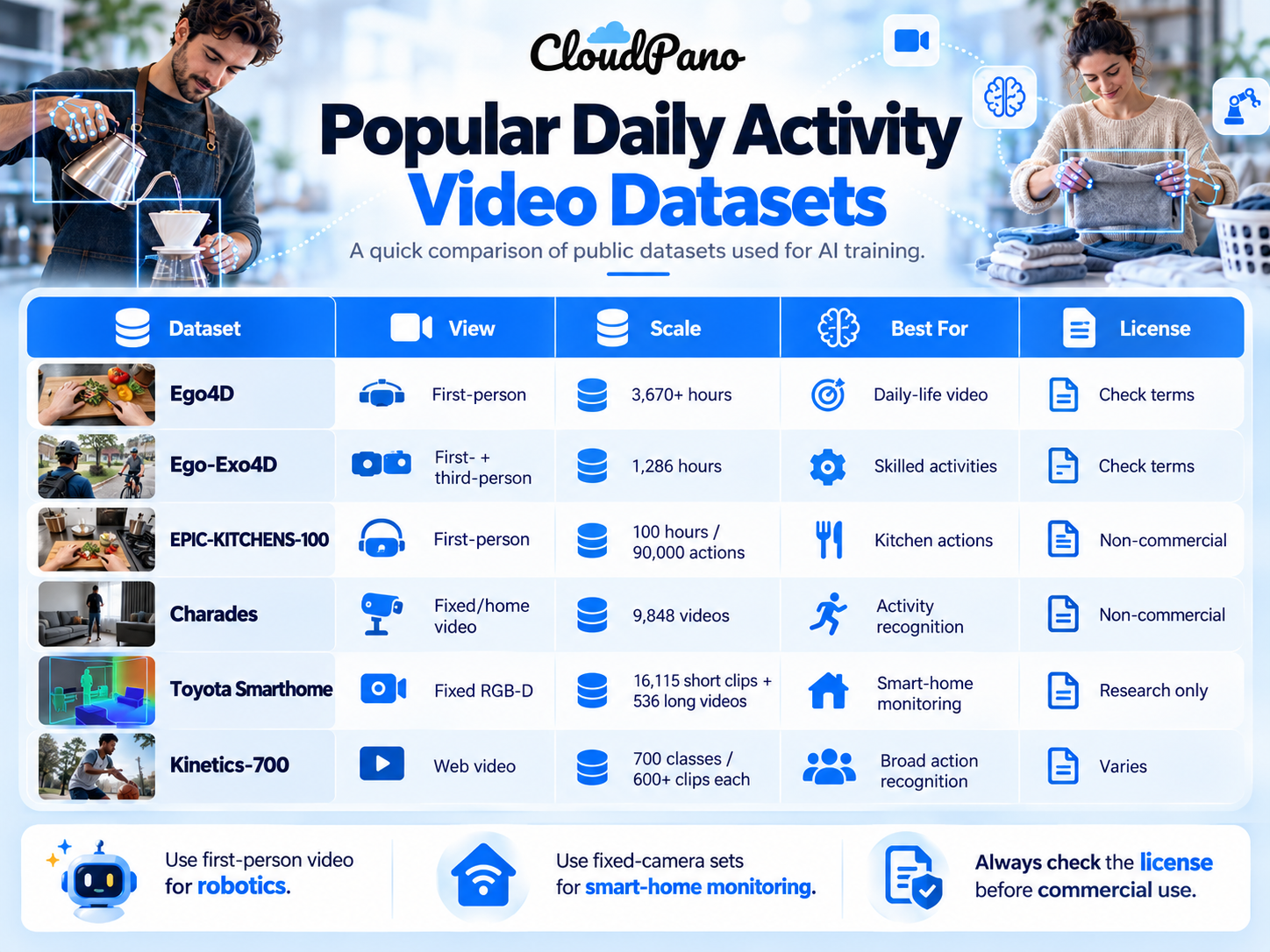
A useful dataset matches the setting, viewpoint and labels your model will meet in the real world. Hours alone don't tell you much.
Often not without permission. Charades bars for-profit use, Toyota Smarthome is for academic research only, and EPIC-KITCHENS uses a non-commercial CC BY-NC 4.0 license with commercial licenses available by request.
For a product, the options are to license a dataset commercially where the owner offers it, use data with commercial-friendly terms, or collect your own.
Custom collection makes sense when public datasets don't cover your tasks, settings or license needs. A home robot that folds towels needs lots of towel folding, in many homes, from the right viewpoint.
Firsthand offers human activity video data collection. Per its service page, capture is first-person by phone, head rig or multi-camera setup, with RGB, depth and IMU. Labels cover hand pose, action segments and contact events synced on one hardware clock. Faces, plates and screens are anonymized before delivery, and data ships in RLDS, LeRobot, WebDataset or HDF5 under a perpetual, buyer-owned license.
Daily activity videos teach AI how real people handle real things, from making coffee to folding laundry. They help vision models recognize actions and help robots learn tasks before they practice on hardware. Public datasets like Ego4D, EPIC-KITCHENS and Charades are great for research, but many restrict commercial use, so check the license, the setting and the labels before you build on one.
Activity recognition is the task of identifying what a person is doing from data such as video or sensor readings, for example opening a fridge or washing dishes. Models learn it from labeled clips that mark each action and when it starts and ends. Datasets like Charades and Toyota Smarthome were built for this.
Human activity recognition using machine learning means training a model on labeled examples of people's actions so it can name new ones. With video, the model sees thousands of clips, such as Charades' 9,848 home videos across 157 action classes, and learns the visual patterns of each activity.
Yes. AI models are routinely trained on video, from action recognition datasets like Kinetics-700, built from YouTube clips, to first-person datasets like Ego4D. Robotics companies also pretrain on human video; Dyna Robotics reported robot task scores rising from 20% to 53% as its egocentric video set grew.
AI uses whatever data matches its task: text, images, audio, video and sensor readings, usually paired with labels. Models that work in the physical world rely heavily on video of real activities, plus depth and motion data, so they can learn how people and objects behave in ordinary settings.
It varies widely by task. A research action dataset may hold around 100 hours, such as EPIC-KITCHENS-100's 100 hours of kitchen video, while Ego4D has over 3,670 hours. At the top end, Dyna Robotics pretrained on more than one million hours of egocentric human video.

Compact, ready to go anywhere
Interchangeable lens that’s upgradeable
Dual 1-inch sensors for improved clarity and low light performance
Dynamic range and 6K 360° capture
360° photo resolution at 21MP

8K 360° video recording for ultra-detailed visuals.
4K single-lens mode for traditional wide-angle shots.
Invisible selfie stick effect for drone-like perspectives.
2.5-inch touchscreen with Gorilla Glass protection.
Waterproof up to 33ft for underwater shooting.

360° photo resolution in 23MP
Slim design at 24 mm thick
Built-in image stabilization for smooth video capture.
Internal 19GB storage for photo and video storage.
Wireless connectivity for remote control and sharing.

60MP 360° still images for high-resolution photography.
5.7K 360° video recording at 30fps.
2.25-inch touchscreen for intuitive control.
USB Type-C port for fast charging and data transfer.
MicroSD card slot for expandable storage.
.png)

.png)

Try it free. No credit card required. Instant set-up.






.svg)


.svg)