


.png)


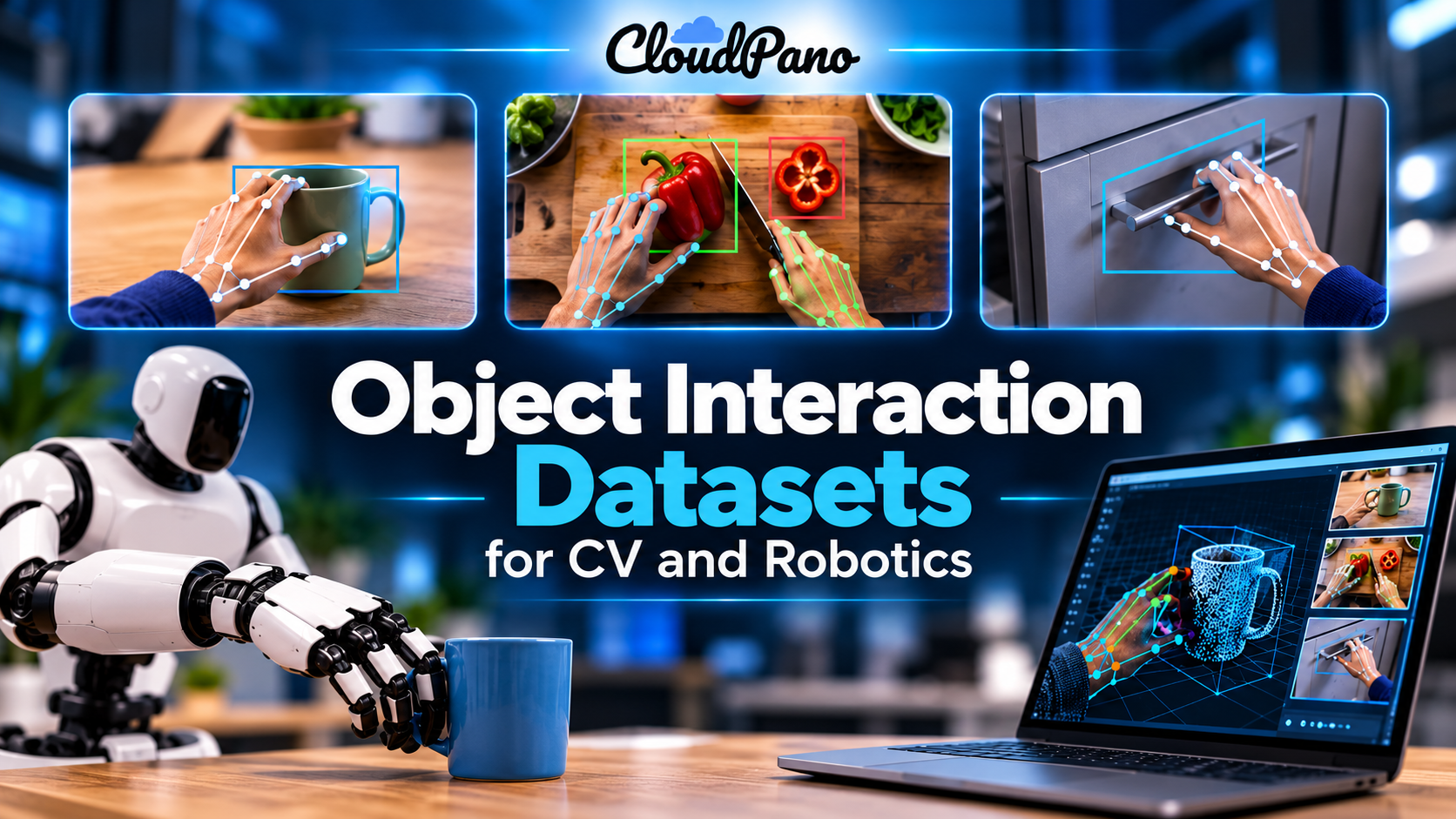
An object interaction dataset is video or sensor data showing hands touching, grasping, moving and using objects, labeled so a model can learn from it. Computer vision teams use it to detect hands, objects and actions. Robotics teams use it to teach manipulation. Popular open sets include EPIC-KITCHENS, HOI4D and EgoDex, but most carry non-commercial licenses.
A robot that can see a mug still has to learn how to pick it up. That gap is why teams go looking for an object interaction dataset: footage of real hands reaching for, grasping, turning and using everyday things. Apple's EgoDex alone packs 829 hours of hands-on video of people doing 194 tabletop tasks, from tying shoelaces to folding laundry.
This guide explains what object interaction data is, how computer vision and robotics teams use it, which open datasets are worth knowing, and what to check before you train a commercial model on any of them.
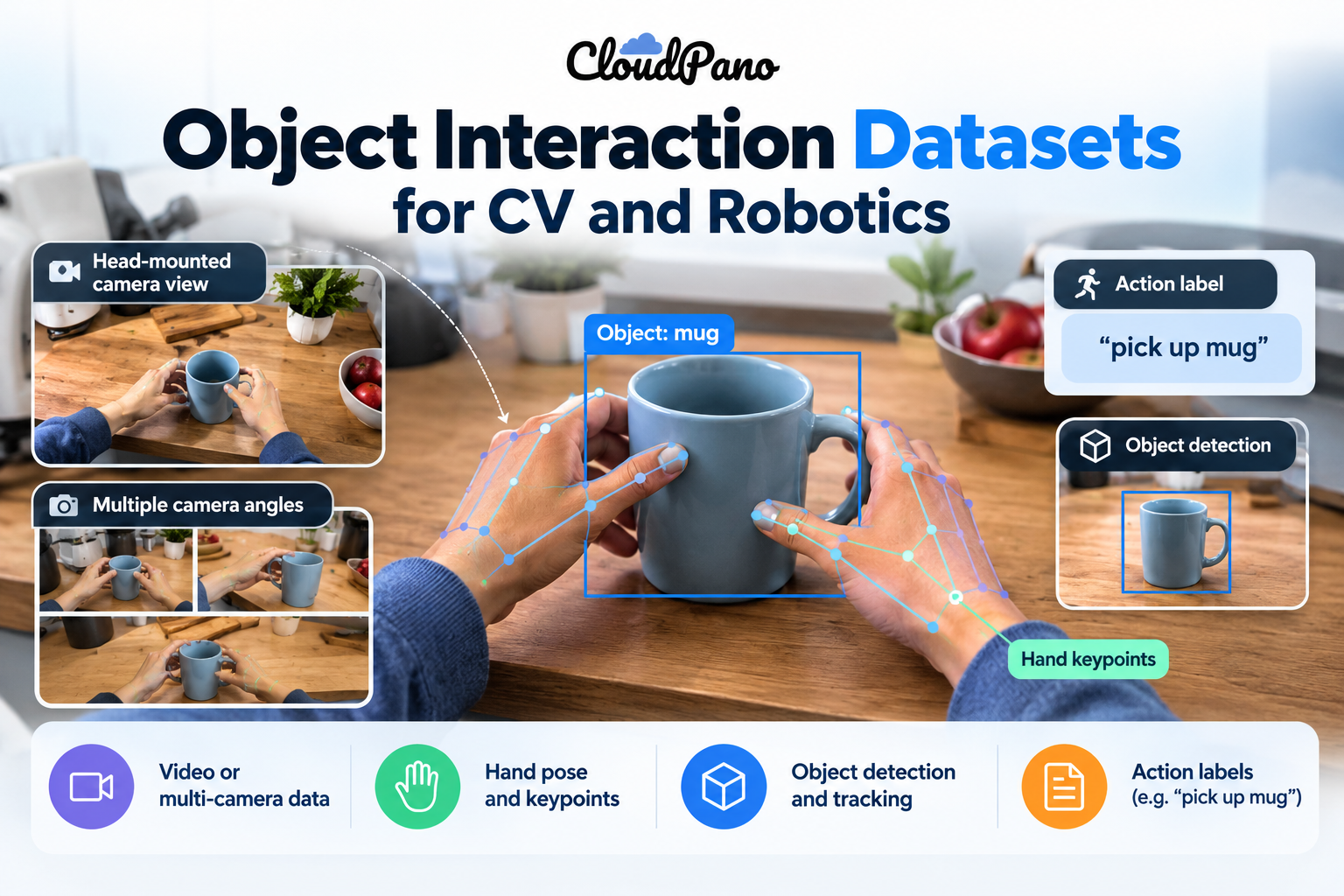
An object interaction dataset is a collection of video or sensor recordings that show people (usually their hands) touching, moving and using objects, plus labels that describe what happened. In plain terms, it is a record of "hand meets thing" that a model can learn from.
The recordings can be ordinary RGB video, depth (RGB-D) video, or multi-camera captures. The labels vary by dataset, but they usually answer some of these questions:
Both fields need to understand how hands and objects move together, and most general image datasets don't show that. Object interaction data gives models many examples of grasps, tool use and object state changes in real settings.
For computer vision, it trains models to detect hands and objects, recognize actions, estimate 3D hand pose and predict what someone will do next. The Ego4D benchmark suite, for example, includes a dedicated Hand + Object Interaction track alongside its other benchmarks.
For robotics, it is a source of human demonstrations. A robot learning to grasp benefits from seeing how people place their fingers, how hard they grip and how objects move in response. DexYCB, for instance, includes a robotics-relevant task: generating safe robot grasps for human-to-robot object handover.
Human video doesn't replace robot data, though. It is one ingredient. Our guide to what humanoid robots actually need explains how human video, teleoperation and simulation fit together.
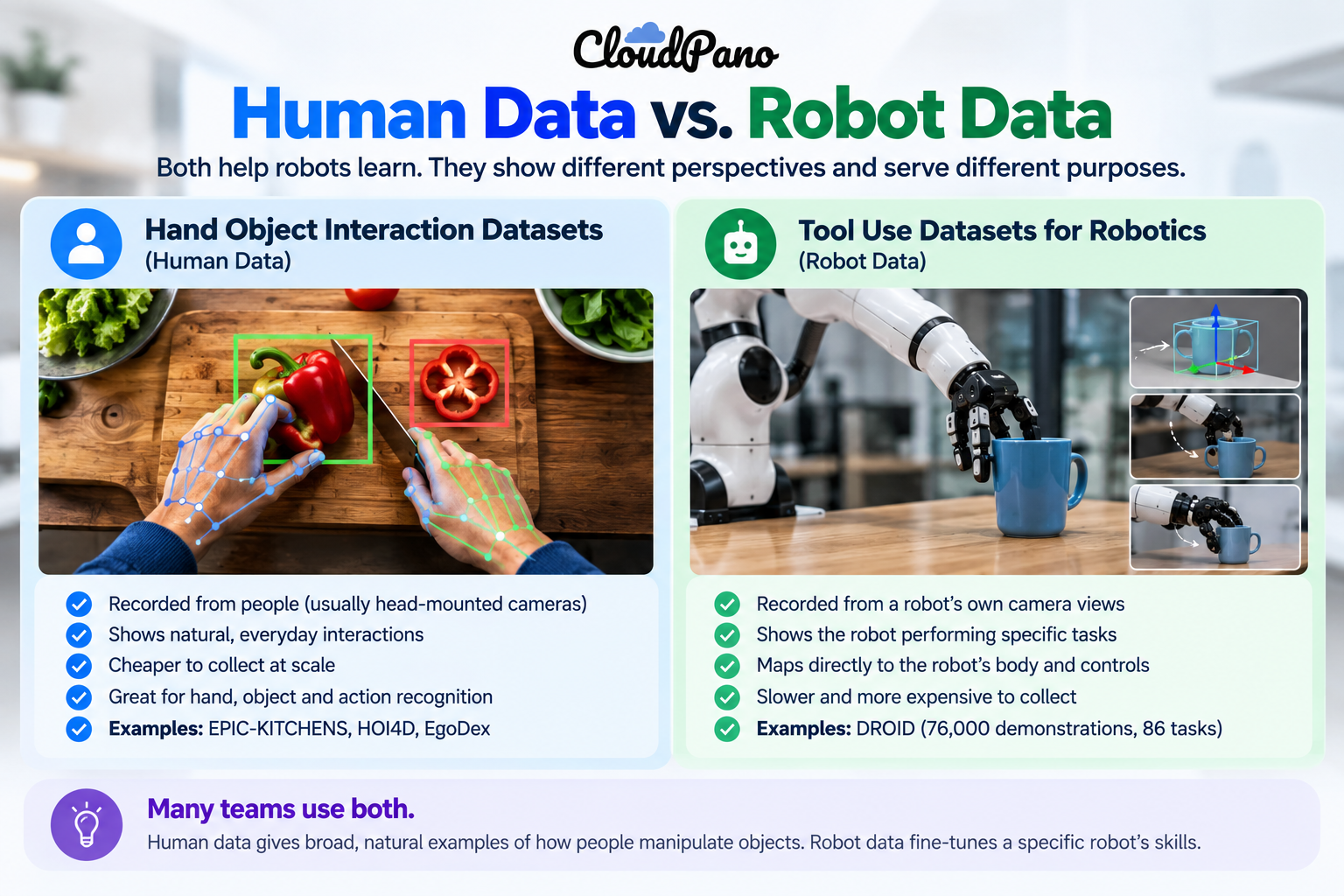
A hand object interaction dataset is recorded from people, while a tool use dataset for robotics is usually recorded from robots. The first teaches what manipulation looks like; the second shows a specific robot doing it.
Many teams use both: human data for breadth, robot data to fine-tune a specific embodiment.
Seven datasets come up again and again. Each has a different strength, and most restrict commercial use.
Start with your use case, then check five things: viewpoint, sensors, labels, coverage and license. A dataset that is strong on one can be useless on another.
For a broader look at why coverage matters more than raw volume, see our guide to real-world video data.
Usually not without permission. EPIC-KITCHENS, HOI4D and DexYCB use CC BY-NC 4.0, EgoDex uses CC-BY-NC-ND, and ARCTIC's license prohibits commercial use outright.
Non-commercial terms are fine for academic research and benchmarking. For a product, you have three options: negotiate a commercial license with the dataset owner where one is offered, build on data with commercial-friendly terms, or commission new data you own.
Custom collection makes sense when the open datasets don't match your objects, environments, sensors or license needs. A warehouse picking robot, for example, gains little from kitchen footage alone.
Firsthand collects hand-object interaction video data to a buyer's spec. Per its service page, captures run on a synchronized rig (RGB, depth and IMU on one hardware clock, with an optional wrist camera), and annotation covers 3D hand joint pose with per-joint visibility, contact onsets and grasp events, with instance segmentation as an option. Data ships in RLDS, LeRobot, WebDataset or HDF5 under a perpetual, buyer-owned license.
Custom data has limits, and it's worth being plain about them:
An object interaction dataset teaches models what hands do with things, which is the core of both action recognition and robot manipulation. Open datasets like EPIC-KITCHENS, HOI4D, ARCTIC and EgoDex are excellent for research, but most restrict commercial use. Match the dataset's view, sensors and labels to your task, read the license early, and commission custom data when nothing open fits.
Object interaction is any moment when a person or robot touches, grasps, moves or uses an object, such as opening a drawer or pouring water. In AI, it is recorded as video or sensor data and labeled with the action, hand pose, object position and contact timing so models can learn from it.
Interacting objects are things that affect each other through contact or use, such as a hand gripping a mug, scissors cutting paper, or a lid twisting off a jar. Datasets like ARCTIC capture two hands working articulated objects such as scissors and laptops, with 3D meshes for both hands and objects.
AI learns from examples: images, video, text, audio and sensor readings, usually paired with labels. For physical tasks, models also learn from demonstrations, such as egocentric video of human hands or recorded robot trajectories. The right mix depends on the task, and real-world coverage matters as much as volume.
DROID contains 76,000 robot demonstration trajectories, or about 350 hours of interaction data, recorded on a Franka Panda arm. It spans 564 scenes and 86 tasks, collected by 50 data collectors over 12 months across North America, Asia and Europe.
Object detection finds and labels things in an image, for example drawing a box around a cup and tagging it "cup". Human-object interaction detection goes further, linking a person to the object and the action, such as "person holding cup". Benchmarks like DexYCB test 2D object detection alongside hand pose estimation.


Compact, ready to go anywhere
Interchangeable lens that’s upgradeable
Dual 1-inch sensors for improved clarity and low light performance
Dynamic range and 6K 360° capture
360° photo resolution at 21MP

8K 360° video recording for ultra-detailed visuals.
4K single-lens mode for traditional wide-angle shots.
Invisible selfie stick effect for drone-like perspectives.
2.5-inch touchscreen with Gorilla Glass protection.
Waterproof up to 33ft for underwater shooting.

360° photo resolution in 23MP
Slim design at 24 mm thick
Built-in image stabilization for smooth video capture.
Internal 19GB storage for photo and video storage.
Wireless connectivity for remote control and sharing.

60MP 360° still images for high-resolution photography.
5.7K 360° video recording at 30fps.
2.25-inch touchscreen for intuitive control.
USB Type-C port for fast charging and data transfer.
MicroSD card slot for expandable storage.
.png)

.png)

Try it free. No credit card required. Instant set-up.






.svg)


.svg)