


.png)


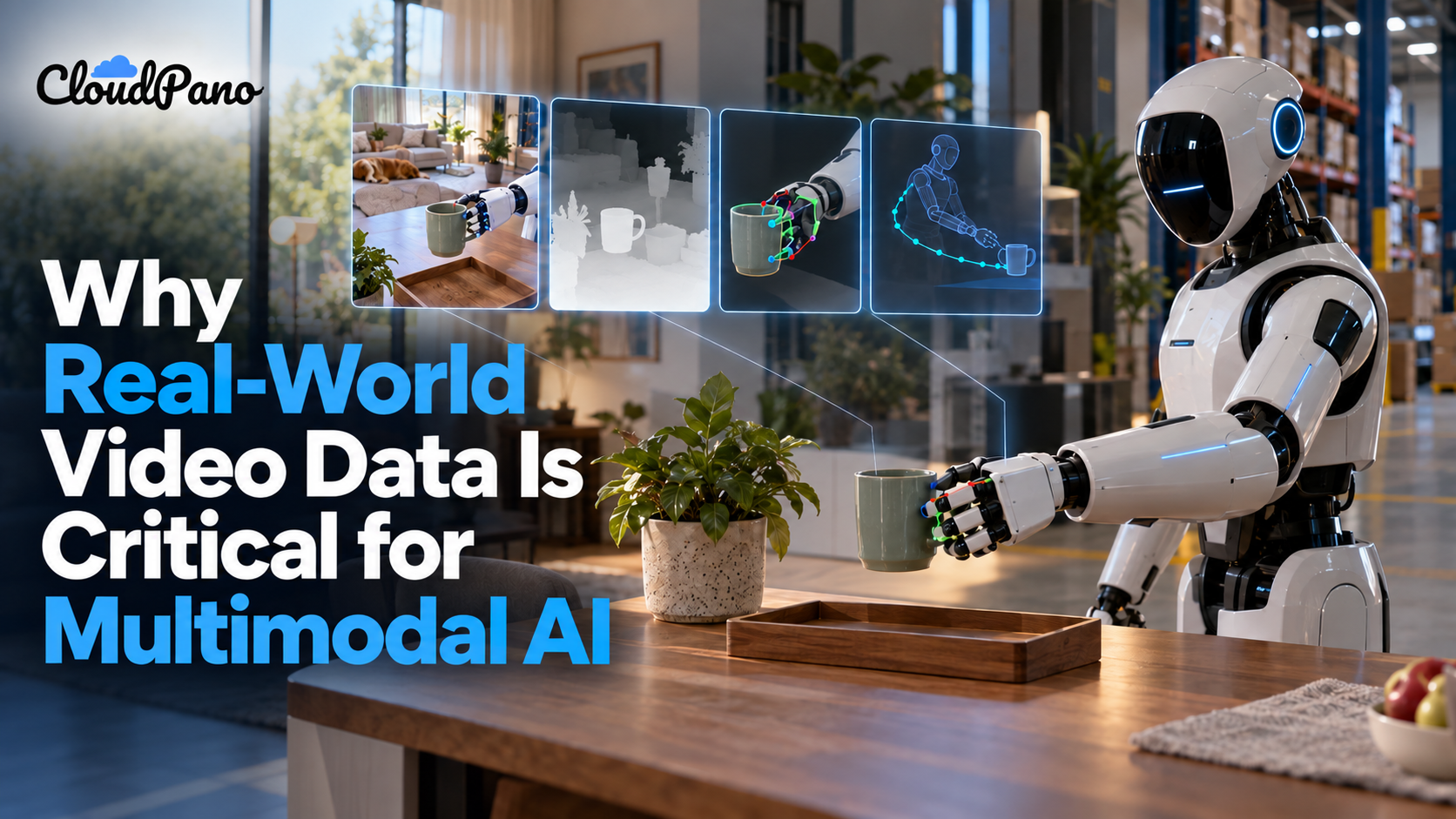
AI systems learn how the world actually behaves by watching it. Everyday footage carries the lighting, clutter, and unscripted human motion that simulated datasets smooth away, so models trained on it perform better after deployment — Dyna Robotics saw robot task success rise from 20% to 53% scaling egocentric pretraining from one thousand to one million hours.
Every multimodal model inherits the limits of the footage it learned from. Train on staged, well-lit, carefully framed clips and you get a system that performs beautifully right up until it meets an actual kitchen, warehouse, or living room. The gap between benchmark and deployment is a data problem long before it's a modeling problem.
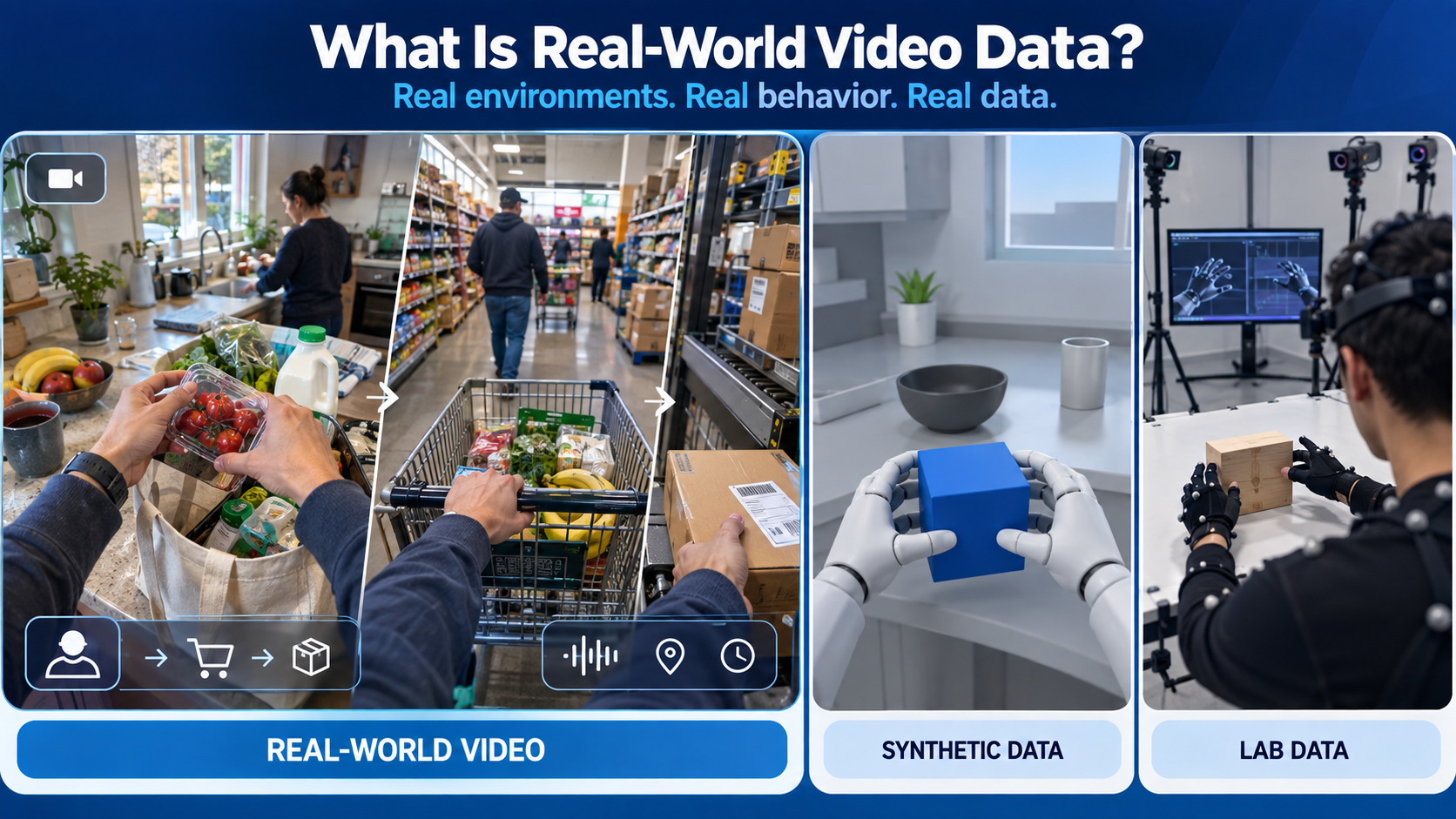
High-quality real-world video datasets for AI give teams access to authentic environments, human behavior, and physical variation that models need to understand before they can perform reliably in real deployments. Real-world video data is footage captured in actual, uncontrolled environments — homes, warehouses, kitchens, retail floors — rather than in a lab, a simulation, or a studio. It typically includes first-person (egocentric) footage, environment-specific task recordings, and metadata describing what's happening, when, and by whom.
This differs from two more common alternatives:
The short answer: because it's measurably improving model performance, and the companies buying it are proving it publicly.
These aren't projections — they're numbers the companies themselves have published, and they all point the same direction: real-world video, at scale, produces measurably better models.
Multimodal models combine multiple types of input — video, audio, text, sensor data — and need those inputs to be time-aligned and consistently labeled to learn effectively. Real-world video collected with proper hardware sync (rather than a single phone camera) captures depth, motion, and environmental context that a model can correlate with other data streams. Without that sync and context, a multimodal model has a harder time learning which signals actually relate to each other.
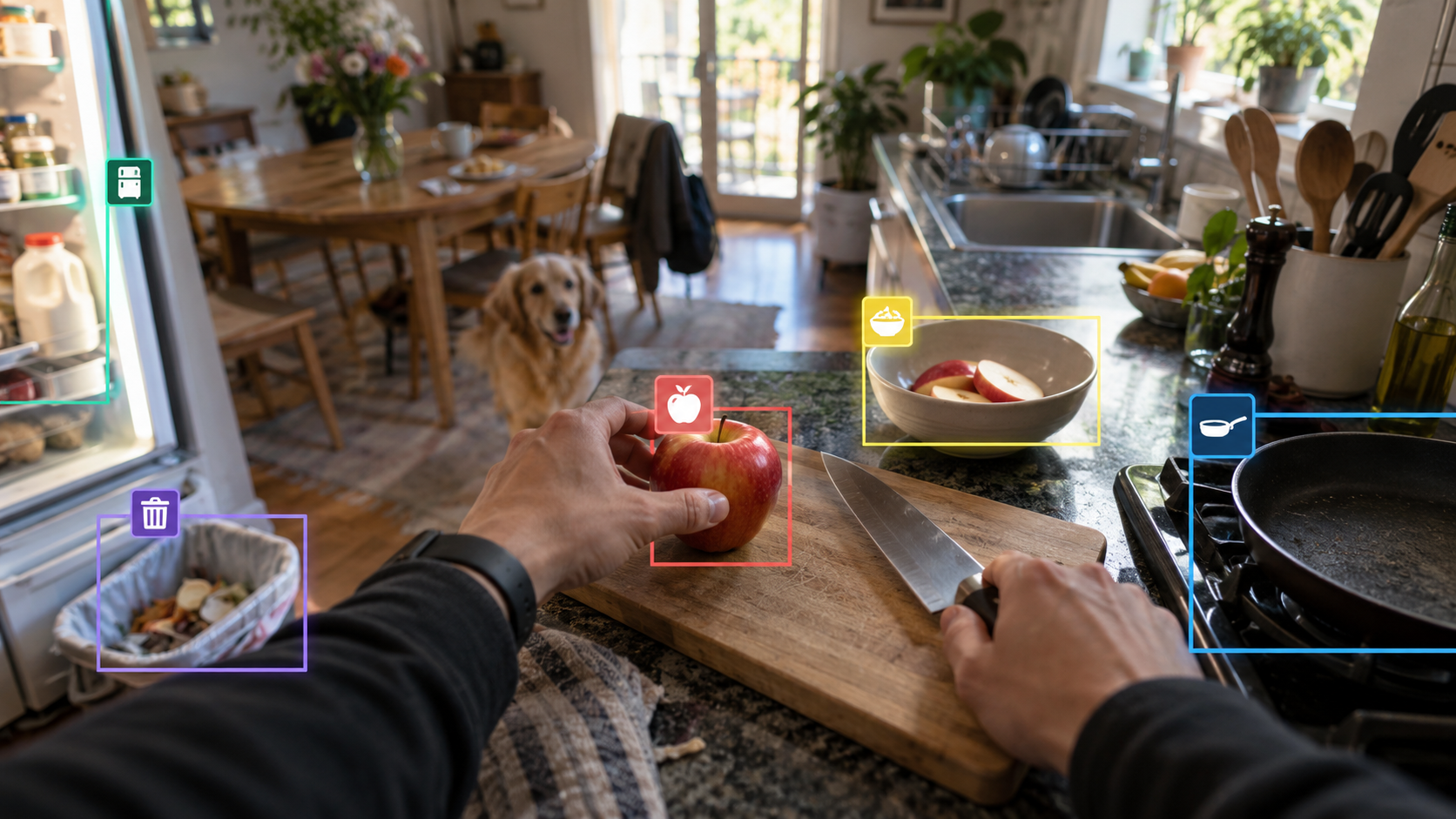
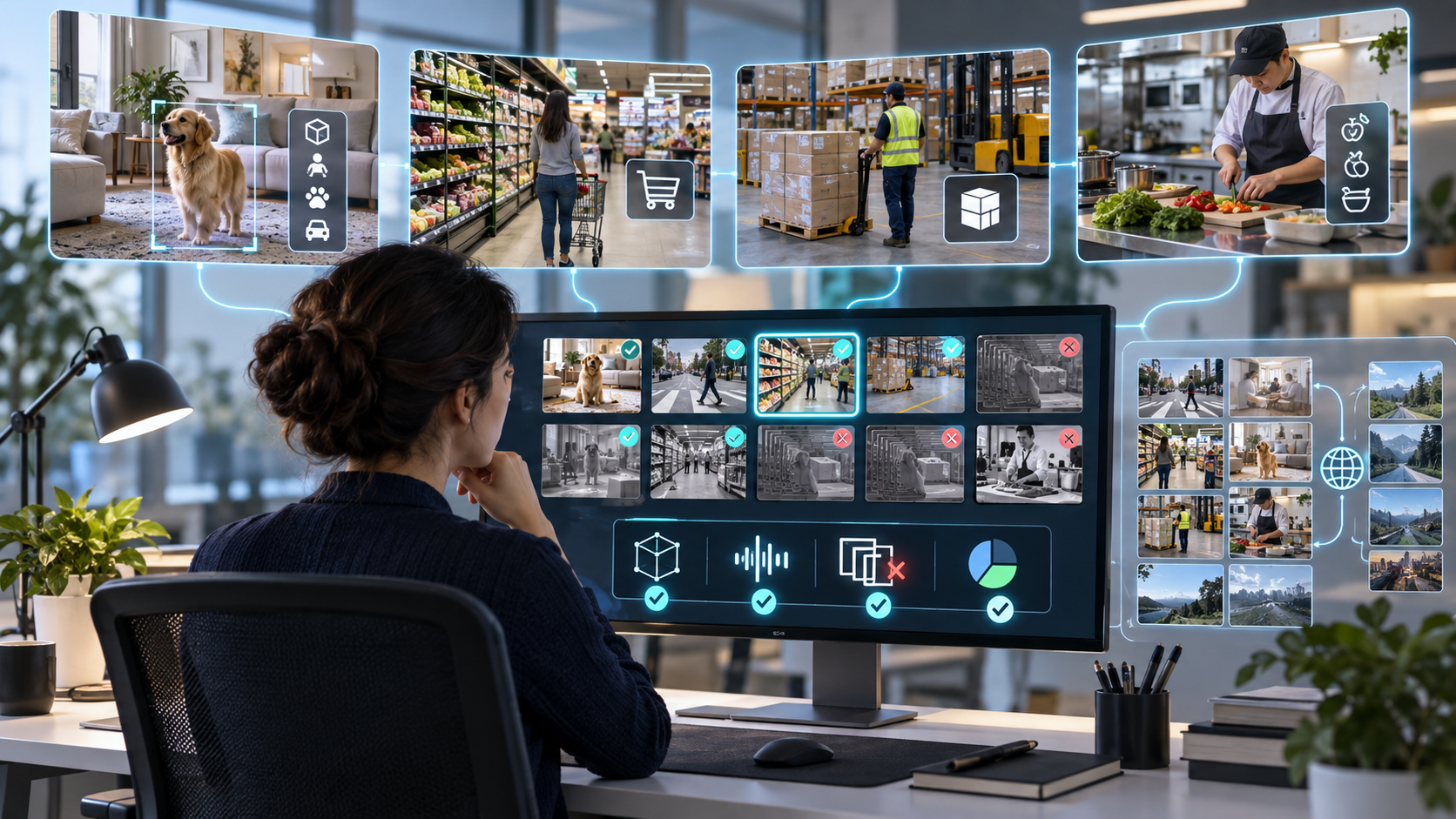
The most useful real-world video datasets for AI are not defined by video volume alone. They need reliable quality control, diverse coverage, consistent capture methods, and metadata that helps models learn from each recording.
Hour count alone isn't the whole story. Useful real-world video data generally needs:
Firsthand (CloudPano's AI training data arm) specializes in exactly this: real-world, hardware-synced video collection with human review built into the process, across a national network of trained capture operators. If your model needs coverage a public dataset doesn't have — a specific environment, task, or demographic — that's the gap this kind of collection is built to close.
Real-world video data isn't just a nice-to-have for multimodal AI — the companies furthest ahead in robotics and embodied AI are the ones publishing scaling laws that prove it directly improves model performance. If your model needs coverage that public and synthetic datasets cannot provide, real-world video datasets for AI built around your specific environments, tasks, and users can help close the gap.
It depends on the use case, but for tasks involving physical interaction or human behavior, real-world video generally produces models that generalize better to real deployments, since synthetic data struggles to fully replicate real-world variation.
There's no fixed number — Dyna Robotics' own scaling law shows meaningful gains from 1,000 hours up to 1,000,000 hours, so the right amount depends on your task complexity and how much public or synthetic data you're combining it with.
Egocentric (first-person) video is captured from a head-mounted or body-worn camera, showing what a person sees as they act. Third-person video is filmed from an external viewpoint. Egocentric footage is especially valuable for robotics and hand-object interaction tasks.
Most flagship public egocentric datasets are licensed for non-commercial research only. Check the specific license before using one in a commercial training pipeline.
A phone camera can capture monocular video, but it lacks depth, IMU sync, gaze tracking, and calibrated intrinsics — all of which matter for multimodal and robotics training. Hardware-synced rigs capture these additional signals natively.
Sources / References


Compact, ready to go anywhere
Interchangeable lens that’s upgradeable
Dual 1-inch sensors for improved clarity and low light performance
Dynamic range and 6K 360° capture
360° photo resolution at 21MP

8K 360° video recording for ultra-detailed visuals.
4K single-lens mode for traditional wide-angle shots.
Invisible selfie stick effect for drone-like perspectives.
2.5-inch touchscreen with Gorilla Glass protection.
Waterproof up to 33ft for underwater shooting.

360° photo resolution in 23MP
Slim design at 24 mm thick
Built-in image stabilization for smooth video capture.
Internal 19GB storage for photo and video storage.
Wireless connectivity for remote control and sharing.

60MP 360° still images for high-resolution photography.
5.7K 360° video recording at 30fps.
2.25-inch touchscreen for intuitive control.
USB Type-C port for fast charging and data transfer.
MicroSD card slot for expandable storage.
.png)

.png)

Try it free. No credit card required. Instant set-up.






.svg)


.svg)