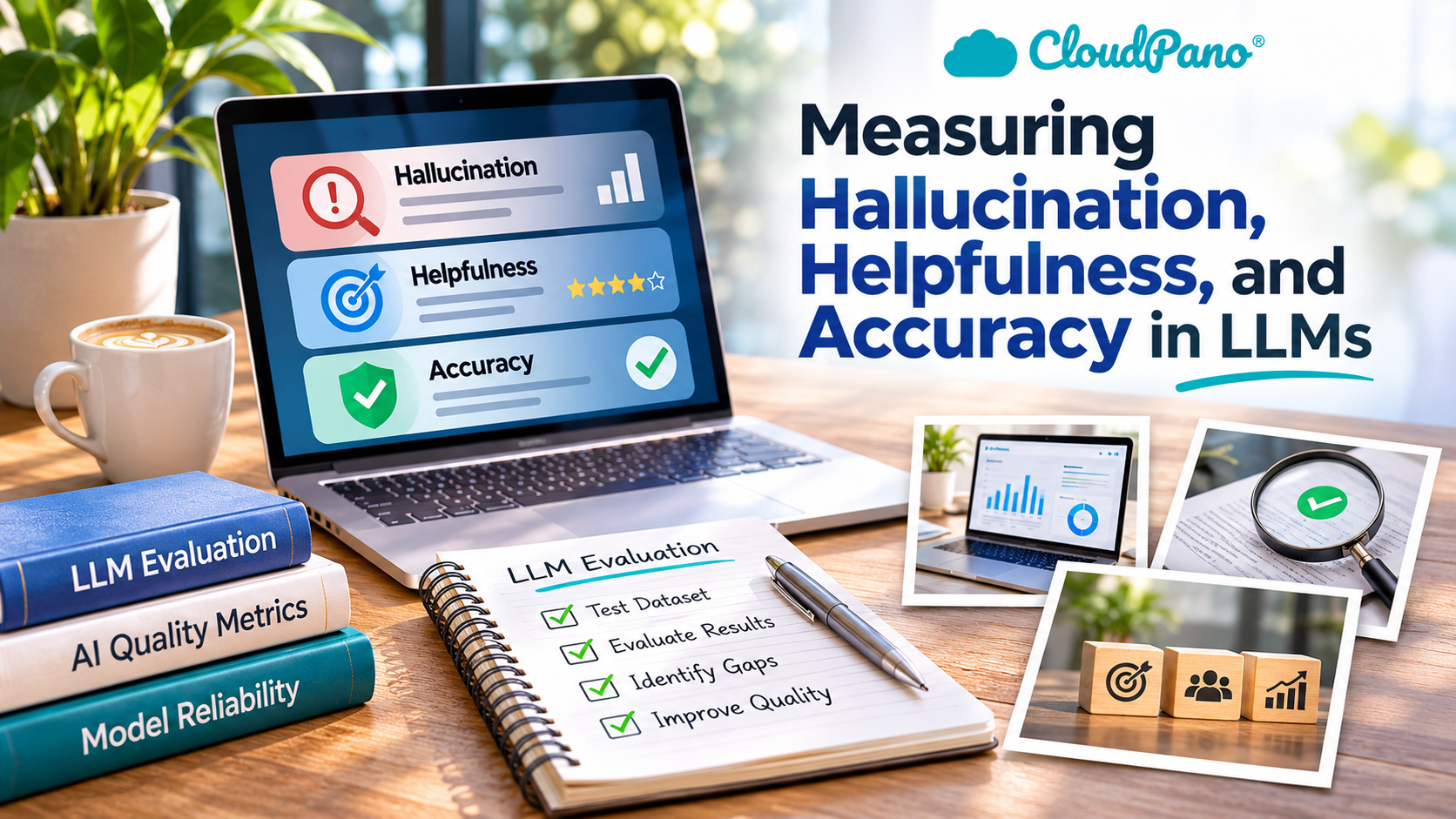
Organizations measure hallucination, helpfulness, and accuracy in LLMs using structured evaluation datasets, automated metrics, and human reviewers. Hallucination testing identifies unsupported claims, accuracy testing checks factual correctness, and helpfulness evaluation measures how effectively responses satisfy user needs. Combining these methods provides a more reliable assessment of overall model quality.
Large language models (LLMs) are becoming essential tools for customer support, research, content creation, software development, and business automation. However, generating fluent responses does not necessarily mean an AI system is producing reliable information.
An LLM can deliver a confident answer that contains fabricated facts, misunderstand a user's request, or provide technically correct information that fails to solve the actual problem.
This is why LLM evaluation must go beyond checking whether a response sounds natural.
Organizations need structured methods for measuring three critical dimensions of AI performance: hallucination, helpfulness, and accuracy.
By combining human evaluation, automated testing, and a carefully designed hallucination evaluation dataset, teams can identify weaknesses, monitor improvements, and build more trustworthy AI applications.
LLMs can produce convincing responses even when their underlying information is incomplete or incorrect.
For example, an AI-powered customer service assistant might provide an outdated refund policy. A research assistant might invent a citation. A business chatbot might offer a technically correct explanation that is too complicated for the customer to understand.
These failures create different risks.
Incorrect information can reduce trust, increase operational costs, and potentially lead to poor business decisions.
Organizations deploying LLMs therefore need evaluation frameworks that measure multiple aspects of response quality.
Three dimensions are particularly important:
Although these dimensions overlap, they should not be treated as interchangeable.
A response can be accurate but unhelpful. It can also be helpful in tone while containing factual mistakes.
Reliable evaluation requires measuring each dimension independently.
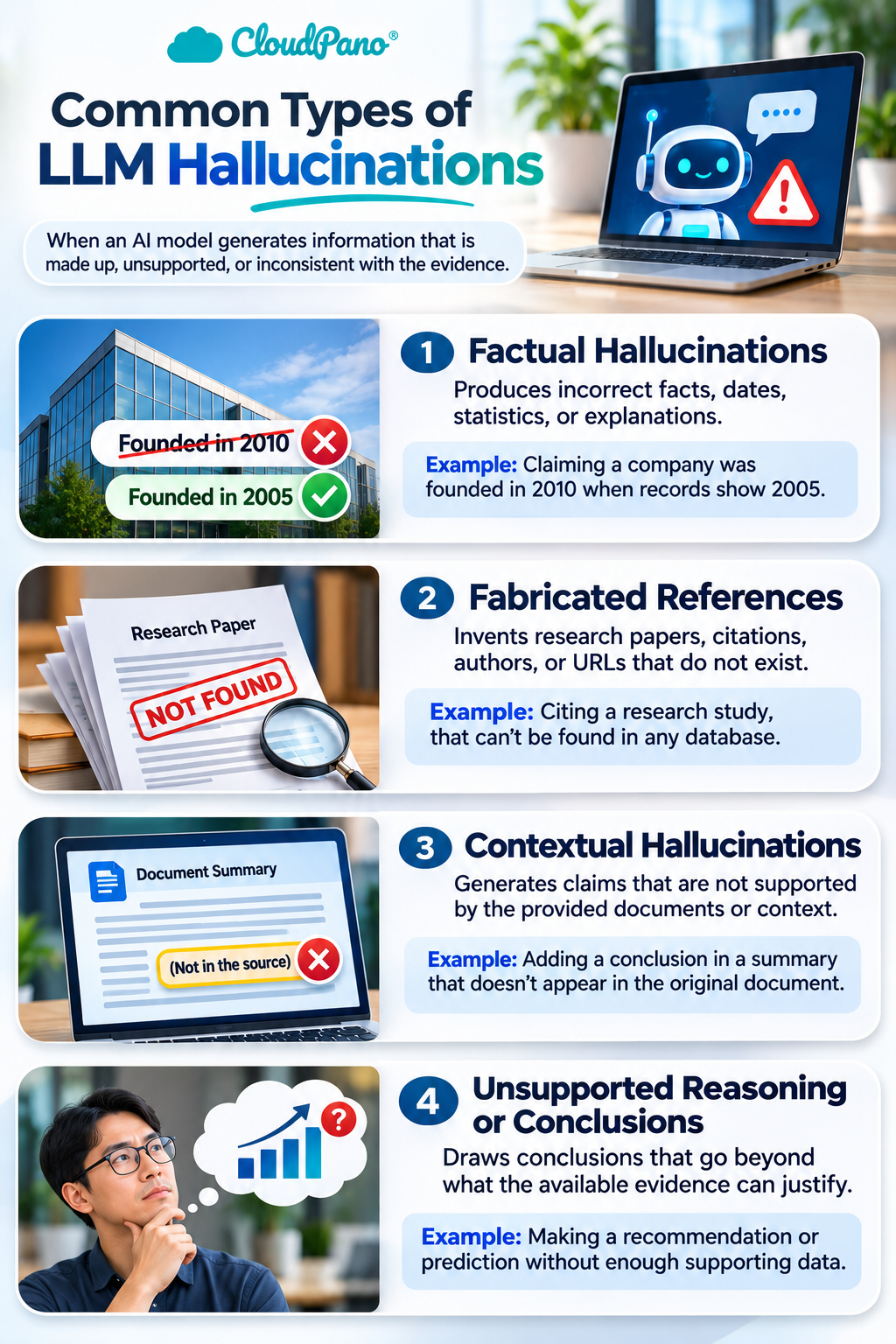
An LLM hallucination occurs when a model generates information that is fabricated, unsupported, or inconsistent with the evidence available for a task.
Hallucinations are particularly concerning because AI-generated responses often sound authoritative.
1. Factual Hallucinations
The model produces incorrect facts, dates, statistics, or explanations.
For example, an AI assistant might claim that a company was founded in a particular year when the verified company history shows otherwise.
2. Fabricated References
The model invents research papers, citations, authors, or URLs that do not exist.
This is especially problematic in academic research and professional reporting.
3. Contextual Hallucinations
The model generates claims that are not supported by the documents or information provided.
For example, a document summarization tool might introduce a conclusion that does not appear in the source material.
4. Unsupported Reasoning or Conclusions
The model draws conclusions that go beyond what the available evidence can justify.
These errors can be difficult to detect because the response may appear logically structured.
One approach is to calculate the percentage of evaluated responses containing at least one hallucination.
Hallucination Rate = (Responses Containing Hallucinations ÷ Total Evaluated Responses) × 100
For example, if 25 out of 500 evaluated responses contain unsupported claims, the response-level hallucination rate is 5%.
However, this metric does not capture the severity or number of unsupported claims within each response.
Organizations may also measure:
Using multiple measurements provides a more complete picture of hallucination risk.
A high-quality hallucination evaluation dataset is one of the most important components of a trustworthy LLM testing process.
An evaluation dataset contains prompts, reference information, and scoring criteria that allow organizations to assess model behavior consistently.
Realistic User Questions
Include prompts that reflect actual user interactions rather than relying entirely on simplified benchmark questions.
Verified Reference Answers
Where possible, provide authoritative sources or validated answers that evaluators can use to check factual correctness.
Ambiguous Questions
Test whether the model asks for clarification or acknowledges uncertainty instead of inventing missing details.
Unanswerable Questions
Include examples where the correct behavior is to state that sufficient information is unavailable.
Domain-Specific Scenarios
Evaluate the model using questions relevant to its intended application, such as customer support, finance, education, or technical documentation.
Challenging Examples
Include conflicting information, outdated documents, incomplete evidence, and misleading prompts.

An evaluation dataset that contains only simple questions may produce misleadingly high performance scores.
Real-world interactions are often more complicated.
Users may ask unclear questions, provide incomplete context, or request information that cannot be verified.
A representative dataset helps organizations identify these weaknesses before they affect production systems.
It is also important to keep evaluation data separate from training and development examples whenever possible.
This reduces the risk of measuring memorization rather than genuine model performance.
Accuracy measures whether an LLM produces information that is correct according to verified facts, trusted references, or defined task requirements.
Unlike hallucination evaluation, which emphasizes unsupported claims, accuracy evaluation focuses on correctness.
Exact match compares a model's response with a predefined correct answer.
This method works well for tasks involving short, standardized outputs.
Examples include:
However, exact match is less useful for open-ended responses because multiple valid answers may use different wording.
Semantic evaluation measures whether the meaning of an AI-generated response matches the expected answer.
For example, two responses may express the same correct information using different sentences.
Semantic evaluation can recognize this similarity without requiring identical wording.
Embedding-based comparisons and LLM-based evaluators can support this process, although similarity alone does not establish factual correctness.
Factual verification checks individual claims against reliable evidence.
This process may involve:
For retrieval-augmented generation (RAG) systems, evaluators should also examine whether responses accurately reflect retrieved documents.
Organizations may monitor exact match accuracy, factual correctness, claim-level precision, and task completion accuracy.
The appropriate metrics depend on the application's purpose.
For example, a document extraction system may prioritize field-level correctness, while a research assistant may require detailed factual verification.
An AI response can be factually correct but still fail to help the user.
Consider a customer asking how to reset a password.
An LLM might accurately explain password authentication technology without providing the steps needed to reset the account.
The response may be technically correct, but it is not particularly helpful.
Helpfulness evaluation measures how effectively a response supports the user's intended goal.
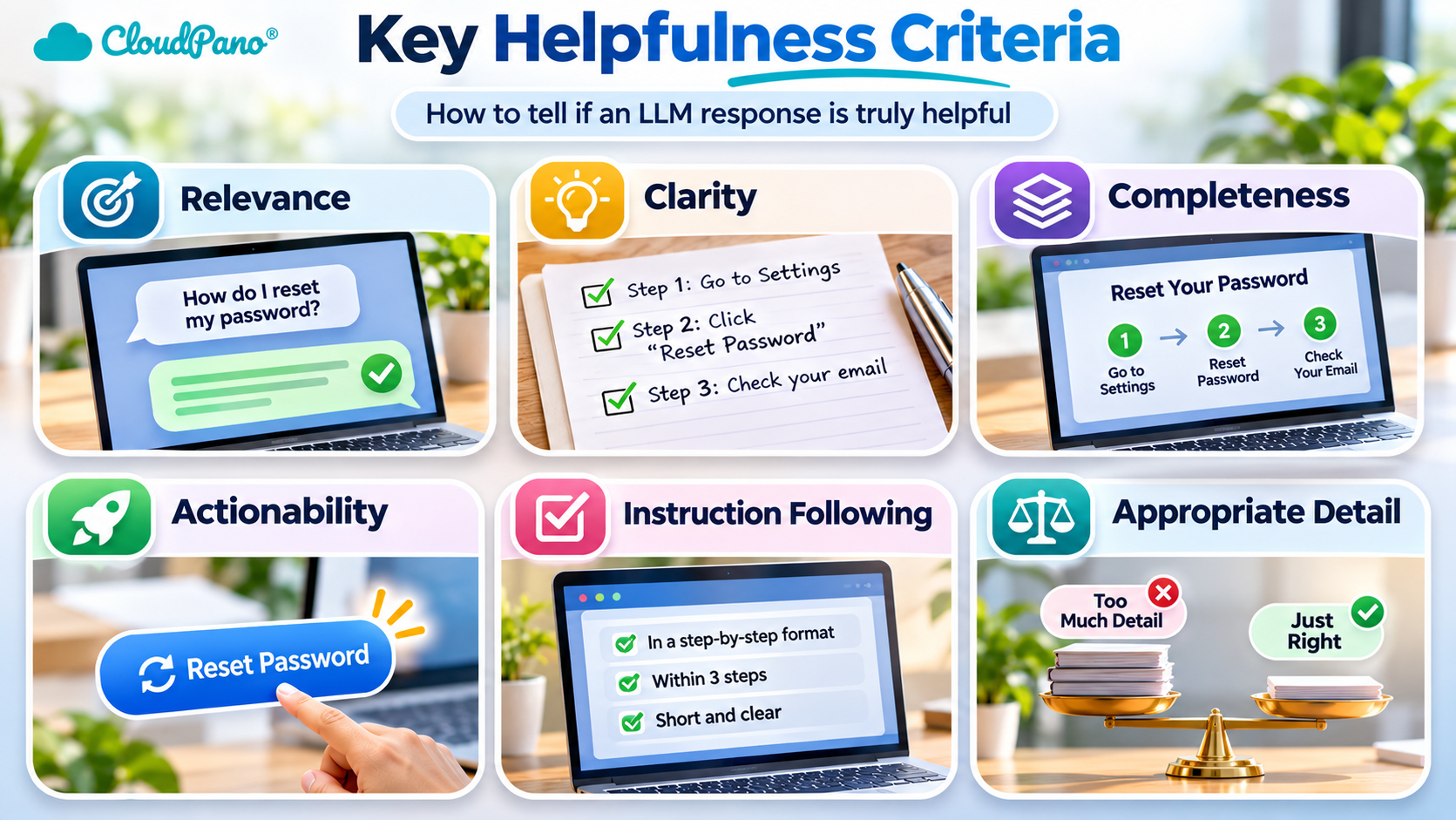
Relevance
Does the response directly address the user's question?
Clarity
Is the information easy to understand?
Completeness
Does the response provide enough information to solve the problem?
Actionability
Can the user apply the advice or instructions?
Instruction Following
Does the response respect the user's requested format, constraints, and objectives?
Appropriate Detail
Is the response sufficiently informative without unnecessary complexity?
Human reviewers can score helpfulness using a consistent rubric.
For example:
Organizations should provide examples for each rating level to improve consistency between reviewers.
Both human and automated evaluation methods have important roles in measuring LLM quality.
Automated evaluation systems can process large volumes of model responses quickly.
Common approaches include:
These methods are useful for regression testing, routine quality monitoring, and identifying potential failures.
However, automated evaluators can make mistakes, inherit biases, or incorrectly judge plausible but unsupported information.
Human reviewers provide contextual judgment that automated systems may struggle to reproduce.
Reviewers can assess whether an answer is genuinely useful, whether evidence supports a conclusion, and whether the response is appropriate for the intended audience.
Human evaluation is especially valuable for ambiguous questions, complex reasoning, and high-impact applications.
The main limitations are cost, review time, and potential disagreement between evaluators.
A practical evaluation framework combines automated testing with targeted human review.
Automated systems can identify potential problems across large datasets.
Human reviewers can then investigate difficult examples, validate evaluator decisions, and assess response quality in greater depth.
This approach supports both scalability and reliable quality control.
Organizations can establish a repeatable process for measuring hallucination, helpfulness, and accuracy.
Identify the application's purpose and determine which quality dimensions matter most.
A research assistant may prioritize factual accuracy and citation quality.
A customer support chatbot may emphasize helpfulness, instruction following, and policy correctness.
Collect realistic prompts, verified answers, supporting documents, and challenging scenarios.
Include a dedicated hallucination evaluation dataset to test how the model handles uncertain, incomplete, or misleading information.
Define measurable criteria for each evaluation dimension.
Specify what constitutes an error, how severity is assessed, and when a response should receive a passing score.
Use automated metrics to evaluate large response volumes.
Assign human reviewers to ambiguous cases, high-risk responses, and examples where automated evaluators disagree.
Track evaluation results across model versions, prompt changes, and system updates.
Review recurring failure patterns and adjust prompts, retrieval systems, training data, or application workflows accordingly.
Evaluation should be an ongoing process rather than a one-time test.
Even well-designed evaluation programs can produce misleading results when important details are overlooked.
Relying on a Single Metric
A high accuracy score does not guarantee that responses are helpful or free from hallucinations.
Using Unrealistic Test Questions
Simplified benchmarks may not reflect actual user behavior.
Treating Automated Judgments as Ground Truth
LLM-based evaluators should be validated against trusted human judgments.
Ignoring Error Severity
A minor wording issue should not receive the same priority as fabricated information in a high-impact decision.
Failing to Update Evaluation Datasets
Models, products, policies, and user expectations change over time.
Regular dataset reviews help keep evaluation results relevant.
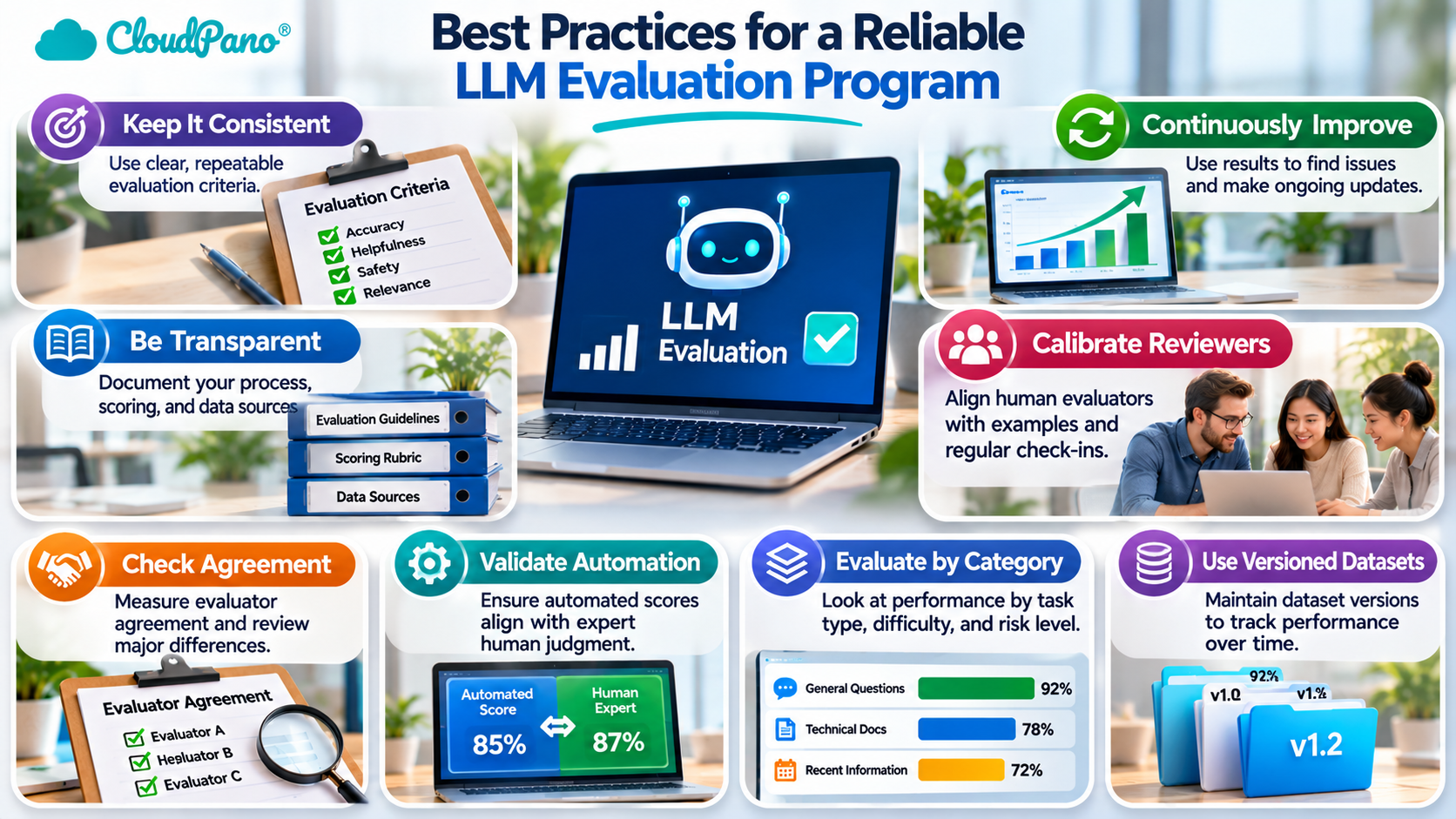
A reliable evaluation program should prioritize consistency, transparency, and continuous improvement.
Organizations should document scoring criteria, maintain verified reference sources, and regularly calibrate human reviewers.
They should also measure agreement between evaluators and investigate cases where judgments differ significantly.
For automated evaluations, teams should test whether scoring systems correlate with expert human assessments.
Another important practice is analyzing performance across different categories rather than relying exclusively on an overall average.
For example, a model may perform well on general questions while struggling with technical documentation or questions requiring recent information.
Breaking results down by task type, difficulty, and risk level helps teams identify where improvements are most necessary.
Finally, organizations should maintain versioned evaluation datasets so performance changes can be tracked consistently over time.
As LLM applications become more sophisticated, evaluation methods will continue to evolve.
Traditional benchmarks remain useful, but organizations increasingly need assessments that reflect realistic workflows and changing information environments.
Emerging approaches include claim-level verification, multi-step task evaluation, calibrated AI judges, and targeted human review.
Evaluation is also expanding beyond individual responses to examine whether AI systems complete entire tasks correctly.
For example, an AI assistant may need to retrieve information, interpret documents, follow instructions, and produce a final recommendation.
Each stage introduces potential opportunities for error.
Reliable evaluation therefore requires examining both individual responses and overall task outcomes.
The goal is not simply to achieve a higher benchmark score.
It is to build AI systems that consistently provide accurate, useful, and appropriately supported information.
Measuring hallucination, helpfulness, and accuracy is essential for building reliable large language model applications.
Each dimension provides a different perspective on AI response quality.
Hallucination evaluation identifies unsupported claims. Accuracy testing verifies correctness. Helpfulness evaluation determines whether responses effectively serve users.
By combining structured datasets, automated testing, and human judgment, organizations can develop a more complete understanding of model performance.
A carefully maintained hallucination evaluation dataset, supported by clear scoring rubrics and ongoing monitoring, can help teams detect weaknesses and measure improvements over time.
Ultimately, successful LLM evaluation is not about producing perfect scores. It is about creating AI systems that deliver trustworthy, relevant, and useful results consistently.
Hallucination evaluation focuses on identifying fabricated or unsupported information generated by an LLM. Accuracy evaluation determines whether the response is factually correct or satisfies defined task requirements. Although related, the two metrics measure different qualities. A response may contain accurate facts alongside unsupported claims, making both evaluations necessary.
Start by collecting realistic prompts, verified reference answers, and trustworthy supporting documents. Include ambiguous questions, unanswerable requests, conflicting evidence, and domain-specific scenarios. Establish clear annotation guidelines for identifying unsupported claims. A strong hallucination evaluation dataset should also include examples reviewed by qualified evaluators to improve scoring consistency.
LLM helpfulness can be measured through relevance, clarity, completeness, actionability, and instruction-following scores. Human reviewers often use standardized rating scales, while automated evaluators estimate response quality using predefined rubrics. Combining multiple criteria provides a more meaningful assessment than relying on a single overall helpfulness score.
Automated tools can identify many potential hallucinations by comparing generated claims with reference answers, retrieved documents, or verified evidence. However, they may incorrectly classify statements or overlook subtle factual errors. Human review remains important for validating automated judgments, especially in complex, ambiguous, or high-impact applications.
Human evaluation provides contextual understanding that automated metrics may miss. Reviewers can assess whether responses are genuinely useful, appropriately detailed, and supported by credible evidence. Human judgment is particularly valuable for nuanced questions, complex reasoning, and situations where multiple answers may be acceptable.


Compact, ready to go anywhere
Interchangeable lens that’s upgradeable
Dual 1-inch sensors for improved clarity and low light performance
Dynamic range and 6K 360° capture
360° photo resolution at 21MP

8K 360° video recording for ultra-detailed visuals.
4K single-lens mode for traditional wide-angle shots.
Invisible selfie stick effect for drone-like perspectives.
2.5-inch touchscreen with Gorilla Glass protection.
Waterproof up to 33ft for underwater shooting.

360° photo resolution in 23MP
Slim design at 24 mm thick
Built-in image stabilization for smooth video capture.
Internal 19GB storage for photo and video storage.
Wireless connectivity for remote control and sharing.

60MP 360° still images for high-resolution photography.
5.7K 360° video recording at 30fps.
2.25-inch touchscreen for intuitive control.
USB Type-C port for fast charging and data transfer.
MicroSD card slot for expandable storage.


Try it free. No credit card required. Instant set-up.