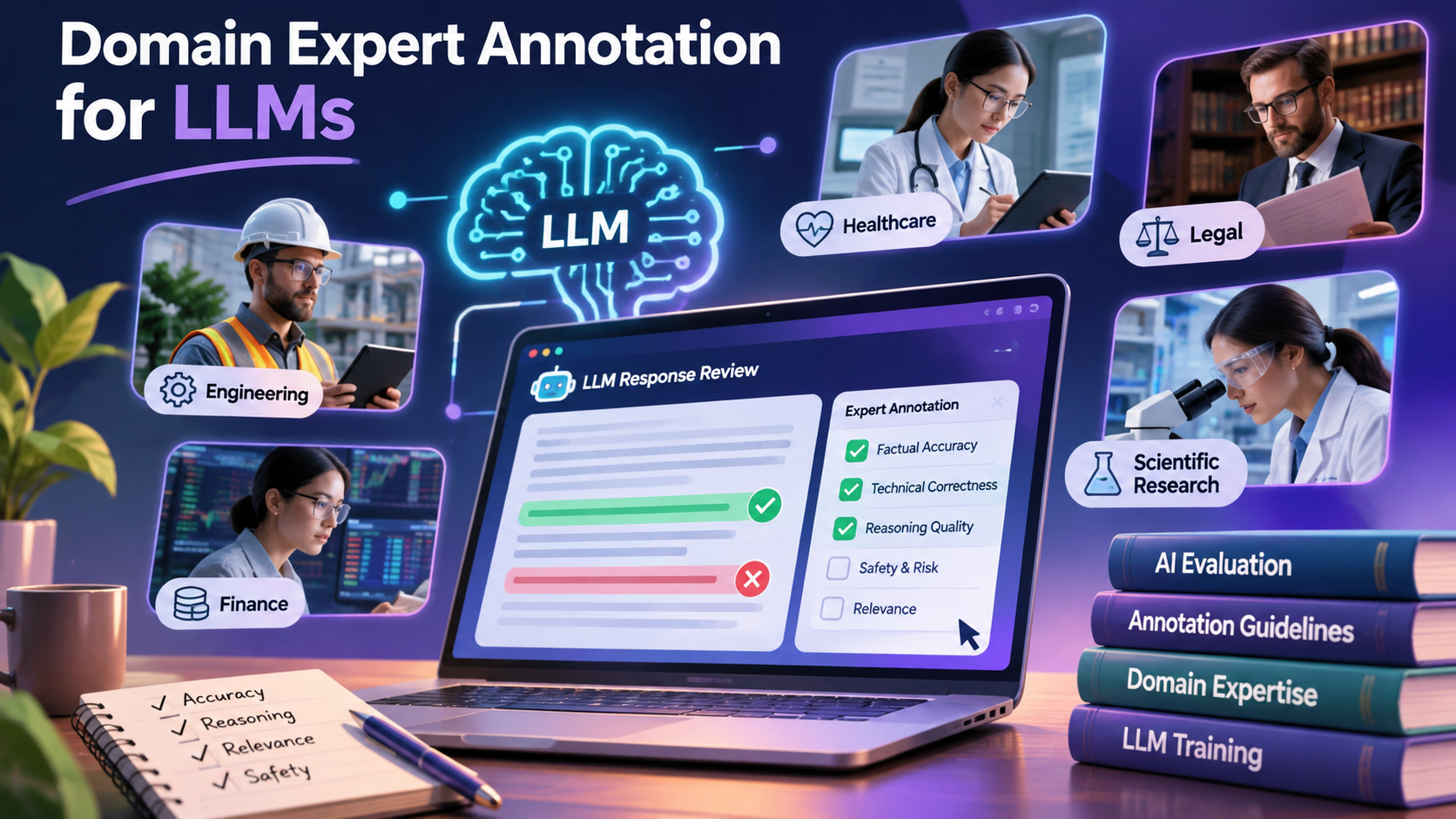
Domain expert annotation for LLMs is the process of using qualified specialists to label, review, and evaluate AI-generated content within their fields of expertise. It supports domain expert AI training by identifying factual errors, assessing technical reasoning, improving evaluation datasets, and providing structured human feedback that helps developers measure and improve model performance.
Large language models (LLMs) can generate fluent responses, summarize complex documents, and answer questions across thousands of topics. But producing convincing language is not the same as delivering accurate, trustworthy information.
This distinction becomes especially important in specialized fields such as healthcare, law, finance, engineering, and scientific research. A response may sound professional while containing subtle errors that only an experienced practitioner can recognize.
That is where domain expert AI training becomes essential.
Domain expert annotation brings specialized human knowledge into AI development and evaluation. Rather than relying entirely on general-purpose annotators or automated scoring systems, organizations involve qualified professionals who can assess technical accuracy, reasoning, terminology, and real-world relevance.
For teams building and evaluating LLMs, expert annotation helps turn subjective quality judgments into structured, actionable feedback.
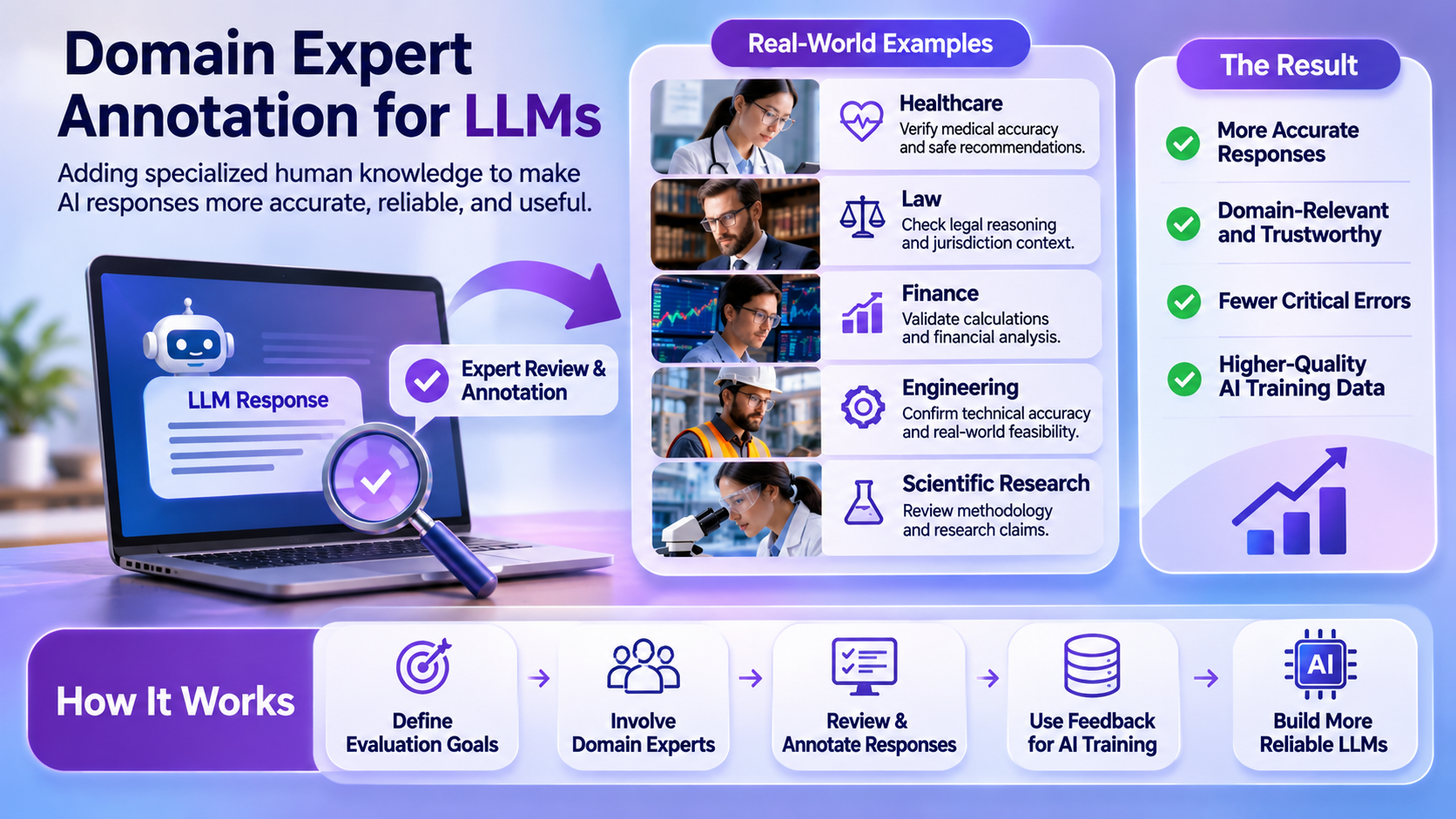
Domain expert annotation is the process of having specialists evaluate, label, or improve data used to develop and assess artificial intelligence systems.
A domain expert is someone with relevant professional knowledge, training, or practical experience in a particular field.
Examples include:
Unlike general-purpose annotation, expert annotation requires an understanding of the subject matter beyond basic reading comprehension.
For example, a general reviewer might determine whether an AI-generated medical response is clear and grammatically correct. A qualified medical expert may additionally recognize an incorrect contraindication, an unsupported diagnosis, or a recommendation that conflicts with established clinical guidance.
The difference is not simply better writing. It is deeper evaluation of the content itself.
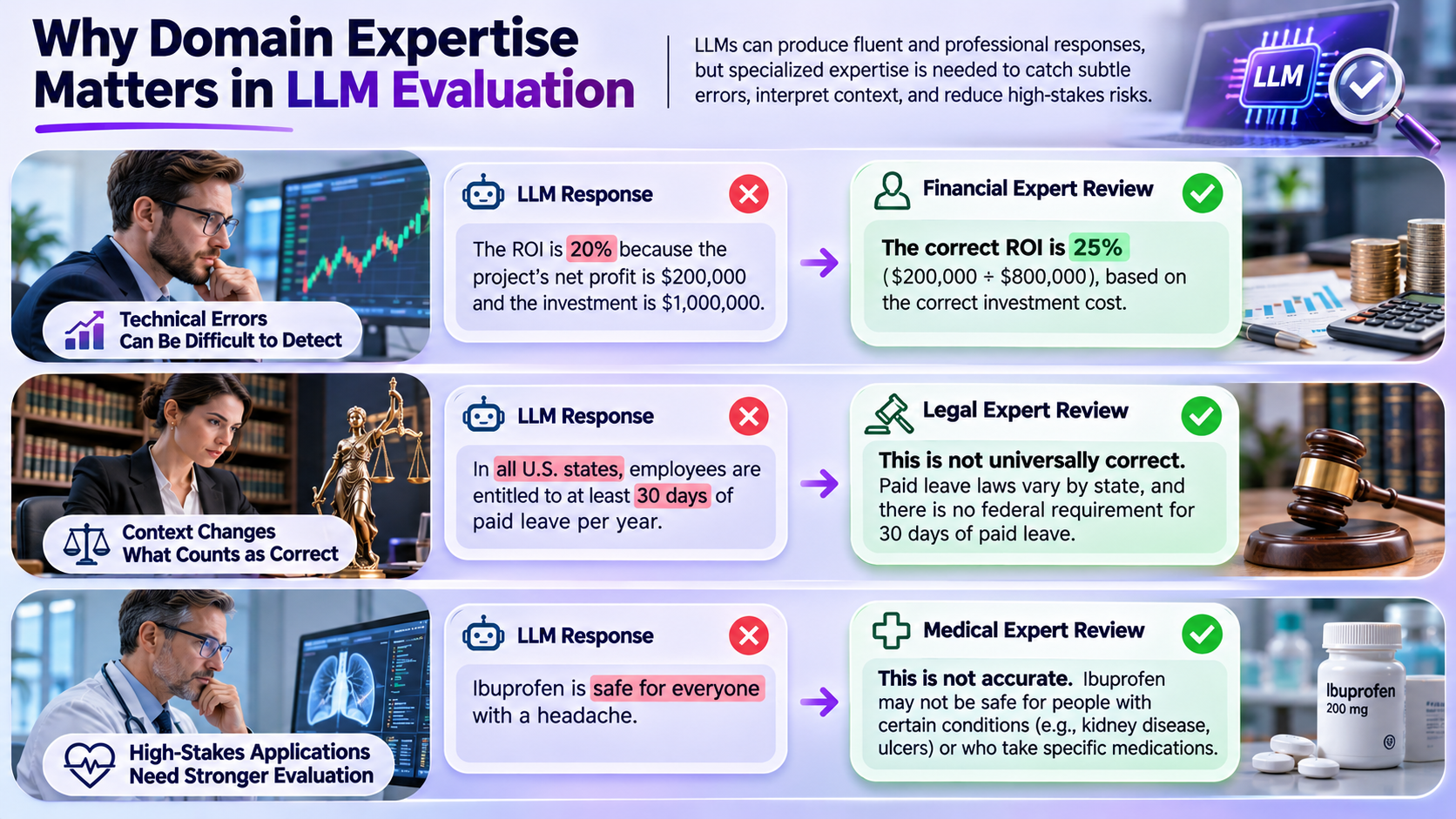
LLMs learn statistical relationships from large datasets. Although this allows them to produce sophisticated responses, it does not guarantee that every answer is factually correct.
Specialized fields introduce additional challenges.
An AI response may use appropriate terminology while reaching an incorrect conclusion.
For instance, an LLM might describe a financial calculation using the right concepts but apply the wrong assumptions.
A general evaluator may consider the answer convincing. A financial specialist can examine the underlying methodology and identify the error.
In many professional fields, accuracy depends on context.
Legal interpretations may vary by jurisdiction. Medical recommendations depend on patient circumstances. Engineering decisions require specific operating conditions.
Domain experts understand these constraints and can distinguish broadly reasonable statements from answers that are appropriate for a particular situation.
Errors in entertainment recommendations may be inconvenient. Errors in medical, legal, financial, or safety-related applications can have more serious consequences.
Expert review helps identify potentially harmful inaccuracies before models are deployed or updated.
However, expert annotation is one component of responsible AI development, not a guarantee that a system will be safe or error-free.
A reliable annotation process involves more than asking specialists whether an AI response looks correct.
It requires a structured workflow that makes expert judgments consistent, reviewable, and useful for model development.
Start by identifying what the annotation project needs to measure.
Common objectives include:
The evaluation criteria should reflect the model's intended use.
For example, a legal research assistant may require accurate citations and jurisdiction-specific reasoning, while an engineering assistant may need correct calculations and explicit assumptions.
Expert selection should match the difficulty and risk level of the annotation task.
Relevant qualifications may include professional credentials, specialized education, research experience, or demonstrated industry expertise.
Not every task requires the same level of specialization.
A general medical terminology classification task may have different reviewer requirements from evaluating complex clinical reasoning.
Organizations should document reviewer qualifications and assign tasks accordingly.
Even experienced specialists can disagree when evaluation instructions are ambiguous.
A strong annotation guide should define:
Guidelines should also distinguish factual correctness from writing quality.
An answer can be clearly written but factually wrong. It can also be technically accurate but difficult for the intended audience to understand.
Experts review model outputs using the established criteria.
Depending on the project, they may assign numerical scores, identify errors, compare responses, or provide corrected explanations.
For example, an expert might evaluate two responses to the same technical question and determine which provides more accurate reasoning.
These judgments can support benchmark development, model comparisons, supervised fine-tuning, or preference-based training.
Expert judgments are not automatically identical.
Two specialists may interpret an ambiguous question differently or disagree about whether a response contains enough supporting evidence.
Quality assurance processes can include independent reviews, calibration exercises, adjudication, and updates to annotation guidelines.
The goal is not to eliminate every disagreement. It is to understand why disagreements occur and improve the reliability of the resulting evaluation data.
A comprehensive expert review examines multiple dimensions of response quality.
Does the response contain correct information?
Experts identify false statements, inaccurate terminology, and unsupported claims.
Does the answer follow a valid line of reasoning?
A response may reach the correct conclusion through flawed logic. Expert evaluation can identify these weaknesses.
Are the model's claims supported by the provided documents, evidence, or authoritative references?
This is especially important for retrieval-augmented generation (RAG) systems.
Does the response address the actual professional question?
An answer can be generally informative without meeting the user's specialized needs.
Does the model recognize when information is incomplete, uncertain, or potentially risky?
Experts can identify situations where an AI system should qualify its response, request additional information, or recommend qualified human involvement.
These dimensions help make domain expert AI training more targeted and measurable.
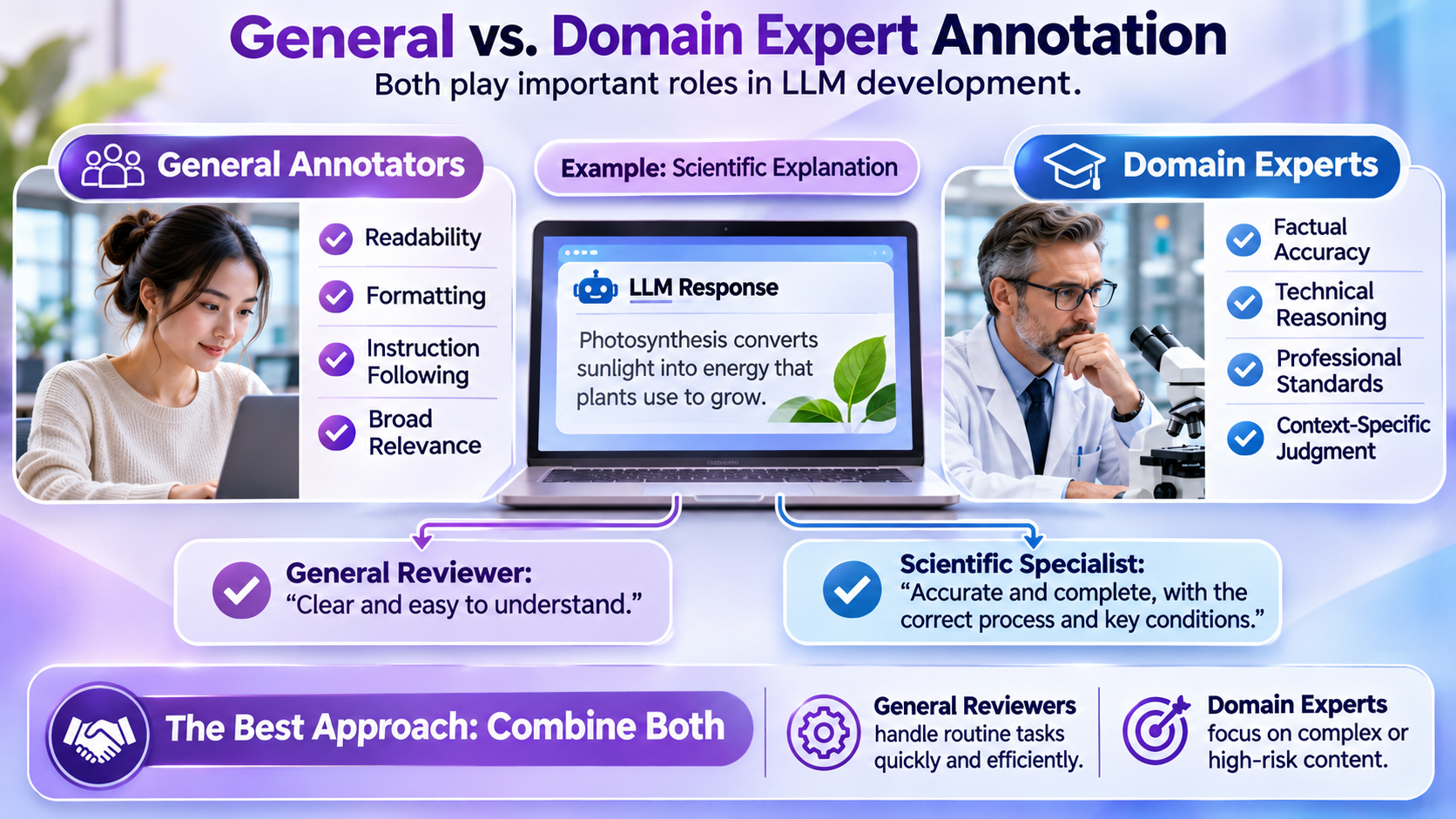
Both general and expert annotation play valuable roles in LLM development.
General annotators are often well suited to evaluating readability, formatting, basic instruction following, and broad response relevance.
Domain experts are better suited to evaluating specialized factual accuracy, technical reasoning, professional standards, and context-sensitive judgments.
For example, general reviewers can assess whether a scientific explanation is understandable. Scientific specialists can determine whether its methodology, assumptions, and conclusions are valid.
The most efficient evaluation strategy often combines both approaches.
General reviewers handle tasks that do not require specialized expertise, while qualified experts focus on complex or high-risk content.
This division can improve efficiency without sacrificing the depth of evaluation where it matters most.
Expert annotations are useful beyond final-stage testing.
They can contribute to several parts of the model development lifecycle.
Specialists can create or review high-quality examples that demonstrate how an AI system should respond to domain-specific questions.
These examples help developers adapt models to specialized tasks.
Experts can compare multiple model responses and indicate which better satisfies technical requirements.
Preference data can inform training methods that improve model behavior.
Specialists can help construct representative test datasets containing realistic professional questions, difficult edge cases, and known failure scenarios.
These benchmarks provide a more meaningful assessment than relying entirely on generic language tasks.
Expert annotations reveal recurring failure patterns.
For example, a model may consistently misinterpret technical terminology, omit important assumptions, or make unsupported recommendations.
Developers can use this feedback to prioritize improvements and track whether subsequent model versions perform better.
In this way, domain expert AI training connects specialized human judgment with measurable model improvement.
Automated evaluations are valuable because they can process large numbers of model outputs quickly.
They can check formatting, compare answers against references, identify certain policy violations, and use model-based evaluators to estimate response quality.
However, automated scoring has limitations.
An AI evaluator may overlook the same subtle technical error as the model being tested. It may also reward a confident explanation that lacks adequate evidence.
Human experts provide a different perspective.
They can interpret specialized context, challenge unsupported assumptions, and explain why an answer is incorrect.
The strongest evaluation workflows often combine both methods:
This approach uses automation for efficiency and expert judgment for deeper evaluation.
Despite its benefits, expert annotation introduces operational challenges.
Qualified experts may have limited availability, particularly in highly specialized fields.
Organizations need recruitment and screening processes that verify relevant expertise.
Expert reviewers generally require greater compensation than general-purpose annotators.
Projects should prioritize expert involvement where specialized judgment provides the greatest value.
Professional expertise does not eliminate subjective interpretation.
Clear rubrics, calibration, and disagreement resolution help improve consistency.
Some annotation projects involve confidential business information, legal documents, or health-related data.
Organizations should establish appropriate privacy, security, access controls, and data-handling procedures before sharing material with reviewers.
Professional standards, regulations, and scientific knowledge can change.
Expert-developed benchmarks and guidelines may require periodic updates to remain relevant.
Scaling expert annotation requires a repeatable quality management process.
Organizations should begin with clear evaluation objectives and representative datasets rather than collecting large quantities of labels without a defined purpose.
A practical approach includes:
Active learning and uncertainty-based sampling can also help teams identify examples that deserve additional expert attention.
Instead of reviewing every output with the same level of effort, organizations can prioritize ambiguous cases, model disagreements, and situations with higher potential consequences.
This makes expert involvement more focused and scalable.
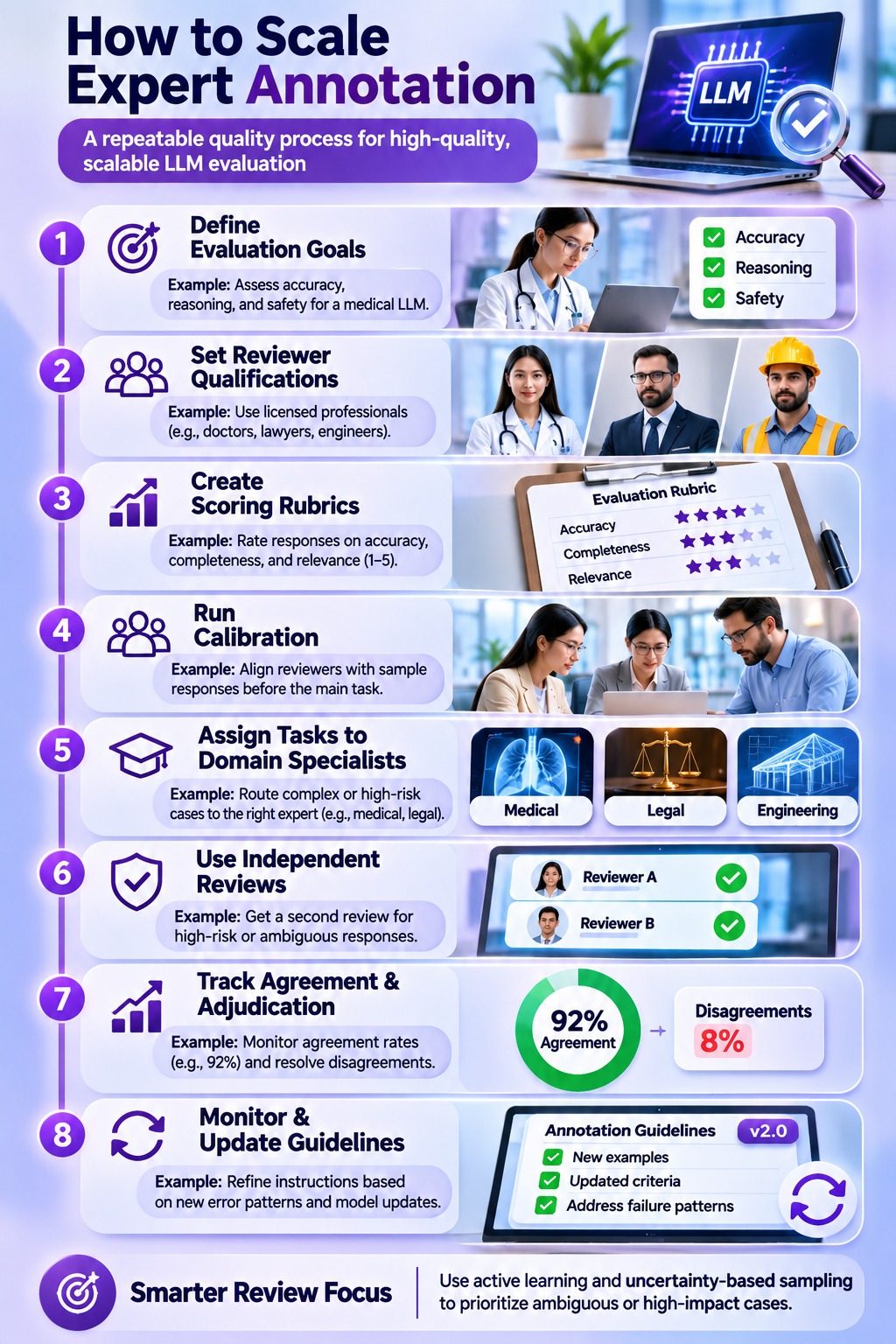
The quality of an annotation project should not be judged solely by the number of completed labels.
Useful measures include:
Inter-annotator agreement: How consistently do independent reviewers apply the same evaluation criteria?
Adjudication outcomes: What types of disagreements occur, and how are they resolved?
Error detection quality: Are reviewers identifying meaningful technical mistakes rather than superficial differences?
Guideline adherence: Do annotations follow the documented scoring instructions?
Downstream usefulness: Do the resulting annotations help identify model weaknesses, improve benchmarks, or support measurable model improvements?
Agreement scores should be interpreted carefully. High agreement does not necessarily prove that annotations are correct, especially when reviewers share the same misunderstanding.
Periodic expert audits and clearly documented decisions provide additional confidence.
Not every LLM application requires extensive specialist review.
Expert annotation is particularly valuable when:
For organizations developing specialized AI assistants, investing in expert evaluation can provide a clearer picture of model performance than generic accuracy scores alone.
The objective is not simply to make AI responses sound more authoritative.
It is to determine whether those responses are actually accurate, appropriate, and useful.
LLMs can produce impressive language, but fluency alone is not a reliable measure of expertise.
Domain expert annotation helps organizations evaluate what matters beneath the surface: factual correctness, technical reasoning, professional relevance, and appropriate handling of uncertainty.
By combining qualified reviewers, structured rubrics, quality assurance, and automated evaluation tools, AI development teams can build more dependable evaluation datasets and identify model weaknesses more effectively.
As specialized AI applications become more common, domain expert AI training will remain an important part of creating and evaluating systems that people can use with greater confidence.
The goal is not simply to produce more annotations. It is to turn expert knowledge into trustworthy evidence for improving AI performance.
Domain expert annotation involves qualified specialists labeling, reviewing, or evaluating AI training data and model outputs. Experts assess specialized accuracy, reasoning, relevance, and safety within their professional fields. Their feedback supports the development of higher-quality datasets, evaluation benchmarks, and model improvement processes.
Domain experts can identify technical inaccuracies, unsupported assumptions, and context-specific errors that general reviewers may miss. Their knowledge is particularly valuable in specialized or high-risk applications where fluent language alone does not demonstrate correctness. Expert evaluations help developers better understand model limitations and performance.
Expert annotation provides structured examples, corrections, preference judgments, and evaluation data that can support model development. These inputs help developers identify weaknesses and create more targeted training or testing datasets. Improvements depend on annotation quality, training methods, and how effectively the feedback is incorporated.
Automated evaluation can handle many repetitive checks and help prioritize responses for review, but it cannot reliably replace specialized human judgment in every situation. Domain experts remain important for assessing nuanced reasoning, professional context, and high-risk errors. Combining automation with expert review often provides a more practical evaluation workflow.
Industries that rely on specialized knowledge can benefit from domain expert AI training, including healthcare, legal services, finance, engineering, scientific research, and cybersecurity. Expert annotation is particularly useful when AI-generated responses must meet technical requirements, reflect professional standards, or support decisions where inaccurate information could have serious consequences.


Compact, ready to go anywhere
Interchangeable lens that’s upgradeable
Dual 1-inch sensors for improved clarity and low light performance
Dynamic range and 6K 360° capture
360° photo resolution at 21MP

8K 360° video recording for ultra-detailed visuals.
4K single-lens mode for traditional wide-angle shots.
Invisible selfie stick effect for drone-like perspectives.
2.5-inch touchscreen with Gorilla Glass protection.
Waterproof up to 33ft for underwater shooting.

360° photo resolution in 23MP
Slim design at 24 mm thick
Built-in image stabilization for smooth video capture.
Internal 19GB storage for photo and video storage.
Wireless connectivity for remote control and sharing.

60MP 360° still images for high-resolution photography.
5.7K 360° video recording at 30fps.
2.25-inch touchscreen for intuitive control.
USB Type-C port for fast charging and data transfer.
MicroSD card slot for expandable storage.


Try it free. No credit card required. Instant set-up.