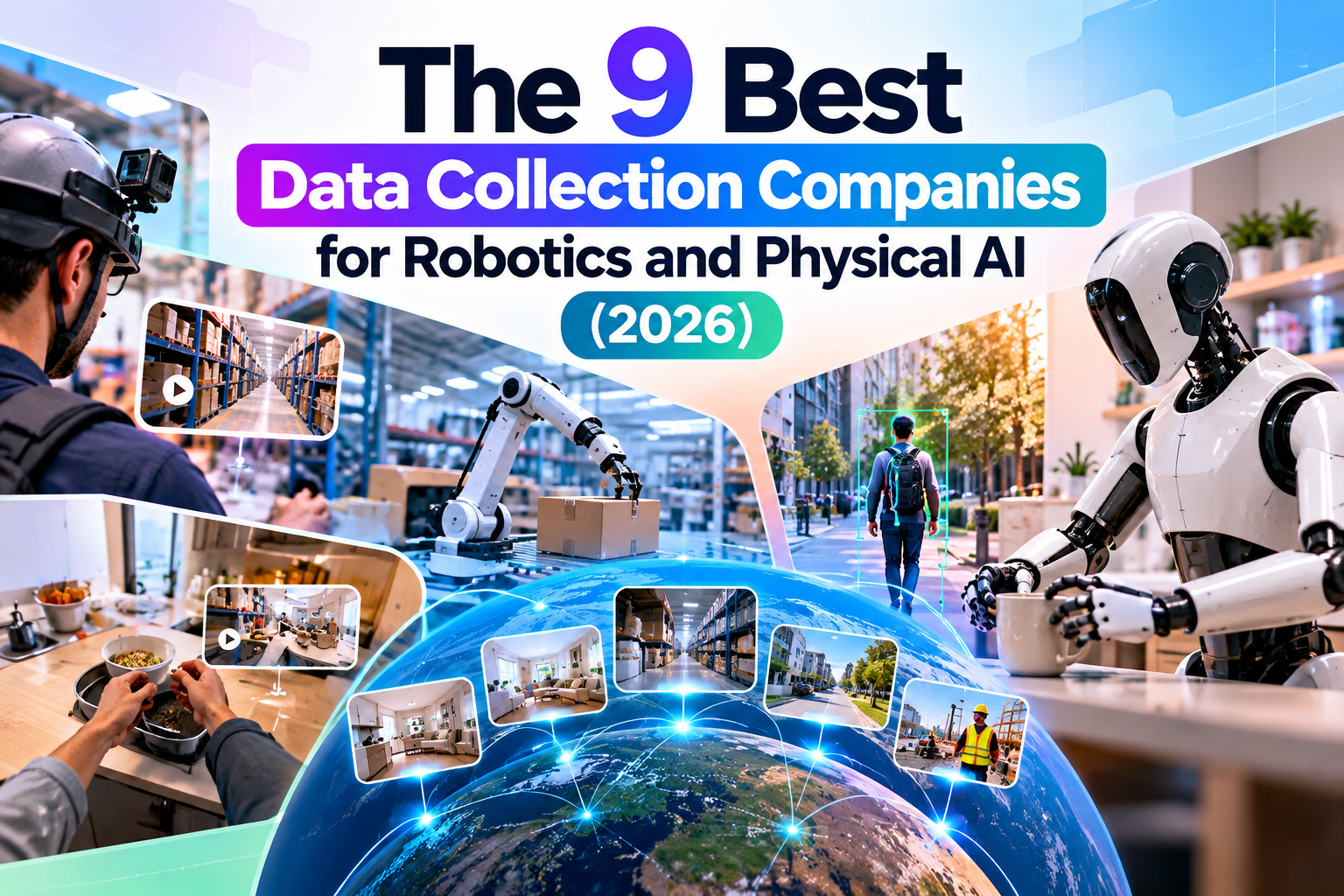
The best robotics and physical AI data collection companies in 2026 include Firsthand, Scale AI, Encord, Appen, Defined.ai, Toloka, Prolific, iMerit, and XDOF. They differ significantly in specialization, from egocentric human demonstrations and teleoperation to multimodal sensor capture, annotation, evaluation, and enterprise-scale data operations.
Robotics has a data problem that is fundamentally different from the one faced by large language models.
LLMs can learn from enormous collections of text that already exist. Robots need data about actions in the physical world: hands manipulating objects, tools being used, people completing tasks, robot trajectories, force measurements, depth information, and synchronized sensor streams.
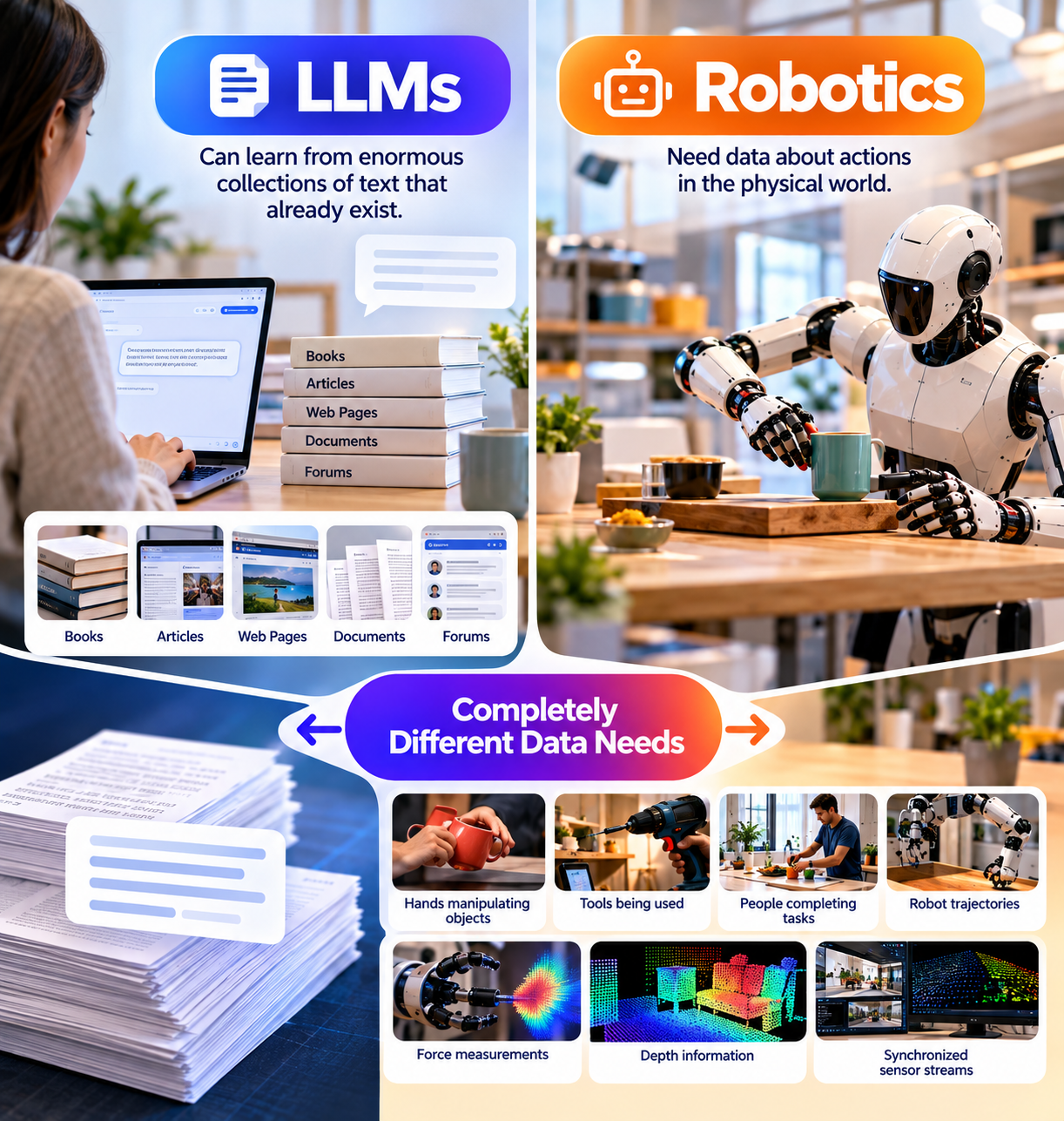
Much of that data has to be deliberately collected.
That has created a growing market for physical AI data collection companies specializing in egocentric video, teleoperation, human demonstrations, multimodal sensor capture, annotation, and evaluation.
For robotics teams, however, choosing a provider based only on the number of hours it can collect is risky. The right partner depends on the robot, environment, task, sensors, data rights, synchronization requirements, and how the resulting dataset will actually be used.
A strong robotics dataset needs to represent not only what happened, but often how it happened over time.
A manipulation dataset, for example, might combine:
Video + Depth + Hand Pose + Robot State + Actions + Language + Metadata
These streams need to remain synchronized and usable by the downstream training pipeline.
That makes robotics collection substantially different from commissioning an ordinary image dataset. Physical AI data may be gathered through teleoperation, wearable cameras, robot-mounted cameras, UMI-style grippers, motion-capture systems, real-world deployment, or combinations of these methods.
Before selecting among physical AI data collection companies, evaluate:
The goal is not simply to collect the most hours.
The goal is to produce training-ready episodes that match the model's requirements.
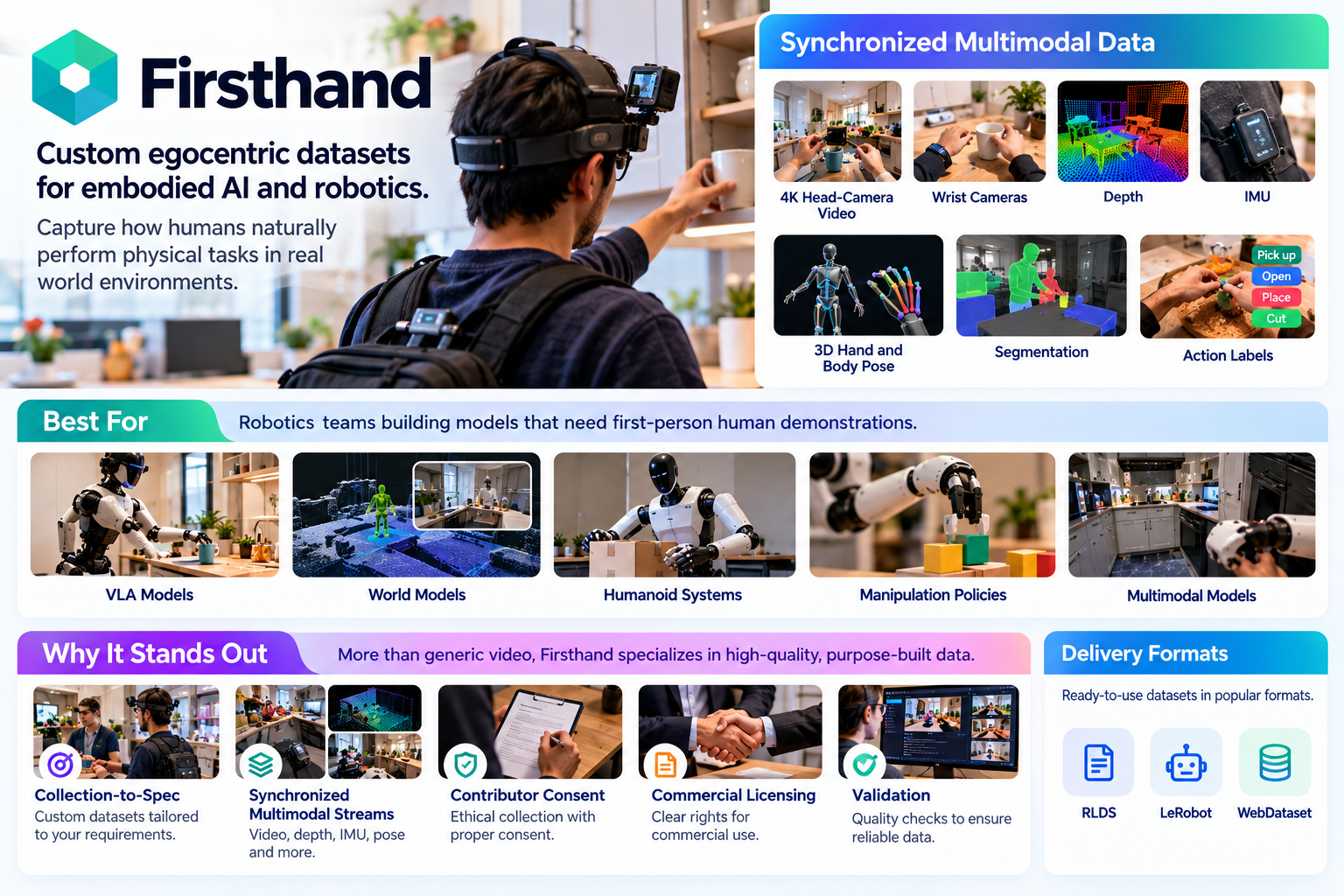
Firsthand focuses specifically on custom egocentric datasets for embodied AI and robotics.
Its approach is useful when teams want to capture how humans naturally perform physical tasks rather than relying entirely on robot teleoperation.
Firsthand states that its episodes can include synchronized 4K head-camera video, wrist cameras, depth, IMU, 3D hand and body pose, segmentation, and action labels. It also advertises delivery formats including RLDS, LeRobot, and WebDataset.
Robotics teams building VLA models, world models, humanoid systems, manipulation policies, or multimodal models that need first-person human demonstrations.
Firsthand emphasizes collection-to-spec, synchronized multimodal streams, contributor consent, commercial licensing, and validation rather than simply selling generic video.
For models learning human skills from first-person observation, that specialization can matter considerably.
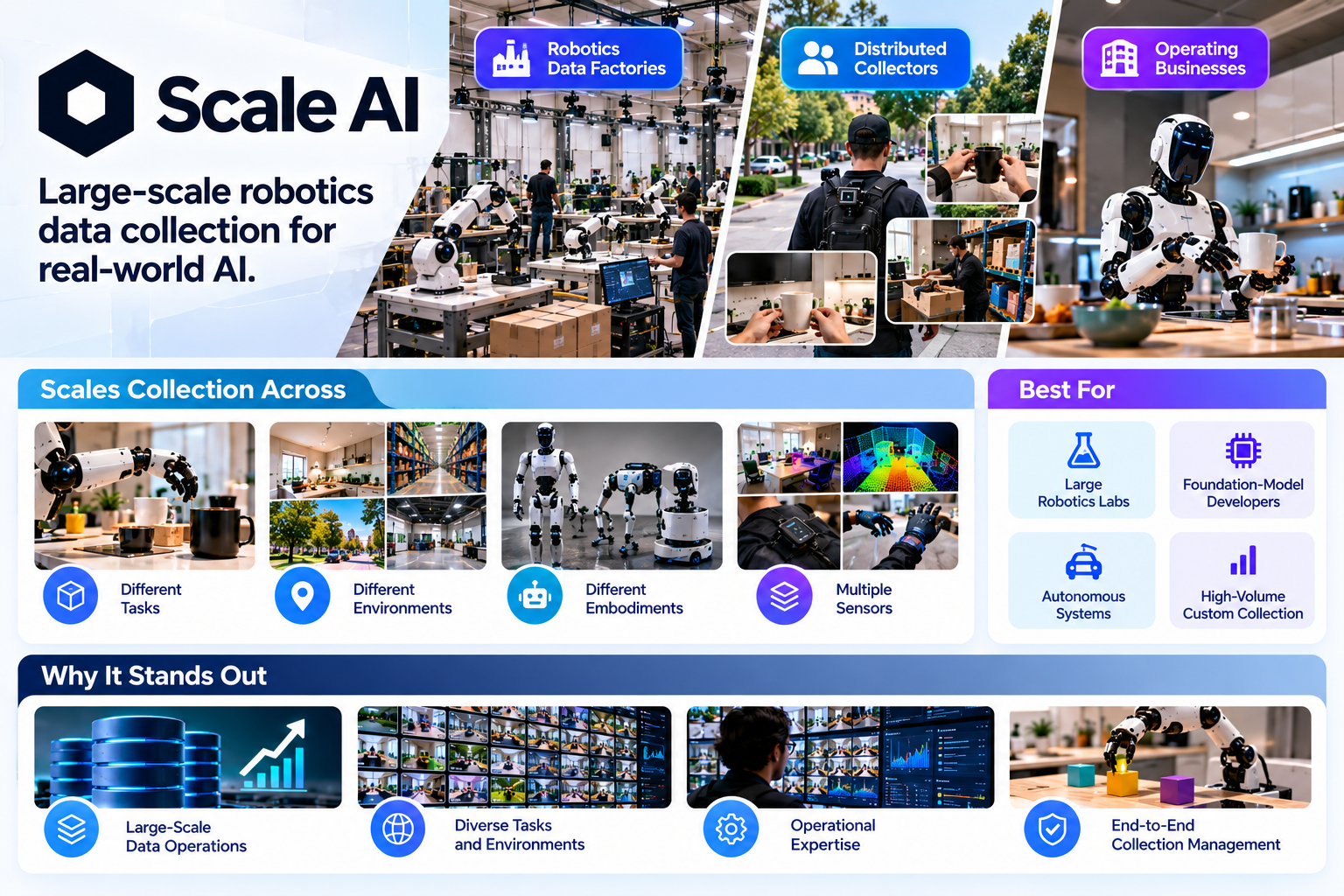
Scale AI has expanded its data infrastructure into Physical AI through its Physical AI Data Engine.
The company describes a collection network spanning robotics data factories, distributed collectors, and operating businesses. Its offering emphasizes scaling collection across different tasks, environments, and embodiments.
Scale's background in large AI data programs also makes it relevant for organizations that need significant operational capacity.
Large robotics labs, foundation-model developers, autonomous systems, and companies requiring high-volume custom collection.
Scale is particularly compelling when the problem is not merely obtaining a few hundred demonstrations, but creating and managing a much larger data operation.
Teams should still evaluate whether a proposed collection method matches their exact embodiment, sensors, and downstream training requirements.
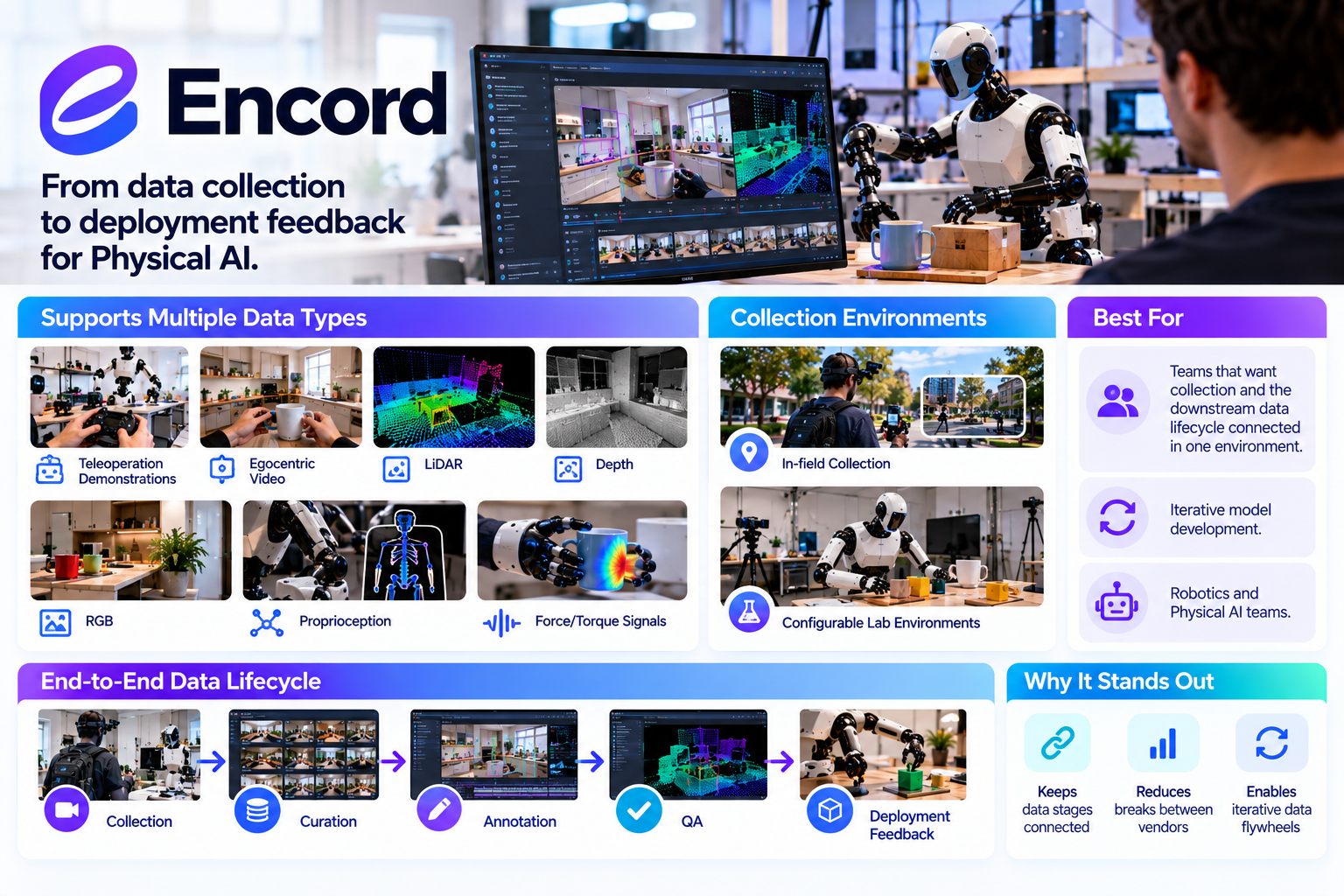
Encord combines collection, curation, annotation, and deployment feedback.
Its Physical AI offering supports data such as teleoperation demonstrations, egocentric video, LiDAR, depth, RGB, proprioception, and force/torque signals. The company also operates in-field collection and configurable lab environments.
That makes Encord different from a provider focused solely on recruiting contributors.
Teams that want collection and the downstream data lifecycle connected in one environment.
Robotics data often breaks when different vendors independently handle capture, synchronization, annotation, curation, and QA.
Encord's proposition is to keep more of those stages connected.
That can be valuable for teams building iterative data flywheels in which deployment failures determine what data should be collected next.
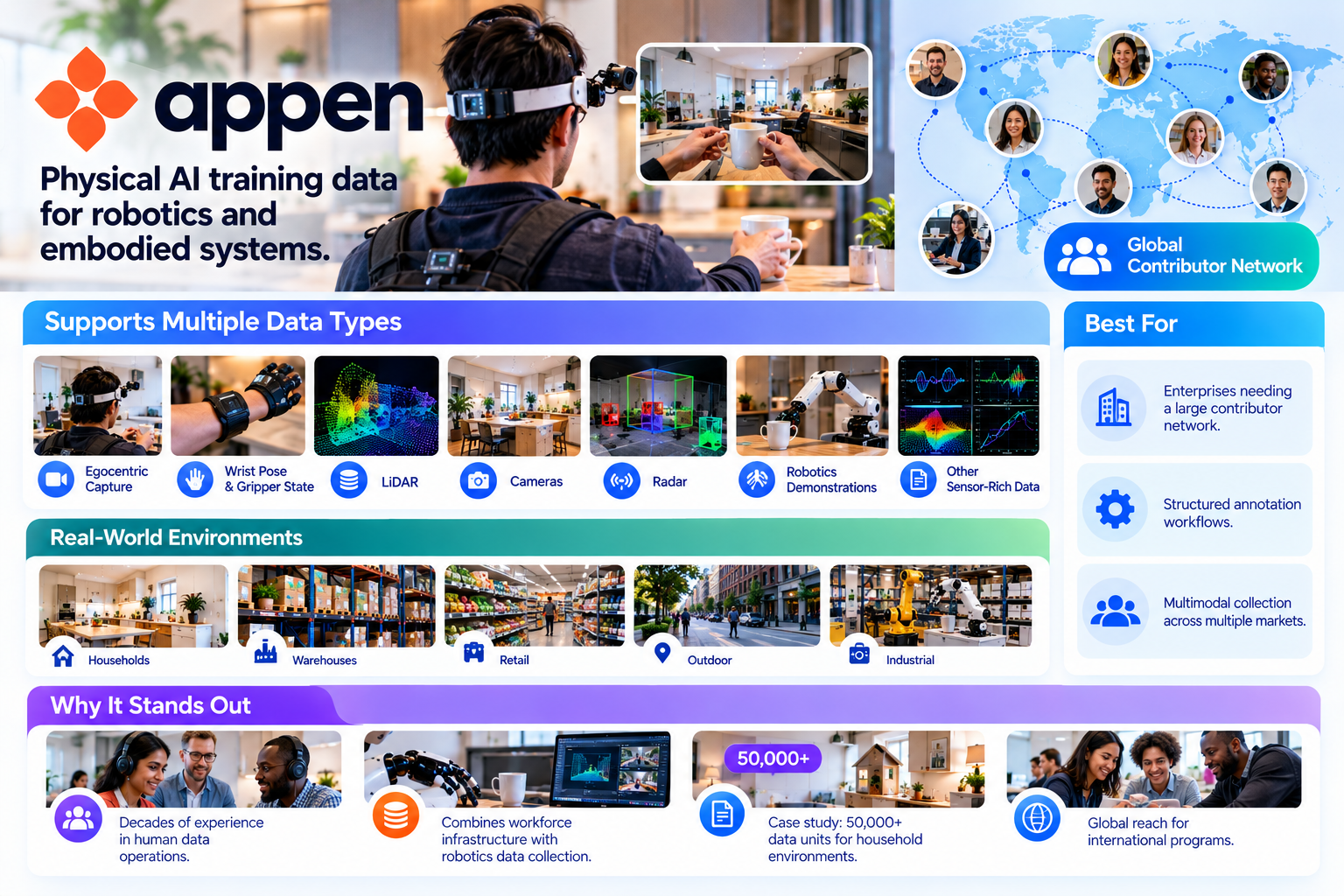
Appen now offers Physical AI training data for robotics and embodied systems.
Its capabilities include egocentric capture, synchronized wrist pose and gripper state, LiDAR, cameras, radar, robotics demonstrations, and other sensor-rich workflows.
Appen also brings decades of experience managing distributed human data operations.
Enterprises requiring a large contributor network, structured annotation workflows, or multimodal collection across multiple markets.
Appen combines its traditional workforce infrastructure with newer robotics-oriented collection.
It has also published a Physical AI case study involving more than 50,000 data units delivered for annotation and robot-performance evaluation in household environments.
For international programs, workforce reach can be an important differentiator.
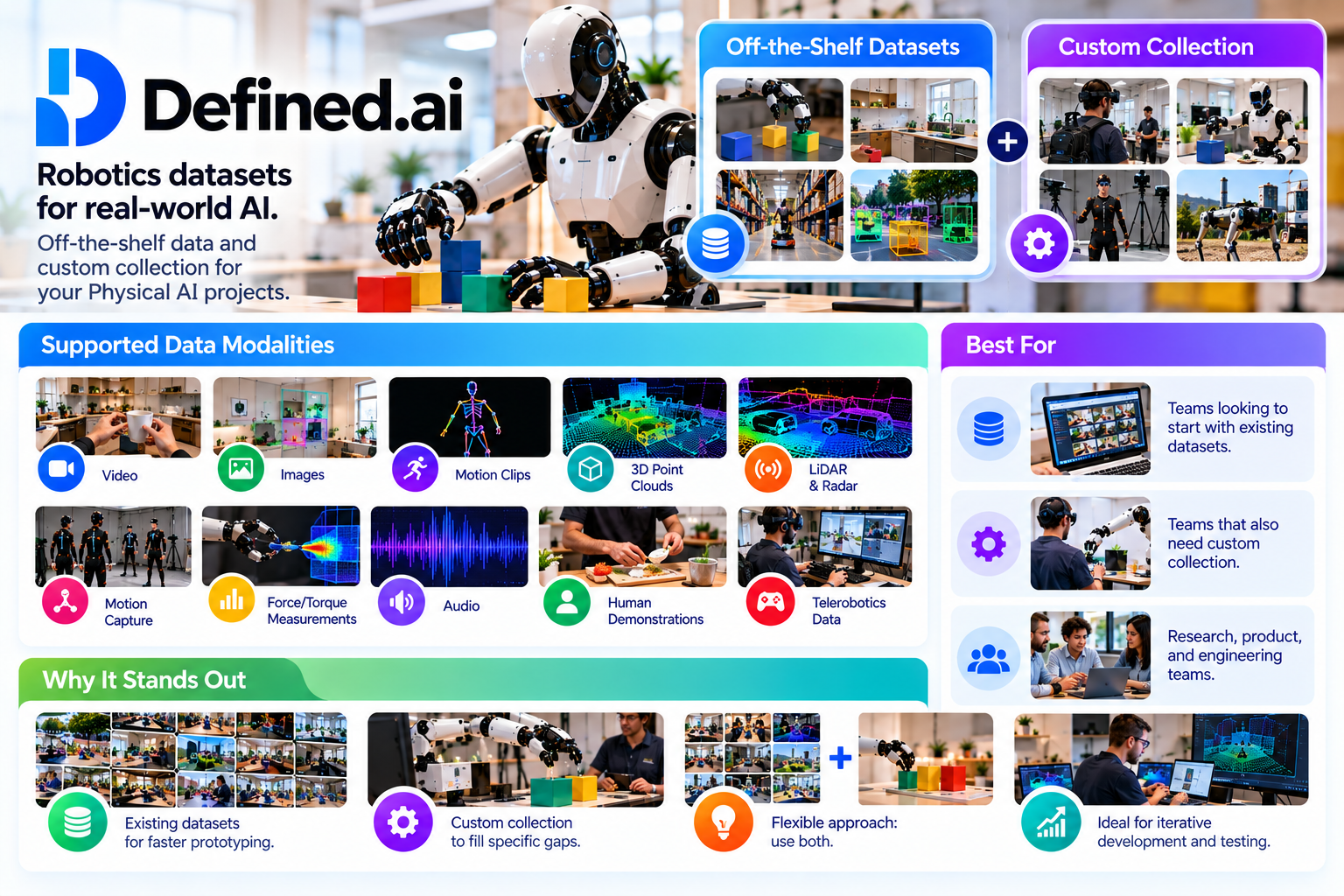
Defined.ai expanded its Physical AI offering in 2026 with both off-the-shelf robotics datasets and customizable collection.
Its supported modalities include video, images, motion clips, 3D point clouds, LiDAR, radar, motion capture, force/torque measurements, audio, human demonstrations, and telerobotics data.
Teams that want to combine existing datasets with bespoke collection.
Not every robotics project should begin with a completely new collection program.
An off-the-shelf dataset can help teams prototype, benchmark, or identify coverage gaps before commissioning expensive custom capture.
Defined.ai's combination of marketplace-style data and custom services makes it useful for this staged approach.
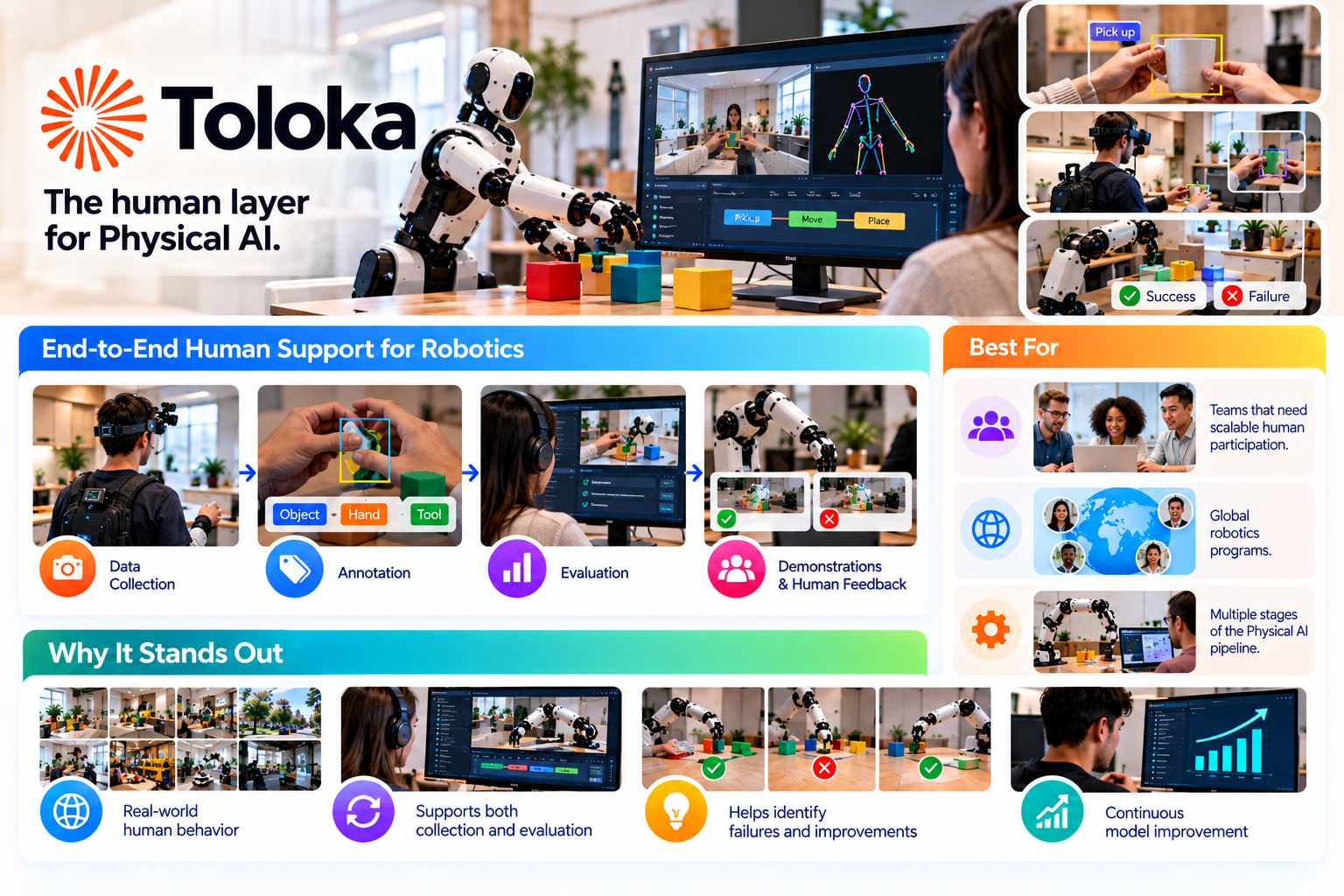
Toloka positions its Physical AI offering around the human layer of robotics development.
Its services cover data, demonstrations, annotation, and evaluation designed to help physical systems learn from real-world behavior.
Teams that need scalable human participation across multiple stages of their Physical AI pipeline.
Physical AI does not end with data capture.
Humans may also be required to annotate actions, compare robot behaviors, evaluate trajectories, identify failures, and judge whether a policy completed a task correctly.
Providers that can support both collection and evaluation may become increasingly important as robotics teams move from initial training into continuous model improvement.
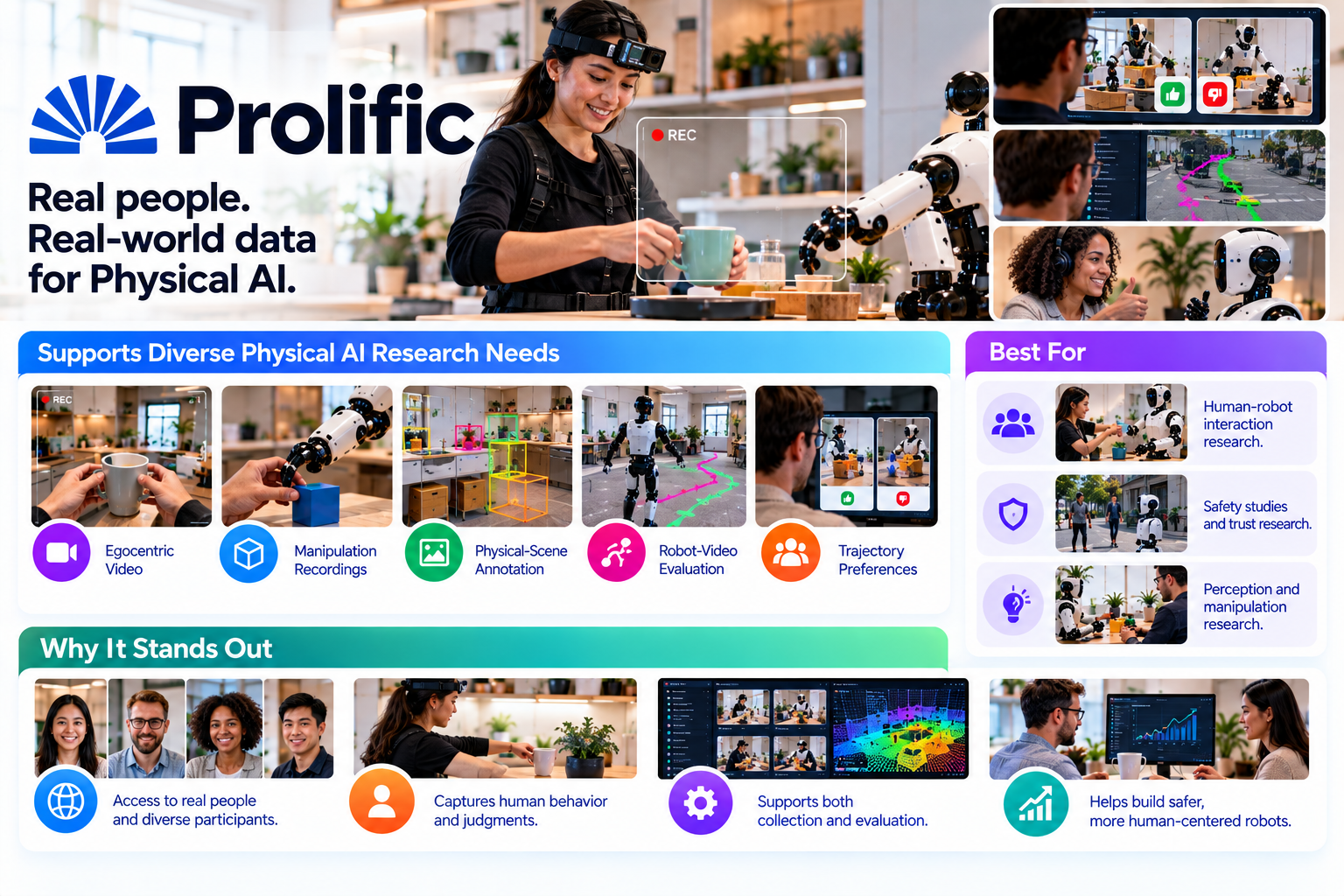
Prolific has expanded beyond conventional research participation into Physical AI.
Its platform supports commissioned egocentric video, manipulation recordings, physical-scene annotation, robot-video evaluation, trajectory preferences, and human-robot interaction research.
Human-robot interaction, safety studies, perception research, manipulation demonstrations, and human evaluation.
A robot ultimately operates around people.
That means some Physical AI problems require more than technically correct trajectories. Developers may need to understand human trust, acceptance, perceived safety, task preferences, or how people naturally interact with objects.
Prolific is particularly interesting where human behavior and judgment are themselves part of the dataset.
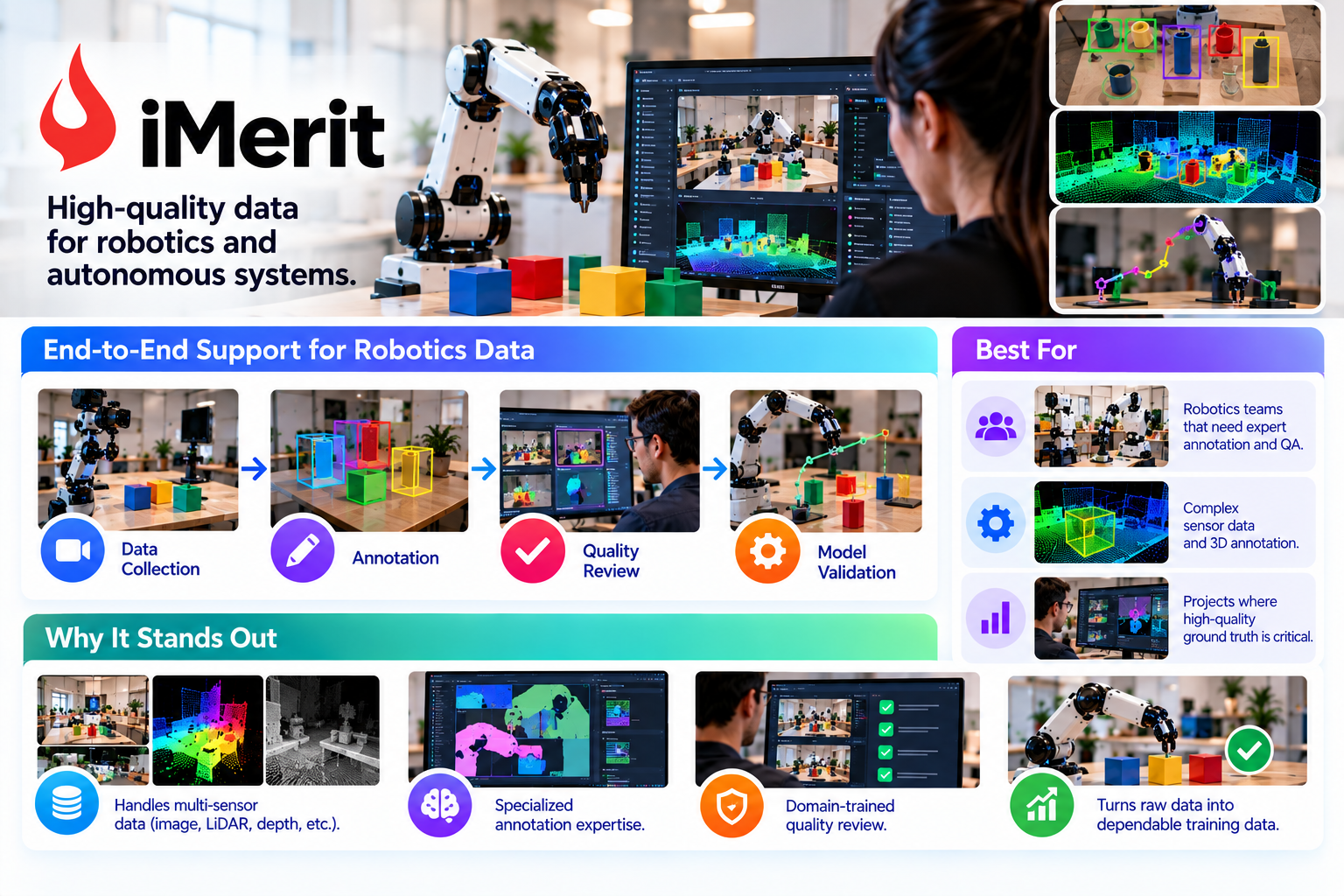
iMerit is a long-established data services provider with expertise across computer vision, autonomous systems, and complex annotation workflows.
Industry comparisons highlight iMerit for domain-trained quality review and support spanning data collection through model validation.
Robotics projects where specialized annotation and QA are as important as collection.
Raw physical-world footage is rarely immediately training-ready.
Robot datasets can require object labels, trajectories, segmentation, action descriptions, 3D annotations, sensor-fusion work, or expert review.
iMerit is therefore worth considering when the difficult part of the project lies in turning collected sensor data into dependable ground truth.
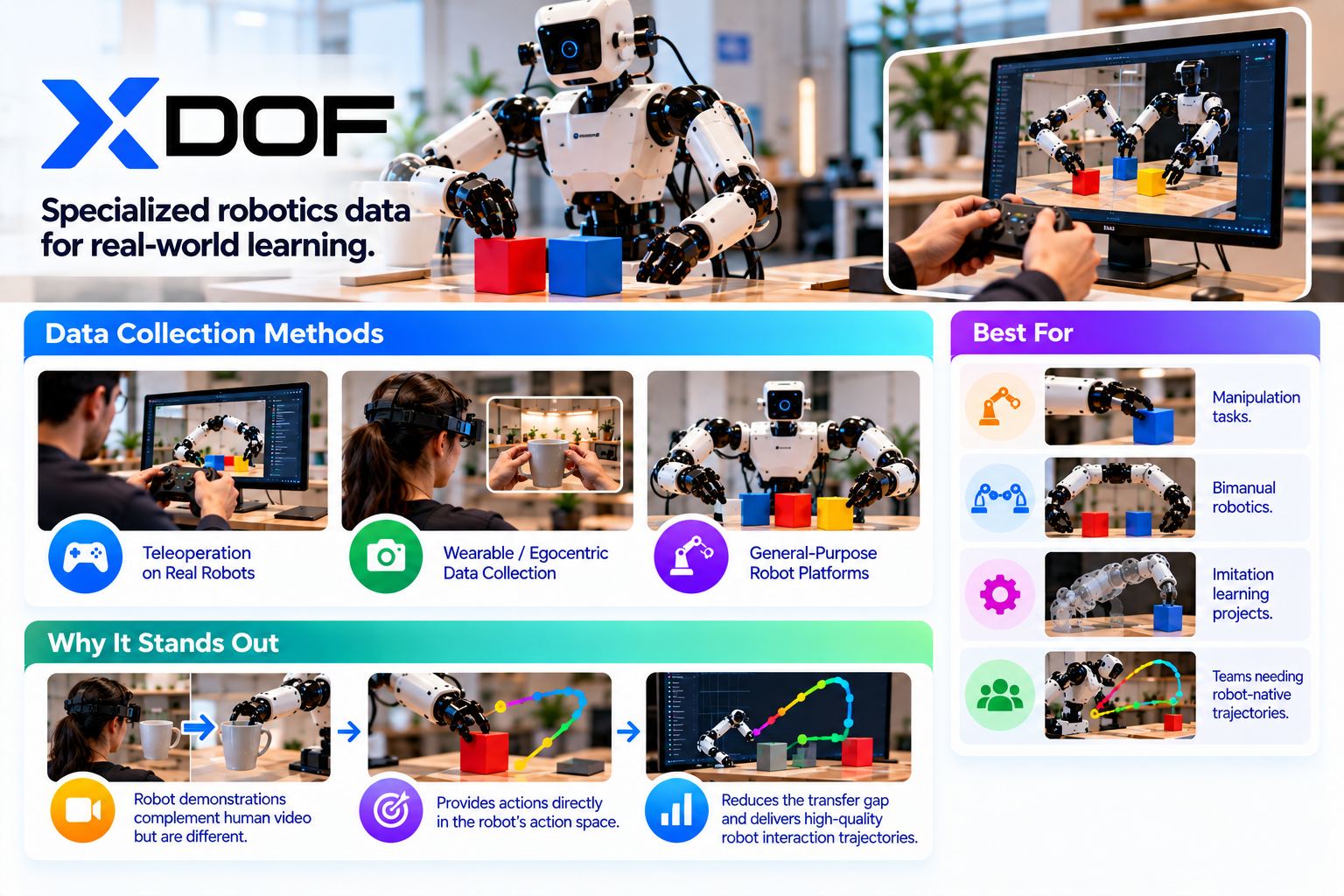
XDOF is one of the newer specialist providers focused specifically on robotics data.
Its approach includes teleoperation on deployed robots, general-purpose robot platforms, and wearable/egocentric data collection. The company emerged from researchers associated with GELLO, a low-cost teleoperation system developed for robot-learning research.
Manipulation, bimanual robotics, imitation learning, and teams that prioritize robot-native trajectories.
Human video and robot demonstrations are related, but they are not interchangeable.
Teleoperated trajectories can provide actions directly within the robot's embodiment and action space. This can reduce some of the transfer problem involved when a robot learns only from human motion.
For teams whose primary bottleneck is high-quality robot interaction trajectories, XDOF deserves consideration.
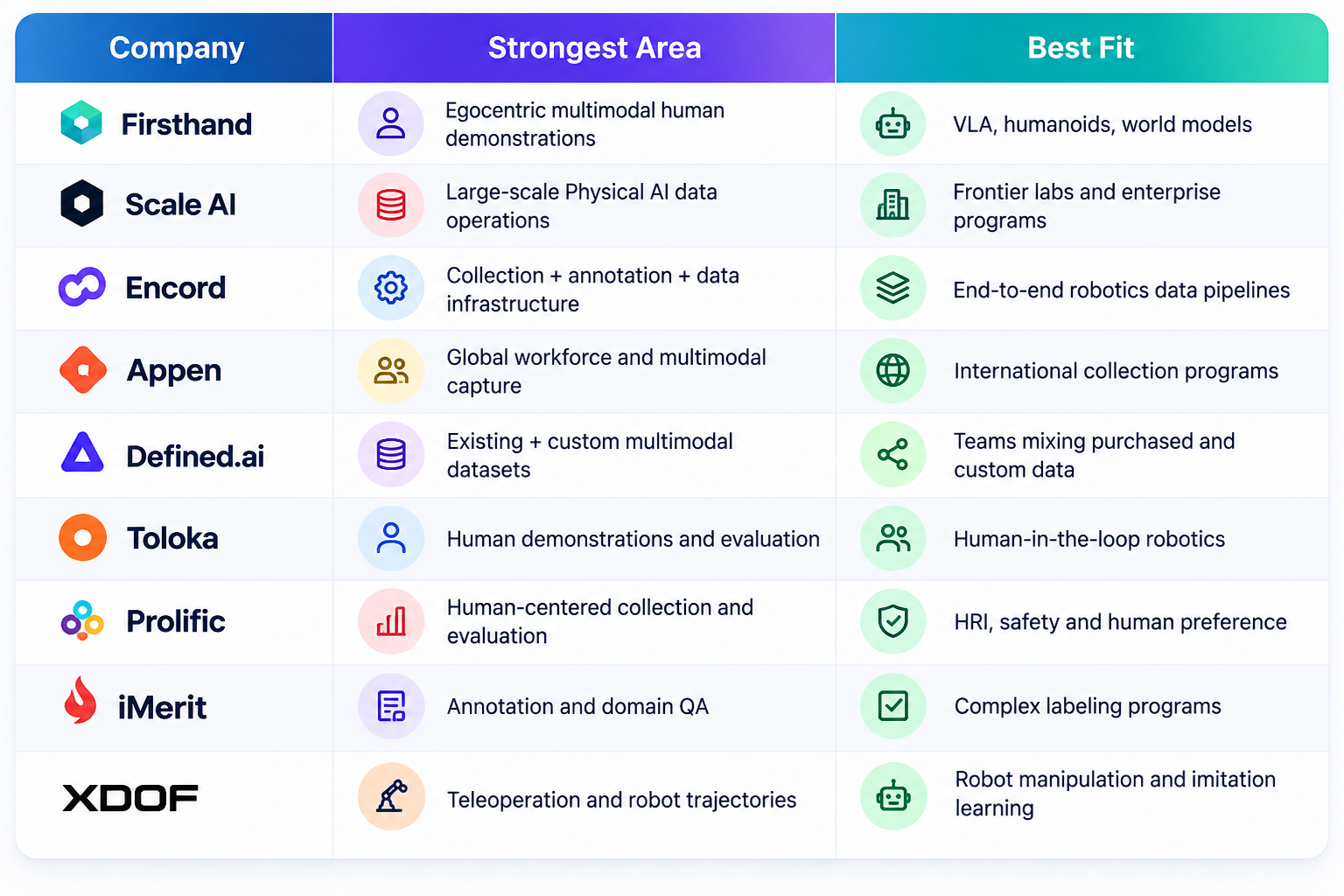
There is no universal winner.
If your model needs first-person examples of humans performing real tasks, Firsthand may be a natural starting point.
If you need an enterprise-scale collection operation, Scale AI or Appen may be more appropriate.
If collection must connect directly with curation and annotation, Encord deserves consideration.
For robot-native teleoperation, XDOF offers a more specialized approach.
The important question is therefore not:
“Which company can collect the most data?”
It is:
“Which company can collect the data my model actually needs?”
Before signing a large contract, consider running a pilot and measuring usable-episode acceptance rate, sensor synchronization, task coverage, annotation accuracy, metadata completeness, licensing clarity, and downstream training compatibility.
The market for physical AI data collection companies is becoming increasingly specialized.
Some providers focus on people. Others focus on robots. Some specialize in teleoperation, while others concentrate on egocentric capture, multimodal sensors, annotation, evaluation, or complete data infrastructure.
That specialization is useful because Physical AI does not have one universal data requirement.
A warehouse manipulation model, humanoid household robot, autonomous vehicle, surgical system, and general-purpose VLA model may all require very different training signals.
The strongest strategy in 2026 is therefore to start with the model requirement and work backward:
Model Requirement → Tasks → Environment → Embodiment → Sensors → Annotations → QA → Licensing → Provider
Choose the company that can reliably deliver that specification—not simply the company promising the largest number of hours.
A Physical AI data collection company captures real-world training data for robots, embodied AI systems, autonomous machines, and world models. Data can include egocentric video, robot trajectories, depth, LiDAR, pose, force/torque, IMU readings, language instructions, demonstrations, and synchronized sensor streams.
Robots interact with specific hardware, objects, environments, and tasks that may not exist in public datasets. Custom collection allows teams to gather demonstrations and sensor data that closely match their target embodiment, deployment conditions, failure cases, and model-training objectives.
Egocentric data records physical tasks from a first-person viewpoint, usually with head-, chest-, wrist-, or wearable-mounted cameras. It can help robotics models learn how humans manipulate objects, use tools, navigate environments, and perform multi-step activities from a viewpoint closer to embodied interaction.
Neither is universally better. Teleoperation provides robot-native actions and trajectories, while human video can provide much greater behavioral diversity and demonstrate natural human skills. Many Physical AI programs may benefit from combining human demonstrations, robot trajectories, simulation, and deployment data.
Compare providers based on task coverage, environments, sensor modalities, synchronization, quality assurance, annotation, consent, provenance, commercial usage rights, delivery formats, scalability, and compatibility with your training stack. A small dataset closely matched to your model can be more valuable than a much larger generic collection.


Compact, ready to go anywhere
Interchangeable lens that’s upgradeable
Dual 1-inch sensors for improved clarity and low light performance
Dynamic range and 6K 360° capture
360° photo resolution at 21MP

8K 360° video recording for ultra-detailed visuals.
4K single-lens mode for traditional wide-angle shots.
Invisible selfie stick effect for drone-like perspectives.
2.5-inch touchscreen with Gorilla Glass protection.
Waterproof up to 33ft for underwater shooting.

360° photo resolution in 23MP
Slim design at 24 mm thick
Built-in image stabilization for smooth video capture.
Internal 19GB storage for photo and video storage.
Wireless connectivity for remote control and sharing.

60MP 360° still images for high-resolution photography.
5.7K 360° video recording at 30fps.
2.25-inch touchscreen for intuitive control.
USB Type-C port for fast charging and data transfer.
MicroSD card slot for expandable storage.


Try it free. No credit card required. Instant set-up.