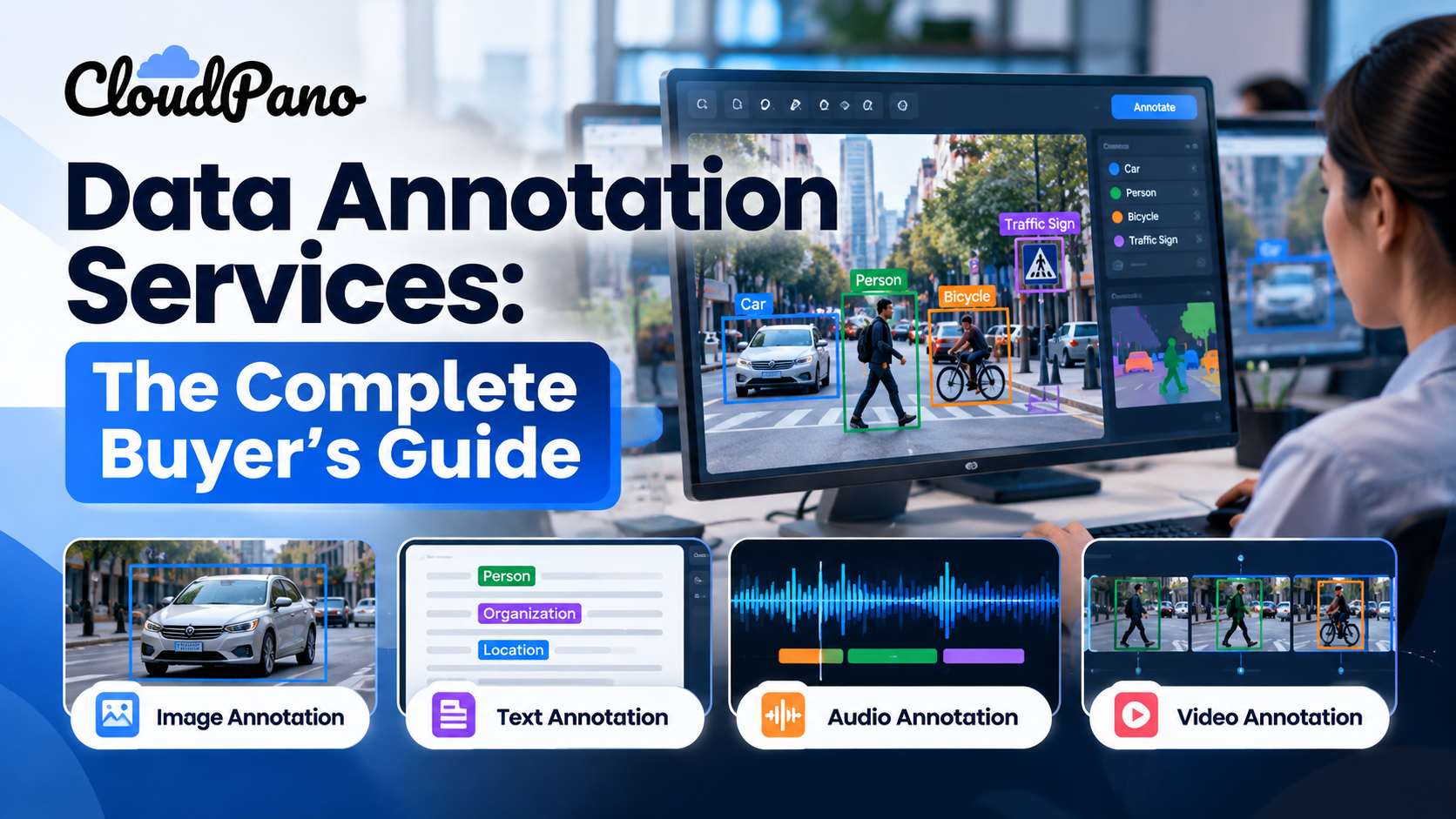
Data annotation services help businesses prepare training datasets by labeling images, videos, audio, text, and other information for machine learning. To choose the right provider, evaluate annotation expertise, quality assurance, data security, scalability, pricing, and communication. Start with a representative pilot project to verify annotation accuracy and delivery standards before committing to large-scale production.
Artificial intelligence may be getting smarter, but there's something that even the most advanced AI systems still depend on: good data.
Behind every AI model that recognizes objects, understands customer questions, or processes complex documents is a collection of training examples. And in many cases, those examples need to be carefully labeled, reviewed, and organized before they're useful.
That's where data annotation services come in.
For businesses developing AI solutions, choosing an annotation provider isn't simply about finding someone who can label thousands of images or documents. It's about finding a partner who understands the project, maintains consistent quality, protects sensitive information, and can grow alongside your needs.
The challenge? Not all data annotation companies offer the same expertise, technology, or quality standards.
This buyer's guide explains what data annotation services include, how pricing works, which questions to ask potential providers, and how to make a confident purchasing decision.
Data annotation services help businesses prepare raw information for machine learning by adding labels, descriptions, or structured metadata.
These annotations provide information that AI models can use during training and evaluation.
For example, imagine a company developing an AI system that identifies damaged vehicles from photographs.
The system needs more than thousands of random car images. It may need examples showing exactly where dents, scratches, or broken components appear.
Human annotators can identify these details and create the structured training data needed for the model.
Data annotation services typically handle several responsibilities:
The specific workflow depends on the project.
Some businesses need straightforward image classification, while others require detailed segmentation, specialized industry knowledge, or human evaluation of AI-generated responses.
It's also worth understanding the distinction between labeling and annotation. Although the terms frequently overlap, annotation can include more detailed information about locations, relationships, and context.
For a closer explanation, read Data Labeling vs. Data Annotation: What's the Difference in AI Training?.
Building an internal annotation team sounds straightforward until the project begins to grow.
A small dataset might be manageable with a few employees. But what happens when a business needs hundreds of thousands of annotations, multiple languages, or continuous quality reviews?
Suddenly, the work requires recruitment, training, annotation software, project management, and ongoing supervision.
Outsourcing can help businesses address these challenges.
Different AI projects require different skills.
Annotating retail products is not the same as labeling medical images or reviewing technical AI responses.
An experienced provider can help organizations access annotators with relevant domain knowledge without building every capability internally.
AI development rarely follows a perfectly predictable schedule.
One month, a company might need 5,000 annotated images. The next, it could require 100,000.
An established annotation service may be able to adjust staffing and workflows as demand changes.
Managing annotation teams takes time away from model development.
Outsourcing can reduce the internal burden of recruitment, training, supervision, and routine quality checks.
However, businesses should still maintain oversight of annotation requirements and final dataset quality.
Professional providers often use structured review processes, including sample audits, reviewer comparisons, and escalation procedures.
These controls can help reduce annotation inconsistencies.
Of course, outsourcing doesn't automatically guarantee better results. The quality of the provider's processes matters more than whether the work happens internally or externally.
Before comparing providers, buyers should understand which annotation methods their AI projects actually require.
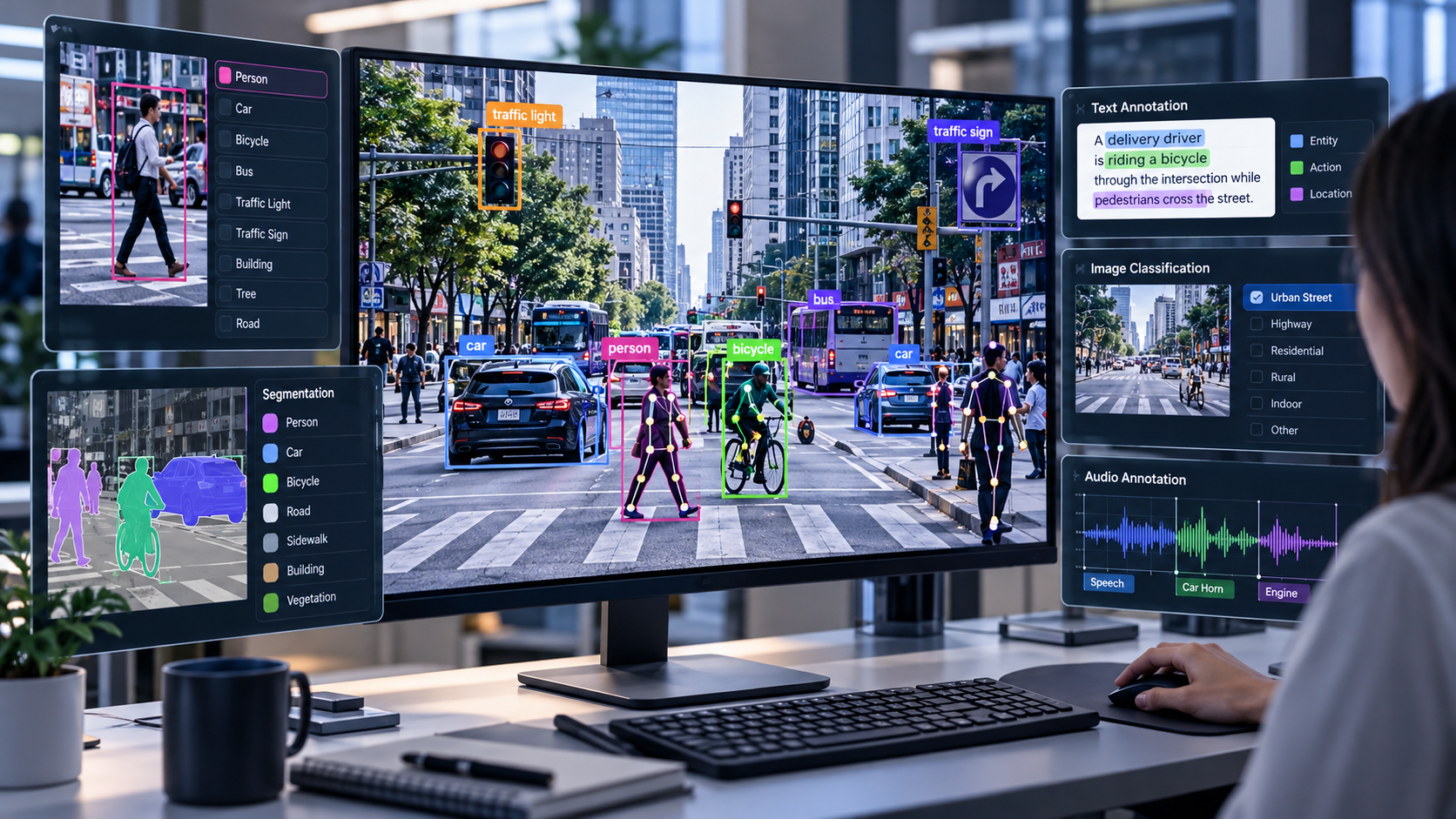
Image annotation helps computer vision systems identify and interpret visual information.
Common techniques include:
These techniques support applications including autonomous driving, manufacturing inspection, retail analytics, and medical imaging.
Video annotation adds another layer of complexity because objects and events change over time.
Annotators may track vehicles, identify human activities, mark events, or maintain consistent object identities across frames.
Video annotation is commonly used in surveillance analytics, robotics, sports technology, and autonomous systems.
For buyers, an important consideration is whether the provider can maintain temporal consistency rather than treating each frame as an unrelated image.
Text annotation supports natural language processing applications.
Common tasks include sentiment classification, named entity recognition, intent detection, document categorization, and relationship extraction.
For example, a customer service AI might need thousands of messages labeled according to customer intent.
Text annotation can also require multilingual capabilities and an understanding of cultural or industry-specific terminology.
Audio annotation helps AI systems understand speech and environmental sounds.
Services may include transcription, speaker identification, timestamps, emotion classification, and sound-event labeling.
Applications include speech recognition, virtual assistants, call center analytics, and accessibility technologies.
Audio quality, accents, overlapping speakers, and background noise can significantly affect annotation complexity.
Large language models introduce additional annotation requirements.
Instead of simply identifying objects or classifying documents, annotators may evaluate AI-generated responses for accuracy, relevance, clarity, and instruction following.
Some projects collect preference rankings or comparisons to support Reinforcement Learning from Human Feedback (RLHF).
Businesses developing generative AI systems can learn more in What Is RLHF? How Human Feedback Improves AI Models.

Selecting a provider requires more than comparing websites and requesting quotes.
A useful evaluation starts with understanding how the provider will handle your actual data.
Ask whether the provider has worked with projects similar to yours.
A team experienced in e-commerce image labeling may not automatically have the expertise needed for clinical documentation or complex industrial datasets.
Relevant experience can reduce onboarding time and help providers anticipate common annotation challenges.
Request examples of comparable work, ideally with measurable quality results.
Quality assurance should be one of the most important factors in your decision.
Ask potential providers how they measure annotation accuracy, identify inconsistent labels, and resolve disagreements.
Strong workflows may include:
For subjective tasks, agreement between annotators can be useful, but it should not be treated as a complete measure of correctness.
A provider should explain how quality is measured for your particular task.
Annotation projects sometimes involve confidential business records, customer information, or sensitive images.
Before sharing data, investigate the provider's security controls.
Ask about encryption, access restrictions, data retention, employee confidentiality agreements, and subcontractor policies.
If the provider claims compliance with frameworks such as ISO 27001 or SOC 2, request relevant documentation and verify its scope.
For regulated information, confirm that the proposed workflow satisfies applicable legal and contractual requirements.
Even technically capable annotation teams can struggle when requirements change or questions remain unanswered.
Look for a provider that offers clear communication channels, defined escalation procedures, and regular progress reporting.
You should know who is responsible for the project, how issues are documented, and how quickly annotation guidelines can be updated.
Ask how the provider would handle a sudden increase in workload.
Can the team add trained annotators without sacrificing quality?
How long does onboarding take?
What happens when a project requires additional languages or specialized reviewers?
Scalability should mean maintaining reliable performance as volume increases, not simply assigning more people to the work.
One of the most common questions buyers ask is how much data annotation services cost.
Unfortunately, there isn't a universal price.
Annotation costs vary according to the type of data, complexity, quality requirements, workforce expertise, and delivery schedule.
A basic image classification task may take seconds, while detailed polygon annotation or expert document review can require considerably more time.
When reviewing quotes, pay attention to what's included.
A low per-image rate may not include quality reviews, project setup, revisions, or specialized validation.
For example, a provider charging less per annotation could become more expensive if your internal team spends significant time correcting errors.
The better comparison is cost per accepted, usable annotation—not simply cost per label.
Ask vendors to provide a detailed breakdown of production work, quality assurance, revisions, minimum commitments, and potential additional charges.
A discovery call is your opportunity to determine whether a provider can deliver what your project actually needs.
Rather than relying entirely on a sales presentation, ask practical questions.
The answers should be specific.
A provider promising exceptionally high accuracy without explaining its measurement process deserves additional scrutiny.
One of the smartest purchasing decisions is to begin with a small, representative annotation project.
A pilot allows you to evaluate real results before investing in a larger engagement.
Choose a dataset that reflects the complexity of your production workload, including ambiguous examples and difficult edge cases.
Then establish acceptance criteria before annotation begins.
Depending on the task, you might measure classification accuracy, bounding-box overlap, segmentation quality, reviewer agreement, or annotation completeness.
Evaluate communication, turnaround time, revision handling, and export compatibility as well.
A pilot may reveal that your own guidelines need improvement.
That's valuable information. Annotation quality depends on both the provider's execution and the clarity of the instructions.
The goal is to identify problems while they're still inexpensive to correct.
As annotation technology advances, buyers increasingly encounter providers offering AI-assisted workflows.
These services use existing machine learning models to generate preliminary annotations that humans can review or correct.
For repetitive tasks, this approach may improve efficiency.
However, automation is not equally effective for every dataset.
Unusual objects, rare events, low-quality recordings, and unfamiliar environments can cause automated systems to produce incorrect annotations.
Human-in-the-loop workflows combine automated assistance with human judgment.
Google Cloud describes human-in-the-loop machine learning as incorporating human expertise into model training, evaluation, and operation.
For buyers, the important question is not whether a provider uses AI tools.
It's whether those tools improve efficiency while preserving the accuracy and reliability your project requires.
Ask how automated annotations are validated and whether difficult examples receive additional human review.
Even experienced AI teams can make purchasing decisions that create problems later.
One common mistake is choosing the cheapest provider without considering the cost of errors.
Another is beginning large-scale annotation before defining clear guidelines and acceptance criteria.
Businesses also sometimes underestimate the importance of representative data.
A perfectly annotated dataset may still perform poorly if it doesn't reflect the conditions the AI system will encounter in practice.
Other problems include unclear ownership of deliverables, unsupported export formats, insufficient security reviews, and unrealistic turnaround expectations.
The best way to avoid these issues is to establish requirements early, test the workflow, and document responsibilities before scaling.
Data annotation shouldn't be treated as a one-time administrative task.
AI systems evolve. New use cases emerge, model errors reveal missing examples, and changing business requirements create additional data needs.
A reliable annotation partner should be able to support this evolution.
That might mean updating annotation guidelines, incorporating new categories, reviewing difficult examples, or helping prepare additional datasets.
Organizations should also maintain version histories, document changes, and track recurring quality issues.
The National Institute of Standards and Technology's AI Risk Management Framework emphasizes the importance of managing AI-related risks throughout the system lifecycle.
For annotation buyers, that reinforces a practical lesson: data quality, documentation, and oversight remain important long after the first dataset is delivered.
Choosing the right data annotation services provider can influence the reliability, efficiency, and long-term success of an AI project.
The strongest providers do more than produce large volumes of labels.
They understand the intended use of the data, establish clear quality standards, protect sensitive information, communicate effectively, and adapt as requirements change.
Before signing a contract, define your annotation needs, compare quality assurance processes, understand the complete pricing structure, and run a representative pilot.
Most importantly, remember that more annotated data doesn't automatically mean better AI.
What matters is having accurate, relevant, consistent training data that supports the problem your model is designed to solve.
A thoughtful purchasing decision today can prevent expensive corrections and delays later.
Data annotation services prepare raw data for AI training by adding labels, descriptions, and structured metadata. They support machine learning applications involving images, video, audio, text, and other data types.
Data annotation pricing varies based on dataset size, annotation complexity, expertise, quality requirements, and turnaround time. Providers may charge per annotation, per item, hourly, or through project-based contracts.
Businesses should evaluate relevant experience, annotation accuracy, quality assurance procedures, security practices, scalability, communication, and pricing transparency. A paid pilot is useful for verifying a provider's capabilities.
Yes. AI-assisted annotation tools can generate preliminary labels and identify objects automatically. However, human review remains important for complex, ambiguous, or high-risk tasks where automated systems may produce errors.
Data annotation provides structured information that helps machine learning models recognize patterns, identify objects, classify information, and learn expected outputs. Accurate annotations support more reliable model training and evaluation.
Google Cloud — What Is Human-in-the-Loop?
Read Google Cloud's explanation — Explains human involvement in AI training, annotation, and evaluation.
AWS — Data Labeling With a Human-in-the-Loop
Read AWS documentation — Covers data labeling workflows and quality controls. Note that SageMaker Ground Truth is no longer open to new customers.
NIST — Artificial Intelligence Risk Management Framework (AI RMF 1.0)
Read NIST's framework — Provides guidance on AI reliability, accountability, transparency, and risk management.


Compact, ready to go anywhere
Interchangeable lens that’s upgradeable
Dual 1-inch sensors for improved clarity and low light performance
Dynamic range and 6K 360° capture
360° photo resolution at 21MP

8K 360° video recording for ultra-detailed visuals.
4K single-lens mode for traditional wide-angle shots.
Invisible selfie stick effect for drone-like perspectives.
2.5-inch touchscreen with Gorilla Glass protection.
Waterproof up to 33ft for underwater shooting.

360° photo resolution in 23MP
Slim design at 24 mm thick
Built-in image stabilization for smooth video capture.
Internal 19GB storage for photo and video storage.
Wireless connectivity for remote control and sharing.

60MP 360° still images for high-resolution photography.
5.7K 360° video recording at 30fps.
2.25-inch touchscreen for intuitive control.
USB Type-C port for fast charging and data transfer.
MicroSD card slot for expandable storage.


Try it free. No credit card required. Instant set-up.