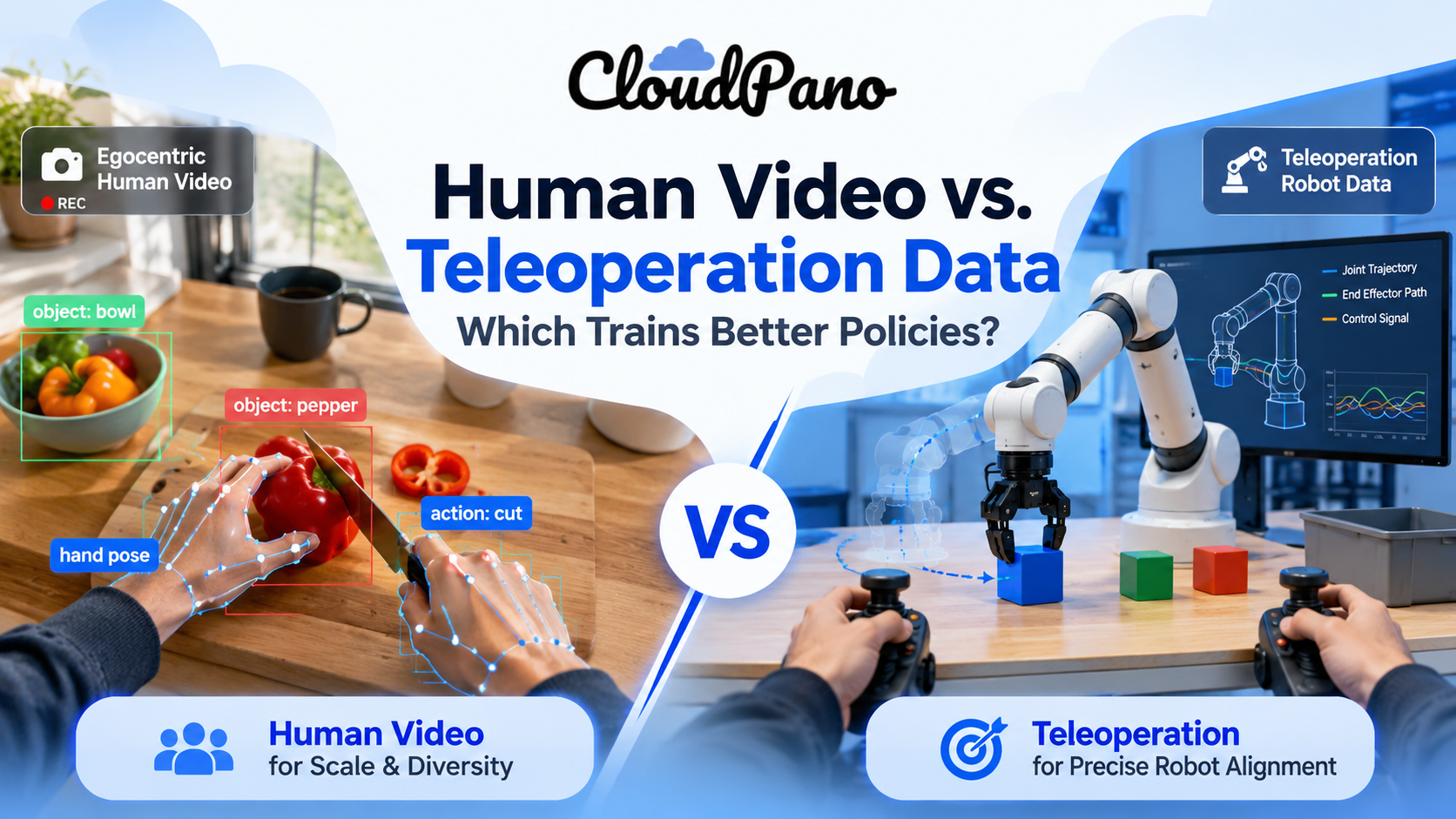
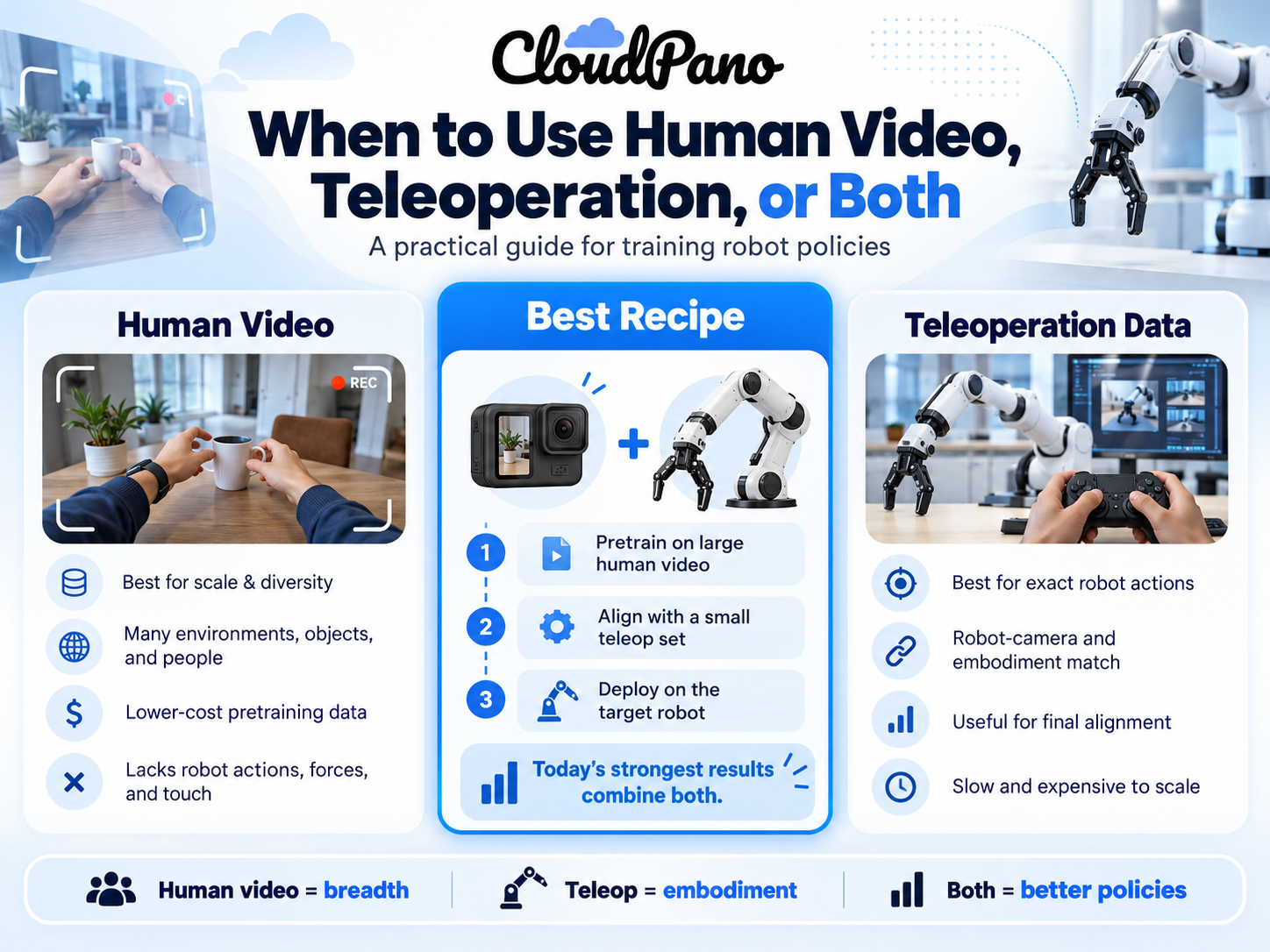
Neither wins alone. Human video scales cheaply and adds diversity: in the 2026 HumanScale study, same-size egocentric pretraining beat teleoperated robot data, with 90% higher out-of-distribution success. Teleoperation still supplies exact robot actions, forces and embodiment match. The best current recipe pretrains on large human video, then aligns with a small amount of robot data.
If you are budgeting a robot learning project, the hardest call is not the model. It is where your human demonstration data for robots will come from. The best-known open teleoperation set, DROID, took 50 collectors 12 months to gather 350 hours of robot interaction. NVIDIA's EgoScale pretrained on 20,854 hours of egocentric human video.
That gap in scale is why so many teams are asking the same question. Should you keep paying for teleoperation data collection, or shift budget to human video? This guide compares both fairly, walks through what the research from 2024 to 2026 actually measured, and explains why the answer is usually "both, in the right order." For background on the market side, see why robotics labs are buying egocentric video at scale.
Teleoperation data is recorded when a person drives a real robot remotely, and the robot logs its own camera views, joint positions and commands. Every frame comes with the exact action the robot took, in the robot's own body.
That is why it has been the default for training manipulation policies. The HumanScale paper describes teleoperated real-robot trajectories as the dominant pretraining source, because they offer precise action supervision and match the robot's embodiment.
Typical examples of a teleoperated robot manipulation dataset include:
Human video data is footage of people doing real tasks, usually filmed from a head, chest or glasses-mounted camera so it shows hands and objects from the actor's point of view. It is often paired with hand tracking so the motion can be turned into action labels.
Nobody has to operate a robot to collect it. A contributor with a camera can record in their own kitchen, workshop or warehouse. Physical Intelligence notes this kind of data is easy to record, which is the main reason it scales (Physical Intelligence).
Teleoperation runs in real time and needs a robot in the room, so hours of data cost hours of operator time plus hardware. The DROID team wrote that collecting robot data in diverse settings brings logistical and safety challenges and heavy investment in hardware and labor (arXiv).
Skild AI makes the same argument from the other direction. In its January 2026 post, the company says teleoperation is tied to places where a robot is already deployed, and that even a global workforce driving robots around the clock could not reach LLM-scale data. It calls that goal "mathematically unfeasible" (Skild AI).
The practical result is narrow coverage. Even large teleop sets tend to come from a limited number of labs, rooms and objects.
Human video is missing two things robots need: the physical signals behind a motion, and a body that matches the robot. Skild AI lists both problems plainly: video does not show forces, torques or touch, and a human hand looks and moves differently from a robot arm or gripper (Skild AI).
Physical Intelligence calls this the domain gap. Humans and robots look different and move differently, so a robot cannot copy a human directly (Physical Intelligence).
Video quality also matters more than volume. HumanScale's positive result depended on a carefully designed filtering and labeling pipeline, not on raw footage (arXiv).
Recent studies point the same way: human video can match or beat robot data for pretraining, but it works best when a small amount of robot data is added for alignment. Here is what each study measured.
Note what these numbers compare. HumanScale compares pretraining sources of equal size. EgoScale compares against no human pretraining at all. Physical Intelligence compares a policy with and without human video added. None of them shows robot data becoming unnecessary.
No. The strongest results use human video for breadth and robot data for alignment. HumanScale's own conclusion is to pretrain on egocentric video for diverse world knowledge, then adapt with a small amount of labeled robot data (arXiv). EgoScale uses the same pattern with a short mid-training stage (NVIDIA). Skild AI says it fine-tunes new skills from video plus less than 1 hour of robot data (Skild AI).
Physical Intelligence adds a useful twist. On its egg-sorting task, more robot pretraining stopped helping the robot-only policy after about 60% of the dataset, but kept improving the policy that also learned from human video (Physical Intelligence). In other words, robot data makes human video more useful, and human video keeps the gains going.
Choose by the job each data type does best.
If your target is a humanoid, the trade-offs shift again, since hand dexterity and whole-body motion matter. We cover that in what humanoid robots actually need.
Firsthand collects the human side of this recipe: first-person video of real people doing real tasks, to spec. Capture runs from a chest-mounted phone up to a synchronized head, wrist and depth rig, with annotation for actions, hand pose and objects, and delivery in RLDS, LeRobot or WebDataset formats. See our egocentric video data collection service for capture tiers and turnaround.
What we can't do matters just as much:
Teleoperation data gives robots exact actions in their own bodies, but it is slow and narrow. Human video is broad and scalable, and in equal-size tests it has matched or beaten teleop data for pretraining. The best policies today use both: human video to learn the world, then a small amount of robot data to learn the body.
Teleoperation means a person controls a robot remotely, guiding its arms or grippers in real time. In robot learning, each teleoperated session is recorded with the robot's camera views, joint positions and commands, so the data shows exactly what action the robot took. That precision is why teleoperation has long been the default source of robot training data.
Both involve a person steering a machine from a distance. In robotics data work, teleoperation usually means guiding a robot's arms and hands through a task in real time, often while the session is logged as training data. Remote control more often describes simpler commands, like driving a vehicle or toy, with no learning goal attached.
Yes. Robot models can learn useful skills from human video, especially first-person footage paired with hand tracking. Physical Intelligence reported that adding egocentric human video roughly doubled performance on scenarios seen only in the human data. Video lacks forces and touch, though, so most teams still add some robot data.
The two main approaches are imitation learning, where a robot copies demonstrations from people, and reinforcement learning, where it improves through trial and reward. Human video and teleoperation data both feed imitation learning. The studies in this guide, including HumanScale, EgoMimic and EgoScale, focus on demonstration data for imitation-style policy training.
It depends on the task and approach, but current datasets range from hundreds to tens of thousands of hours. The DROID teleoperation dataset holds 350 hours of robot interaction. NVIDIA's EgoScale pretrained on 20,854 hours of egocentric human video, then added a small aligned human-robot stage before deployment.


Compact, ready to go anywhere
Interchangeable lens that’s upgradeable
Dual 1-inch sensors for improved clarity and low light performance
Dynamic range and 6K 360° capture
360° photo resolution at 21MP

8K 360° video recording for ultra-detailed visuals.
4K single-lens mode for traditional wide-angle shots.
Invisible selfie stick effect for drone-like perspectives.
2.5-inch touchscreen with Gorilla Glass protection.
Waterproof up to 33ft for underwater shooting.

360° photo resolution in 23MP
Slim design at 24 mm thick
Built-in image stabilization for smooth video capture.
Internal 19GB storage for photo and video storage.
Wireless connectivity for remote control and sharing.

60MP 360° still images for high-resolution photography.
5.7K 360° video recording at 30fps.
2.25-inch touchscreen for intuitive control.
USB Type-C port for fast charging and data transfer.
MicroSD card slot for expandable storage.


Try it free. No credit card required. Instant set-up.