


.png)


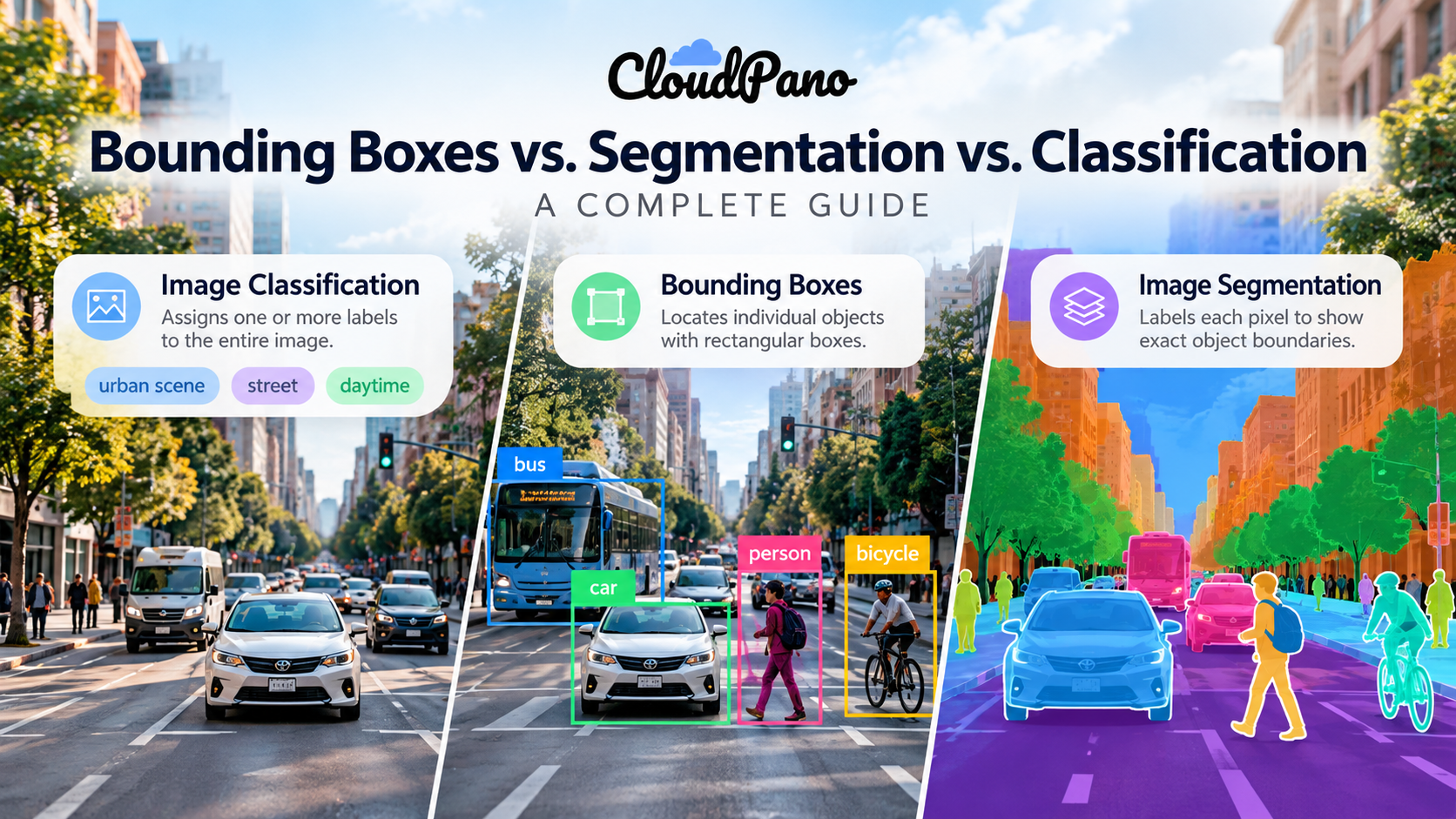
Bounding boxes, segmentation, and classification are three computer vision annotation methods used to train AI models. Classification assigns labels to entire images, bounding boxes identify the approximate location of objects using rectangles, and segmentation labels precise pixels or regions. The best method depends on whether an AI system needs category recognition, object detection, or detailed visual understanding.
Every computer vision project starts with a fundamental question: What exactly does the model need to understand about an image?
It sounds simple, but the answer has a significant impact on how training data should be prepared.
A model designed to recognize whether an image contains a damaged product doesn't need the same annotations as a robotic arm learning to pick up individual objects. Likewise, an autonomous driving system that needs to distinguish the road from the sidewalk requires a different level of visual detail than a model simply identifying vehicles.
This is why choosing the right annotation method matters.
Bounding boxes, segmentation, and classification are three of the most established approaches used in computer vision annotation services. They all help machines interpret visual information, but they solve different problems.
And while it's tempting to assume that more detailed annotations always produce better results, that isn't necessarily true. In many cases, a simpler annotation method can deliver everything a model needs, with significantly less labeling effort.
Let's look at how these methods work, where each makes sense, and what teams should consider before building their next training dataset.
Computer vision annotation services involve labeling images or videos so machine learning models can learn to recognize, locate, and interpret visual information.
The labels act as reference information during training. They tell the model what it should learn to identify, whether that's an entire image category, an individual object, or a specific region.
Consider a photograph of a busy intersection.
One annotation project might label the image as an urban traffic scene. Another might draw boxes around every visible vehicle. A third might identify the exact pixels belonging to the road, sidewalks, pedestrians, and traffic signs.
All three datasets use the same underlying image, but they're designed to teach different tasks.
That's an important distinction because annotation isn't simply about adding labels. It's about translating a project's objectives into training data that a model can actually use.
Professional annotation workflows also involve decisions about label definitions, ambiguous objects, annotation formats, quality control, and consistency across large datasets.
Getting those decisions right early can prevent expensive rework later.
Image classification is usually the most straightforward of the three methods.
Instead of identifying where objects appear, classification assigns one or more labels to an entire image.
Imagine a manufacturer developing an AI system to inspect product photographs. If the goal is to determine whether each image shows an acceptable or defective product, image classification may be sufficient.
The model doesn't necessarily need to know where the defect is. It only needs to predict the appropriate category.
As described in Amazon SageMaker's image classification documentation, image classification labeling involves assigning predefined categories to images, creating the labeled examples needed for supervised learning.
Classification is commonly divided into two approaches.
Single-label classification assigns one category to an image. For example, a medical image might be categorized according to a predefined diagnostic classification scheme.
Multi-label classification allows multiple categories to apply to the same image. A photograph could be labeled as containing a person, a bicycle, and a traffic light.
This distinction matters because real-world images don't always fit neatly into one category.
Classification is particularly useful when the desired output is a category rather than an object location.
Common applications include:
One of classification's biggest advantages is annotation efficiency.
Since annotators generally don't need to draw shapes or trace objects, large image datasets can often be labeled relatively quickly.
However, classification has a clear limitation.
Suppose an image contains five products, but only one is damaged. An image-level label can indicate that damage is present, but it doesn't identify which product is responsible.
If the system needs that information, classification alone won't solve the problem.
Bounding box annotation takes computer vision a step further.
Rather than labeling an entire image, annotators draw rectangular boxes around individual objects and assign a class to each one.
This is the foundation of many object detection systems.
For example, consider a warehouse camera monitoring packages moving along a conveyor belt.
A classification model might recognize that packages are present. A bounding box detection model can go further by identifying where each visible package is located.
That location information makes it possible to count objects, track their movement, or pass their approximate positions to another system.
A bounding box is typically represented by coordinates describing its position and dimensions.
Depending on the annotation format, those coordinates may represent the box's corners or its center point, width, and height.
Each box is also associated with an object category.
As outlined in Amazon SageMaker's bounding box annotation documentation, rectangular annotations provide location information for objects within images, making them suitable for training object detection models.
During training, an object detection model learns to predict both the category and location of objects in images it hasn't encountered before.
Bounding boxes are widely used because they offer a practical compromise between annotation effort and spatial information.
They don't require annotators to outline every curve or edge, but they provide substantially more information than image-level labels.
Bounding box annotation is commonly used in:
For many object detection projects, bounding boxes provide enough information to train a useful model.
But they aren't always precise enough.
Imagine drawing a rectangle around a bicycle. The box includes the wheels and frame, but it also contains substantial background space between those components.
The model learns the approximate object location, not its exact visible outline.
This becomes a problem when an application depends on precise boundaries, surface measurements, or detailed interactions between objects.
That's where segmentation becomes valuable.
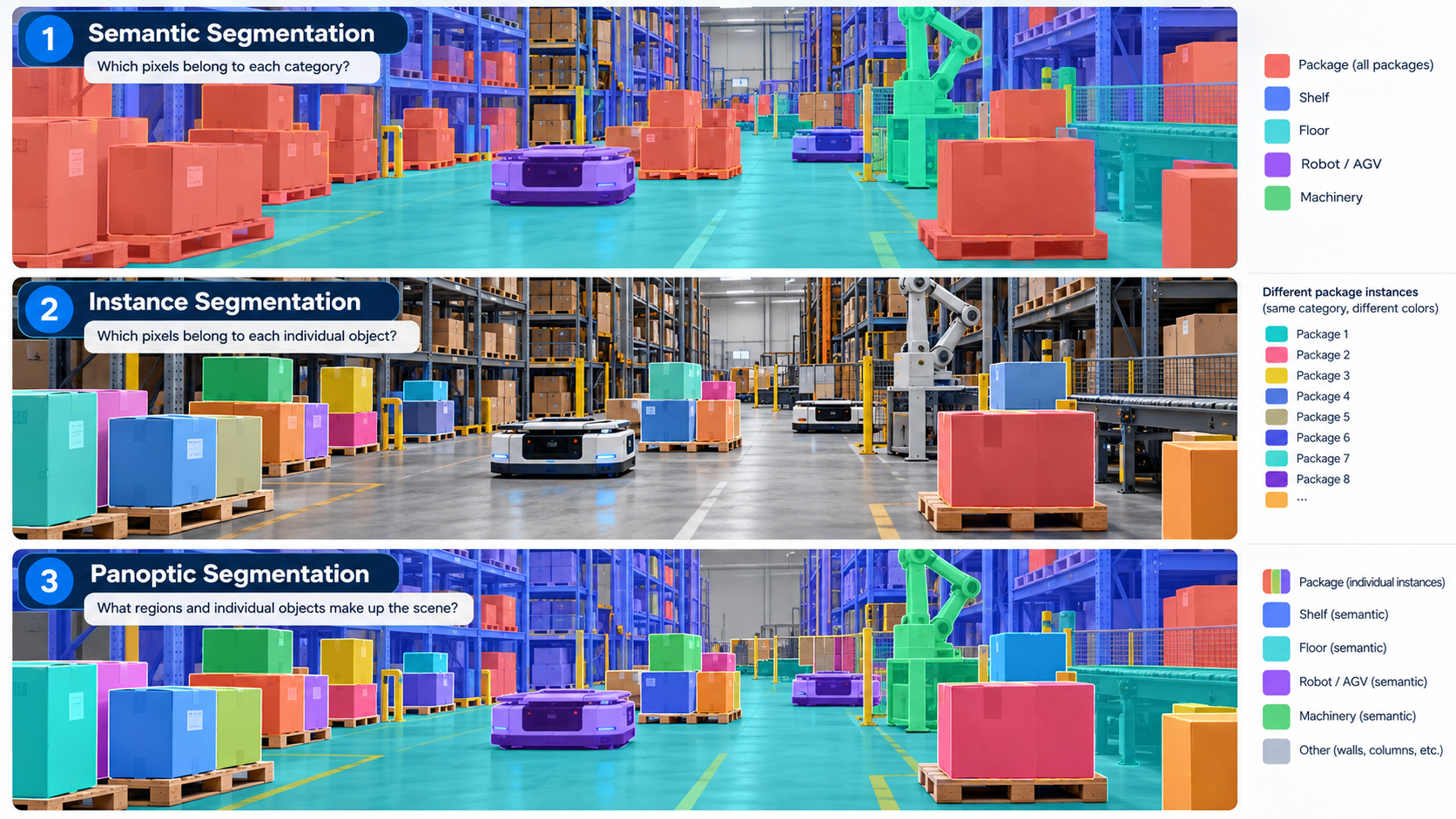
Segmentation is designed for applications that need a more detailed understanding of an image.
Instead of drawing a rectangle around an object, segmentation identifies the pixels belonging to specific objects or regions.
This makes it possible to distinguish irregular shapes, understand spatial relationships, and analyze regions that bounding boxes cannot represent accurately.
Consider a robotic system that needs to pick up an oddly shaped component from a crowded workbench.
A bounding box may help the robot locate the component, but a segmentation mask can provide more information about its visible shape and separation from surrounding objects.
That additional detail may be useful for grasp planning, although successful manipulation can also require depth information, pose estimation, and other sensor inputs.
Segmentation itself isn't one single technique. There are several approaches, each designed for a different kind of visual understanding.
Semantic segmentation assigns a category to pixels in an image.
In an autonomous driving scene, for example, pixels might be labeled as road, sidewalk, building, vegetation, vehicle, or pedestrian.
The result is a detailed map of the scene's visual regions.
Amazon SageMaker's semantic segmentation documentation explains how pixel-level classification enables models to assign categories to individual pixels rather than treating the entire image as a single category.
However, semantic segmentation doesn't distinguish individual objects within the same category.
If an image contains four cars, all four may share the same car label.
This works well when the model needs to understand the overall scene rather than track individual object identities.
Instance segmentation goes further by separating individual objects.
If four cars appear in an image, each car receives its own mask, even though they all belong to the same category.
This distinction is especially useful in crowded environments.
For example, a warehouse robot may need to distinguish two overlapping packages before deciding which one to pick up.
Instance segmentation provides object-level separation that ordinary semantic segmentation doesn't.
One influential development in this field was Mask R-CNN, a computer vision framework introduced by Kaiming He and colleagues. The research demonstrated how object detection could be extended to predict segmentation masks for individual object instances.
Panoptic segmentation combines the strengths of semantic and instance segmentation.
It assigns semantic categories across the image while distinguishing individual countable objects.
In a street scene, the road and sky can be represented as broader regions, while individual vehicles and pedestrians receive separate identities.
This provides a more comprehensive representation of the visual environment.
Segmentation is particularly valuable in applications such as medical image analysis, autonomous navigation, satellite imagery, agricultural monitoring, and robotic manipulation.
However, the additional detail comes at a cost.
Creating accurate segmentation masks generally requires more annotation time than drawing bounding boxes, especially when objects have complicated edges, overlap, or are partially obscured.
Reviewing segmentation quality can also be more demanding.
For that reason, teams should be able to explain why pixel-level information is necessary before committing to segmentation across an entire dataset.
The easiest way to compare these methods is to focus on the question each one answers.
From an annotation perspective, classification is generally the least labor-intensive, followed by bounding boxes and then segmentation.
But that doesn't mean segmentation is automatically the most effective option.
A well-annotated bounding box dataset can be more useful than a segmentation dataset that provides unnecessary detail for the intended task.
The key is matching annotation complexity to the model's actual requirements.
Before selecting an annotation approach, teams should evaluate what their model needs to predict and how those predictions will be used.
Here are four considerations that can help guide that decision.
This should always come first.
If the model only needs to categorize images, classification is a logical starting point.
If it needs to detect and locate individual objects, bounding boxes are usually more appropriate.
If it needs to distinguish precise object boundaries, segmentation may be necessary.
Choosing the method based on the intended output helps avoid unnecessary annotation work.
Not all images are equally difficult to annotate.
A product photographed against a plain background presents different challenges from a crowded street scene containing overlapping pedestrians, moving vehicles, and partially hidden objects.
Complex environments require carefully defined annotation guidelines.
Teams need to decide how to handle occluded objects, unclear boundaries, reflections, and objects that are only partially visible.
Without consistent rules, two annotators may label the same image differently.
Annotation costs depend on more than the number of images.
The number of objects per image, annotation complexity, review requirements, and expected quality standards all influence the amount of work involved.
For example, annotating 10,000 images with a single classification label is very different from creating individual segmentation masks for hundreds of objects across those same images.
Before investing in more detailed labels, it's worth testing whether they produce a meaningful improvement in the model's performance.
A pilot dataset can help answer that question before the project scales.
Not every computer vision project needs to begin with a completely new dataset.
Publicly available datasets can provide useful starting points for experimentation, benchmarking, and model development.
However, their value depends on how closely they match the intended application.
A dataset collected from stationary cameras may not adequately represent the viewpoint of a mobile robot. Likewise, annotations designed for object detection may not be sufficient for a project requiring instance segmentation.
For teams working on embodied AI, robotics, or first-person visual understanding, CloudPano's guide to 47 open egocentric and robotics datasets with licenses is a useful resource for exploring available datasets and reviewing their licensing considerations.
Before using any external dataset, teams should verify its annotation structure, coverage, licensing terms, and suitability for their target environment.
Absolutely. In fact, many real-world computer vision systems rely on multiple annotation types.
Consider a robotic sorting system operating in a distribution center.
Image classification might help identify the category of a package.
Bounding boxes could locate packages moving along a conveyor belt.
Instance segmentation could distinguish packages that overlap or have unusual shapes.
Each annotation method contributes different information.
The important point is that combining methods should serve a specific technical purpose.
Adding more labels without a clear use case increases annotation costs and dataset complexity without guaranteeing better model performance.
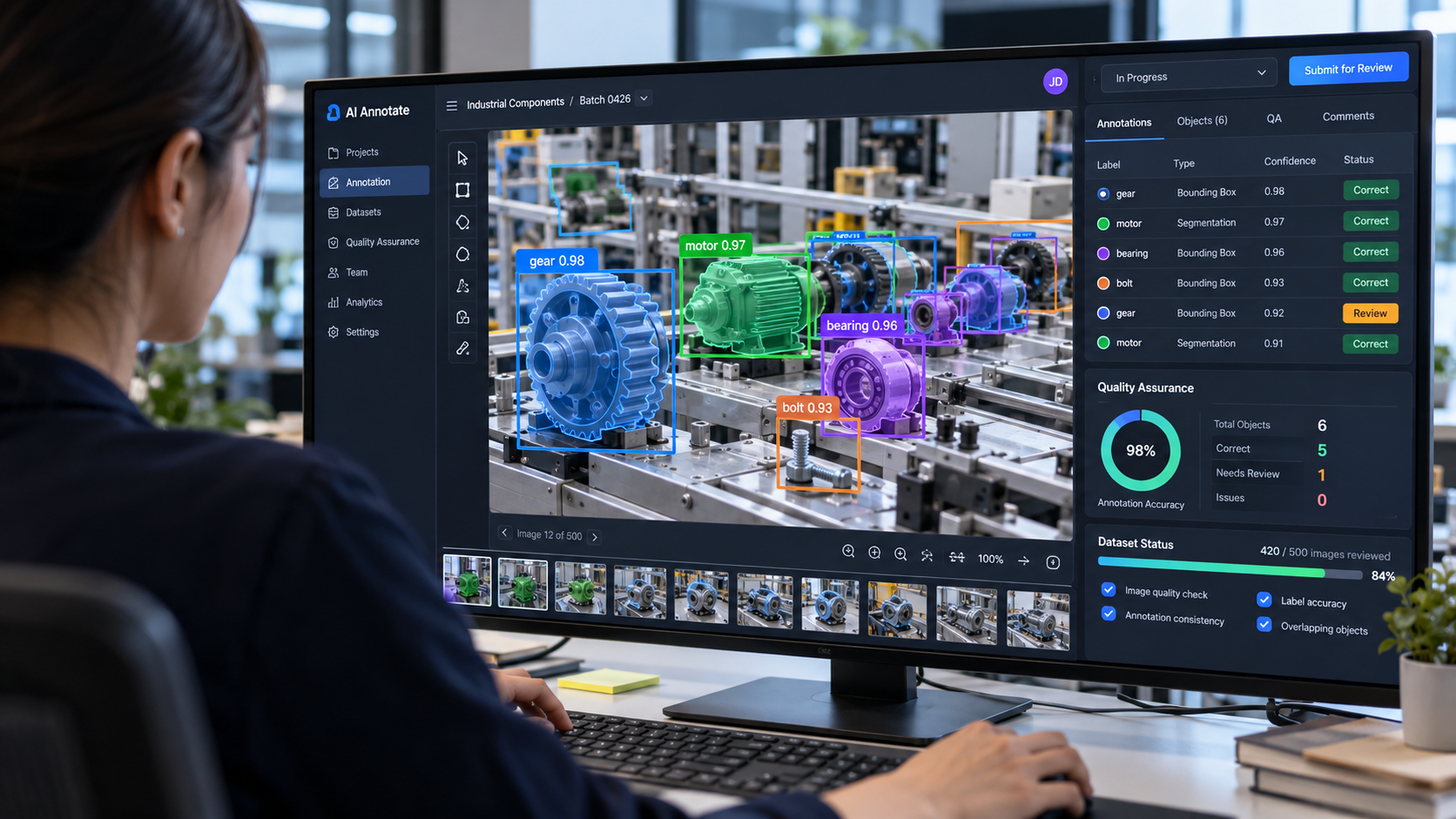
One of the most common mistakes in computer vision development is focusing heavily on model architecture while underestimating the importance of training data quality.
Even a sophisticated model can struggle when its annotations are inconsistent.
For example, imagine a dataset where some annotators draw tight bounding boxes around visible objects while others include large amounts of surrounding background.
Both may believe they're following the instructions, but the inconsistency introduces noise into the training process.
Segmentation projects face similar challenges when annotators interpret object boundaries differently.
This is why reliable computer vision annotation services need more than annotation tools.
They need clear labeling guidelines, structured review processes, and measurable quality standards.
Amazon SageMaker's documentation on image label verification illustrates how annotation workflows can incorporate human review to check and refine labels before they're used for model training.
Depending on the project, quality assurance may also involve automated validation, independent reviewer checks, inter-annotator agreement, or targeted reviews of difficult examples.
It's important to evaluate annotations against the intended task.
A dataset can be technically consistent and still perform poorly if its labels don't represent the environments or scenarios the model will encounter in production.
Choosing an annotation provider should involve more than comparing turnaround times or per-image pricing.
A capable provider should understand how annotation decisions affect downstream model development.
Before starting a project, consider asking:
It's also worth requesting a small pilot before committing to a large-scale annotation project.
A pilot can reveal whether the provider understands your requirements, how consistently the team applies guidelines, and whether the resulting annotations are suitable for model training.
Computer vision annotation is becoming increasingly automated, but human expertise remains important.
Modern annotation platforms can use pretrained models to suggest object labels, generate preliminary bounding boxes, and create segmentation masks.
Instead of starting every annotation manually, human reviewers can correct and refine those predictions.
This approach can reduce repetitive work, particularly when the underlying model performs well on the target dataset.
However, automated annotation isn't equally reliable across every environment.
Unusual camera angles, poor lighting, unfamiliar objects, and complex scenes can still lead to incorrect predictions.
For this reason, human-in-the-loop annotation workflows remain valuable, especially in projects where errors have significant consequences.
The most effective workflow is often one that combines automation for efficiency with human review where judgment and precision are needed.
Bounding boxes, segmentation, and classification are all essential tools in computer vision development, but they shouldn't be treated as interchangeable.
Classification works well when the model needs to recognize image categories. Bounding boxes provide the location information required for object detection. Segmentation offers the detailed spatial understanding needed for applications where object boundaries and individual regions matter.
The best choice isn't necessarily the most advanced or expensive method.
It's the one that gives the model the right information to accomplish its intended task.
For organizations evaluating computer vision annotation services, that means starting with clearly defined model objectives, testing annotation requirements early, and maintaining consistent quality standards throughout the dataset.
Because ultimately, successful computer vision systems depend not just on how much data they receive, but on how well that data represents what they're expected to understand.
Computer vision annotation services label images and videos to create training datasets for AI models. Common methods include image classification, bounding boxes, and segmentation, depending on the visual information a model needs to learn.
Bounding boxes use rectangles to identify the approximate location of objects, while segmentation identifies the exact pixels belonging to an object or region. Segmentation provides more detailed spatial information but typically requires greater annotation effort.
Image classification is generally simpler to annotate because it assigns labels to an entire image. Object detection requires identifying and locating individual objects, usually through bounding boxes.
Autonomous vehicle systems often combine object detection and segmentation. Bounding boxes help locate vehicles and pedestrians, while segmentation helps distinguish roads, sidewalks, and other important regions.
Yes. AI-assisted annotation tools can generate preliminary labels, bounding boxes, and segmentation masks. However, human review remains important for correcting errors, handling difficult images, and maintaining annotation consistency.


Compact, ready to go anywhere
Interchangeable lens that’s upgradeable
Dual 1-inch sensors for improved clarity and low light performance
Dynamic range and 6K 360° capture
360° photo resolution at 21MP

8K 360° video recording for ultra-detailed visuals.
4K single-lens mode for traditional wide-angle shots.
Invisible selfie stick effect for drone-like perspectives.
2.5-inch touchscreen with Gorilla Glass protection.
Waterproof up to 33ft for underwater shooting.

360° photo resolution in 23MP
Slim design at 24 mm thick
Built-in image stabilization for smooth video capture.
Internal 19GB storage for photo and video storage.
Wireless connectivity for remote control and sharing.

60MP 360° still images for high-resolution photography.
5.7K 360° video recording at 30fps.
2.25-inch touchscreen for intuitive control.
USB Type-C port for fast charging and data transfer.
MicroSD card slot for expandable storage.
.png)

.png)

Try it free. No credit card required. Instant set-up.






.svg)


.svg)