


.png)


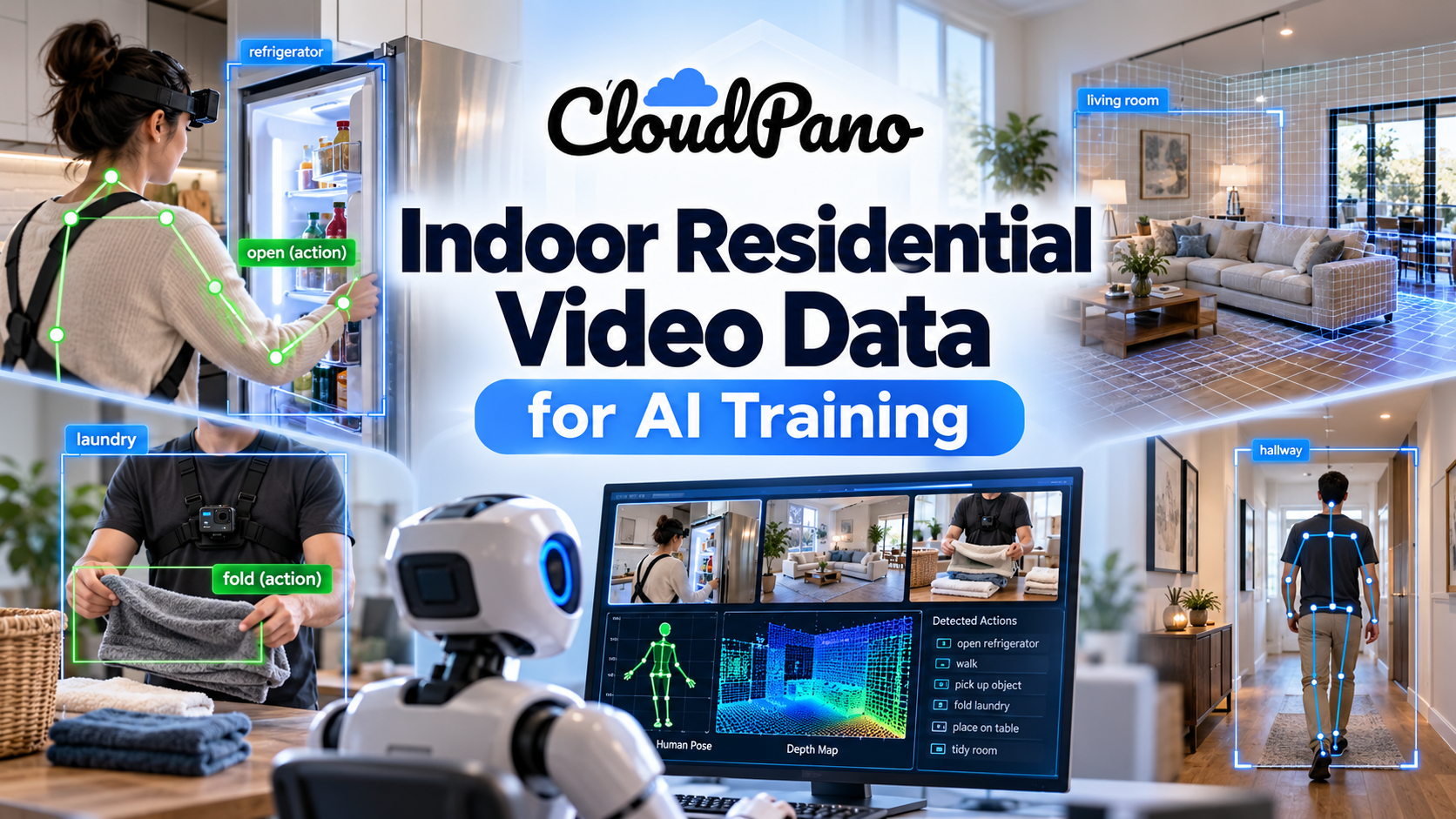
An indoor video dataset for AI is a collection of video recorded inside homes or other buildings, labeled so models can learn rooms, objects and everyday tasks. Real home footage is scarce because homes are private, cluttered and all different. Public sets like EPIC-KITCHENS-100 cover 45 kitchens, so teams building household robots often commission custom in-home capture
If you are building a model that has to work inside people's homes, the hardest part is often finding video of real homes to train it on. EPIC-KITCHENS-100, one of the best-known home video datasets, covers 45 kitchens in 4 cities (EPIC-KITCHENS), and it is licensed for non-commercial use only.
That gap is the reason indoor residential video has become one of the most sought-after types of real-world video data. This guide covers what an indoor video dataset for AI contains, why home footage is so scarce, what public datasets offer, and how teams collect their own.
An indoor video dataset for AI is a set of videos recorded inside buildings, paired with labels that tell a model what is happening in each clip. When the buildings are homes, it is often called indoor residential video data or a home activity dataset for AI.
The labels are what turn footage into training data. Depending on the use, a home video dataset can include:
Two camera styles are common. Third-person video is filmed from a fixed spot, like a camera on a shelf. First-person (egocentric) video is filmed from a camera worn on the head or chest, so it shows the scene the way the person doing the task sees it.
Home footage is scarce because homes are private, everyday chores are not the kind of video people post, and no two homes look alike. Each of those adds cost and time to collection.
Everyday home life is missing from the internet. The researchers behind the Charades dataset made this point directly: the boring daily scenes models need to learn from typically do not appear on YouTube, in movies or on TV (Sigurdsson et al., arXiv). Web video is full of cooking shows and home tours, but very little of it shows someone folding laundry, wiping a counter or looking for keys in a cluttered room.
Homes are private spaces. Filming inside a home means filming people's belongings, family members, mail on the counter and screens in the background. A responsible collector needs signed consent from the person recording, a plan for anyone else who walks into frame, and a way to blur faces and personal details before data leaves the capture stage.
Every home is different. Layouts, furniture, lighting and clutter change from one home to the next. A model trained in one apartment learns that apartment. To generalize, it needs many homes, not many hours in the same home.
Robots cannot easily go there yet. Collecting robot data in a home means bringing an early-stage robot into a stranger's kitchen or bathroom. That is why many teams now record people doing household tasks instead, and use that human video to pretrain robot models.
Public datasets are a good starting point for research, but most cover a limited number of homes and many restrict commercial use. Here are some of the best-known options, with figures taken from each dataset's own page or paper:
For more on datasets that focus on everyday tasks, see our guide to daily activity video datasets.
Before you train on any public set, read its license. A dataset can be free to download and still forbid commercial training.
Household robots are one of the main buyers of indoor video, because a home robot has to work in homes it never saw during training. Human video recorded in real homes is a practical way to show a model that variety.
Two public examples show the trend:
The takeaway for anyone building in this space: the homes in your training data shape the homes your model can handle.
Useful home video covers many different homes, follows a clear task list, and comes with clean labels, consent records and a license that allows your use. Raw hours matter less than whether the footage matches what your model will face.
A practical checklist:
Most teams that need home data at scale commission it: they write a spec, and a collection provider records paid, consenting contributors doing those tasks in their own homes. Firsthand, CloudPano's data line, runs this kind of in-home egocentric data collection.
According to Firsthand's own pages, the process works like this:
Firsthand also lists a pre-collected household chores dataset with 2,310 validated hours, 14,100 episodes, 188 participants and 88 capture sites, covering laundry, tidying, cleaning and surface reset across living spaces, bedrooms, bathrooms, utility rooms, stairs and hallways (Firsthand).
Custom collection has real limits, and it is better to know them up front:
If a public dataset already covers your rooms and tasks under a license you can use, start there. If it doesn't, Firsthand's egocentric video data collection can be scoped to the homes and tasks your model is missing.
An indoor video dataset for AI is only as good as the homes inside it. Public sets like EPIC-KITCHENS-100, Charades and Ego4D are valuable for research, but they cover a limited number of homes and some forbid commercial use. As robotics companies turn to real homes for training data, the teams that can name the rooms, tasks and license they need, and collect against that spec, will have a clear edge.
Most are trained on a mix of data: video of people doing tasks, simulation, and recordings of real robots. NVIDIA's GR00T N1, for example, was trained on real-robot trajectories, human videos and synthetic data. Human video from real homes helps a robot see many layouts and objects before it ever enters one.
Start with public datasets such as EPIC-KITCHENS-100, Charades or Ego4D, but check each license, since some ban commercial use. For video your model needs that public sets don't cover, such as specific rooms or chores, you can buy pre-collected datasets or commission custom collection from a provider.
Define the task first, then record it in the real setting where the model will be used, with consent from everyone filmed. Add labels for actions and objects, have people review them, and record the license terms. For home video, plan for privacy: blur faces, plates and screens before the data is shared.
It shouldn't. Responsible AI training data is collected with documented consent from the people being recorded. For home video, that means a signed release from each contributor, a rule for anyone else who walks into frame, and anonymization such as blurring faces and screens before the footage is used.
Many are trained by watching people. Teams record first-person video of humans doing tasks, then use it to pretrain robot models. Figure AI reported that after training on egocentric human video only, its Helix model could navigate cluttered real-world spaces from natural language commands.


Compact, ready to go anywhere
Interchangeable lens that’s upgradeable
Dual 1-inch sensors for improved clarity and low light performance
Dynamic range and 6K 360° capture
360° photo resolution at 21MP

8K 360° video recording for ultra-detailed visuals.
4K single-lens mode for traditional wide-angle shots.
Invisible selfie stick effect for drone-like perspectives.
2.5-inch touchscreen with Gorilla Glass protection.
Waterproof up to 33ft for underwater shooting.

360° photo resolution in 23MP
Slim design at 24 mm thick
Built-in image stabilization for smooth video capture.
Internal 19GB storage for photo and video storage.
Wireless connectivity for remote control and sharing.

60MP 360° still images for high-resolution photography.
5.7K 360° video recording at 30fps.
2.25-inch touchscreen for intuitive control.
USB Type-C port for fast charging and data transfer.
MicroSD card slot for expandable storage.
.png)

.png)

Try it free. No credit card required. Instant set-up.






.svg)


.svg)