


.png)


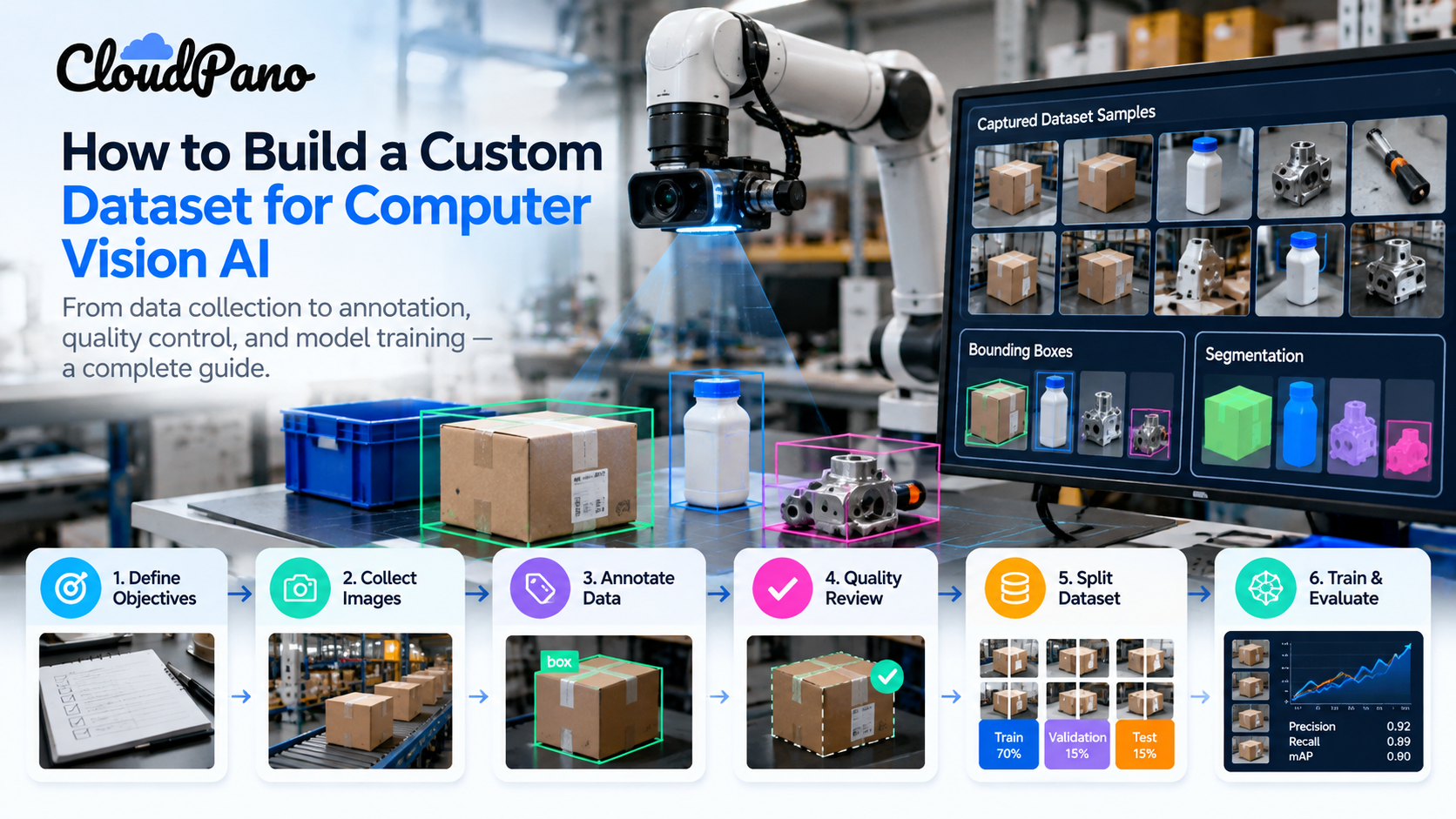
To build a custom computer vision dataset, define the model's objectives, collect representative images or videos, select an annotation method, establish labeling guidelines, and verify annotation quality. Next, divide the data into training, validation, and test sets, apply appropriate preprocessing, train a baseline model, and improve the dataset based on evaluation results.
A computer vision model can perform exceptionally well during testing and still struggle when it encounters the real world.
A product recognition system might identify objects perfectly against a clean background but fail when those same products appear on crowded shelves. A warehouse robot might recognize packages under bright lighting yet struggle when shadows or overlapping objects enter the scene.
When this happens, the instinct is often to improve the model itself. But sometimes, the bigger problem is the data it learned from.
Public datasets are valuable for experimentation, but they rarely capture every environment, camera angle, object variation, or unusual scenario a specialized AI application needs to handle.
That's where custom datasets become important.
Building a custom computer vision dataset involves more than collecting images and labeling objects. It requires a clear understanding of the model's objectives, a thoughtful data collection strategy, reliable annotation workflows, and ongoing evaluation.
In this guide, we'll walk through the process and explain how computer vision annotation services, custom data collection, and quality assurance contribute to reliable AI training data.
A custom computer vision dataset is a collection of images or videos specifically gathered and prepared to train, fine-tune, or evaluate an AI model for a particular task.
Unlike general-purpose datasets, custom datasets are built around the conditions a model is expected to encounter.
For example, a manufacturer might collect images of defects unique to its production line. A robotics company may need first-person video recorded from a robot's perspective, while an agricultural technology provider might require crop images captured across different seasons.
The dataset may contain raw visual data, annotations, metadata, and documentation describing how the information was collected.
Custom dataset development is part of a broader data preparation process. As explained in CloudPano's guide to AI training data services, preparing usable training data often involves collection, annotation, validation, and evaluation.
Each stage matters because a model can only learn from the information represented in its training data.
Before collecting images, establish exactly what the model should accomplish.
This sounds straightforward, but poorly defined objectives can lead to expensive annotation work and datasets that don't support the intended application.
Consider an AI system designed to inspect manufactured components.
Does it need to determine whether a component is defective? Locate the defect? Or identify its precise shape and affected area?
These are different computer vision tasks, and they may require different types of training data.
Start by defining the model's intended output, target objects, operating environment, and performance requirements.
For object detection, evaluation metrics might include precision, recall, and mean average precision (mAP). Segmentation projects may use intersection over union (IoU) or Dice scores.
It's also important to identify which errors carry the greatest consequences.
A missed cosmetic defect and a missed safety-critical defect may require very different evaluation priorities.
Clear objectives make subsequent decisions about collection, annotation, and quality assurance much easier.
Not every computer vision project needs to start from scratch.
Existing datasets can be useful for initial experimentation, model pretraining, benchmarking, or fine-tuning.
However, the fact that a dataset is publicly available doesn't mean it's suitable for every application.
A dataset collected from dashboard cameras may not represent the viewpoint of a mobile warehouse robot. Similarly, images captured under controlled laboratory conditions may not reflect the lighting and visual clutter of an actual production environment.
Before using an existing dataset, consider its relevance to your target application.
Look at object categories, camera perspectives, environmental conditions, annotation formats, and licensing restrictions.
Custom collection becomes particularly valuable when available datasets lack the environments, devices, activities, or edge cases your model needs.
In many projects, the most practical approach is to combine existing data with newly collected examples that address specific gaps.
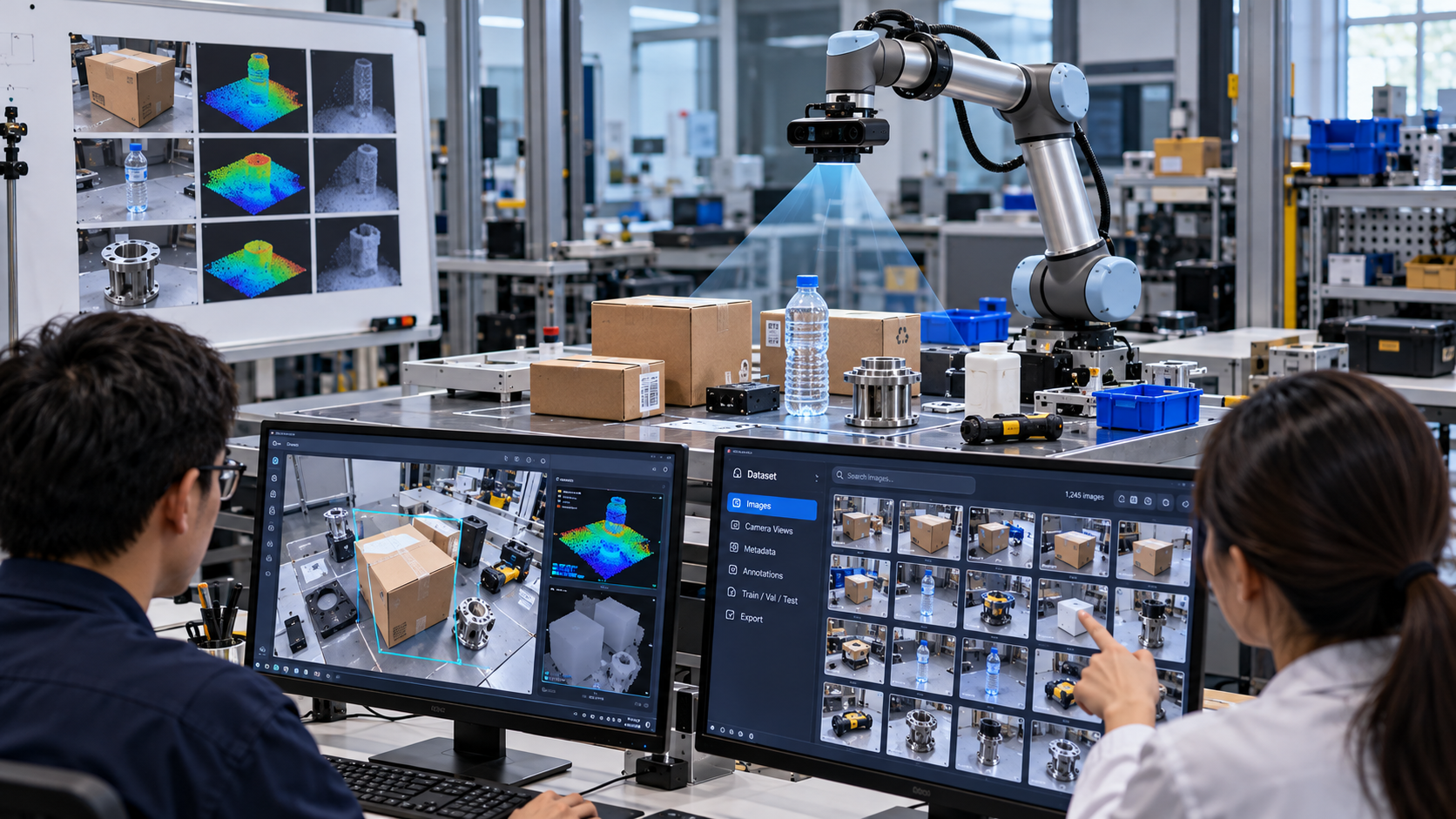
Collecting thousands of images isn't necessarily difficult. Collecting thousands of images that genuinely improve model performance is another matter.
Imagine training a system to recognize damaged packages in a warehouse.
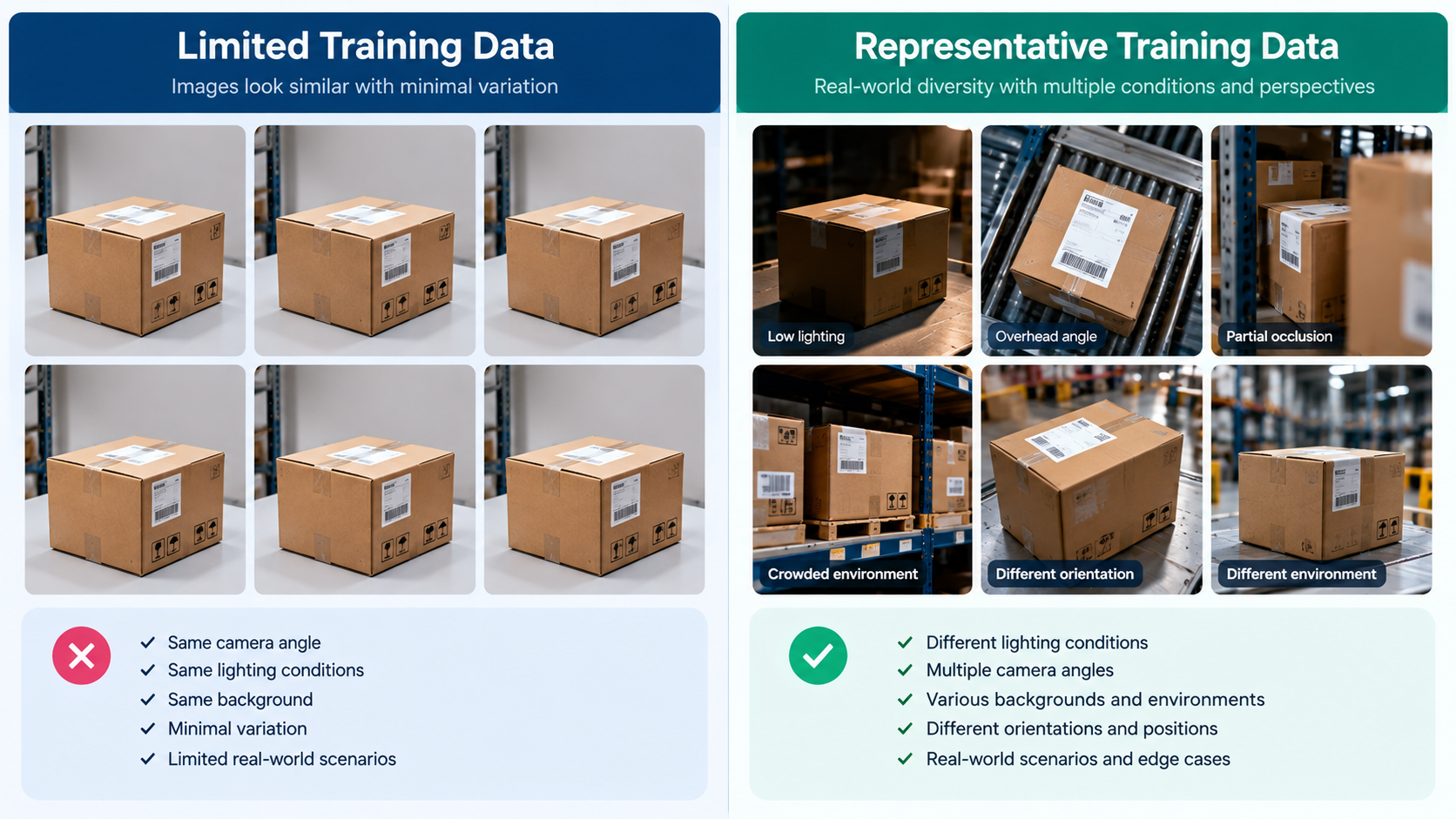
If every image comes from the same camera, at the same height, under identical lighting, the model may perform well during development but struggle when deployed elsewhere.
Real environments introduce variation.
Packages overlap. Lighting changes throughout the day. Cameras capture objects from different angles. Some objects are partially hidden, while others appear blurry because they're moving.
A strong data collection strategy accounts for these conditions.
Your collection plan should consider:
The objective isn't simply to maximize image count. It's to capture enough meaningful variation for the model to learn patterns that generalize.
Some data requirements are difficult to meet through internal collection alone.
For example, a robotics project might require first-person footage recorded in specific environments using specialized capture devices. Other projects may need data from multiple countries, particular operating conditions, or uncommon activities.
In these situations, a specialized provider can help organize collection around clearly defined requirements.
Firsthand's custom data collection services, for example, are designed around project-specific specifications covering environments, devices, tasks, and edge cases. Its published workflow includes defining requirements, sourcing contributors, capturing data, conducting quality checks, and delivering the resulting dataset with documentation.
This type of approach can be useful when the required training data doesn't already exist or when collecting it internally would be difficult to coordinate.
Regardless of whether data is collected internally or externally, teams should establish clear acceptance criteria, privacy safeguards, consent requirements, and data usage rights before collection begins.
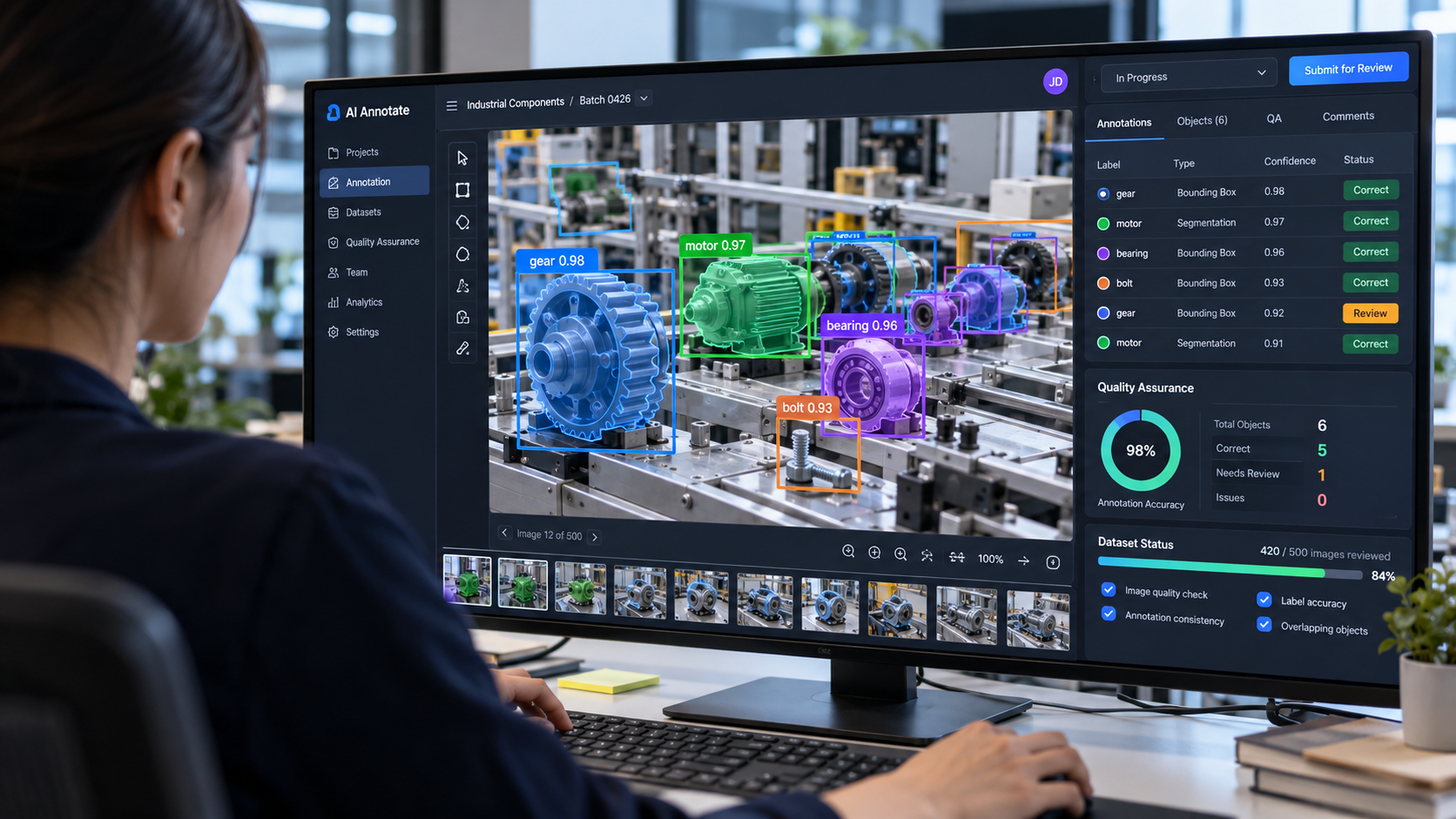
Once you've collected the images, the next question is how they should be labeled.
The annotation method determines what information the model can learn from the dataset.
Different computer vision tasks require different levels of detail.
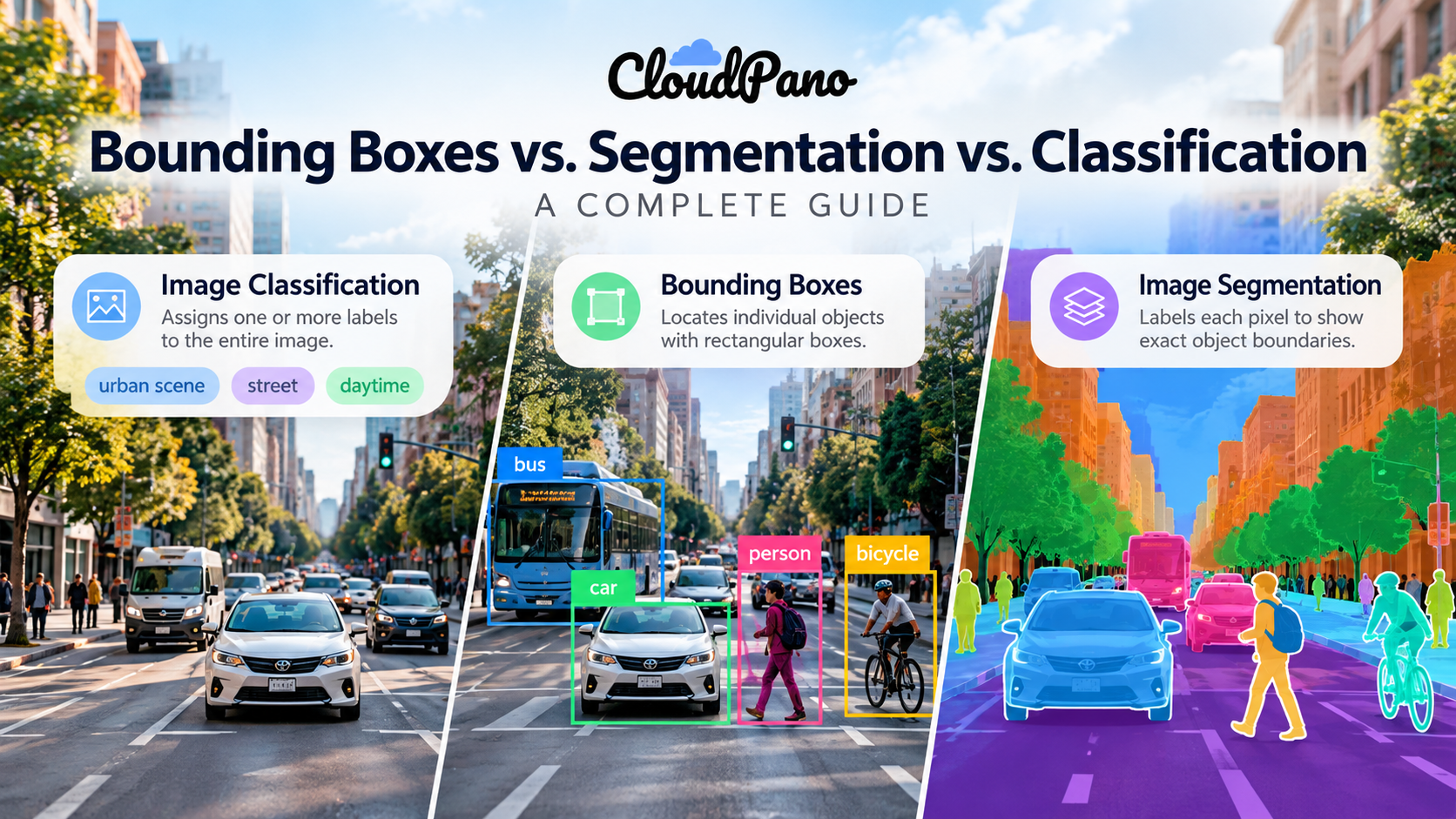
For a system that only needs to identify whether an image contains a damaged product, classification may be sufficient.
If the system must locate the damaged product, bounding boxes could be more appropriate.
When precise boundaries matter, segmentation may provide the necessary detail.
More detailed annotation isn't automatically better.
Segmentation generally requires more labeling effort than bounding boxes, and bounding boxes usually require more work than image-level classification.
The goal is to select the simplest annotation method that still provides the information your model needs.
This is where professional computer vision annotation services can help translate model requirements into consistent, scalable labeling instructions.
Even skilled annotators can interpret the same image differently.
Suppose a package is partially hidden behind another object.
Should the annotator label only the visible portion? Should the bounding box estimate the package's full dimensions? What happens if the object is too blurry to identify confidently?
Without clear instructions, different annotators may make different decisions.
Those inconsistencies can introduce noise into the training data.
Before annotation begins, create guidelines covering object definitions, labeling conventions, difficult examples, and review procedures.
Include visual examples wherever possible.
For segmentation tasks, explain how boundaries should be traced. For object detection, specify how to handle partially visible or overlapping objects.
Annotation platforms such as CVAT can help organize image and video labeling workflows, but even sophisticated software cannot compensate for unclear annotation requirements.
Consistency begins with well-defined rules.
Annotation quality should be evaluated throughout dataset development, not only after labeling is complete.
Common problems include missing objects, inaccurate bounding boxes, inconsistent class names, and segmentation masks that fail to follow object boundaries.
These errors can affect model training and make evaluation results less reliable.
A practical quality assurance process usually involves initial annotation, independent review, correction, and automated validation.
Reviewers should pay particular attention to difficult images, ambiguous objects, and categories that are frequently confused.
Automated checks can help identify invalid coordinates, missing labels, unexpected class names, or incorrectly formatted files.
The CVAT quality control documentation describes review and validation capabilities that can support these workflows.
For larger projects, teams may also measure agreement between annotators or evaluate a sample of annotations against verified reference labels.
The objective is not simply to eliminate obvious mistakes. It's to maintain a consistent interpretation of the annotation guidelines across the entire dataset.
After annotation and quality review, the dataset needs to be organized for model development.
Most supervised computer vision projects use three subsets.
Training data is used to fit the model.
Validation data helps compare models, tune parameters, and guide development decisions.
Test data is reserved for evaluating the final model on examples that weren't used during training or model selection.
A 70/15/15 split is one possible starting point, although the appropriate proportions depend on the dataset and evaluation strategy.
Google's Machine Learning Crash Course explains the importance of keeping training, validation, and test data separate.
One issue deserves particular attention: data leakage.
Imagine extracting thousands of frames from a warehouse video and randomly distributing them across the three subsets.
Nearly identical frames could appear in both training and testing data.
The resulting evaluation might look impressive, but it wouldn't necessarily demonstrate that the model can generalize to new environments.
For video datasets, splitting by recording session is often more appropriate than splitting individual frames randomly.
Other projects may need to separate data by location, camera, product batch, or collection date.
The split should reflect the kind of real-world generalization the model is expected to achieve.
Computer vision models often require images to be resized, normalized, or converted into specific formats before training.
Annotations must also match the model's expected input structure.
Data augmentation can introduce additional variation into the training set.
Common techniques include controlled rotations, brightness adjustments, cropping, scaling, and horizontal flipping.
However, augmentation should be applied carefully.
For example, flipping an image may be appropriate for general object recognition but unsuitable when orientation is essential to the task.
Any geometric transformation must also be applied correctly to bounding boxes, keypoints, or segmentation masks.
Otherwise, the image and its annotations will no longer match.
Augmentation should generally be applied to training data rather than altering validation and test examples in ways that compromise evaluation.
A custom dataset isn't truly validated until it's tested through model training and evaluation.
Start with a reasonable baseline model and measure its performance against the project's original objectives.
But don't stop at a single accuracy score.
Examine which objects the model frequently misses, which categories it confuses, and which environmental conditions produce poor predictions.
Suppose a package detection model performs well under normal warehouse lighting but struggles when objects overlap.
That result suggests a possible dataset coverage problem.
Collecting additional examples of overlapping packages may be more useful than simply adding more ordinary warehouse images.
This is one of the most valuable parts of dataset development.
Model errors provide evidence about what the training data may be missing.
The process becomes iterative: evaluate performance, identify weaknesses, collect or relabel relevant examples, and test again.
Computer vision datasets rarely remain unchanged.
New images are collected, annotation guidelines evolve, labeling errors are corrected, and additional object categories may be introduced.
Without dataset versioning, it becomes difficult to reproduce experiments or determine which data produced a particular model.
A good dataset management process records collection dates, annotation changes, class definitions, dataset splits, preprocessing settings, and evaluation results.
This becomes particularly important when multiple teams or external annotation providers contribute to the same project.
It also helps organizations respond to changes after deployment.
A model trained on one environment may need additional examples when new cameras, products, or operating conditions are introduced.
Treating the dataset as a maintained resource rather than a one-time deliverable supports more reliable long-term development.
Small, well-defined datasets may be manageable internally.
However, larger or more specialized projects often introduce challenges involving contributor recruitment, data collection logistics, annotation consistency, and quality assurance.
Professional providers can be useful when teams need access to environments they cannot easily capture, specialized annotation capabilities, or ongoing dataset production.
The right provider depends on the project's actual requirements.
Some specialize in annotation, while others support the broader workflow from custom data collection through validation and delivery.
Before committing, ask about collection methodology, annotation standards, quality assurance, data ownership, privacy requirements, and delivery formats.
A small pilot project can help verify that the resulting data meets your specifications before production scales.
Several mistakes repeatedly undermine custom computer vision datasets.
Prioritizing quantity over diversity. Thousands of nearly identical images may add little useful information.
Using unclear annotation rules. Inconsistent labels can make training data less reliable.
Ignoring unusual scenarios. Rare events may be precisely where the model needs stronger performance.
Allowing data leakage. Similar examples across training and evaluation sets can create misleading results.
Neglecting dataset documentation. Without clear records, reproducing experiments and tracking improvements becomes difficult.
Assuming the first dataset is final. Real-world performance often reveals gaps that weren't obvious during initial development.
Avoiding these problems requires deliberate planning, not necessarily a larger budget.
Building a custom computer vision dataset is about creating training data that accurately reflects the problem an AI model is expected to solve.
That begins with clearly defined objectives and representative image collection. It continues through appropriate annotation methods, consistent labeling, quality assurance, careful dataset splitting, and ongoing evaluation.
Existing datasets can provide a useful foundation, while custom collection helps address the environments, activities, and edge cases that general-purpose resources may not cover.
Whether teams manage the process internally or work with professional computer vision annotation services, the most important principle remains the same.
A successful dataset isn't measured only by how many images it contains. Its real value comes from how effectively it prepares the model for the conditions it will encounter beyond the training environment.
There is no universal minimum. The number depends on the task, model architecture, visual complexity, class diversity, and whether pretrained models are used. Start with a representative pilot dataset and expand based on evaluation results.
The best method depends on the model's task. Classification labels entire images, bounding boxes locate objects, and segmentation identifies precise regions. More detailed annotations aren't automatically better.
Yes, provided the images are appropriately licensed and suitable for the intended use. Teams should verify usage rights, annotation quality, dataset relevance, and applicable privacy requirements.
A common starting point is 70% training, 15% validation, and 15% testing, but there is no mandatory ratio. The most important requirement is preventing data leakage and ensuring that evaluation data reflects real-world conditions.
Professional annotation services can help teams label large or complex datasets consistently, implement quality control, and prepare training data in formats compatible with machine learning workflows.
1. Google for Developers – Dividing Datasets for Machine Learning
Best practices for splitting datasets into training, validation, and test sets while preventing data leakage.
2. CVAT – Annotation Platform Overview
An overview of computer vision annotation tools, labeling methods, and dataset annotation workflows.
3. CVAT – Annotation Quality Control
Guidance on reviewing annotations, measuring labeling accuracy, and maintaining dataset quality.
4. Roboflow – Dataset Preprocessing
Information about image preprocessing techniques used when preparing computer vision datasets.


Compact, ready to go anywhere
Interchangeable lens that’s upgradeable
Dual 1-inch sensors for improved clarity and low light performance
Dynamic range and 6K 360° capture
360° photo resolution at 21MP

8K 360° video recording for ultra-detailed visuals.
4K single-lens mode for traditional wide-angle shots.
Invisible selfie stick effect for drone-like perspectives.
2.5-inch touchscreen with Gorilla Glass protection.
Waterproof up to 33ft for underwater shooting.

360° photo resolution in 23MP
Slim design at 24 mm thick
Built-in image stabilization for smooth video capture.
Internal 19GB storage for photo and video storage.
Wireless connectivity for remote control and sharing.

60MP 360° still images for high-resolution photography.
5.7K 360° video recording at 30fps.
2.25-inch touchscreen for intuitive control.
USB Type-C port for fast charging and data transfer.
MicroSD card slot for expandable storage.
.png)

.png)

Try it free. No credit card required. Instant set-up.





.svg)


.svg)