


.png)


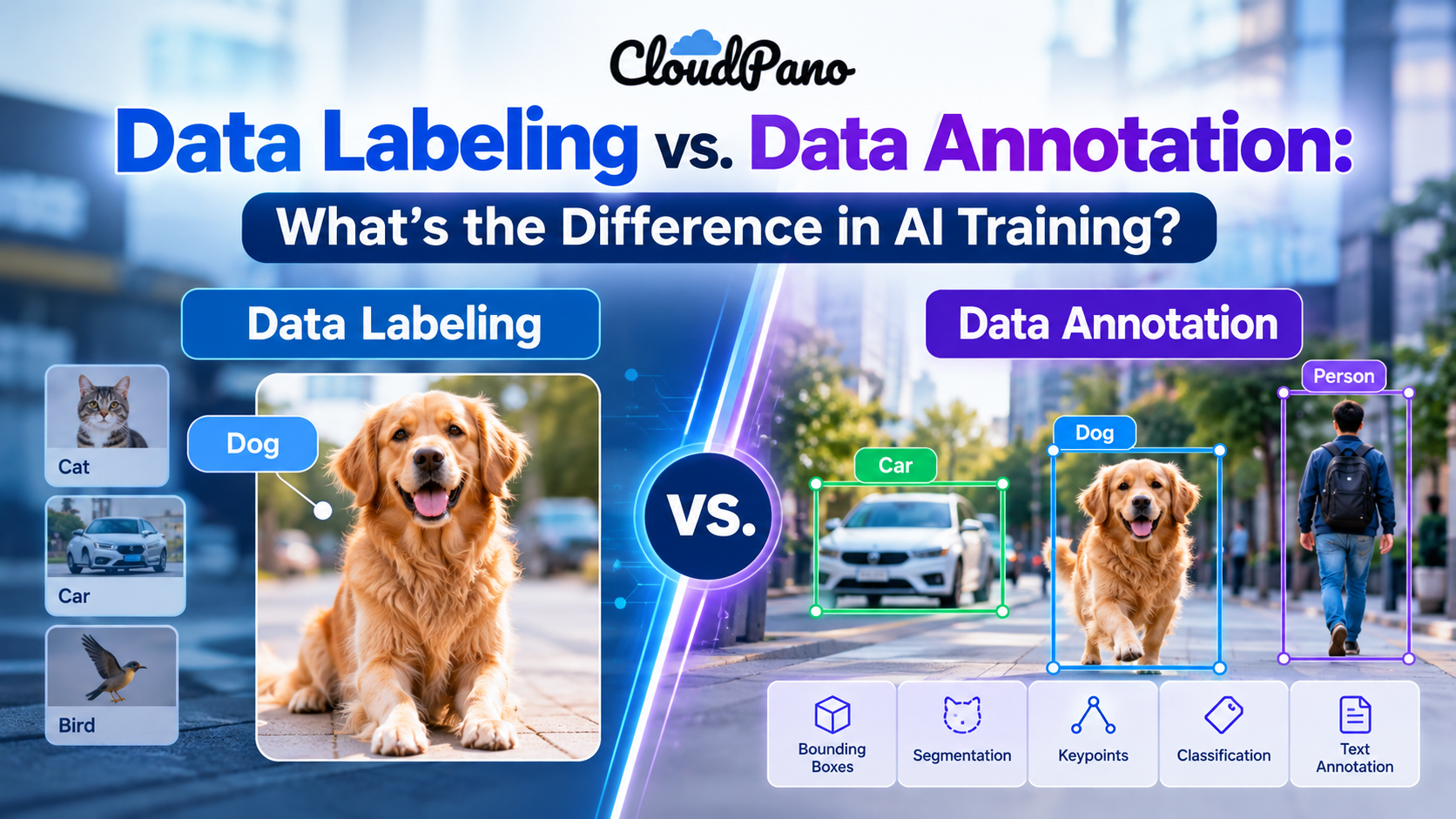
Data labeling involves assigning categories, tags, or target values to information so machine learning models can learn from examples. Data annotation is a broader process that may include labeling as well as identifying object boundaries, text spans, timestamps, and relationships within data. Although the terms are often used interchangeably, the practical difference is usually the level of detail required by the AI task.
Artificial intelligence learns from examples. But before a machine learning model can recognize a damaged product, understand a customer complaint, or identify a pedestrian in an image, it needs data that communicates what those examples mean.
That is where data labeling and data annotation come in.
These two terms appear frequently in conversations about AI development, often describing what seems to be the same activity. In many organizations, they are used interchangeably. Yet depending on the project, they can describe different levels of detail in preparing training data.
Understanding the distinction matters because not every AI system needs the same kind of information.
A model that sorts emails into categories has different data requirements from one that identifies individual objects in a photograph. Both may rely on labeled examples, but the structure and complexity of those examples can vary significantly.
This guide explains data labeling vs. data annotation, how each process works, where they overlap, and how to choose the right approach for an AI project.
Data labeling is the process of assigning meaningful categories, values, or identifiers to data so that machine learning systems can learn from examples.
In supervised machine learning, labels often represent the expected answer associated with an input.
For example, an email classification dataset might contain messages labeled as "spam" or "not spam."
A sentiment analysis dataset might classify customer reviews as positive, negative, or neutral.
In both cases, the label tells the model what outcome it should learn to predict.
Data labeling can be relatively straightforward when the categories are clearly defined. However, complex projects may require expert knowledge, detailed guidelines, and multiple rounds of review.
A medical imaging dataset, for example, might require qualified specialists to classify images according to specific diagnostic criteria.
The central purpose of data labeling is to create reliable learning signals that help models connect input information with expected outputs.
These labels help AI systems recognize patterns and make predictions when presented with new information.
Data annotation is the process of adding descriptive information, structured markers, or contextual details to raw data.
It can involve assigning categories, but it also includes tasks that identify where something appears, when an event occurs, or how different elements relate to one another.
For example, rather than simply labeling an image as containing a vehicle, an annotator might draw a bounding box around each vehicle.
A more detailed project could identify the precise pixels belonging to the vehicle, classify its type, or track its movement across video frames.
Text annotation may involve highlighting named entities, identifying relationships between words, or marking important passages.
Audio annotation can include transcription, speaker identification, and timestamping.
The purpose is to make relevant information explicit and machine-readable.
Annotation is particularly important when an AI model must understand structure, location, sequence, or relationships rather than predict a single category.
The most useful distinction is that data labeling usually emphasizes assigning a category or target value, while data annotation can describe a broader range of structured information.
However, this distinction is not universal.
In practical AI development, a bounding box can itself carry a class label, and an image classification label can be considered a simple annotation.
The terminology often depends on the organization, software platform, and type of machine learning task.
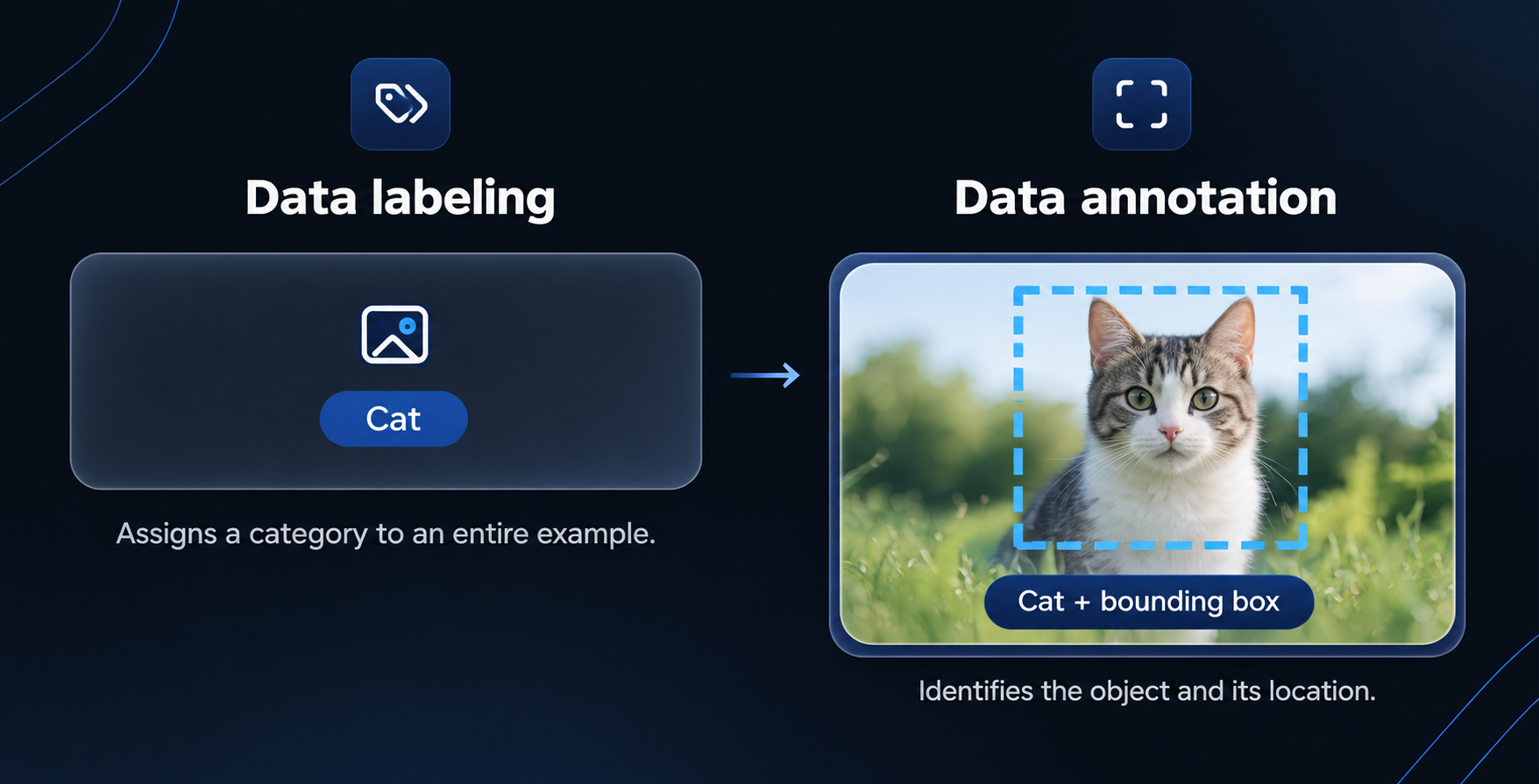
The practical takeaway is that these processes overlap. What matters most is defining the exact output the model needs.
Data labeling generally begins with a clearly defined prediction task.
Suppose a company wants to develop an AI system that automatically categorizes incoming customer support messages.
The team first determines the categories the model should recognize, such as billing, technical support, account access, and general inquiries.
Next, a representative collection of historical messages is gathered and reviewed.
Human labelers or automated systems assign the appropriate category to each message according to established instructions.
Some messages may be ambiguous or contain multiple issues. These cases require rules for selecting a primary category or assigning multiple labels.
After labeling, the dataset undergoes quality checks to identify inconsistencies and mistakes.
The verified examples can then be organized for model training and evaluation.
Although the process sounds simple, effective labeling depends on clear category definitions, consistent interpretation, and examples that reflect actual operating conditions.
Before annotation begins, organizations must first gather relevant information. Although these processes are closely connected, AI data collection vs. data annotation highlights an important distinction: data collection focuses on acquiring information, while annotation adds the labels and context needed for specific machine learning tasks.
Data annotation follows a similar preparation process but may involve more detailed instructions and specialized tools.
Consider a computer vision system designed to identify safety hazards at construction sites.
Simply labeling an image as "unsafe" may not provide enough information for the model to identify specific hazards.
Instead, annotators might mark the locations of workers, safety helmets, equipment, and restricted areas.
Depending on the model's objective, the project could require bounding boxes, segmentation masks, or relationships between objects.
For video analysis, annotations may also need to remain consistent across frames.
This additional structure helps the model learn where relevant objects appear and how they relate to the surrounding environment.
Annotation projects often require careful quality control because small mistakes in object boundaries or timestamps can affect training results.
The correct level of detail depends on what the model is expected to predict.

Image annotation
Includes bounding boxes, polygons, keypoints, and segmentation masks used for object detection, image segmentation, and pose estimation.

Text annotation
Identifies entities, sentiment, intent, relationships, or specific text spans for natural language processing applications.

Audio annotation
Includes transcription, speaker diarization, sound event identification, and time-aligned labels.

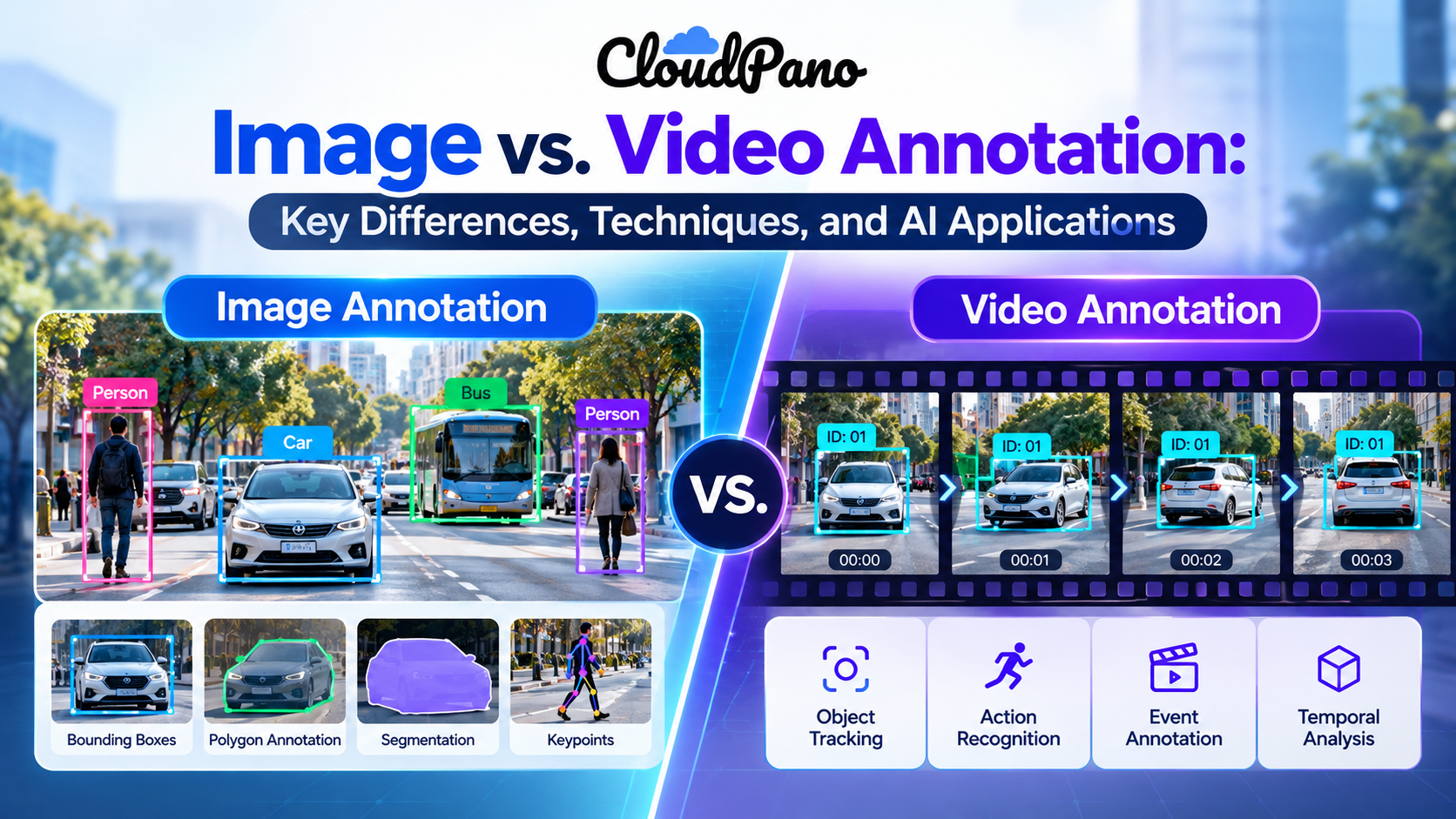
Video annotation
Tracks objects, actions, and events across sequences of frames, often requiring spatial and temporal consistency.
These annotation methods are not mutually exclusive. Multimodal AI systems may require several types of annotation within the same dataset.
Whether a dataset uses simple labels or detailed annotations, accuracy and consistency are essential.
Machine learning models learn patterns from the examples provided during training.
When those examples contain incorrect information, the model may learn associations that do not reflect reality.
For example, inconsistent sentiment labels can make it harder for a model to distinguish positive and negative language.
Poorly positioned bounding boxes may reduce an object detection model's ability to locate objects accurately.
Quality problems can also arise when certain categories or real-world situations are underrepresented.
Strong quality assurance processes therefore examine label accuracy, annotation consistency, dataset coverage, and potential bias.
Organizations may use automated checks, reviewer comparisons, expert audits, and targeted inspections of difficult examples.
The objective is not necessarily to achieve perfect agreement on every subjective task. It is to establish dependable standards that produce useful training signals.
Data labeling and annotation can be performed manually, automatically, or through a combination of both.
Manual workflows rely on people to interpret examples and apply project guidelines.
They are useful for complex tasks requiring contextual understanding or specialized expertise.
Automated workflows use algorithms or existing AI models to generate preliminary labels and annotations.
These methods can accelerate large-scale projects, particularly when the categories are well defined.
However, automated outputs may contain systematic errors or fail on unfamiliar examples.
A human-in-the-loop approach combines automation with human oversight.
For example, an object detection model may generate preliminary bounding boxes that reviewers correct before the annotations enter the training dataset.
This approach can reduce repetitive work while maintaining stronger quality controls.
The appropriate workflow depends on dataset complexity, accuracy requirements, budget, and the risks associated with incorrect predictions.
These activities are also part of broader AI training data services, which help organizations collect, prepare, label, annotate, and validate datasets for machine learning. Understanding how these services work together can help businesses build more reliable AI development workflows.
Labeling and annotation are important components of the broader AI training data pipeline.
Before either activity begins, teams typically collect relevant information, verify data permissions, remove unusable records, and standardize formats.
Next, they establish labeling or annotation guidelines based on the model's intended purpose.
The resulting data undergoes validation before being divided into training, validation, and test sets.
Dataset versioning and documentation help maintain consistency across experiments.
This process also creates opportunities for improvement.
If model evaluation reveals poor performance on certain examples, teams may revisit the data, correct annotations, or collect additional representative samples.
Understanding the complete training data pipeline helps organizations recognize that labeling and annotation are not isolated tasks.
Their effectiveness depends on the quality of the processes surrounding them.
The right approach depends primarily on the output the AI model needs to produce.
If the goal is to assign a category to an entire example, simple data labeling may be sufficient.
An email spam filter, for example, typically needs examples associated with spam or non-spam categories.
If the model must identify locations, relationships, or sequences within data, more detailed annotation is usually required.
A system that detects individual pedestrians in traffic footage needs information about where those pedestrians appear.
A speech recognition model may require transcripts aligned with audio segments rather than broad recording-level categories.
Teams should also consider annotation complexity, available expertise, project timelines, and the level of precision needed.
The most efficient solution is not necessarily the one with the most detailed annotations.
Collecting unnecessary information increases preparation costs without guaranteeing better model performance.
The objective is to create training data that provides the information required for the specific learning task.
Successful projects begin with clearly documented instructions.
Teams should define categories, annotation boundaries, ambiguous cases, and expected outputs before large-scale production begins.
A small pilot dataset can help reveal unclear guidelines and disagreements between reviewers.
Quality checks should then be incorporated throughout the process rather than postponed until the entire dataset is complete.
For complex tasks, organizations may use expert reviewers or adjudication procedures to resolve difficult cases.
It is also important to track dataset versions, annotation changes, and the origin of training examples.
Privacy and access controls should be considered whenever sensitive information is involved.
Finally, teams should evaluate whether the resulting dataset supports the model's intended real-world use.
These practices help make labeling and annotation more consistent, reproducible, and useful for AI development.
Data labeling and data annotation share a common purpose: making information useful for machine learning.
The difference is primarily one of scope and detail.
Data labeling often focuses on assigning categories or expected values to examples. Data annotation can include those labels while also describing object locations, text spans, timestamps, and other structured information.
In practice, the terms frequently overlap, and neither represents an inherently superior method.
What matters is choosing the right type of training data for the model being developed.
By defining clear requirements, maintaining consistent guidelines, and prioritizing quality, organizations can create datasets that support more accurate and dependable AI systems.
Ultimately, better AI does not begin with more complicated labels or annotations. It begins with the right information, prepared for the right purpose.
Data labeling and data annotation are often used interchangeably in machine learning. However, data labeling commonly refers to assigning categories or target values, while annotation may also involve adding detailed information such as object boundaries, text spans, and timestamps. The exact terminology depends on the project.
A common example is assigning positive, negative, or neutral labels to customer reviews for sentiment analysis. These labels provide examples that help a supervised machine learning model learn to classify new reviews.
An example is drawing bounding boxes around pedestrians and vehicles in street photographs. These annotations identify both the objects and their locations, helping computer vision models learn object detection.
Data annotation can be more complex when it requires precise object boundaries, timestamps, or relationships. However, some labeling tasks also require extensive expertise and judgment. Difficulty depends on the data type, task requirements, and quality standards.
Yes. AI tools can generate preliminary labels, identify objects, and assist with annotation. However, automated results may contain errors or biases. Human review and quality validation are often used to ensure that the resulting datasets meet project requirements.
IBM — What Is Data Labeling?
https://www.ibm.com/think/topics/data-labeling
Google Cloud — What Is Data Labeling?
https://cloud.google.com/use-cases/data-labeling
TechTarget — What Is Data Labeling?
https://www.techtarget.com/whatis/definition/data-labeling
AWS — Human-in-the-Loop and Ground Truth FAQs
https://aws.amazon.com/sagemaker/ai/groundtruth/faqs/


Compact, ready to go anywhere
Interchangeable lens that’s upgradeable
Dual 1-inch sensors for improved clarity and low light performance
Dynamic range and 6K 360° capture
360° photo resolution at 21MP

8K 360° video recording for ultra-detailed visuals.
4K single-lens mode for traditional wide-angle shots.
Invisible selfie stick effect for drone-like perspectives.
2.5-inch touchscreen with Gorilla Glass protection.
Waterproof up to 33ft for underwater shooting.

360° photo resolution in 23MP
Slim design at 24 mm thick
Built-in image stabilization for smooth video capture.
Internal 19GB storage for photo and video storage.
Wireless connectivity for remote control and sharing.

60MP 360° still images for high-resolution photography.
5.7K 360° video recording at 30fps.
2.25-inch touchscreen for intuitive control.
USB Type-C port for fast charging and data transfer.
MicroSD card slot for expandable storage.
.png)

.png)

Try it free. No credit card required. Instant set-up.





.svg)


.svg)