


.png)


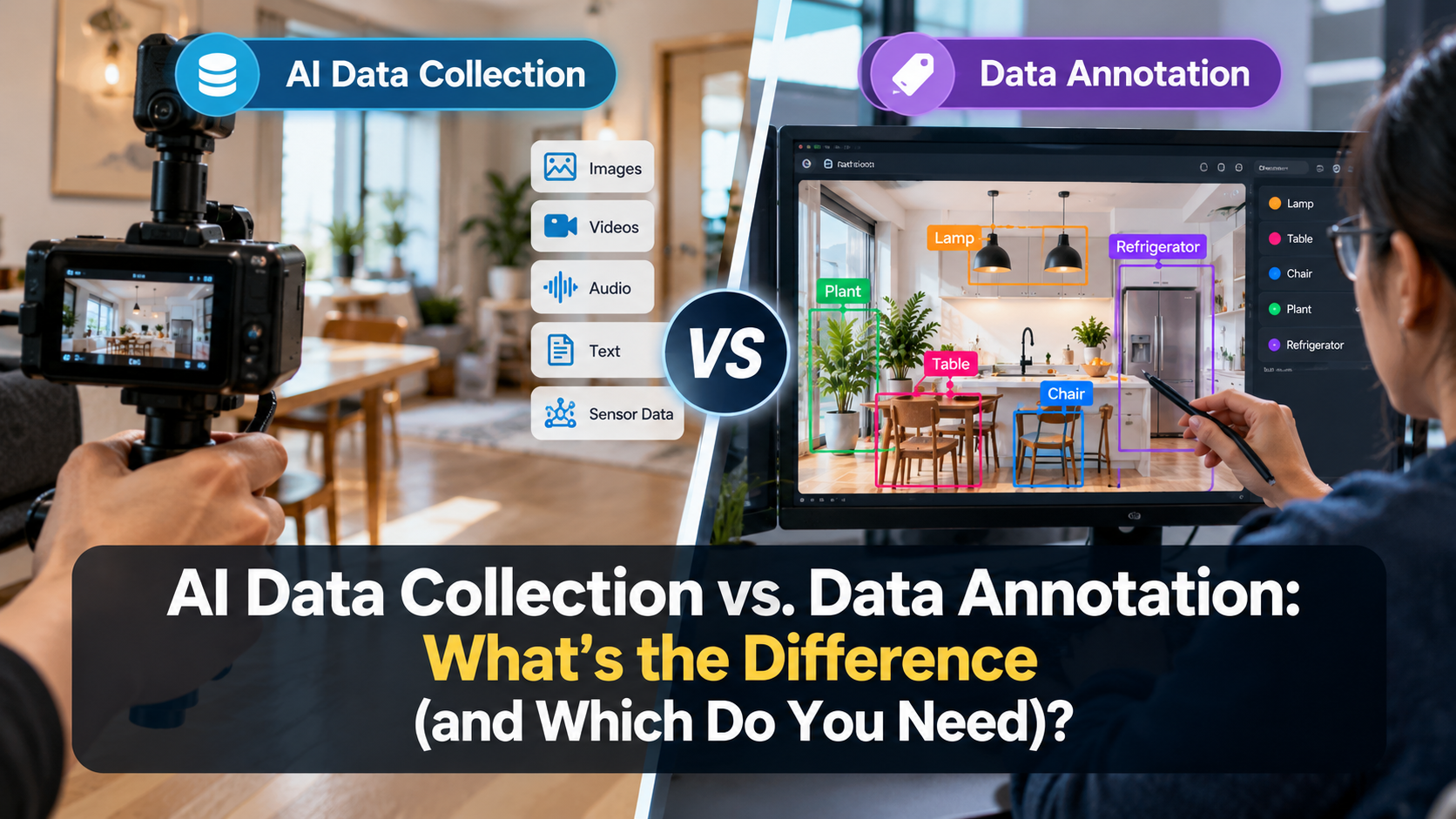
AI data collection gathers raw information such as images, videos, audio, text, or sensor data, while data annotation adds labels and structured metadata that help machine learning models interpret that data. If you don't have representative raw data, you need data collection. If you already have suitable data but need labels for supervised learning, you need annotation. Many AI training projects require both.
AI data collection and data annotation are separate but complementary stages of the machine learning data pipeline. Collection determines which real-world examples, environments, behaviors, and conditions are represented in a dataset, while annotation adds structured labels that can provide ground truth for supervised learning. High-quality annotation cannot compensate for an unrepresentative dataset, while useful raw data can lose value if its labels are inaccurate or inconsistent. AI teams should define their use case, coverage requirements, annotation schema, quality standards, and data rights before beginning large-scale collection or labeling.
Artificial intelligence models need data—but collecting data and annotating data are not the same thing.
AI data collection is the process of gathering raw images, videos, audio, text, sensor readings, or other information needed for AI development. Data annotation is the process of adding labels, tags, categories, or other structured information to that raw data so a machine learning model can learn from or evaluate it.
In simple terms:
Data collection gives you the raw material. Data annotation gives that material structured meaning.
For many supervised machine learning projects, you need both. First, you collect data that represents the environments, objects, behaviors, or situations your model needs to understand. Then, you annotate the relevant portions according to a defined labeling system.
Understanding the difference helps AI teams decide whether they need new raw data, annotation of existing data, or an end-to-end workflow that includes both.
AI data collection is the process of acquiring raw data for developing, training, validating, testing, or improving artificial intelligence and machine learning systems.
According to IBM's overview of training data, training data provides examples from which machine learning models can learn patterns and relationships.
Depending on the project, collected data might include:
For a computer vision project, for example, a team might collect thousands of videos showing people performing everyday activities such as cooking, cleaning, opening doors, handling objects, or using household appliances.
At this stage, the goal is to obtain relevant and representative raw data.
The footage doesn't necessarily need to tell the AI what every object or action means yet.
That comes during annotation.
Data annotation is the process of adding labels or structured metadata to raw data so machine learning systems can use it for tasks such as supervised training and evaluation.
As explained in IBM's guide to data labeling, labeling can add meaningful context to raw information such as images, video, text, and audio.
Imagine an unlabeled image showing a kitchen containing:
a refrigerator + table + person + bowl + chair
Annotation could identify those objects individually:
Refrigerator → refrigerator
Table → table
Person → person
Bowl → bowl
Chair → chair
Depending on the machine learning task, the annotation can become considerably more detailed.
An annotator might draw a bounding box around the refrigerator, identify the exact pixels belonging to an object, track an object through multiple video frames, mark where an action starts and stops, or identify how a person interacts with an object.
For supervised machine learning, these verified annotations can serve as ground truth against which a model learns or is evaluated. IBM's explanation of ground truth in machine learning provides additional context on the role of reference data in AI systems.
The simplest distinction is this:
The two processes solve different problems, but they frequently work together as parts of the same AI data pipeline.
These processes are often part of broader AI training data services, which can include data collection, annotation, validation, quality assurance, and evaluation. For a deeper overview, see our guide to AI training data services.
Define the AI use case → design the dataset → collect raw data → clean and organize the data → annotate relevant data → review annotation quality → split the dataset → train and evaluate the model.
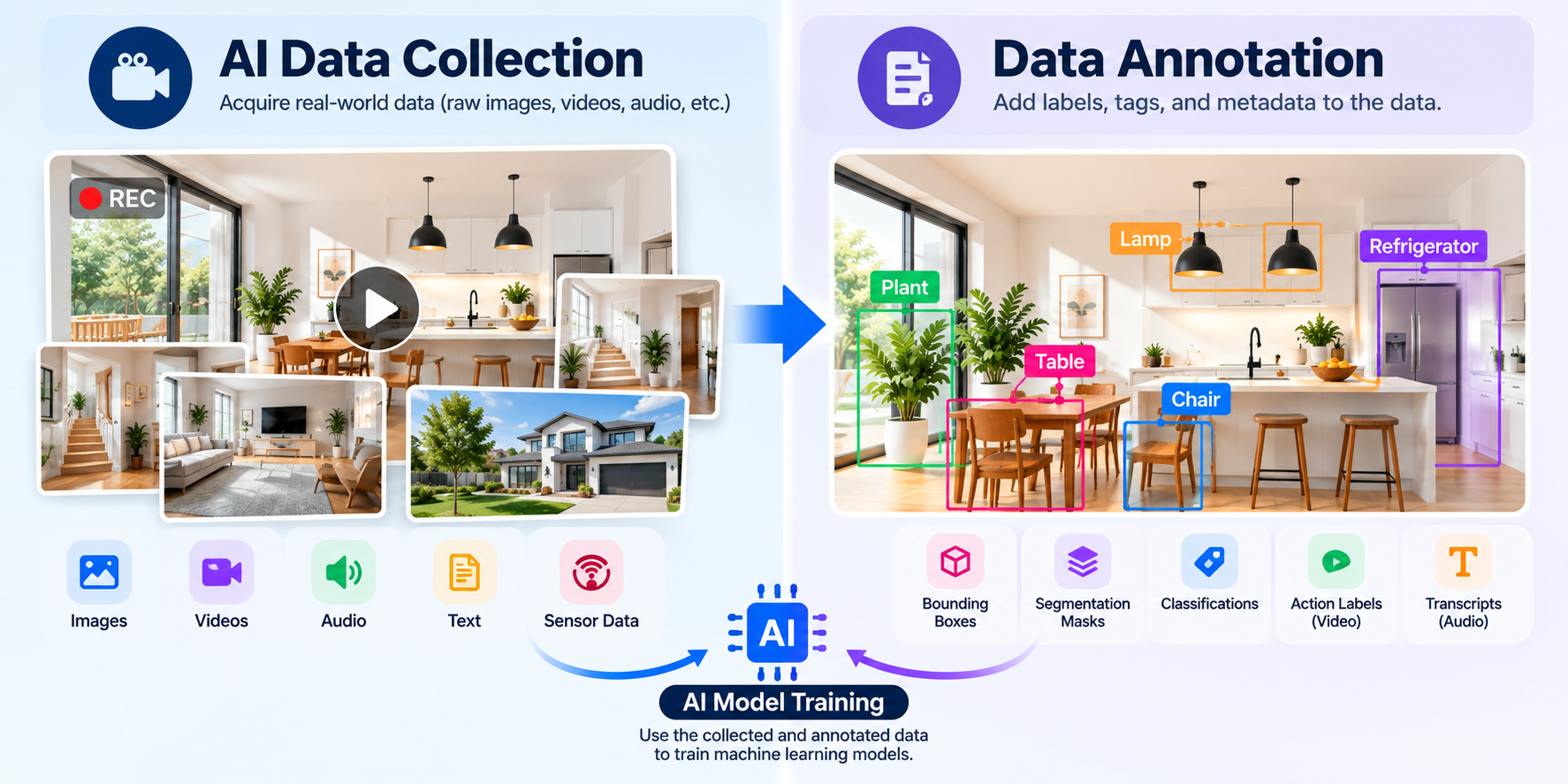
The exact process varies depending on the project.
Imagine you're developing an AI system that needs to understand human-object interactions inside homes.
Participants could record first-person or egocentric video while performing everyday activities.
Examples might include:
At this point, you have the real-world footage.
The relevant footage can then be labeled according to the AI task.
Annotators might identify:
Objects: cup, laptop, towel, refrigerator
Actions: opening, picking up, pouring, folding
Interactions: person opens refrigerator
Temporal events: action starts at 00:43 and ends at 00:47
Spatial information: bounding box around refrigerator
The collection stage captures the real-world behavior.
The annotation stage converts selected information within that behavior into structured labels.
This distinction becomes especially important for large-scale video AI projects because collecting more footage and creating more annotations are separate operational challenges.
The type of data you need depends on what the AI system is expected to do.
Image datasets are widely used for:
A retail AI project, for example, might require images of products from different angles, backgrounds, lighting conditions, and camera types.
Video adds movement, sequence, and time to visual data.
It can be useful for:
Video collection is often more operationally demanding than still-image collection because teams may need to control camera perspective, activity duration, environment, participant behavior, and recording quality.
Audio datasets can support:
Collection requirements can vary according to language, accent, background noise, microphone type, and environment.
Text datasets can be used for:
Some AI projects combine several forms of data.
A recording might contain:
Video + audio + GPS + timestamps + motion data + depth information
This is known as multimodal data because the AI system can learn from multiple types of signals associated with the same event.
The right modality should be chosen according to the model's intended real-world task—not simply according to which type of data is easiest to obtain.
Just as there are multiple forms of raw data, there are multiple annotation methods.
The entire image receives a category.
For example:
Kitchen
Bedroom
Office
Outdoor
The model learns to associate the overall image with a particular class.
Rectangular boxes are drawn around objects.
For example, every visible vehicle in an image could receive a car, truck, or bus label.
Bounding boxes are commonly used for object-detection tasks.
Instead of placing a rectangle around an object, individual pixels are assigned to categories.
This provides much more precise information about an object's shape and boundaries.
Specific points are identified on an object.
Human-pose projects, for example, might annotate:
Objects, actions, or events can be labeled over time.
For example:
Person reaches for cup → person picks up cup → person pours water → person places cup down
Video annotations can also identify when an action begins and ends.
Text can be labeled according to:
Audio annotation can include:
The appropriate annotation method depends on what you want the model to predict or understand.
The answer depends primarily on what data you already have and what the AI system needs to learn.
You don't have enough relevant raw data.
This is particularly likely when:
For example, a robotics company developing a system that operates inside homes might need first-person recordings of people completing specific household routines.
If those scenarios aren't present in existing datasets, annotation alone cannot create them.
You need new data collection.
You already have suitable raw data but need structured labels.
For example, you might have 50,000 useful images but need every vehicle identified with a bounding box.
The underlying data already exists.
The challenge is converting it into the labeled format required by the model.
You're creating a supervised AI dataset from scratch.
This is common in commercial computer vision projects.
You first collect representative data around the intended use case and then annotate the information needed for training or evaluation.
No. Not every AI dataset needs manual annotation.
Supervised learning typically relies on labeled examples that associate input data with expected outputs.
However, other machine learning approaches can use unlabeled or partially labeled data.
For example, semi-supervised learning combines a smaller amount of labeled data with a larger amount of unlabeled data.
Modern AI workflows may also use techniques such as:
Synthetic data is artificially generated rather than captured directly from real-world events and can sometimes supplement real-world datasets.
The correct approach depends on the AI problem, the available data, the required accuracy, and the development strategy.
One of the biggest mistakes an AI team can make is assuming annotation can fix an unsuitable dataset.
It can't.
Imagine collecting 100,000 perfectly clear driving images during daylight.
You then carefully annotate every vehicle, pedestrian, road sign, and traffic signal.
But your AI system also needs to operate at night.
Perfect labels don't create the missing nighttime examples.
This illustrates an important principle:
Perfect annotations on unrepresentative data still produce an unrepresentative dataset.
Before collecting data, teams should consider variables such as:
The goal isn't simply to collect the largest possible dataset.
The goal is to collect data that adequately represents the problem the model needs to solve.
The opposite problem can happen too.
A well-designed raw dataset can lose value if its labels are inconsistent.
Suppose one annotator labels an object:
sofa
Another uses:
couch
And another labels a similar object:
chair
Without a clearly defined taxonomy, the model can receive inconsistent ground truth.
Annotation projects therefore often require:
Reliable ground truth data provides a reference that can be used during model training and evaluation.
Poor annotations can introduce noise or teach the model incorrect relationships.
Neither is inherently more important.
They address different parts of the same problem.
High-quality collection + poor annotation = unreliable labels.
Poor collection + perfect annotation = precisely labeled but potentially unsuitable data.
For supervised AI development:
Data collection determines what the model gets to experience.
Data annotation determines what the model is explicitly taught about those experiences.
This is why the AI use case should determine the data strategy—not the annotation platform, camera, or number of examples alone.
Before collecting or annotating thousands of examples, answer these questions:
Making these decisions early can reduce wasted collection and annotation work.
Collecting huge amounts of data first and deciding what you actually need afterward can create unnecessary costs and leave important scenarios uncovered.
Yes. Some AI data providers offer end-to-end data services covering both collection and annotation.
Others specialize in only one part of the pipeline.
An end-to-end workflow might include:
Project design → participant recruitment → data capture → secure upload → data organization → annotation → quality assurance → delivery
Whether you should use one provider or several depends on factors such as:
For large video-data projects, having a clear handoff between collection and annotation is especially important because the annotation schema may influence how footage should be captured.
If you need a partner to collect real-world AI training data, evaluate more than the number of contributors they can provide.
Ask about:
For video and egocentric AI projects, also ask whether the provider can capture specific routines, environments, camera perspectives, and human-object interactions rather than simply supplying generic stock footage.
For teams that need purpose-built datasets, Firsthand’s AI data collection services support custom collection across video, images, audio, text, and multimodal sensor data, with projects designed around defined specifications, contributor consent, quality assurance, and commercial usage rights.
The closer the collection design matches the model's intended deployment conditions, the more useful the resulting dataset can be.
AI data collection and data annotation are different stages of building useful AI datasets.
Data collection gathers the raw material:
Images. Videos. Audio. Text. Sensor readings. Human behavior. Real-world observations.
Data annotation adds structured information:
Labels. Bounding boxes. Segmentation masks. Classifications. Transcripts. Keypoints. Timestamps.
If you already have representative raw data but need labels for supervised learning, you may primarily need data annotation.
If your existing dataset doesn't contain the environments, behaviors, perspectives, or edge cases your model needs to understand, you need data collection.
If you're creating a new supervised training dataset from the ground up, you'll often need both.
Ultimately, successful AI development isn't about collecting the largest possible dataset or generating the most labels.
It's about building the right dataset, with the right coverage, appropriate usage rights, and the right annotations for the AI system you're trying to develop.
AI data collection gathers raw information such as images, videos, audio, text, and sensor readings. Data annotation adds labels or metadata to that raw information so machine learning models can use it for tasks such as supervised training and evaluation.
Data annotation generally happens after the relevant raw data has been collected and organized. Teams first acquire the information they need and then annotate the portions required for their machine learning task.
Yes. Not all machine learning approaches require manually labeled datasets. Supervised learning generally relies on labeled examples, while unsupervised, self-supervised, and some semi-supervised approaches can use unlabeled data.
Examples include object bounding boxes, image classifications, segmentation masks, human-pose keypoints, video action labels, audio transcriptions, text sentiment labels, named entities, and timestamps identifying events in recordings.
If you don't have representative raw data, you need data collection. If you already have appropriate data but need labels for supervised learning, you need annotation. If you're creating a new supervised AI dataset from scratch, you'll commonly need both.
IBM — What Is Training Data?
https://www.ibm.com/think/topics/training-data
IBM — What Is Data Labeling?
https://www.ibm.com/think/topics/data-labeling
IBM — What Is Ground Truth in Machine Learning?
https://www.ibm.com/think/topics/ground-truth
IBM — What Is Supervised Learning?
https://www.ibm.com/think/topics/supervised-learning
IBM — What Is Semi-Supervised Learning?
https://www.ibm.com/think/topics/semi-supervised-learning
IBM Research — What Is Synthetic Data?
https://research.ibm.com/blog/what-is-synthetic-data


Compact, ready to go anywhere
Interchangeable lens that’s upgradeable
Dual 1-inch sensors for improved clarity and low light performance
Dynamic range and 6K 360° capture
360° photo resolution at 21MP

8K 360° video recording for ultra-detailed visuals.
4K single-lens mode for traditional wide-angle shots.
Invisible selfie stick effect for drone-like perspectives.
2.5-inch touchscreen with Gorilla Glass protection.
Waterproof up to 33ft for underwater shooting.

360° photo resolution in 23MP
Slim design at 24 mm thick
Built-in image stabilization for smooth video capture.
Internal 19GB storage for photo and video storage.
Wireless connectivity for remote control and sharing.

60MP 360° still images for high-resolution photography.
5.7K 360° video recording at 30fps.
2.25-inch touchscreen for intuitive control.
USB Type-C port for fast charging and data transfer.
MicroSD card slot for expandable storage.
.png)

.png)

Try it free. No credit card required. Instant set-up.
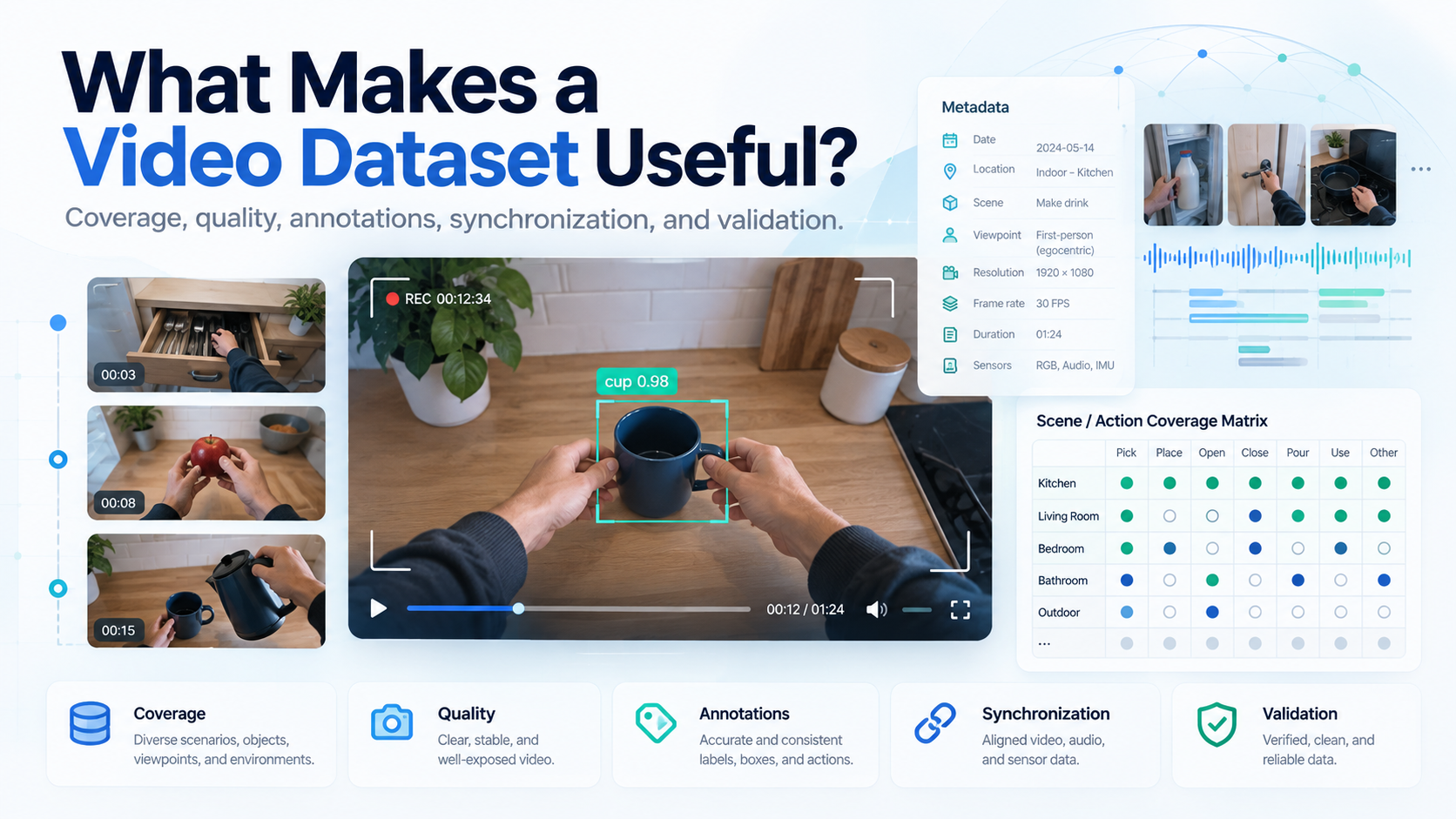




.svg)


.svg)