


.png)


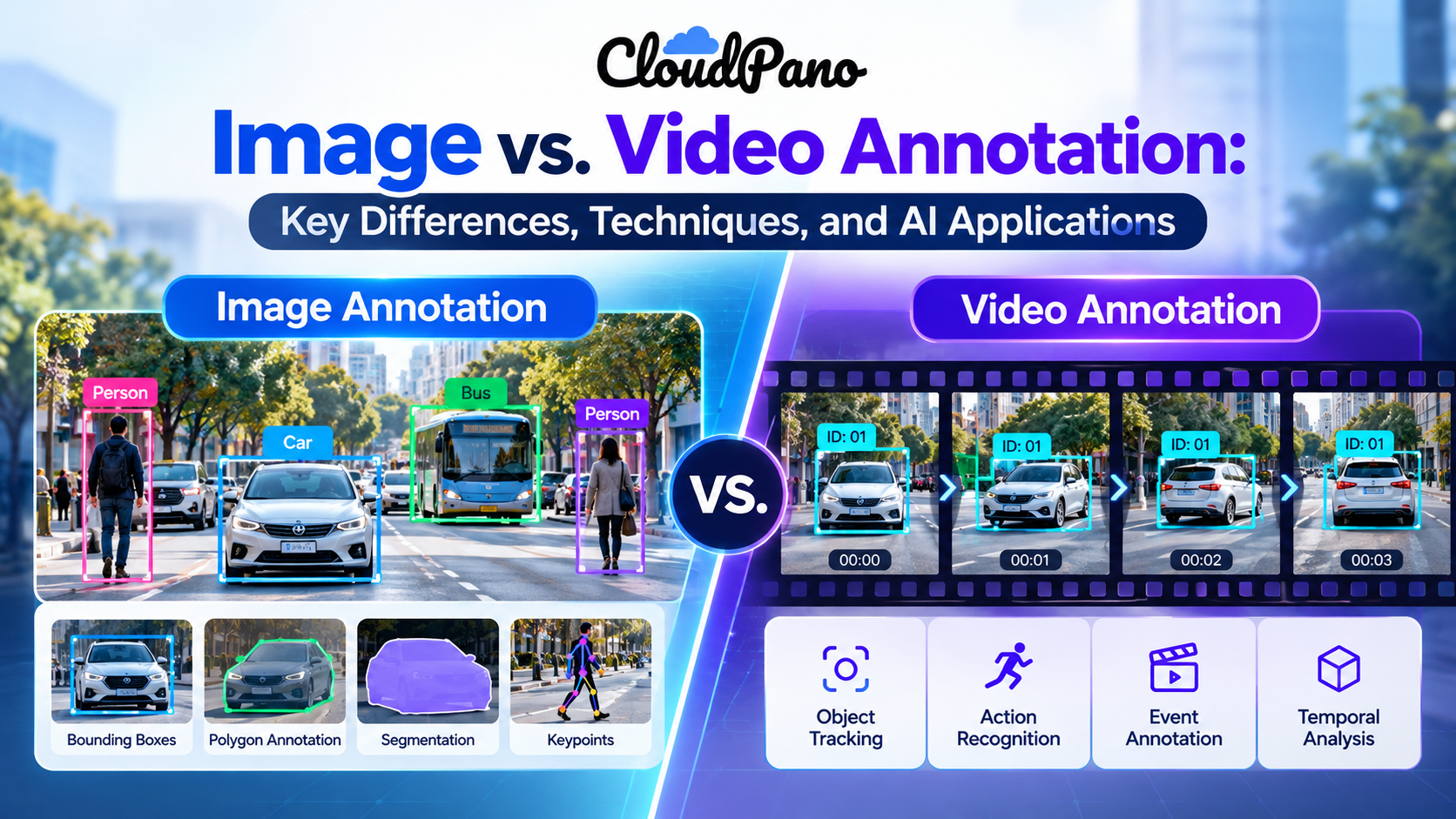
Image annotation involves labeling objects, features, and regions within individual still images to train computer vision models. Video annotation extends this process across sequences of frames, capturing movement, object tracking, timing, and actions. Image annotation is generally suited to static visual recognition, while video annotation supports AI applications requiring temporal understanding, such as activity recognition, traffic analysis, and motion tracking.
Artificial intelligence can recognize products in photographs, identify pedestrians on busy roads, and analyze movements captured by security cameras. These capabilities may appear effortless, but they depend on carefully prepared training data.
Before computer vision models can interpret visual information, they need examples that explain what objects are, where they appear, and sometimes how they move.
This is where image annotation and video annotation become essential.
Although these processes share several techniques, they are not identical. Image annotation focuses on individual pictures, while video annotation can capture information across sequences of frames.
The difference matters because an AI system designed to recognize objects in photographs does not necessarily need the same training data as one designed to understand human movement.
Understanding image vs. video annotation helps businesses choose appropriate methods, control data preparation costs, and develop AI systems that perform reliably in real-world environments.
Image annotation is the process of adding labels, markers, or structured information to still images so machine learning models can identify visual patterns.
Annotations may describe an entire image or identify individual objects within it.
For example, a photograph of a busy intersection may contain vehicles, pedestrians, traffic signs, and buildings. Annotators can assign categories to these objects or mark their positions using bounding boxes and segmentation masks.
The resulting dataset helps computer vision models learn to recognize similar objects in unfamiliar images.
Image annotation supports applications such as object detection, image classification, medical imaging, product recognition, and industrial quality inspection.
Because still images can often be processed independently, image annotation projects are generally easier to divide into separate tasks than projects requiring continuous video tracking.
However, complexity varies. Identifying one object in a photograph may be straightforward, while accurately outlining hundreds of overlapping objects requires considerably more effort.
Video annotation involves adding labels and structured information to video clips or sequences of frames.
It uses many of the same techniques as image annotation, including bounding boxes, polygons, and segmentation masks.
However, video annotation can also capture information about movement, timing, actions, and object continuity.
Consider a video showing a pedestrian crossing a street.
An image annotation might identify the pedestrian's position in one frame.
A video annotation project could track that pedestrian throughout the sequence, maintain a consistent object identifier, and mark when the crossing begins and ends.
This information helps models learn not only what appears in a scene but also how events unfold.
Video annotation is commonly used in autonomous driving research, sports analytics, activity recognition, industrial monitoring, and security applications.
According to Google Cloud's object tracking documentation, video object tracking can associate detected objects with bounding boxes and timestamps across a sequence.
The most important distinction is the presence of a temporal dimension.
Image annotation describes visual information within individual pictures. Video annotation can describe visual information as it changes over time.

Image annotation identifies visual elements in a single picture, while video annotation can track objects and events across multiple frames.
Neither approach is inherently superior.
A system that classifies product photographs may only require image annotations. A system that analyzes how people move through a warehouse may need video annotations.
The appropriate method depends on what the model is expected to learn.
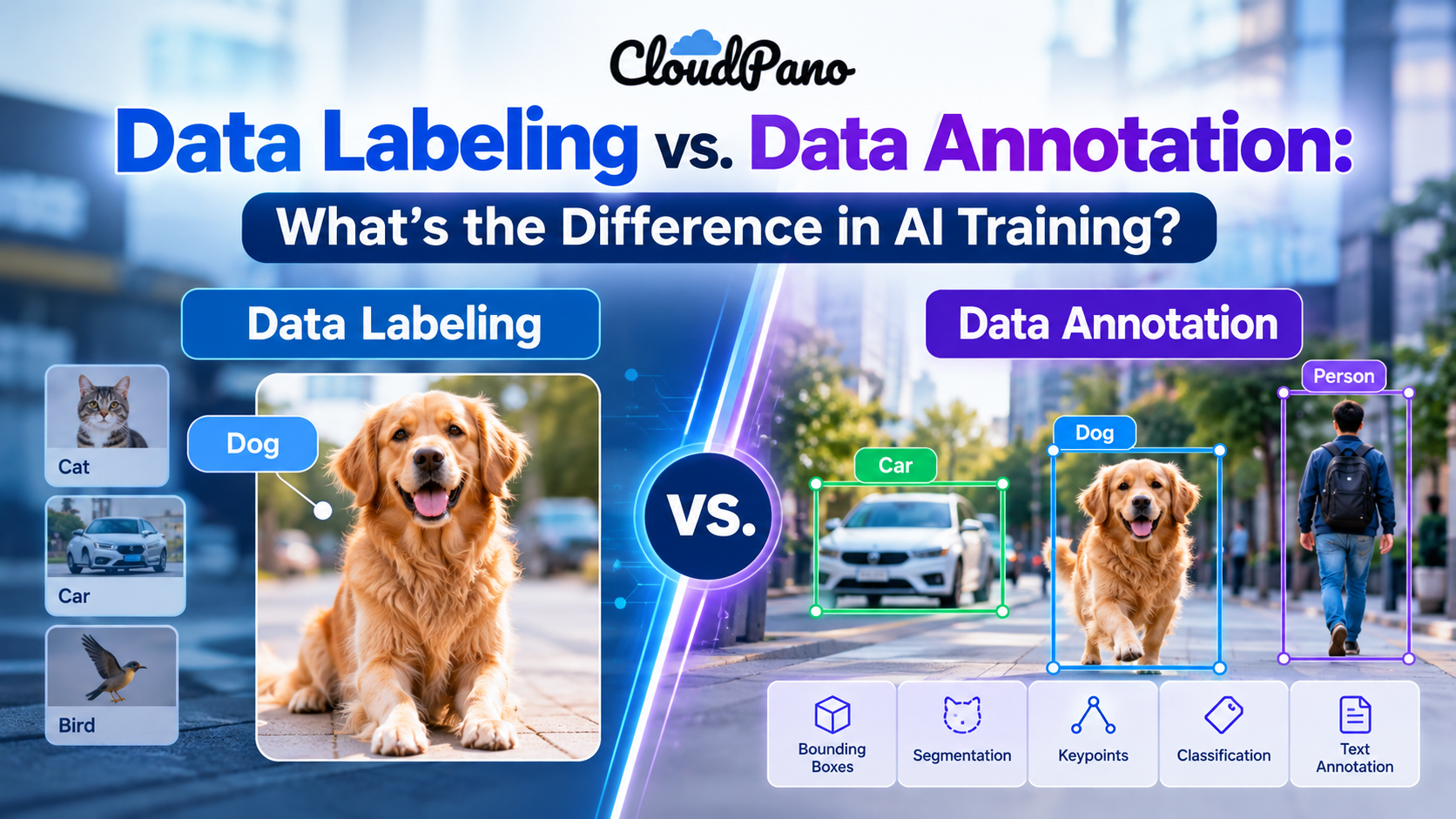
Before exploring these techniques, it's helpful to understand the distinction between data labeling and annotation. Although the terms are often used interchangeably, they can describe different levels of detail in preparing AI training datasets. Our guide to Data Labeling vs. Data Annotation explains how these processes overlap and why both are important for machine learning.
Image annotation includes several methods designed for different computer vision tasks.
Bounding boxes are rectangular markers placed around objects within an image.
They are commonly used to train object detection models that identify vehicles, people, animals, products, and other recognizable items.
Bounding boxes are relatively efficient to create, although they may include background areas around irregularly shaped objects.
Polygon annotation uses connected points to trace an object's outline more precisely.
It is useful when rectangular boundaries do not provide enough detail, such as identifying irregular manufacturing defects or complex road features.
Semantic segmentation assigns categories to pixels, allowing a model to distinguish areas such as roads, buildings, and vegetation.
Instance segmentation separates individual objects belonging to the same category.
For example, a model may need to identify three separate vehicles rather than treating them as one general vehicle region.
Keypoint annotation marks important reference points, such as body joints, facial landmarks, or structural features.
It supports applications including pose estimation, gesture recognition, and certain medical imaging tasks.

Common image annotation methods include bounding boxes, polygons, segmentation masks, and keypoints, each providing a different level of visual detail.
The best technique depends on the required prediction. A simple classification task may need only an image-level label, while precise object localization requires more detailed annotations.
For a broader explanation of how these tasks relate, see our guide to Data Labeling vs. Data Annotation.
Video annotation builds on image annotation methods while introducing techniques that account for time and movement.
Object tracking follows an object across multiple frames while maintaining a consistent identifier.
For example, a car moving through an intersection may receive the same tracking ID throughout the sequence.
This allows models to learn object continuity and movement patterns.
Frame-by-frame annotation involves labeling individual frames extracted from video footage.
This approach can provide detailed information but becomes labor-intensive when clips contain thousands of frames.
Some projects annotate selected frames rather than every frame, depending on the model's requirements.
Temporal annotation identifies when particular activities occur.
For example, annotators may mark the beginning and end of a worker entering a restricted area or a machine completing an operating cycle.
These labels help models recognize events that cannot be understood from one image alone.
Video segmentation identifies objects or regions across multiple frames.
Unlike single-image segmentation, video segmentation may also require maintaining consistent object identities as objects move or become partially obscured.
Interpolation estimates object positions between manually annotated frames.
Instead of drawing a new bounding box for every frame, an annotator can label selected frames and allow software to estimate intermediate positions.
Human reviewers then verify and correct the results.
Technical documentation from Amazon SageMaker AI describes frame-based object tracking, consistent instance identifiers, and annotation assistance. Its Ground Truth service is no longer available to new customers, but the documentation remains a useful technical reference.

Video object tracking maintains consistent object identities across frames, helping AI systems learn movement and temporal relationships.
Video annotation often requires more time and resources because the same objects must be evaluated across multiple frames.
A short video can contain hundreds or thousands of individual images.
Annotators may need to track objects that move quickly, overlap, disappear behind obstacles, or leave and reenter the camera's view.
Camera movement introduces another challenge. An object's position may change within the frame even when the object itself remains stationary.
Temporal consistency is equally important.
If a pedestrian receives one tracking identifier in the first frame and a different identifier in the next, the dataset may incorrectly represent two separate people.
These errors can affect models designed to learn movement or object continuity.
Video projects therefore need clear annotation guidelines, suitable tools, and quality checks that examine both individual frames and complete sequences.
Both methods support computer vision development across many industries.
Image annotation can support the development of systems that analyze medical scans and identify anatomical structures.
Video annotation may support movement analysis or research involving procedures recorded over time.
Manufacturers can use annotated images to train models that detect surface defects or identify missing components.
Video annotation may help analyze equipment movements, production sequences, and operational activities.
Image annotation helps models recognize traffic signs, vehicles, pedestrians, and road features.
Video annotation provides additional information about object movement, traffic patterns, and interactions.
Image annotation supports product recognition, visual search, and inventory classification.
Video annotation can support applications that analyze customer movement or interactions with products, subject to appropriate privacy safeguards.
Video annotation is particularly valuable when models need to track players, identify actions, or analyze movement patterns.
These applications demonstrate why annotation requirements should be determined by the intended AI task rather than the industry alone.
Video annotation often costs more because it can involve multiple frames, tracking identifiers, and additional quality assurance.
However, there is no universal pricing difference.
Project costs depend on dataset size, annotation complexity, object density, precision requirements, and the level of automation available.
A simple video event classification task may require less effort than precisely segmenting thousands of complex medical images.
Similarly, interpolation and automated tracking can reduce the manual effort involved in some video projects.
Organizations should estimate costs based on the number and complexity of required annotations rather than comparing file counts alone.
A clear project scope helps avoid collecting unnecessary information and spending resources on annotation details the model does not need.
Modern annotation workflows increasingly combine automated tools with human expertise.
AI-assisted systems can generate preliminary bounding boxes, segmentation masks, and tracking predictions.
These outputs reduce repetitive work and allow reviewers to focus on difficult examples.
However, automation can introduce errors, particularly when objects overlap, lighting conditions change, or unfamiliar situations appear.
Human reviewers help verify annotations, correct inaccurate predictions, and resolve ambiguous cases.
This approach is commonly called human-in-the-loop annotation.
It can improve efficiency while preserving appropriate oversight.
For organizations exploring this approach, our article What Is Human-in-the-Loop AI? explains how human feedback supports AI development.
Choosing the right method begins with defining what the AI system needs to predict.
If the model must recognize objects or classify static visual features, image annotation is usually the more practical option.
If the model needs to understand movement, sequences, activities, or object continuity, video annotation is generally more suitable.
Some projects benefit from both.
For example, an organization developing a traffic monitoring system may use image annotations to train object detection models and video annotations to support object tracking.
Teams should also consider available expertise, annotation tools, dataset quality requirements, and processing costs.
The objective is not to create the most detailed dataset possible. It is to create a dataset that provides the information necessary for the intended learning task.
Reliable annotation begins with clear project requirements.
Organizations should define object categories, annotation boundaries, difficult examples, and expected outputs before large-scale labeling begins.
A small pilot dataset can reveal unclear instructions and help estimate the time required.
Quality assurance should examine annotation accuracy, consistency, and dataset coverage.
For video projects, reviewers should also check tracking continuity and temporal boundaries.
Automated validation can identify missing labels, invalid coordinates, and formatting inconsistencies.
Human review remains important for complex or ambiguous examples.
Dataset documentation and version control also help teams reproduce experiments and trace errors.
These activities form part of the broader AI training data pipeline, which transforms raw information into datasets suitable for machine learning.
Image and video annotation continue to evolve as AI-assisted tools become more capable.
Automated segmentation, object tracking, and active learning can help reduce repetitive tasks and identify examples that require human attention.
Multimodal AI development also increases the importance of connecting visual information with text, audio, and other data types.
For example, a video dataset may include object tracks, speech transcripts, and event descriptions.
These combinations allow models to learn relationships between different forms of information.
However, better tools do not eliminate the need for accurate training data.
Reliable annotation still depends on clear objectives, consistent guidelines, representative examples, and effective quality assurance.
Image annotation and video annotation share many techniques, but they support different learning requirements.
Image annotation identifies visual information within still pictures, while video annotation can capture movement, actions, and object continuity across time.
Neither approach is automatically better.
The appropriate choice depends on the AI model's intended purpose, the information it needs, and the resources available for preparing training data.
By understanding these differences, organizations can develop more efficient workflows, improve dataset quality, and support reliable computer vision applications.
Ultimately, successful visual AI begins with training data that captures the right information at the right level of detail.
Image annotation identifies objects, features, or regions within still images. Video annotation can track objects and events across multiple frames, adding temporal information such as movement, timestamps, and object continuity. The appropriate method depends on whether the AI model needs static visual information or time-based understanding.
Video annotation is often more complex because it may require maintaining consistent object identities, tracking movement, and identifying events across frames. However, the actual difficulty depends on the dataset, annotation technique, and required precision.
Common image annotation techniques include image classification, bounding boxes, polygon annotation, semantic segmentation, instance segmentation, and keypoint annotation. Each method provides a different level of detail for training computer vision models.
Yes. AI-assisted annotation tools can generate preliminary labels, bounding boxes, segmentation masks, and tracking predictions. However, automated annotations may contain errors, so human review and quality validation are often needed.
Video annotation is generally more suitable when an AI application needs to recognize actions, track moving objects, or analyze events over time. Image annotation is usually sufficient for tasks involving static object recognition, image classification, and visual feature detection.
Google Cloud — Track Objects in Video
https://docs.cloud.google.com/video-intelligence/docs/object-tracking
Google Cloud — Object Tracking Features
https://docs.cloud.google.com/video-intelligence/docs/feature-object-tracking
AWS — Track Objects in Video Frames
https://docs.aws.amazon.com/sagemaker/latest/dg/sms-video-object-tracking.html
AWS — Video Frame Labeling Methods
https://docs.aws.amazon.com/sagemaker/latest/dg/sms-video-task-types.html


Compact, ready to go anywhere
Interchangeable lens that’s upgradeable
Dual 1-inch sensors for improved clarity and low light performance
Dynamic range and 6K 360° capture
360° photo resolution at 21MP

8K 360° video recording for ultra-detailed visuals.
4K single-lens mode for traditional wide-angle shots.
Invisible selfie stick effect for drone-like perspectives.
2.5-inch touchscreen with Gorilla Glass protection.
Waterproof up to 33ft for underwater shooting.

360° photo resolution in 23MP
Slim design at 24 mm thick
Built-in image stabilization for smooth video capture.
Internal 19GB storage for photo and video storage.
Wireless connectivity for remote control and sharing.

60MP 360° still images for high-resolution photography.
5.7K 360° video recording at 30fps.
2.25-inch touchscreen for intuitive control.
USB Type-C port for fast charging and data transfer.
MicroSD card slot for expandable storage.
.png)

.png)

Try it free. No credit card required. Instant set-up.





.svg)


.svg)