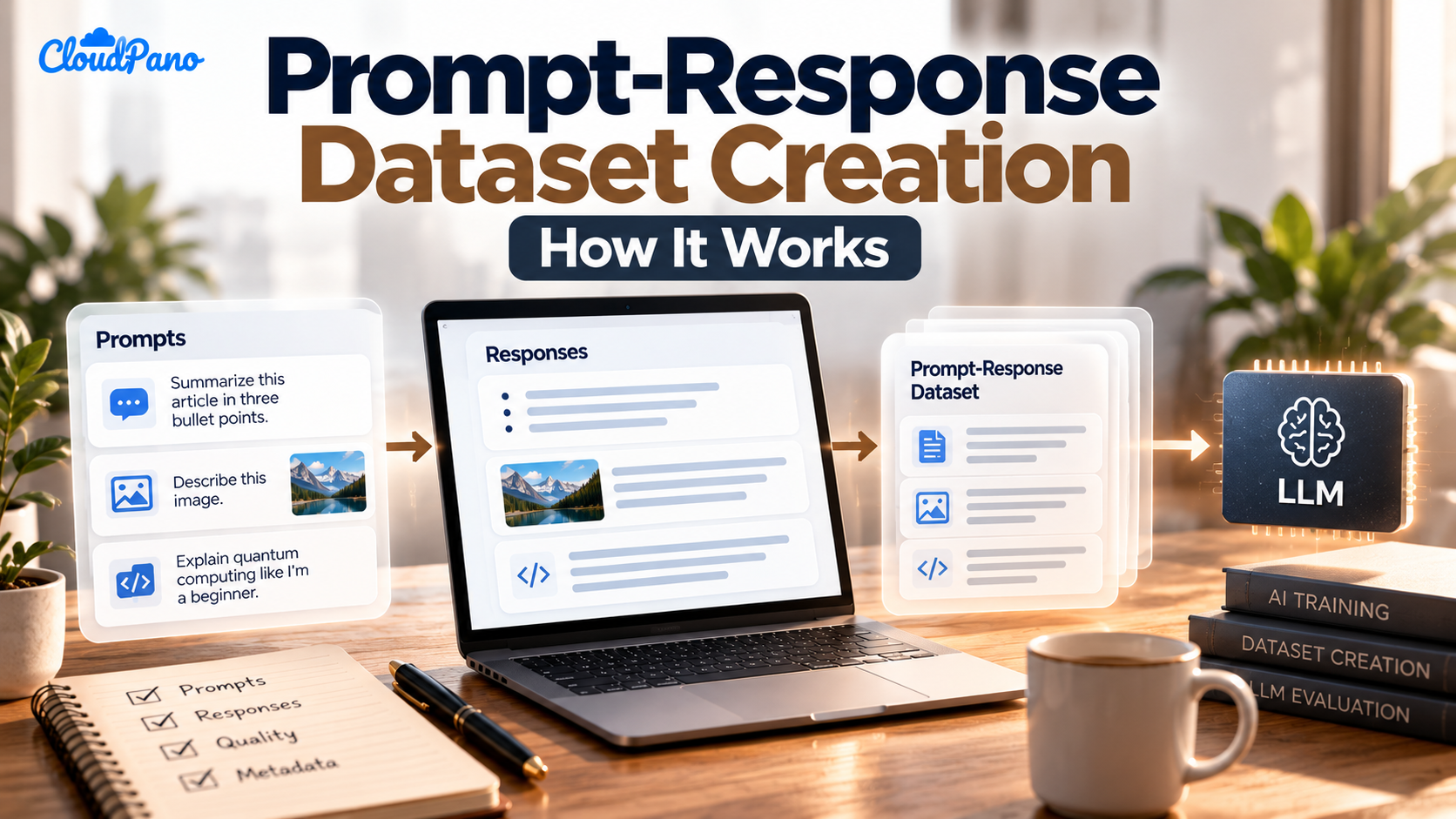
Prompt-response datasets pair user instructions with high-quality example answers. Creation typically involves defining target behaviors, designing diverse prompts, producing human-written or synthetic responses, reviewing accuracy and instruction following, filtering duplicates and low-quality examples, and separating training from evaluation data before the dataset is used for supervised fine-tuning or LLM testing.
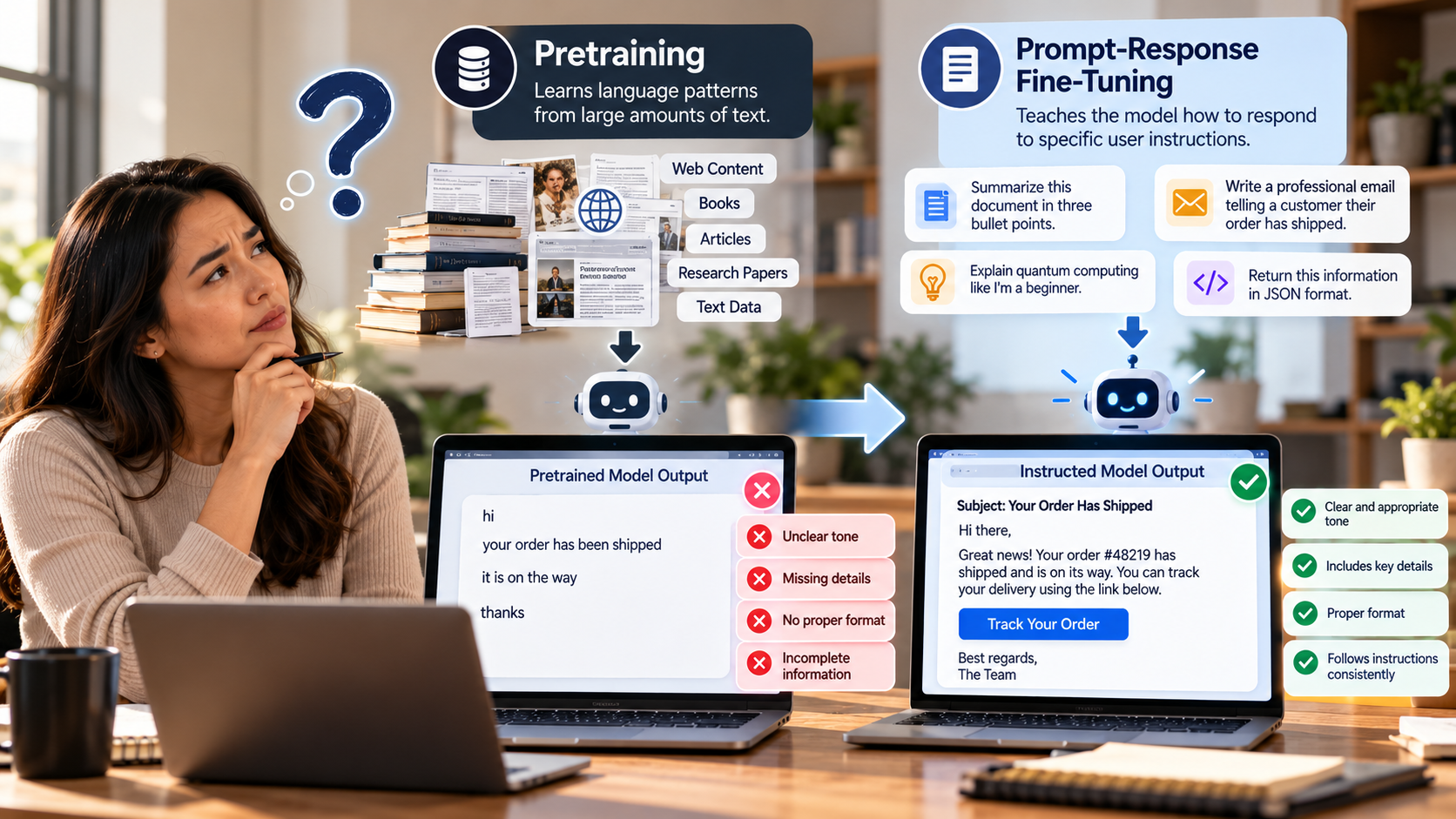
Large language models can learn enormous amounts of information during pretraining, but knowing language patterns is not the same as knowing how to respond well to a user's instructions.
If someone asks an AI assistant to summarize a document in three bullets, write a professional email, explain a technical concept to a beginner, or return information in JSON, the model needs to understand both what the user wants and what a good response should look like.
Prompt-response datasets help teach this behavior.
A prompt-response dataset pairs instructions or questions with high-quality responses. These examples can be written by humans, generated synthetically, derived from existing data, or created through a hybrid workflow combining AI generation with human review.
Effective prompt response dataset creation goes beyond producing thousands of question-and-answer pairs. It requires intentional task design, diverse prompts, reliable responses, quality assurance, and independent evaluation data.
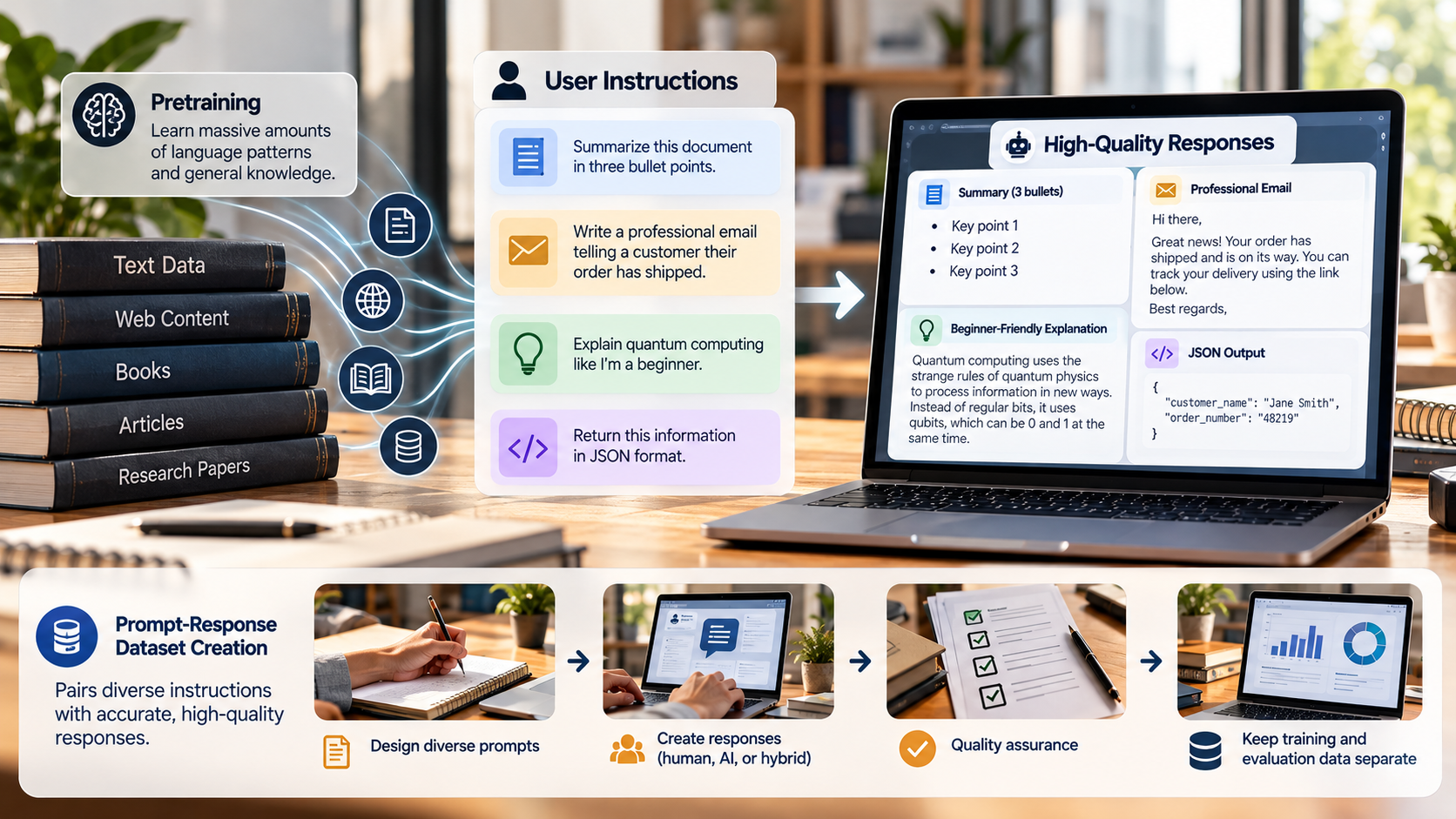
A prompt-response dataset is a collection of inputs paired with examples of desired model outputs.
The basic structure is:
Prompt → Response
For example:
Prompt:
Explain photosynthesis to a 10-year-old in two sentences.
Response:
Plants use sunlight, water, and carbon dioxide to make their own food. This process is called photosynthesis, and it gives plants the energy they need to grow.
Another example might involve formatting:
Prompt:
Extract the customer's name and order number from this message and return them as JSON.
Response:{"customer_name":"Jane Smith","order_number":"48219"}
The model sees examples of both the instruction and an appropriate answer.
During supervised fine-tuning, these examples can help a pretrained model become better at responding to instructions rather than simply continuing text.
The InstructGPT research provides an influential example. Researchers collected labeler-written demonstrations of desired model behavior and used those demonstrations for supervised fine-tuning before later collecting rankings for RLHF.
Pretraining gives an LLM broad capabilities.
Instruction data helps shape how those capabilities are used.
Imagine a pretrained model receives:
“Write a short email telling the customer their order has shipped.”
A model trained primarily to predict text may generate something email-like, but that does not necessarily mean it will reliably follow requirements concerning length, tone, format, or content.
Prompt-response examples demonstrate those behaviors.
Conceptually:
Pretraining:
Text → Learn language patterns
Prompt-response fine-tuning:
Instruction → Learn how to respond
This is why dataset quality can influence model behavior even when the underlying pretrained model remains unchanged.
Stanford's Alpaca project provides a useful illustration. Researchers fine-tuned a 7-billion-parameter LLaMA model on 52,000 instruction-following demonstrations generated using a modified Self-Instruct approach.
A reliable workflow usually involves more than simply asking annotators or another LLM to generate questions and answers.
Before creating examples, define what the dataset is supposed to teach or evaluate.
A general-purpose assistant might need examples involving:
A specialized model may require narrower coverage.
For example, a customer-service assistant might need:
Refund question → Policy-based response
Shipping delay → Status explanation
Missing information → Clarifying question
Unsupported request → Appropriate escalation
Without a clear task taxonomy, datasets can become large but unbalanced.
Prompt diversity is one of the most important parts of prompt response dataset creation.
Real users rarely ask identical questions in identical ways.
Consider these prompts:
Prompt A:
Summarize this report.
Prompt B:
Give me the three most important findings from this report.
Prompt C:
Explain the report's conclusions to someone without a technical background.
All three involve summarization, but they test different capabilities.
Useful prompt diversity can include differences in:
A dataset consisting entirely of simple, perfectly phrased prompts may teach a model little about messy real-world requests.
Once prompts exist, teams need corresponding target responses.
There are three common approaches.
Human annotators or subject-matter experts write the desired answer.
For example:
Prompt:
Explain compound interest to a beginner.
Human Response:
Compound interest means you earn interest not only on your original money but also on the interest you've already earned. Over time, this can make savings grow faster.
Human authors can intentionally account for audience, context, tone, and subtle instructions.
However, human creation can become expensive and slow at large scale.
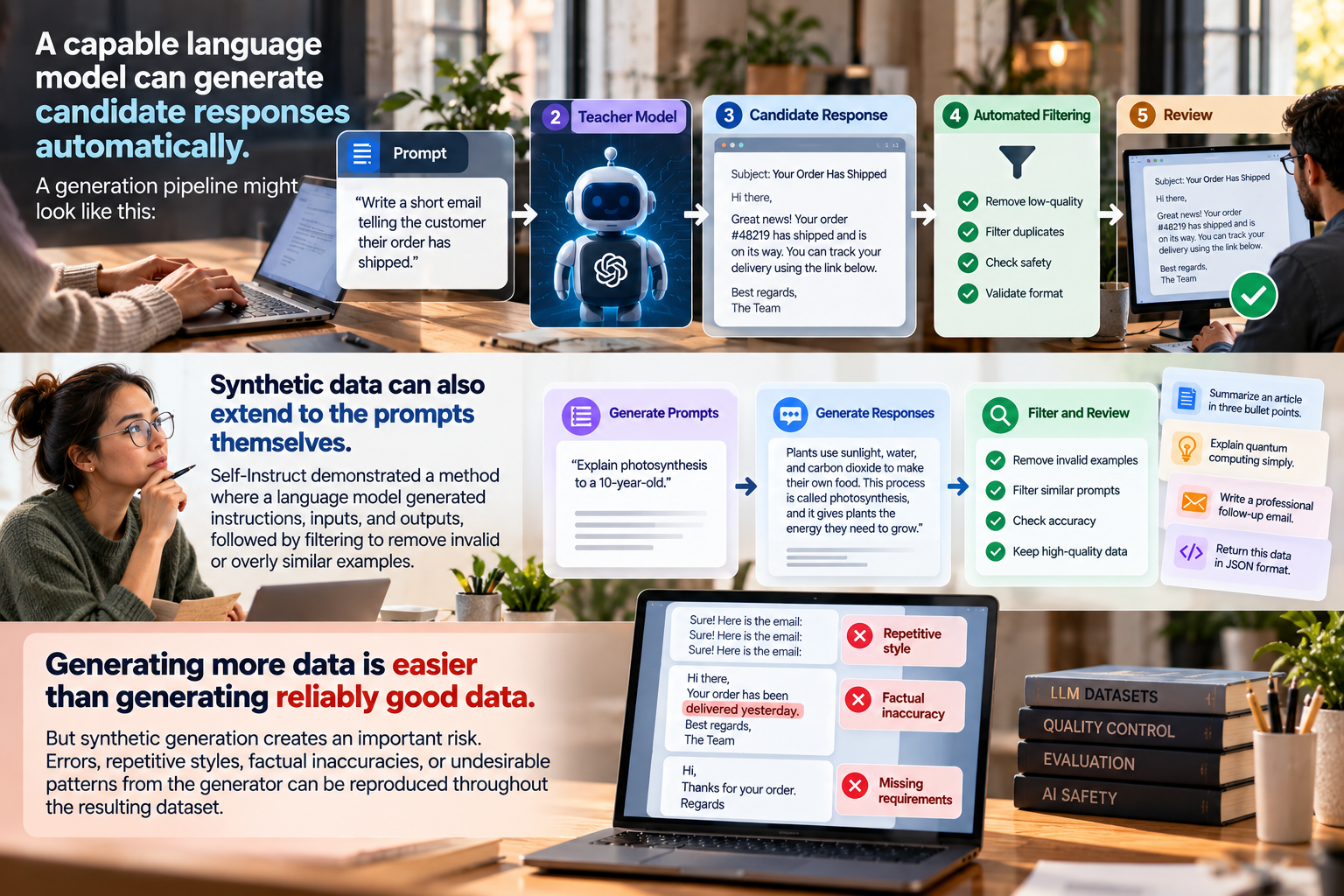
A capable language model can generate candidate responses automatically.
This dramatically increases throughput.
A generation pipeline might look like:
Prompt → Teacher Model → Candidate Response → Automated Filtering → Review
Synthetic data can also extend to the prompts themselves.
Self-Instruct demonstrated a method where a language model generated instructions, inputs, and outputs, followed by filtering to remove invalid or overly similar examples.
The research showed that self-generated instruction data could substantially improve instruction-following performance.
But synthetic generation creates an important risk:
Generating more data is easier than generating reliably good data.
Errors, repetitive styles, factual inaccuracies, or undesirable patterns from the generator can be reproduced throughout the resulting dataset.
A practical alternative combines both approaches.
AI creates drafts at scale.
Humans review, correct, reject, or improve them.
For example:
AI generates prompt → AI generates response → Human verifies → Quality checks → Accepted example
This can provide better scalability than human-only authoring while preserving human oversight for important examples.
For technical fields, responses can also be routed to appropriate experts.
A grammatically polished response is not automatically a good training example.
Each response should be evaluated against defined criteria.
Does the response contain correct information?
Does it answer what the user actually asked?
Does it obey requested constraints?
If the user asks for exactly three bullets and receives seven paragraphs, the response may be factually correct but still be a poor demonstration.
Does it include the information needed to satisfy the request?
Is the answer understandable for the intended audience?
Does the response behave appropriately when the request requires additional safeguards?
These dimensions overlap closely with LLM evaluation.
Stanford's HELM Instruct framework, for example, evaluates instruction-following systems across dimensions including helpfulness, understandability, completeness, conciseness, and harmlessness.
Dataset size can be misleading.
Imagine having 500,000 examples where 150,000 are minor variations of:
“Write an email requesting a meeting.”
The nominal dataset is large, but its behavioral coverage may be narrow.
Filtering should look for:
Self-Instruct explicitly included filtering of invalid or similar generated instructions as part of its pipeline.
The goal should therefore be useful diversity, not maximum row count.
Useful datasets often contain more than prompt and response fields.
An example record might contain:
Prompt: Explain gravity to a child.
Response: Gravity is what pulls objects toward each other...
Category: Explanation
Domain: General science
Difficulty: Beginner
Format: Short answer
Source: Human-written
Reviewer status: Approved
Metadata can help teams analyze dataset composition and create targeted subsets.
For example, if evaluation shows poor performance on structured extraction tasks, researchers can identify relevant training examples without manually searching the entire dataset.
This step is critical.
A model should not be evaluated primarily on the same examples it was trained to reproduce.
Suppose a dataset contains:
10,000 prompt-response examples
A project might divide them into separate sets for:
Training → model optimization
Validation → development decisions
Evaluation/Test → final measurement
The exact split depends on the project, but the principle matters more than the percentage:
Evaluation should measure generalization to examples the model was not trained to memorize.
This is particularly important within the LLM Evaluation topic cluster.
Neither method is automatically superior.
Human-written data can offer strong intentionality, contextual awareness, and expert judgment.
Synthetic data offers scale and speed.
The most appropriate method depends on the task.
Stanford's Alpaca showed the scalability of synthetic instruction generation: its researchers created 52,000 instruction-following demonstrations starting from 175 human-written instruction-output seed pairs.
The result also illustrates why provenance matters. Stanford explicitly documented limitations and restrictions surrounding the model and generated instruction data.
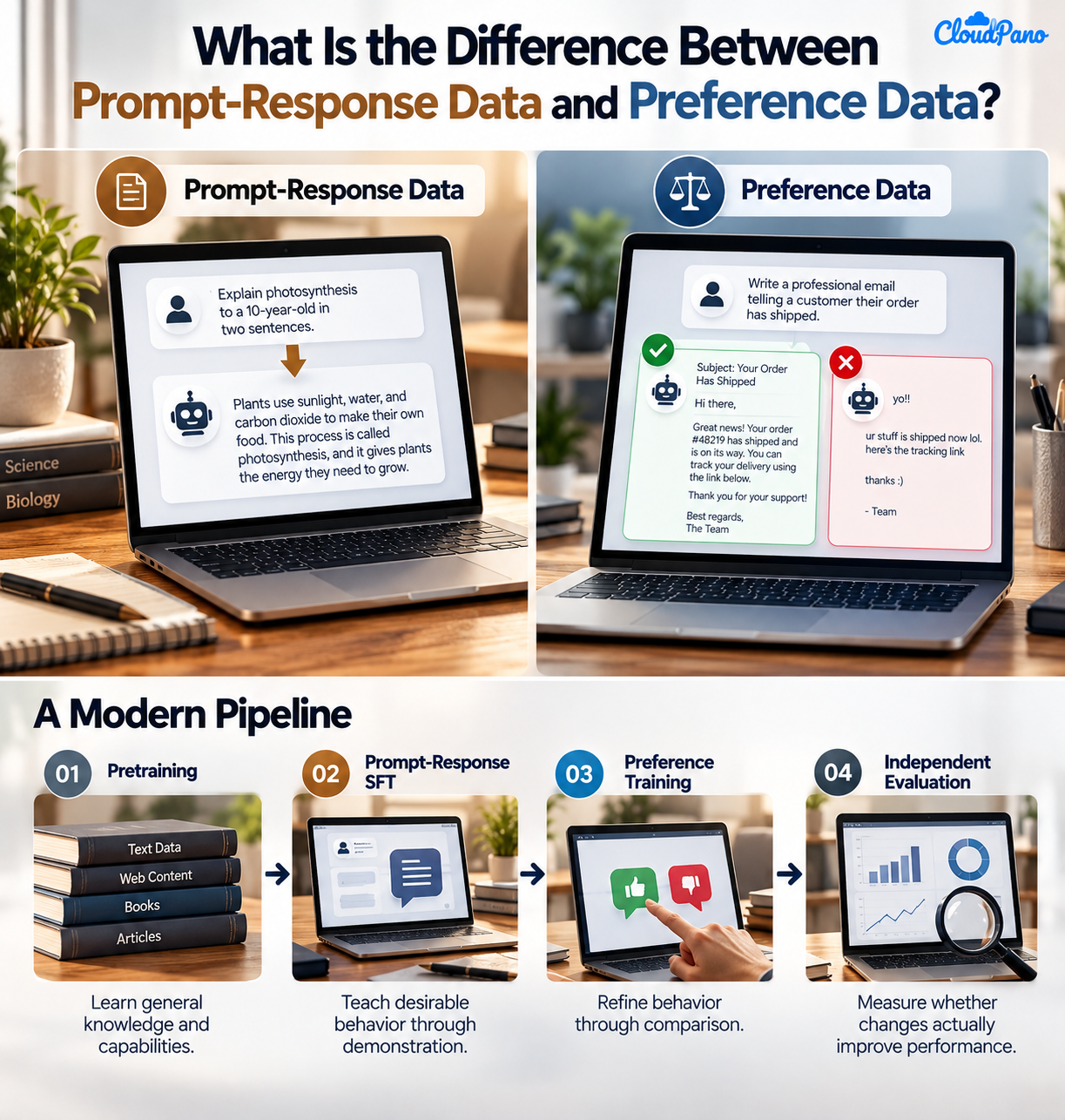
These datasets serve different purposes.
Shows a desired answer:
Prompt → Ideal Response
It effectively teaches:
“For an instruction like this, respond this way.”
This format is commonly associated with supervised fine-tuning.
Compares candidate answers:
Prompt → Chosen Response + Rejected Response
It teaches:
“Between these behaviors, this response is preferable.”
Preference data can support reward modeling, RLHF, Direct Preference Optimization, and related post-training techniques.
A modern pipeline might therefore look like:
Pretraining → Prompt-Response SFT → Preference Training → Independent Evaluation
Prompt-response data teaches desirable behavior through demonstration.
Preference data refines behavior through comparison.
Evaluation measures whether those changes actually improve performance.
Prompt-response datasets are not limited to training.
They can also support evaluation when constructed independently.
For example:
Evaluation Prompt:
Extract the invoice date from the document.
Reference Answer:
October 12, 2026
The model generates an answer, and the evaluation system compares it against the reference.
This works especially well for tasks with clear expected outputs.
Open-ended generation is harder.
Consider:
Prompt:
Write a friendly explanation of why the customer's refund is delayed.
There may be dozens of acceptable answers.
Evaluation may therefore require:
HELM Instruct addresses this challenge by evaluating model responses against multiple criteria rather than assuming every open-ended prompt has one perfect reference answer.
One million weak examples are not automatically better than a smaller, carefully designed dataset.
Models need examples involving ambiguity, multiple constraints, edge cases, and difficult instructions.
Synthetic answers can look convincing while containing subtle errors.
If every example has the same length, tone, or structure, the model may learn stylistic habits rather than flexible instruction following.
This can inflate measured performance and hide weaknesses.
Teams should know where prompts and responses originated, what transformations occurred, who reviewed them, and what usage rights apply.
A practical prompt response dataset creation workflow can be summarized as:
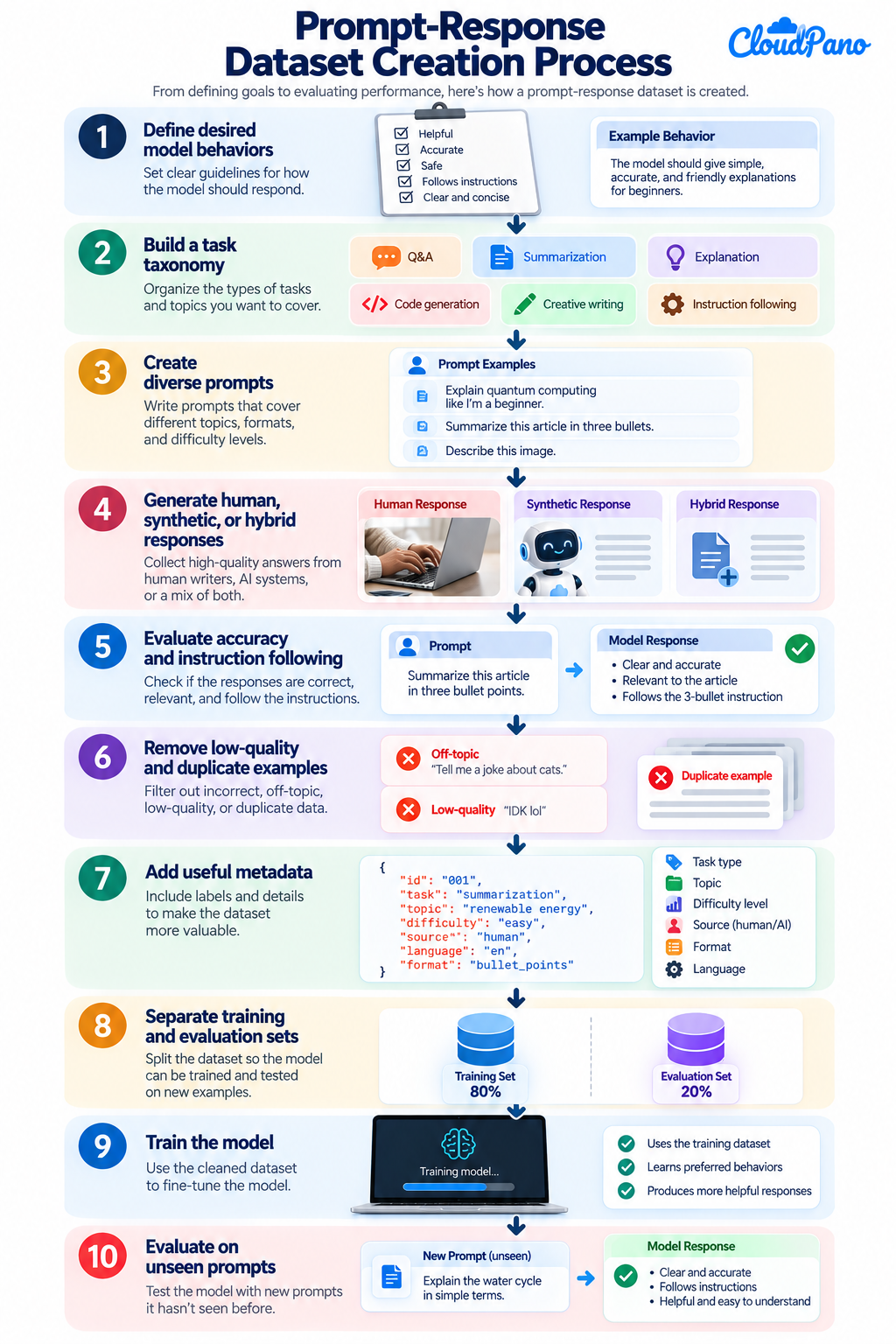
The final step is essential.
Dataset creation should be treated as an iterative process.
Evaluation reveals weaknesses. Those weaknesses inform future data collection. New examples can then target underrepresented behaviors.
That creates a continuous improvement loop:
Create → Train → Evaluate → Identify Gaps → Create Better Data → Retrain
Prompt-response datasets provide one of the clearest ways to teach a language model what desirable responses look like.
The structure appears simple:
Prompt → Response
But effective prompt response dataset creation involves much more.
Teams need to determine which behaviors matter, represent those behaviors through diverse prompts, produce reliable responses, verify their quality, remove repetition and errors, document provenance, and preserve independent data for evaluation.
Human-written examples can provide precision and expertise. Synthetic generation can provide scale. Hybrid workflows can combine the strengths of both.
Most importantly, dataset development should not end when the model starts training.
A stronger process creates a feedback loop:
Dataset Creation → Fine-Tuning → LLM Evaluation → Gap Analysis → Better Dataset Creation
That connection between training data and independent evaluation is what makes prompt-response datasets particularly important within modern LLM development.
A prompt-response dataset contains instructions, questions, or other inputs paired with examples of desired outputs. These datasets are commonly used for supervised fine-tuning, instruction tuning, task adaptation, and LLM evaluation. Examples can be written by humans, generated synthetically, or produced through hybrid workflows.
Prompt response dataset creation is the process of designing prompts, producing appropriate responses, reviewing quality, removing duplicates and errors, adding metadata, and preparing the resulting examples for model training or evaluation. High-quality creation focuses on behavioral coverage and accuracy rather than simply maximizing dataset size.
Teams typically define target behaviors, create a task taxonomy, generate diverse prompts, produce responses, perform quality assurance, filter problematic examples, and divide the resulting data into appropriate training and evaluation sets. Responses may come from human annotators, AI models, domain experts, or combinations of these sources.
Yes. AI models can generate both prompts and responses, allowing instruction datasets to scale quickly. Self-Instruct is a well-known example of generating instruction data synthetically. However, synthetic examples should still be filtered or validated because generator models can introduce factual errors, duplication, bias, or undesirable patterns.
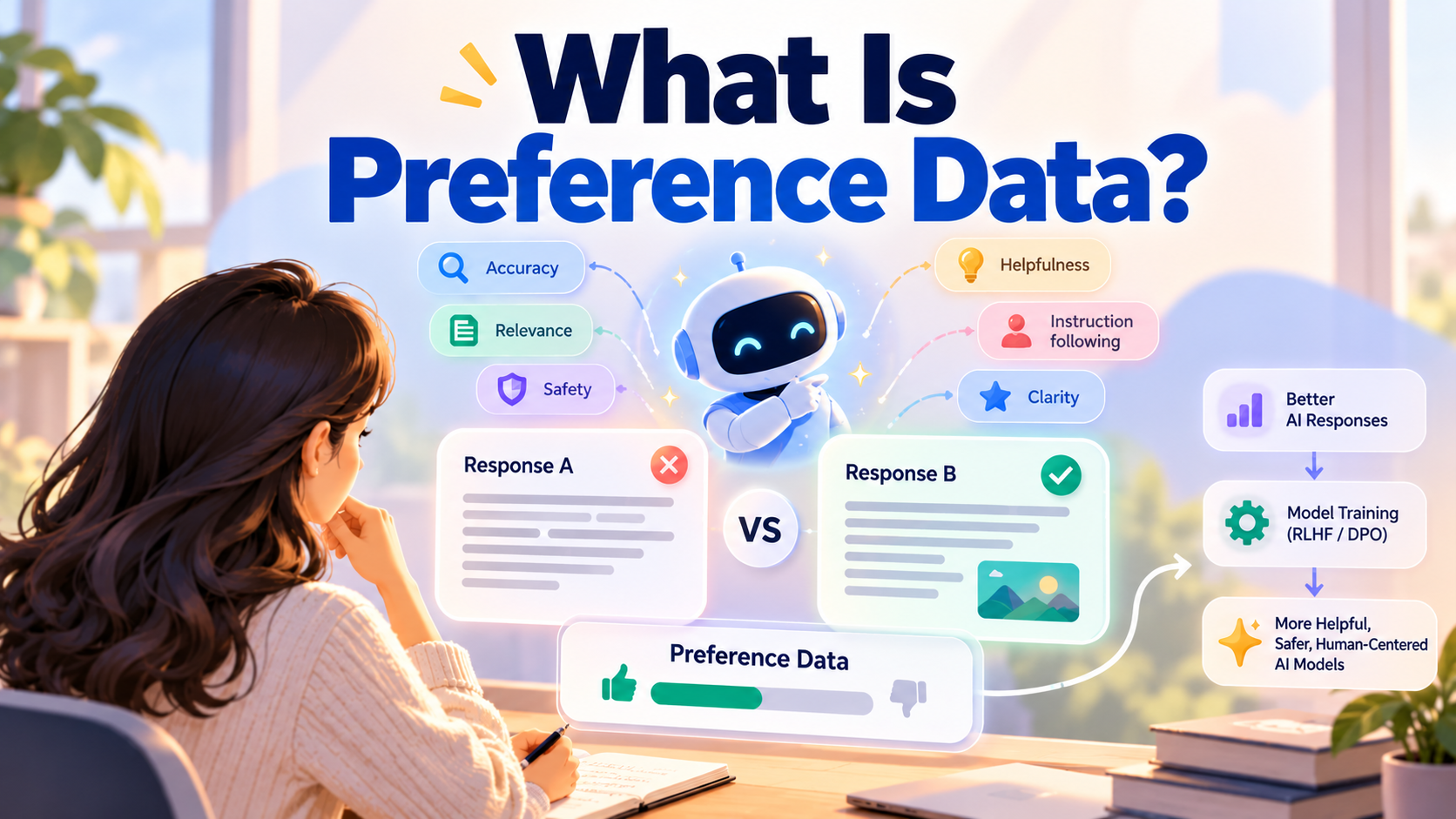
Prompt-response data provides an example of a desired answer: Prompt → Ideal Response. Preference data compares alternatives: Prompt → Chosen Response + Rejected Response. The former is commonly used for supervised fine-tuning, while preference pairs can support RLHF, reward modeling, DPO, and other preference-learning methods.


Compact, ready to go anywhere
Interchangeable lens that’s upgradeable
Dual 1-inch sensors for improved clarity and low light performance
Dynamic range and 6K 360° capture
360° photo resolution at 21MP

8K 360° video recording for ultra-detailed visuals.
4K single-lens mode for traditional wide-angle shots.
Invisible selfie stick effect for drone-like perspectives.
2.5-inch touchscreen with Gorilla Glass protection.
Waterproof up to 33ft for underwater shooting.

360° photo resolution in 23MP
Slim design at 24 mm thick
Built-in image stabilization for smooth video capture.
Internal 19GB storage for photo and video storage.
Wireless connectivity for remote control and sharing.

60MP 360° still images for high-resolution photography.
5.7K 360° video recording at 30fps.
2.25-inch touchscreen for intuitive control.
USB Type-C port for fast charging and data transfer.
MicroSD card slot for expandable storage.


Try it free. No credit card required. Instant set-up.