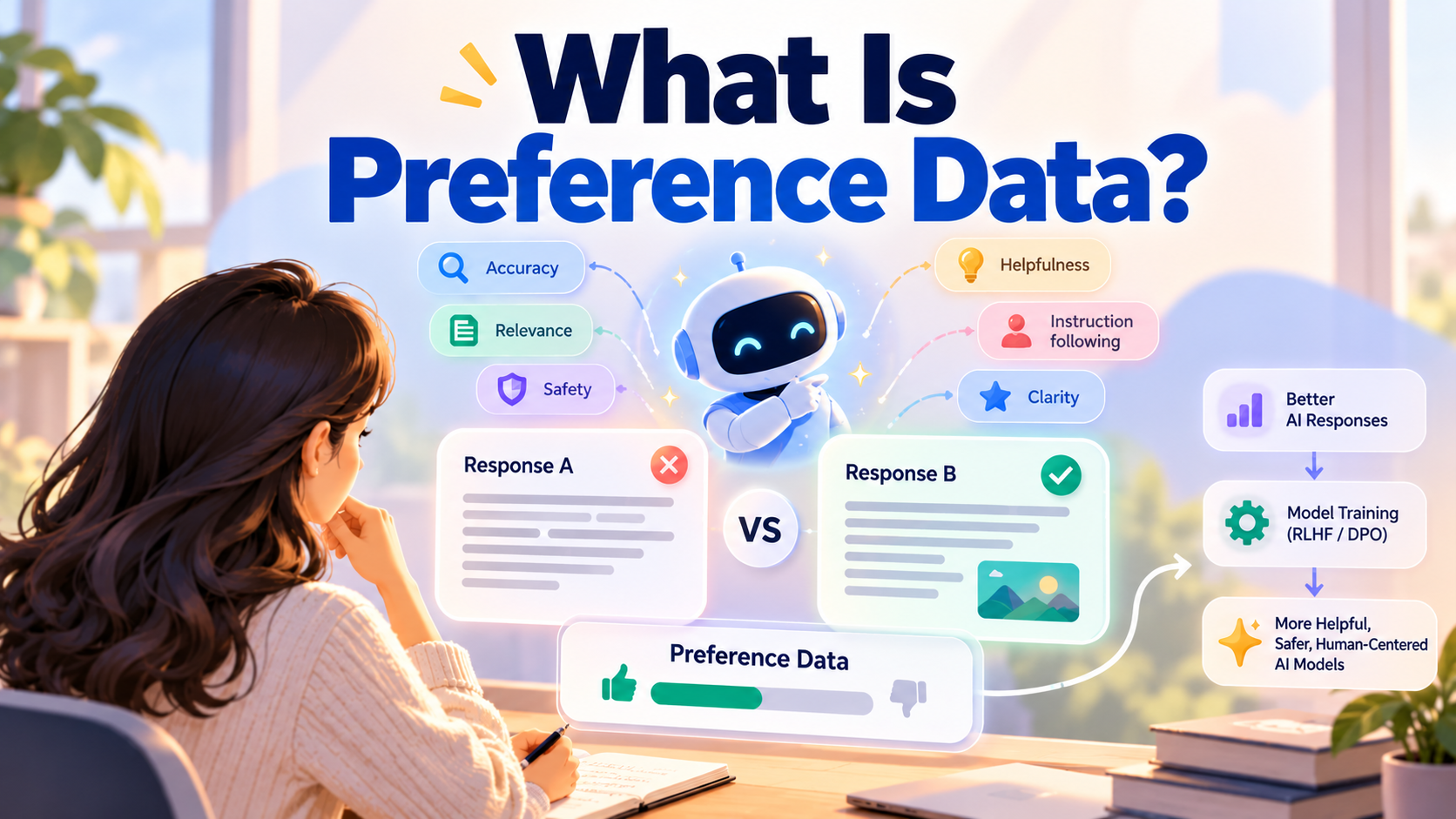
Preference data records which AI responses are preferred over others based on criteria such as accuracy, helpfulness, relevance, safety, and instruction following. In RLHF and other post-training methods, these comparisons help models learn which behaviors people value, making preference data an important bridge between LLM evaluation and model improvement.
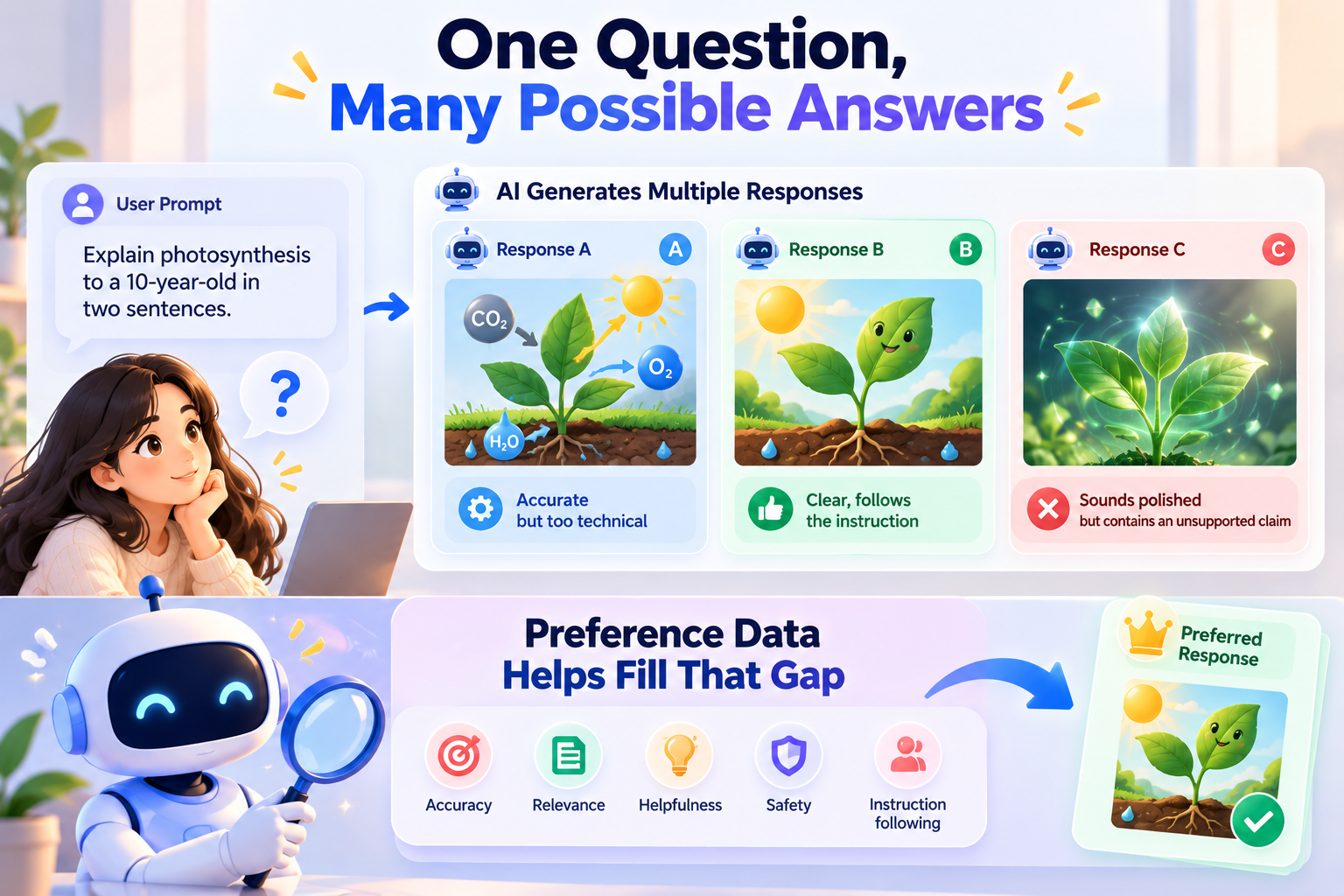
Large language models can generate many plausible answers to the same question. The challenge is determining which answer is actually better.
One response might be more accurate. Another might follow instructions more closely. A third could sound polished but contain an unsupported claim. Traditional language-model pretraining does not directly tell a model which of these responses people prefer.
Preference data helps fill that gap.
Preference data records judgments about which AI outputs are better according to defined criteria. These judgments can come from humans, AI evaluators, experts, or combinations of them. They are widely used in post-training methods such as Reinforcement Learning from Human Feedback (RLHF) and Direct Preference Optimization (DPO).
For teams building and evaluating large language models, high-quality preference data for RLHF can turn subjective judgments about model quality into structured signals that can be analyzed and used for training.
Preference data is structured information describing which output is considered preferable when two or more possible outputs are compared.
Imagine an AI receives this prompt:
Prompt:
“Explain gravity to a 10-year-old in two sentences.”
The model generates two responses.
“Gravity is a fundamental interaction associated with the curvature of spacetime caused by mass-energy according to general relativity.”
“Gravity is the force that pulls things toward each other, which is why you come back down when you jump. It also keeps Earth moving around the Sun.”
Both responses relate to gravity.
But Response B is likely more useful for the specific request because it uses age-appropriate language and follows the user's request for a simple explanation.
A preference example might therefore be stored conceptually as:
Prompt → Response B preferred over Response A
Or in a common training-data structure:
Prompt → Chosen Response → Rejected Response
Collect thousands or millions of carefully constructed comparisons, and developers gain a dataset describing what desirable model behavior looks like across many prompts.
That is preference data.
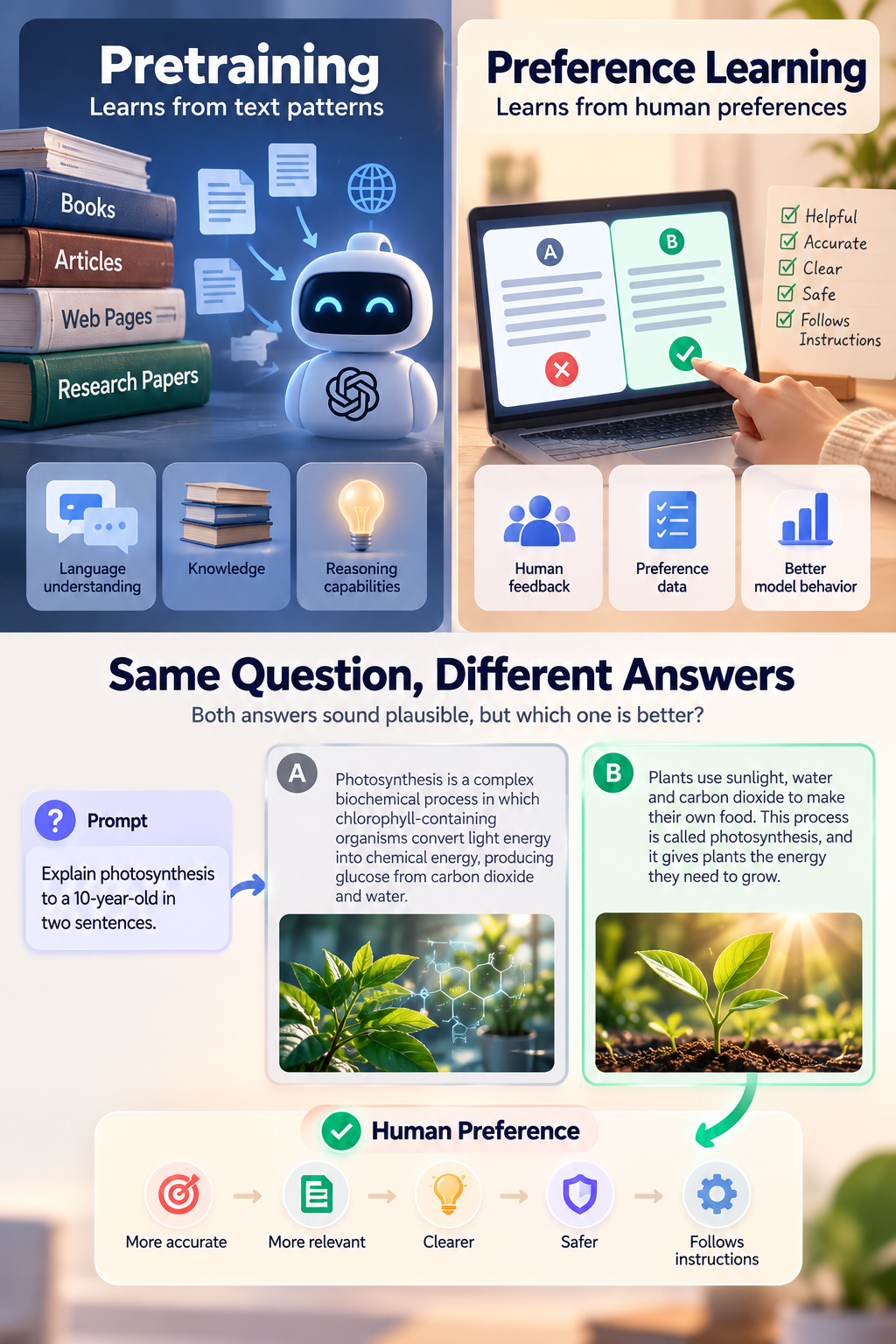
Pretraining and preference learning solve different problems.
During pretraining, a language model generally learns to predict tokens based on patterns in large collections of text.
This is extremely powerful for learning language, knowledge, style, relationships between concepts, and some reasoning capabilities.
But consider two answers that are both statistically plausible.
One may be:
Predicting the next token alone does not explicitly encode all of these preferences.
Preference data introduces another kind of supervision:
“Given these possible answers, which one better represents the behavior we want?”
Research on instruction-following models demonstrated how human comparisons between model outputs could be collected and used to train a reward model, which then provided a signal for further model optimization.
A basic preference data for RLHF record can contain several components.
The instruction or question presented to the model.
Two or more answers generated for that prompt.
A judgment identifying which answer is better.
The rubric explaining what “better” means.
Additional information may record evaluator confidence, task category, model version, disagreement, domain, safety category, or other details.
A simplified record might look like this:
Prompt: Explain photosynthesis to a beginner.
Response A: Long technical explanation with unexplained scientific terminology.
Response B: Short, accurate explanation using familiar examples.
Preference: Response B
Reason: More appropriate for a beginner and follows the requested style.
This structure converts a qualitative human judgment into data that can be used systematically.
There are several ways to collect preference signals.
Pairwise comparison is one of the simplest formats.
An evaluator sees:
Prompt
Response A
Response B
and answers:
Which response is better?
For example:
A vs. B → B wins
This format reduces a complex judgment to a relative choice.
Anthropic has described using A/B comparisons where evaluators interact with model outputs and select responses that are more helpful or harmless. The company has also highlighted important limitations of human evaluation, including cost, evaluator variation, and the challenge of balancing competing qualities.
Instead of comparing only two outputs, evaluators can rank several.
Suppose an LLM generates four answers:
Response C > Response A > Response D > Response B
This provides more information than one binary choice because it establishes relative preferences across several candidates.
Ranked preference modeling has been studied as an approach to improving language-model alignment.
Evaluators may also assign numerical scores.
For example:
Accuracy: 5/5
Instruction following: 4/5
Clarity: 5/5
Relevance: 5/5
These scores can help diagnose why a response succeeds or fails.
However, scoring systems require carefully defined rubrics. One evaluator's “4” may represent another evaluator's “5” unless the rating scale is calibrated.
Evaluators can explain why one answer is better.
For example:
Preferred: Response B
Reason: Response A gives correct information but fails to answer the user's question directly. Response B provides the requested recommendation and explains the reasoning.
Written feedback provides richer information than a simple winner/loser label, although it generally requires more evaluator effort.
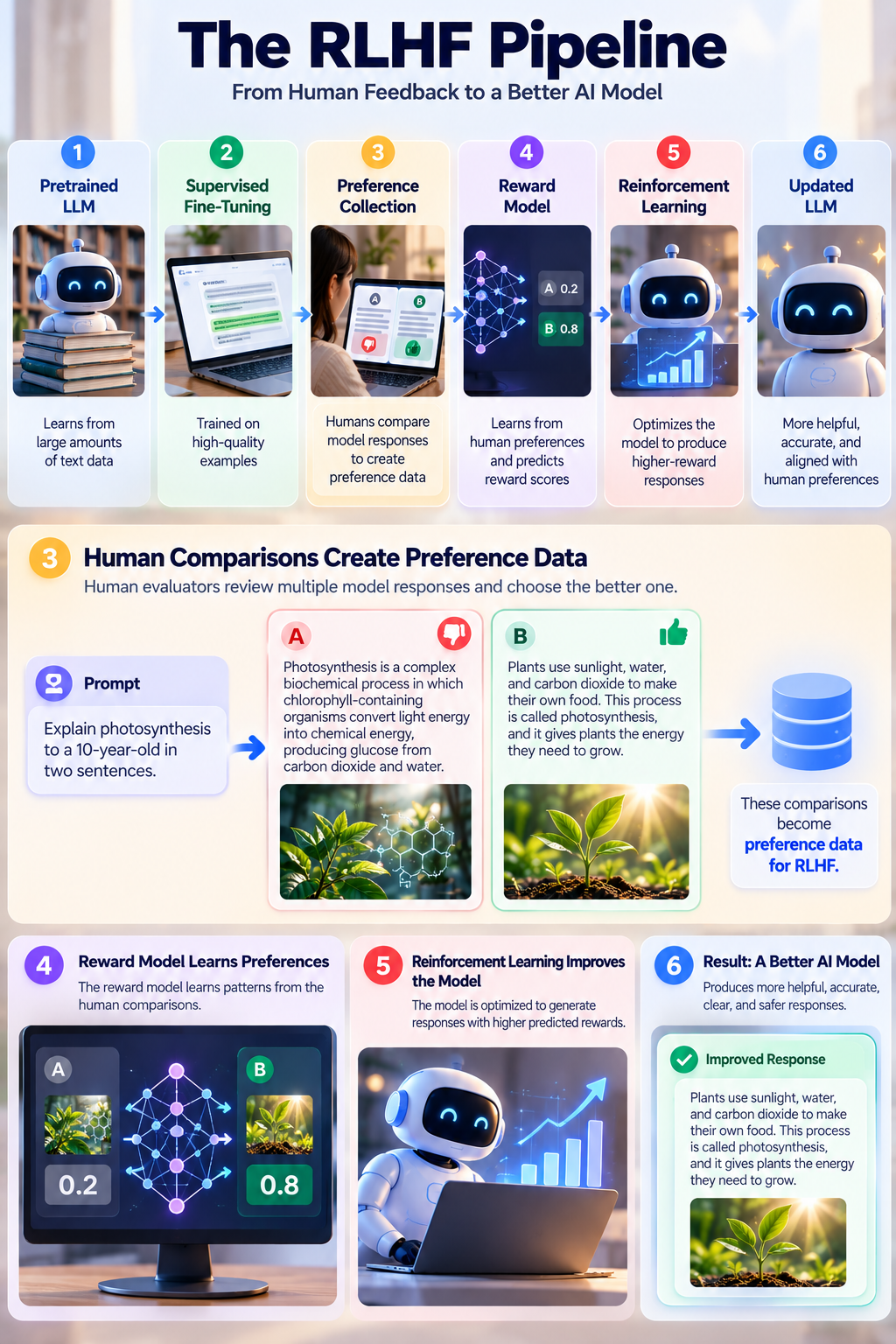
Traditional RLHF pipelines commonly involve several stages.
A simplified version looks like this:
Pretrained LLM → Supervised Fine-Tuning → Preference Collection → Reward Model → Reinforcement Learning → Updated LLM
After candidate responses are generated, human evaluators compare them.
Those comparisons create the preference data for RLHF.
A reward model can then learn from those comparisons.
Suppose humans repeatedly prefer responses that are accurate, concise, transparent about uncertainty, and good at following instructions.
The reward model attempts to learn patterns associated with those preferences.
It can then assign estimated reward scores to additional model outputs.
The language model can subsequently be optimized to produce responses that receive higher predicted rewards.
Anthropic has similarly researched preference modeling combined with RLHF for training assistants toward helpful and harmless behavior.
No.
This distinction has become increasingly important.
Preference data can be useful for several post-training approaches, including methods that do not use the classic reward-model-plus-reinforcement-learning pipeline.
One prominent example is Direct Preference Optimization (DPO).
DPO uses preference data to optimize a language model more directly. The original DPO research proposed a simpler approach that avoids explicitly fitting a separate reward model and then running the traditional reinforcement-learning optimization procedure.
A simplified comparison looks like this:
Preference Data → Reward Model → Reinforcement Learning → Updated Model
Preference Pairs → Direct Optimization → Updated Model
The training algorithm changes, but high-quality preference comparisons remain valuable.
This is why preference-data collection should not be viewed as useful only for one specific alignment algorithm.
Collecting more comparisons does not automatically produce a better dataset.
The quality of the judgments matters.
Annotators need to know exactly what they are evaluating.
Instead of saying:
“Choose the best response.”
a project might define specific criteria:
Clear criteria make judgments more consistent and interpretable.
Evaluators need examples showing how the rubric applies.
Calibration tasks can reveal whether different evaluators interpret instructions consistently before they begin producing large amounts of data.
Human judgments are inherently variable, and characteristics of evaluators can influence assessments.
That makes evaluator selection and training part of dataset quality.
Some comparisons are easy.
A general evaluator can usually tell whether a response follows a formatting instruction.
Other evaluations require expertise.
Consider:
“Which proposed proof of this theorem is mathematically valid?”
or:
“Which explanation of this software vulnerability is technically accurate?”
A response can sound highly convincing while being wrong.
For specialized domains, subject-matter expertise can therefore matter more than raw annotation volume.
Preference data should reflect the situations the model is expected to encounter.
A customer-support model, for example, may require preferences covering:
If training data contains only easy prompts, the resulting preference signal may not generalize well to difficult real-world interactions.
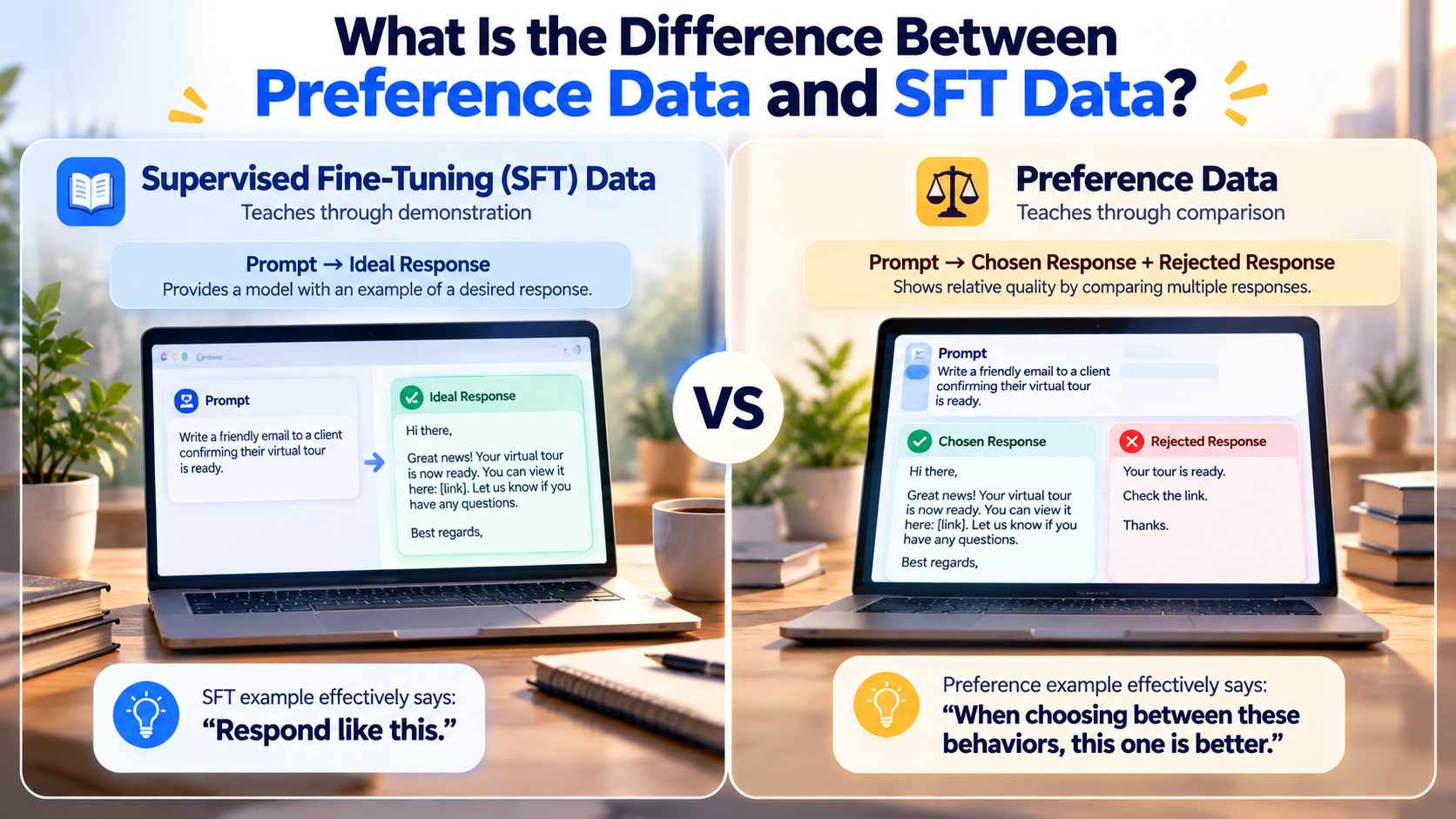
Preference data and supervised fine-tuning data are related but different.
Usually provides a model with an example of a desired response:
Prompt → Ideal Response
This teaches through demonstration.
Shows relative quality:
Prompt → Chosen Response + Rejected Response
This teaches through comparison.
An SFT example effectively says:
“Respond like this.”
A preference example says:
“When choosing between these behaviors, this one is better.”
Modern post-training pipelines may use both because they provide different forms of supervision.
The same types of human judgments can appear in both workflows, but their purpose differs.
The goal is to measure the model.
Prompts → Responses → Human Judgments → Performance Results
Teams may use the results to compare models, detect regressions, or understand weaknesses.
The goal is to change the model.
Prompts → Responses → Preferences → Training Signal → Updated Model
This distinction is important because using evaluation examples directly for training can contaminate an evaluation set.
A strong LLM development process therefore maintains independent evaluation data that the model has not been optimized against.
Preference datasets encode judgments about desirable behavior, so systematic labeling problems can become model-training problems.
A polished answer may appear more convincing than an accurate but less elegant response.
If evaluators consistently reward confidence or writing quality without verifying correctness, the dataset may unintentionally encourage the wrong behavior.
Some questions do not have one universally preferred answer.
Capturing disagreement can sometimes be more informative than forcing artificial consensus.
Evaluators may develop unconscious preferences for responses based on presentation or ordering rather than quality.
Randomization and quality checks can help identify these effects.
Human preferences vary.
A dataset built from a narrow evaluator population may fail to represent the intended user population or product requirements.
Even well-designed preference models remain proxies for desired behavior.
Research into reward-model behavior illustrates why optimizing a learned signal should not be assumed to perfectly capture the underlying objective.
Preference training therefore does not eliminate the need for independent evaluation.
Yes. Human evaluators are no longer the only possible source of preference judgments.
AI models can compare candidate responses according to defined principles or evaluation criteria.
One prominent example is Constitutional AI, where AI-generated feedback based on a set of written principles was used during model training.
This can make preference generation substantially more scalable.
However, AI-generated judgments introduce their own risks.
An evaluator model may share biases or failure modes with the model being evaluated. It may miss subtle factual errors. It may prefer responses based on superficial characteristics.
A practical approach can therefore combine:
Human Preferences + Expert Review + AI Evaluation + Automated Checks
rather than treating any single evaluator as a perfect source of truth.
Preference data sits at an important intersection between evaluation and training.
Evaluation identifies behavior:
Which response is better?
Preference data records that judgment:
Response A > Response B
Post-training can then use the judgment to influence future model behavior.
This creates a feedback loop:
Generate → Evaluate → Compare → Learn → Test Again
But the final step matters.
After a model is optimized using preference data, it should be evaluated again on independent examples.
Otherwise, teams may know that a model learned to score well against its training preferences without knowing whether it actually improved on unseen tasks.
For the broader LLM Evaluation topic cluster, preference data is therefore important not just because it can improve models, but because it forces teams to define what “better” actually means.
Preference data transforms a simple but powerful question—“Which response is better?”—into structured information that can help evaluate and improve AI models.
In traditional RLHF, human comparisons can be used to train reward models. In newer approaches such as DPO, preference pairs can be used more directly during optimization.
But the usefulness of preference data for RLHF depends on far more than the number of comparisons collected.
Strong preference datasets require carefully designed prompts, clear rubrics, trained evaluators, appropriate domain expertise, quality-control processes, and representative examples.
Most importantly, preference data should not replace independent model evaluation.
A reliable development cycle separates training from testing:
Collect preferences → Improve the model → Evaluate on unseen data → Identify failures → Improve again
As language models become more capable, preference data will remain an important link between human judgment, LLM evaluation, and post-training—because before developers can teach a model to behave “better,” they first need a reliable way to define and measure what better means.
Preference data records judgments about the relative quality of AI outputs. It commonly contains a prompt, multiple candidate responses, and an indication of which response is preferred. Preferences may be based on qualities such as correctness, helpfulness, relevance, instruction following, clarity, or safety.
Preference data for RLHF consists of human judgments about which model responses are better. These comparisons can be used to train a reward model that predicts human preferences. The reward model can then provide a training signal used to optimize the language model toward preferred behaviors.
In a preference pair, the chosen response is the output judged to be better according to the evaluation criteria, while the rejected response is the less-preferred alternative. These pairs can provide direct supervision for preference-learning techniques such as DPO.
Preference data can be collected through pairwise comparisons, rankings, numerical ratings, critiques, expert evaluations, or AI-generated judgments. High-quality collection typically requires clear rubrics, trained evaluators, calibration, quality assurance, representative prompts, and processes for handling disagreement.
Supervised fine-tuning data typically provides a prompt and an example of a desired answer. Preference data compares multiple possible answers and indicates which is better. SFT teaches through demonstration, while preference learning provides information about the relative desirability of different model behaviors.


Compact, ready to go anywhere
Interchangeable lens that’s upgradeable
Dual 1-inch sensors for improved clarity and low light performance
Dynamic range and 6K 360° capture
360° photo resolution at 21MP

8K 360° video recording for ultra-detailed visuals.
4K single-lens mode for traditional wide-angle shots.
Invisible selfie stick effect for drone-like perspectives.
2.5-inch touchscreen with Gorilla Glass protection.
Waterproof up to 33ft for underwater shooting.

360° photo resolution in 23MP
Slim design at 24 mm thick
Built-in image stabilization for smooth video capture.
Internal 19GB storage for photo and video storage.
Wireless connectivity for remote control and sharing.

60MP 360° still images for high-resolution photography.
5.7K 360° video recording at 30fps.
2.25-inch touchscreen for intuitive control.
USB Type-C port for fast charging and data transfer.
MicroSD card slot for expandable storage.


Try it free. No credit card required. Instant set-up.