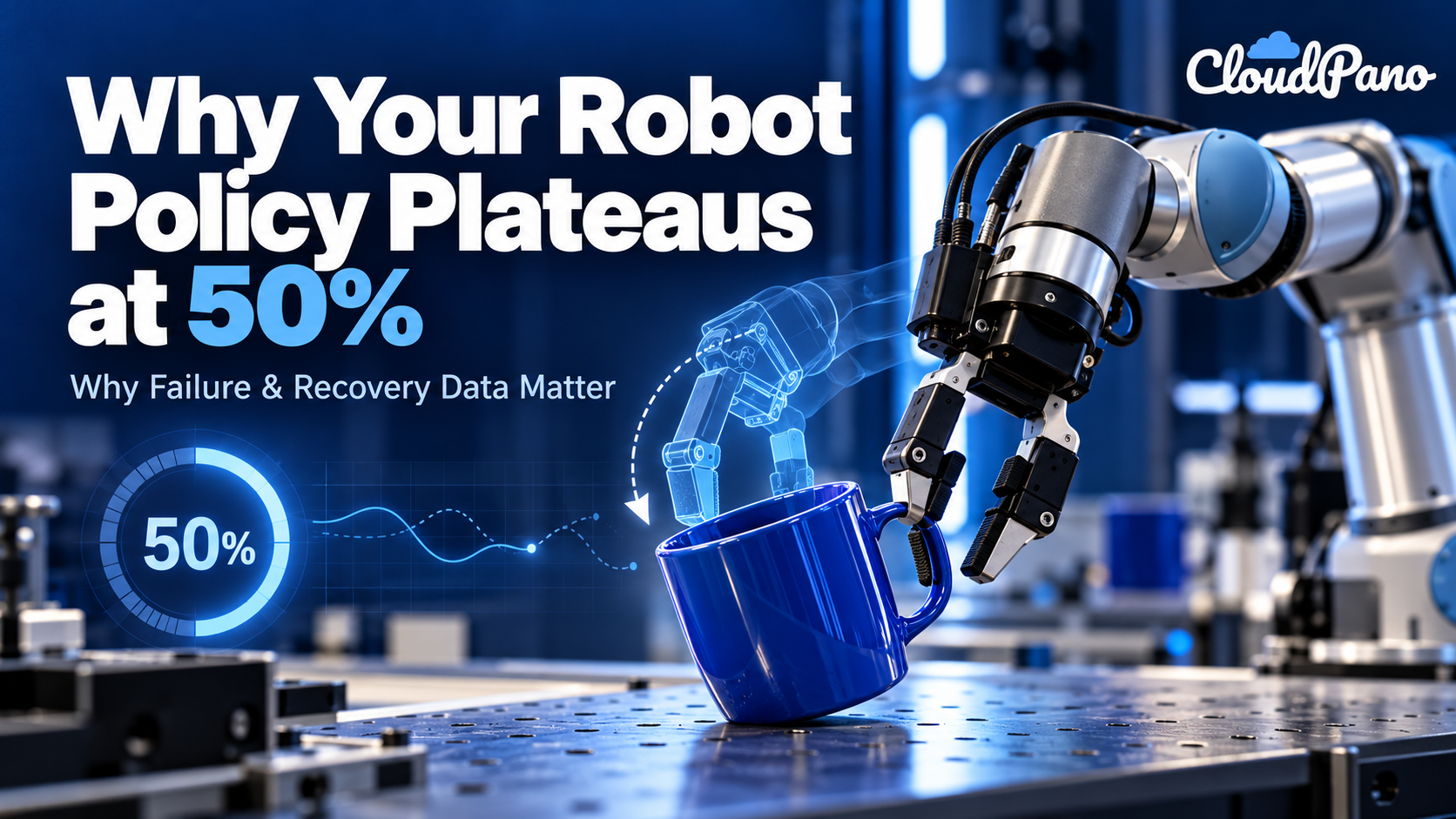
Robot policies trained only on clean demonstrations never see what to do after a mistake. In deployment, small errors push the robot into unfamiliar states where errors compound, so success stalls around half the time. Failure and recovery data fixes this by showing the policy slips, drops and the corrections that follow, so it learns to get back on track.
Your policy picks up the cup in the lab demo, then fails every other run on the real line. Physical Intelligence, the company behind the π0.6 robot model, describes the same wall: with demonstrations alone, "it's not hard to get a robot to succeed half of the time," but succeeding every time is a different problem (Physical Intelligence).
That gap is rarely a model-size problem. It is a data problem, and specifically a missing-data problem: your training set shows the robot what success looks like, but almost never what to do one second after something goes wrong. If you have read Why Robotics Labs Are Buying 1,000,000 Hours of Egocentric Video, this is the other half of the story. Volume gets a policy started. Failure data for robot training is what gets it unstuck.
Because small mistakes compound. A policy trained by imitation makes a tiny error, that error puts the robot in a state its training data never covered, and the next error is bigger.
Physical Intelligence explains it plainly in its write-up on π*0.6. A vision-language-action model controlling a robot will sometimes put the gripper in the wrong spot, miss a grasp or knock something over. Each slip creates a situation slightly different from anything in the demonstrations, where a bigger mistake becomes more likely. The small mistakes are fixable; the chain of them is what causes failure.
This is not a new finding. Back in 2010, Ross, Gordon and Bagnell showed that imitation learning breaks the usual assumption that training and test data come from the same distribution, because a policy's own actions shape what it sees next. They noted this leads to poor performance "in theory and often in practice" (arXiv:1011.0686).
Physical Intelligence also points out why this hits robots harder than chatbots. A language model produces a static output. A robot policy acts, sees the result, and acts again, so every error feeds into the next decision.
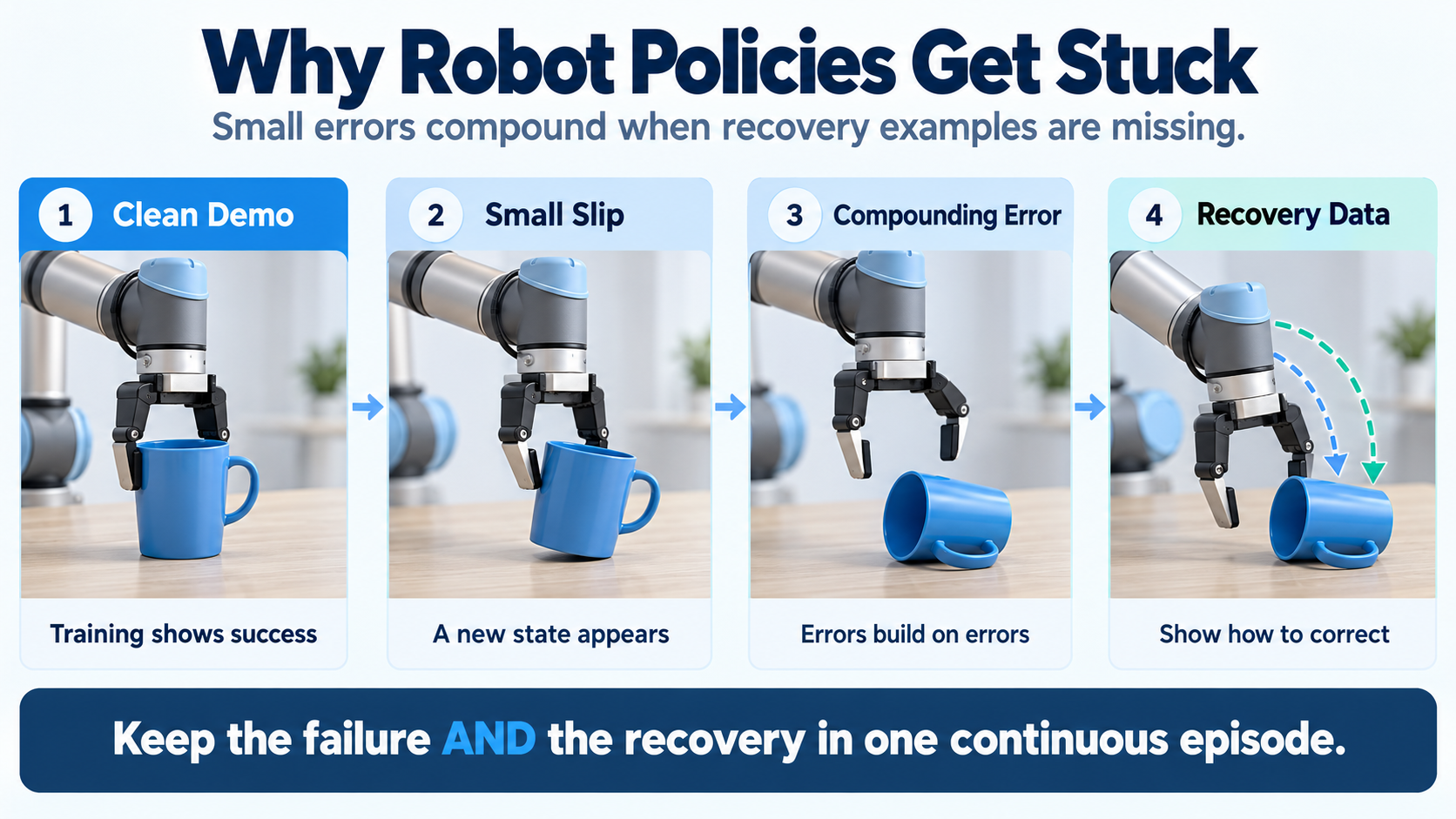
Failure data is training data that keeps the moments where a task goes wrong, plus what happens next. That can mean a slipped grasp and the re-grasp, a dropped object and the pick-up, or a box that has to be refolded after a bad fold.
It comes in a few forms:
The common thread is that the recovery is the valuable part. A clip of a failure on its own teaches the policy what not to do. A clip of a failure and the fix teaches it how to get back on track.
Because clean demonstrations keep showing the policy states it already handles. They rarely show the off-track states the policy creates for itself in deployment, so adding more of them does little for the failures you actually see.
Physical Intelligence makes the point directly: if you train a policy to copy its own past behavior, you just teach it to repeat the same mistakes. The useful signal has to come from what should have happened after the mistake. That is why their RECAP method uses an expert teleoperator who takes over when the robot errs. The correction supervises exactly the situations the policy puts the robot into, which ordinary demonstrations never reach.
The results show what that missing data is worth. Training π*0.6 with corrections and on-robot experience more than doubled throughput on some of the hardest tasks and cut failure rates by 2x or more, compared with earlier training stages of the same model. On espresso making, both throughput and success rate more than doubled once on-robot experience was added (Physical Intelligence). The final model ran espresso drinks from 5:30am to 11:30pm and assembled 59 factory packaging boxes without interruption.
Note what that comparison measures: one model at different training stages, all on Physical Intelligence's own robots and tasks. It shows that data from off-track states moves the ceiling. It does not tell you how much any particular dataset will move yours.
The best failure data covers the mistakes your robot really makes, keeps the recovery attached, and records why the failure happened. Each source does part of that job.
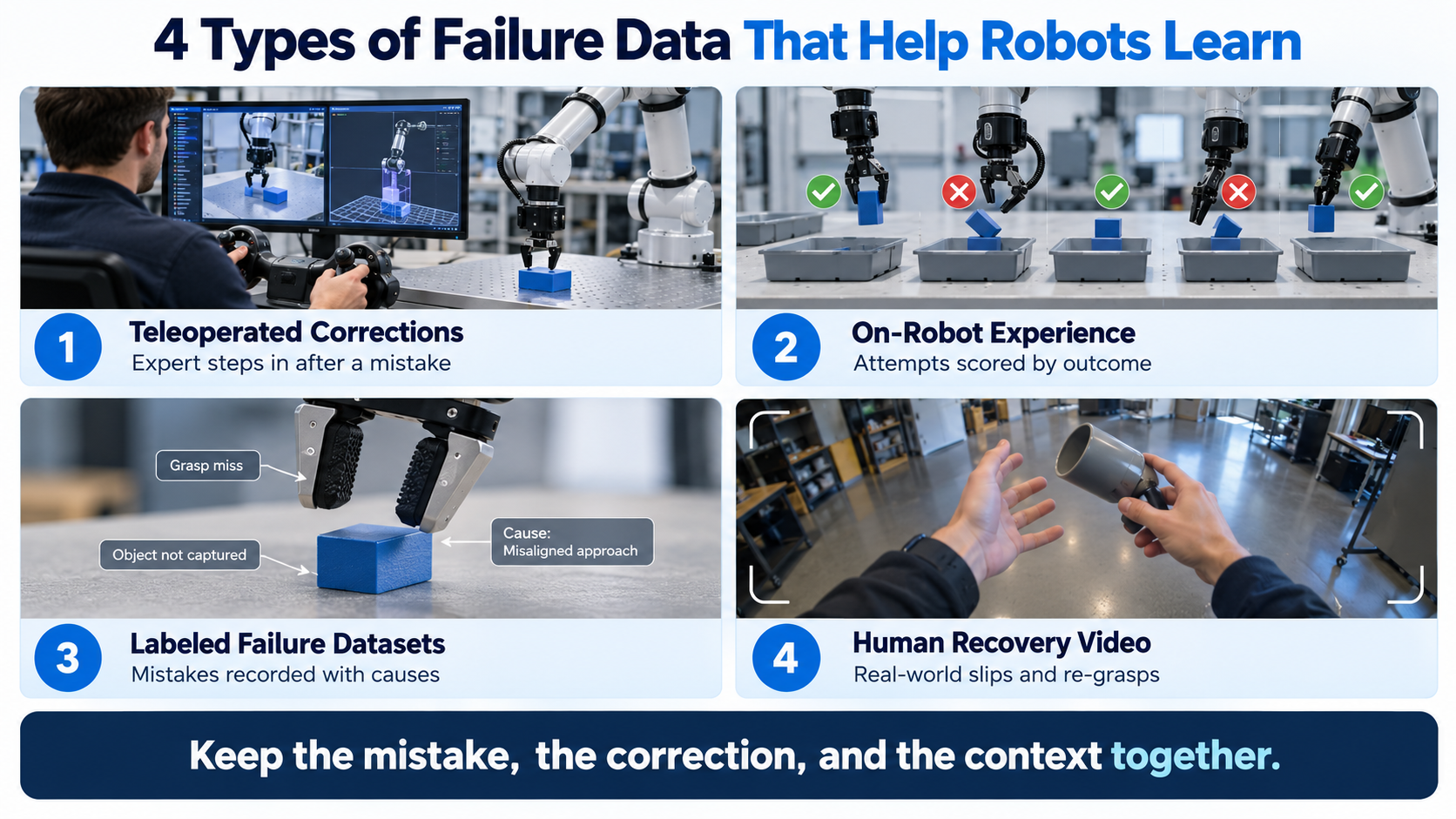
Most teams will need more than one. Human and dataset sources broaden coverage of edge cases; on-robot corrections target the specific failures your policy produces.
Decide which failures matter before anyone presses record. Edge case data collection for AI goes wrong when teams capture "messy footage" and hope the right moments are in it.
Firsthand collects first-person human demonstrations to a written skill spec that names failure scenarios, such as occlusion angles, lighting conditions and recovery cases, before capture starts. Contributors don't pause or re-stage, so a drop and the re-grasp stay in one episode. The recovery gets its own labeled action segment, a contact_events stream flags loss of contact, and hand pose is tracked at 21 joints per hand with occluded joints flagged rather than guessed (Firsthand).
Streams are synchronized to under 2 ms, data ships in RLDS, LeRobot or WebDataset, and the license is buyer-owned. Where coverage is deep, the first validated batch arrives in a median of 48 hours from a signed spec.
Here is what it does not do:
The third-party results in this article, including Physical Intelligence's and RoboMIND's, were not measured on Firsthand data.
If human failure-and-recovery video fits your pipeline, start with our failure-case data collection spec.
A policy that plateaus near 50% is usually telling you it has never seen its own mistakes. More clean demonstrations add little. Data from off-track states, whether robot corrections, labeled failures or human recovery demonstrations, is what raises the ceiling. Name the failures you need, keep the recovery in the episode, and count coverage per scenario.
The biggest issue is compounding error. A policy trained to copy demonstrations makes small mistakes that lead it into situations its training data never covered, where it makes bigger ones. It also can't do better than its demonstrations and needs costly human data. Corrections and failure-and-recovery examples help close the gap.
AI models learn from the examples they are trained on, and edge cases are by definition rare in that data. When a model meets a situation it has seen few times, it guesses. For robots, edge cases like slips, occlusions and low light are common in deployment, so they need to be collected on purpose.
An edge case is a situation that sits at the boundary of what a model normally sees: rare, unusual or extreme inputs. In robotics, examples include an object slipping mid-grasp, a hand blocking the camera view, or two flat boxes stuck together. Models often fail on them because training data contains few or none.
Hardware faults, sensor errors and software bugs all play a part. For learned robot policies, a common cause is a situation the training data didn't cover, such as a missed grasp or a moved object. One small error then leads to another, which is why recovery data matters as much as success data.
For robots that learn from data, reliability is one of the hardest problems. Getting a task to work sometimes is easier than getting it to work every time at a useful speed. Other big challenges include the cost of collecting training data, handling varied real-world settings, and safe operation around people.


Compact, ready to go anywhere
Interchangeable lens that’s upgradeable
Dual 1-inch sensors for improved clarity and low light performance
Dynamic range and 6K 360° capture
360° photo resolution at 21MP

8K 360° video recording for ultra-detailed visuals.
4K single-lens mode for traditional wide-angle shots.
Invisible selfie stick effect for drone-like perspectives.
2.5-inch touchscreen with Gorilla Glass protection.
Waterproof up to 33ft for underwater shooting.

360° photo resolution in 23MP
Slim design at 24 mm thick
Built-in image stabilization for smooth video capture.
Internal 19GB storage for photo and video storage.
Wireless connectivity for remote control and sharing.

60MP 360° still images for high-resolution photography.
5.7K 360° video recording at 30fps.
2.25-inch touchscreen for intuitive control.
USB Type-C port for fast charging and data transfer.
MicroSD card slot for expandable storage.


Try it free. No credit card required. Instant set-up.