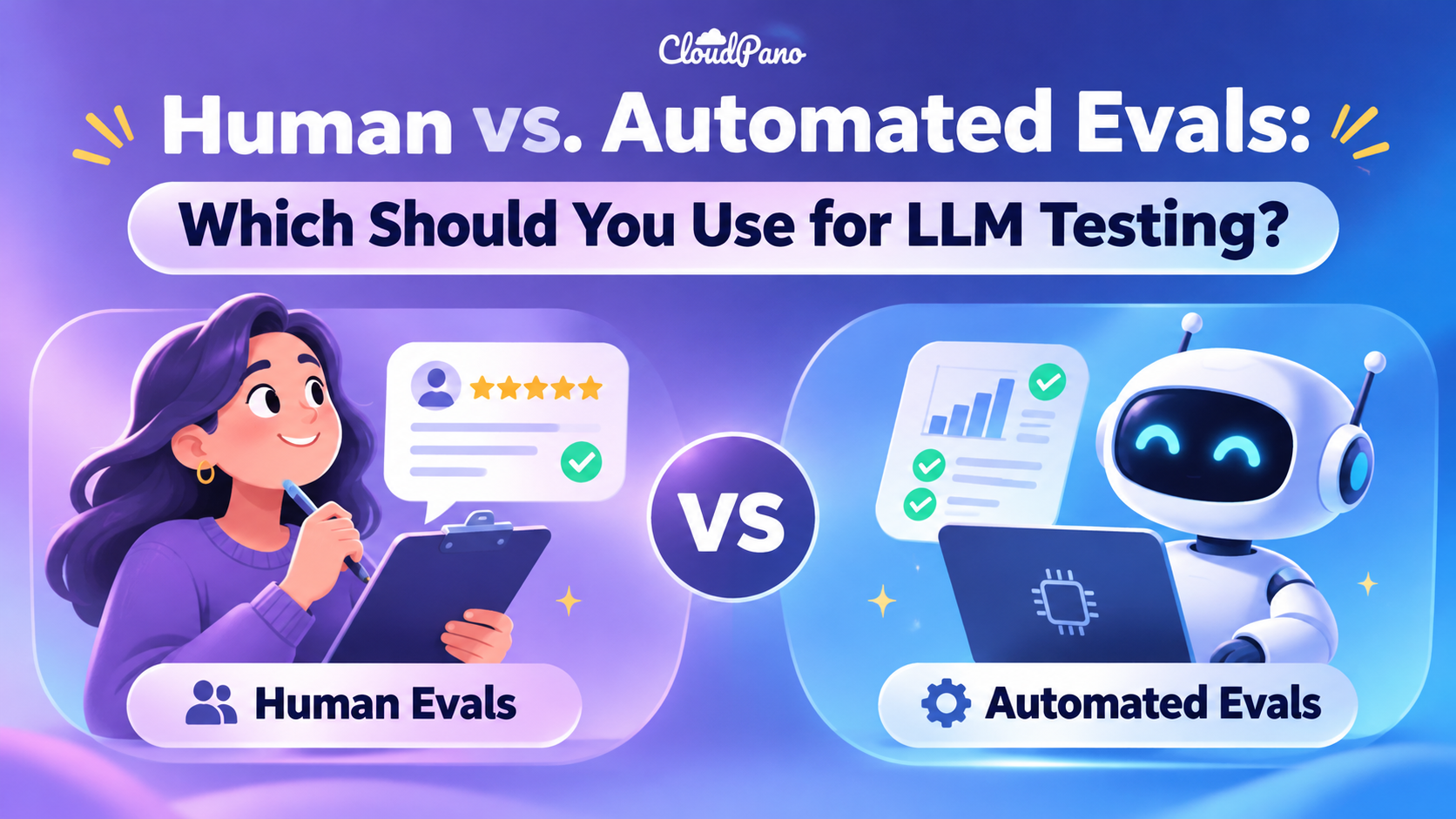
Human evaluations are best for assessing nuanced qualities such as helpfulness, reasoning, tone, and contextual accuracy. Automated evaluations are better for testing large volumes of LLM responses quickly and consistently. A hybrid approach often works best, combining scalable automated checks with human judgment for complex, subjective, or high-risk outputs.
Large language models (LLMs) can generate convincing answers, summarize complex documents, write code, and support customer interactions. But producing fluent text does not guarantee that an AI model is accurate, reliable, safe, or useful.
That is why LLM evaluation has become an essential part of developing and deploying AI systems.
One of the biggest decisions AI teams face is choosing between human evaluation and automated evaluation. Both approaches can identify model weaknesses, but they measure different aspects of performance.
Understanding human vs automated evals helps organizations choose the right evaluation strategy, reduce testing costs, and improve the quality of AI-generated responses.
The best approach is not always choosing one over the other. In many cases, combining human judgment with automated testing produces a more complete picture of model performance.
Human evaluation is the process of having trained reviewers assess AI-generated responses against defined quality standards.
Rather than relying entirely on automated scores, human evaluators examine whether a response meets the user's actual needs.
For example, an AI-generated customer support answer might be grammatically correct but fail to address the customer's problem. An automated grammar checker could rate the response positively, while a human reviewer may recognize that it is unhelpful.
Human reviewers commonly assess:
Evaluators may assign numerical ratings, compare multiple responses, identify specific errors, or provide written feedback.
Human evaluation is especially valuable when responses require interpretation rather than simple verification.
Examples include evaluating conversational assistants, complex reasoning, emotionally sensitive interactions, creative writing, and domain-specific explanations.
Human reviewers can also identify subtle problems that automated metrics may miss, such as misleading implications, inappropriate confidence, or incomplete reasoning.
However, human evaluation has limitations. It requires time, reviewer training, quality assurance, and clearly documented scoring guidelines.
Different reviewers may also interpret the same response differently, making calibration and disagreement resolution important.
Automated evaluation uses software, algorithms, or AI models to assess LLM outputs without requiring a human to inspect every response.
These systems can evaluate large collections of responses, making them useful for repeated testing during model development.
Automated evaluation methods generally fall into three categories.
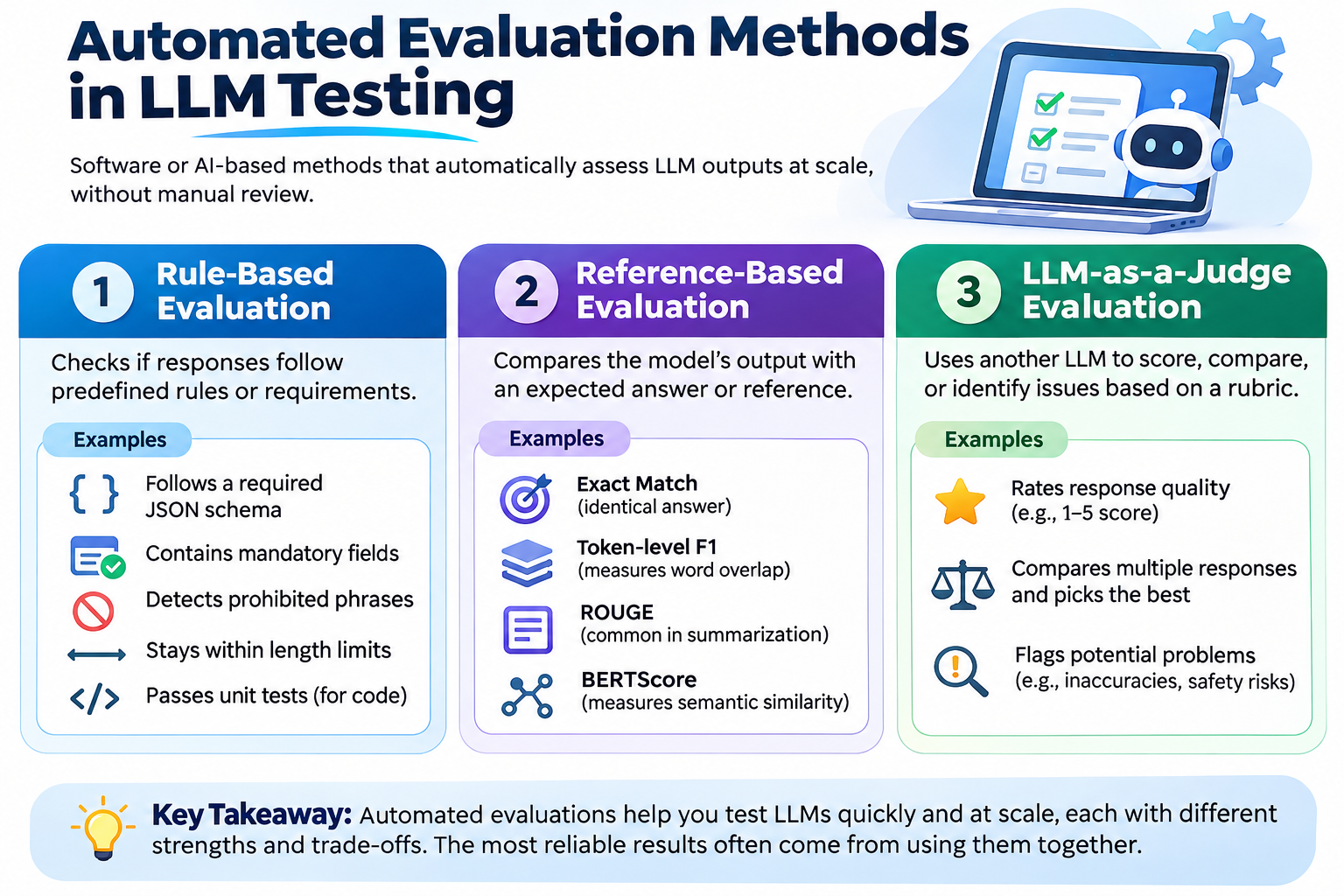
Rule-based evaluation checks whether responses satisfy predefined requirements.
Examples include:
These checks are particularly effective when success can be defined objectively.
However, passing a formatting check does not establish that the content is factually correct or useful.
Reference-based evaluation compares generated outputs with expected answers or reference material.
Common metrics include exact match, token-level F1, ROUGE, and BERTScore.
These approaches can be useful for tasks with established reference answers, such as certain question-answering and summarization benchmarks.
Their limitations become more apparent when multiple different responses could all be correct.
For example, two explanations may communicate the same idea using different wording. A surface-level similarity metric may penalize one response even when both are accurate.
LLM-as-a-judge systems use another language model to evaluate generated responses.
The evaluator receives the original prompt, the response being assessed, and a scoring rubric. Depending on the task, it may also receive reference documents or expected answers.
It can then assign scores, compare candidate responses, or identify potential problems.
This method is useful for evaluating qualities that are difficult to measure using simple rules.
However, LLM judges can introduce their own biases, including sensitivity to response length, wording, presentation order, and similarities between models.
Automated judge scores should therefore be validated against human judgments before being treated as reliable measures of quality.
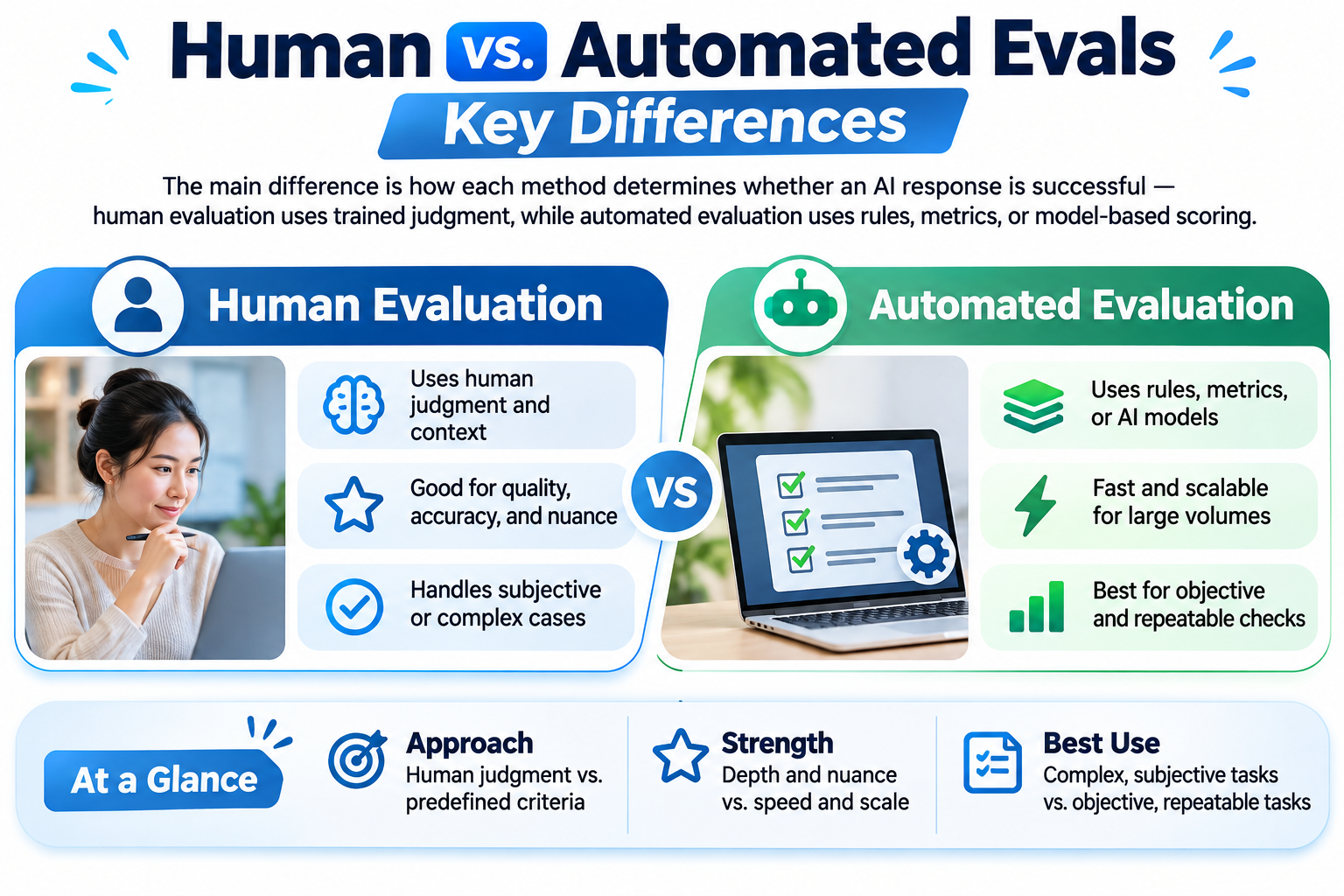
The central difference in human vs automated evals is how each method determines whether an AI response is successful.
Human evaluation relies on trained judgment, while automated evaluation relies on predefined rules, statistical measures, or model-generated assessments.
Human evaluators are often better suited to assessing responses requiring nuanced interpretation.
They can consider the user's intent, the surrounding conversation, and whether an answer is appropriate for the situation.
Automated evaluators can perform well when correctness is measurable, such as checking structured outputs or running code tests.
Neither approach guarantees factual accuracy. Human reviewers can make mistakes, and automated judges may confidently approve incorrect answers.
Automated evaluation is generally faster for large testing datasets.
An organization can run automated checks across thousands of model outputs as part of a continuous testing pipeline.
Human evaluation typically takes longer because each response requires attention and judgment.
This makes automated testing attractive for frequent regression testing, while human review is often reserved for more complex assessments.
Human evaluation involves reviewer compensation, training, management, and quality assurance.
Automated evaluation requires engineering resources, computing infrastructure, and, for LLM-based judges, inference costs.
Although automated testing can reduce the cost per evaluation at scale, developing and validating a trustworthy evaluation system still requires investment.
The most economical approach depends on the task, dataset size, required reliability, and consequences of evaluation errors.
Automated rule-based checks generally apply the same criteria consistently.
Human reviewers may interpret guidelines differently, particularly when evaluating subjective qualities.
However, consistency does not necessarily mean correctness.
An automated evaluator can repeatedly apply a flawed scoring rule, while a human reviewer may recognize that the rubric itself needs improvement.
Reliable evaluation therefore requires both consistent procedures and periodic validation.
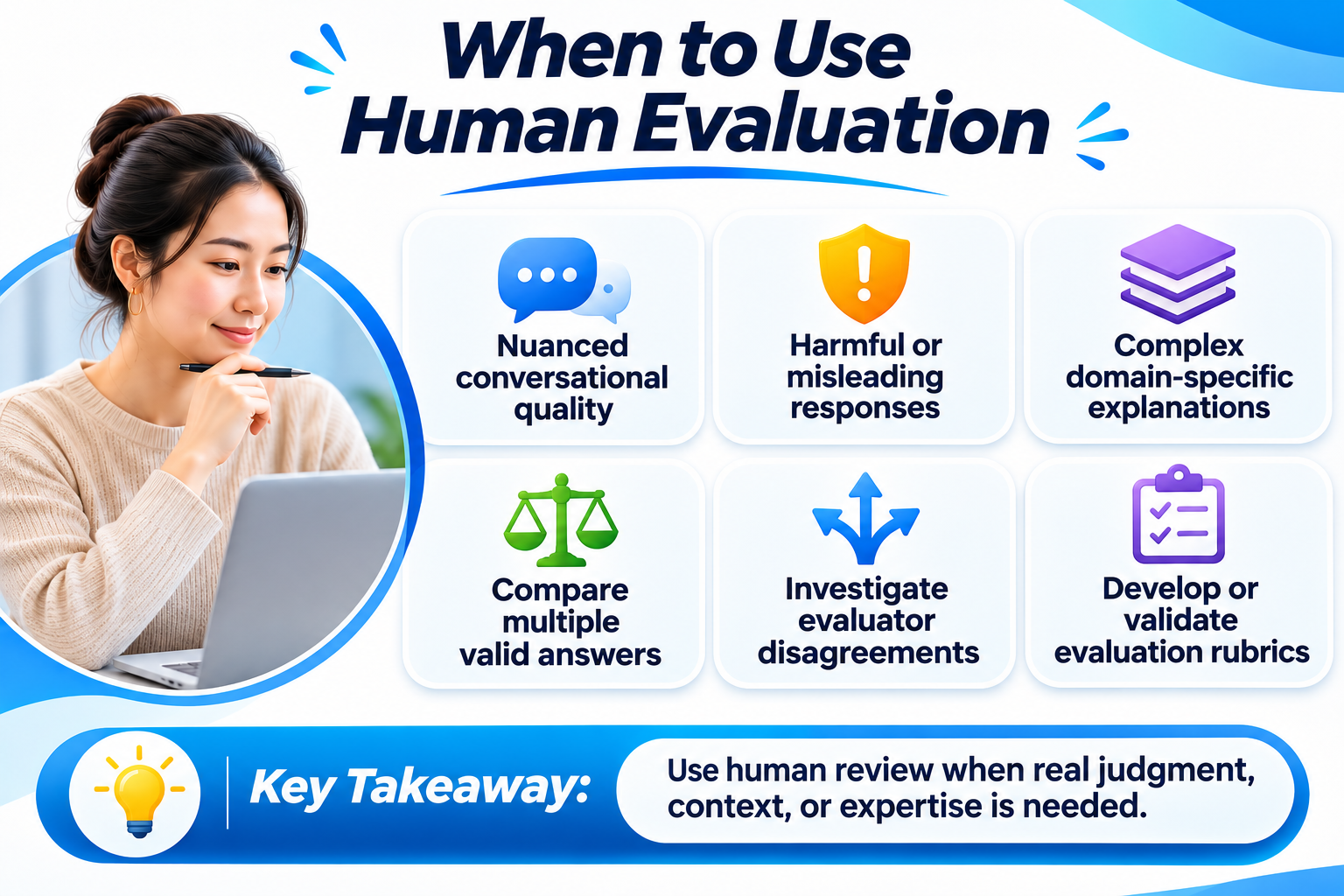
Human evaluation is particularly valuable when the quality of an AI response cannot be reduced to a simple measurable requirement.
Consider prioritizing human review when:
For example, an organization deploying an AI assistant for financial education may need expert reviewers to assess whether explanations are accurate, appropriately qualified, and understandable to the intended audience.
Automated checks can identify missing disclaimers or formatting problems, but expert judgment may still be necessary to evaluate the substance of the advice.
Human evaluation is also useful for creating high-quality labeled datasets that support future automated testing.
Automated evaluation is most useful when testing needs to be frequent, repeatable, and scalable.
It works particularly well for:
For example, a company using an LLM to extract invoice information can automatically verify whether generated outputs contain required fields and follow a valid schema.
If ground-truth values are available, the system can also compare extracted amounts, dates, and identifiers against expected results.
These objective checks provide useful signals without requiring reviewers to inspect every successful extraction.
Nevertheless, unexpected failures and ambiguous cases may still require human investigation.
For many production applications, the most effective human vs automated evals strategy combines both methods.
Automated evaluation provides broad testing coverage, while human reviewers assess difficult cases and validate whether automated scores reflect actual response quality.
A hybrid approach also allows organizations to allocate reviewer time where it has the greatest value.
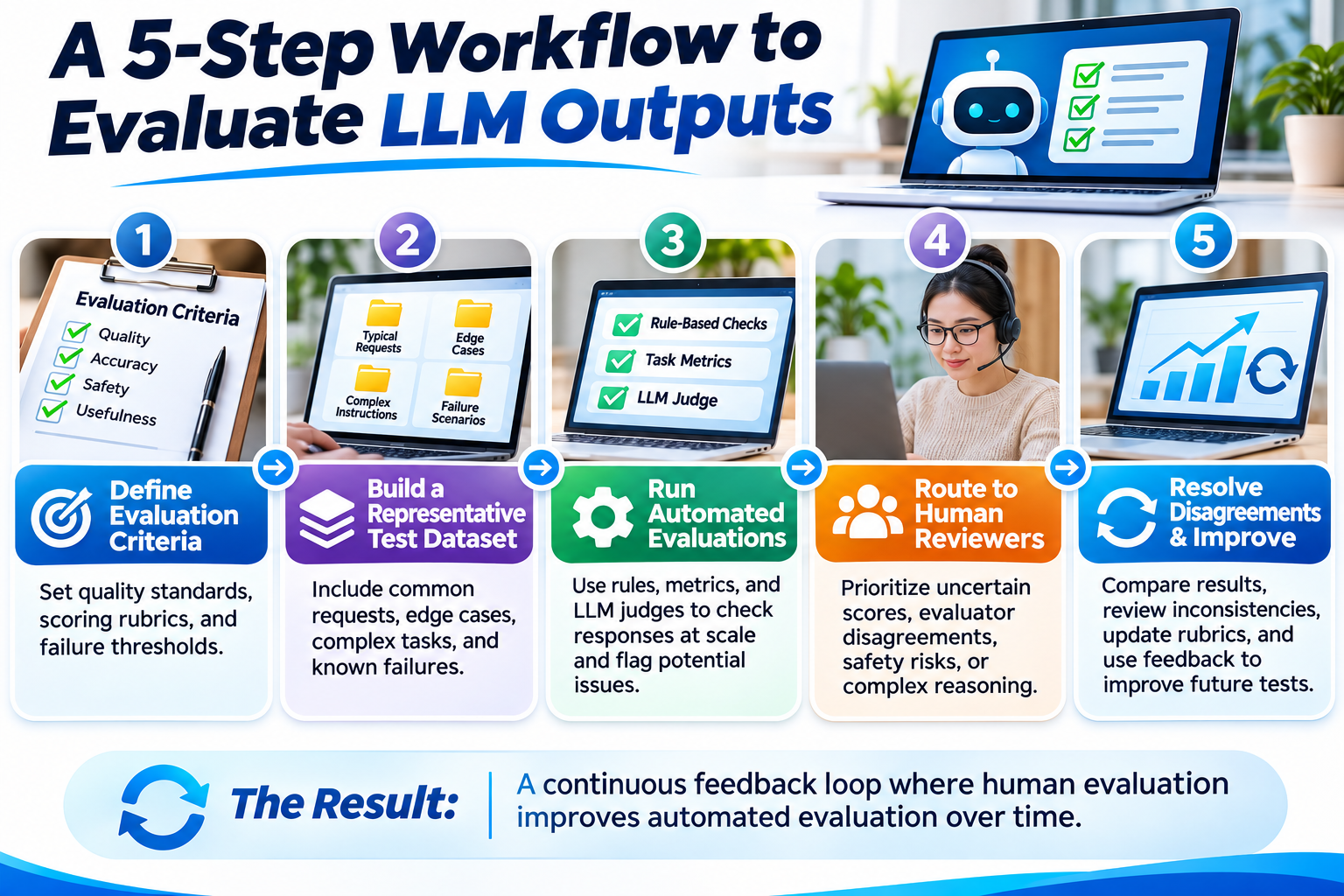
Step 1: Define Evaluation Criteria
Establish quality standards, scoring rubrics, and acceptable failure thresholds. Identify which aspects of model performance can be measured automatically and which require human judgment.
Step 2: Build a Representative Test Dataset
Include typical user requests, edge cases, complex instructions, and known failure scenarios. A diverse dataset helps reveal weaknesses that may not appear in simple benchmark tests.
Step 3: Run Automated Evaluations
Apply rule-based checks, task-specific metrics, and validated LLM judges to evaluate responses at scale.
Automated systems can identify formatting violations, incorrect outputs, and potential quality issues before human review.
Step 4: Route Selected Outputs to Human Reviewers
Prioritize responses with uncertain scores, disagreements between evaluators, potential safety issues, or complex reasoning requirements.
Include randomly sampled responses to identify failures that automated systems may overlook.
Step 5: Resolve Disagreements and Improve the System
Compare human and automated evaluation results, investigate inconsistent ratings, and update scoring rubrics when necessary.
Use reviewer feedback to improve automated evaluators and refine future testing procedures.
This process creates a feedback loop in which human evaluation helps improve automated evaluation over time.
It also helps teams avoid treating a single automated score as definitive proof of model quality.
Even well-designed evaluation programs can produce misleading results when their testing processes are poorly structured.
No single metric captures every dimension of LLM performance.
A model may perform well on factual questions but struggle with instruction following, safety, or multi-turn conversations.
Use multiple metrics that reflect the application's actual requirements.
Evaluation datasets should reflect realistic user interactions, including challenging and unusual requests.
Testing only simple prompts can create an overly optimistic picture of model performance.
LLM judges can produce convincing explanations for incorrect ratings.
Compare their decisions with qualified human reviewers, measure agreement, and investigate systematic errors.
Human evaluation becomes less reliable when reviewers apply different standards.
Provide detailed instructions, representative examples, and periodic calibration exercises to improve consistency.
Model capabilities, user expectations, and application requirements change.
Review evaluation datasets and scoring criteria regularly so testing remains relevant to real-world performance.
An evaluation process should itself be evaluated.
When comparing human vs automated evals, organizations should measure not only response quality but also evaluation consistency, cost, scalability, and the ability to detect important model failures. These factors help determine whether human review, automated testing, or a combination of both delivers the most reliable results.
Useful indicators include:
These indicators help teams distinguish a convenient evaluation workflow from a dependable one.
For high-stakes applications, evaluation results should also inform escalation procedures, deployment decisions, and ongoing monitoring.
The debate around human vs automated evals is not simply about deciding which method is better.
Human evaluation provides contextual judgment, deeper qualitative insights, and the ability to assess complex responses. Automated evaluation delivers speed, repeatability, and broader testing coverage.
Both approaches have limitations, and neither should be treated as a universal solution.
For organizations building reliable LLM applications, the strongest strategy is often to combine automated checks with structured human review.
By establishing clear evaluation criteria, testing representative datasets, validating automated judges, and continuously improving reviewer guidelines, AI teams can develop evaluation processes that support safer, more accurate, and more useful language models.
The goal is not merely to generate evaluation scores. It is to produce trustworthy evidence that helps teams understand how their models perform and where they need to improve.
Human evaluation uses trained reviewers to assess AI responses based on criteria such as accuracy, helpfulness, clarity, and safety. Automated evaluation uses rules, reference-based metrics, or AI judges to score responses. Human evaluation provides contextual understanding, while automated evaluation supports faster, repeatable testing across large datasets.
Not always. Human reviewers are often better at assessing nuanced, subjective, or context-dependent responses, while automated checks can be more dependable for objectively verifiable requirements. Both methods can make mistakes. Accuracy depends on the task, evaluation rubric, reviewer expertise, and whether automated metrics have been validated against reliable reference judgments.
LLM-as-a-judge can reduce the amount of manual review required, but it should not automatically replace human evaluation. AI judges may demonstrate biases, overlook factual errors, or misinterpret scoring criteria. Human reviewers remain valuable for validating judge performance, resolving disagreements, and assessing complex or high-risk responses.
The most cost-effective approach depends on testing volume and complexity. Automated evaluations are often economical for frequent, large-scale checks, while human evaluations provide deeper insight into difficult cases. A hybrid approach can improve efficiency by using automated testing broadly and reserving human review for uncertain, important, or high-risk outputs.
LLM evaluations should be conducted during development, before deployment, and whenever significant changes are introduced to models, prompts, tools, or retrieval systems. Production applications also benefit from ongoing monitoring and periodic human review. Evaluation frequency should reflect the application's risk level, update schedule, and operational requirements.


Compact, ready to go anywhere
Interchangeable lens that’s upgradeable
Dual 1-inch sensors for improved clarity and low light performance
Dynamic range and 6K 360° capture
360° photo resolution at 21MP

8K 360° video recording for ultra-detailed visuals.
4K single-lens mode for traditional wide-angle shots.
Invisible selfie stick effect for drone-like perspectives.
2.5-inch touchscreen with Gorilla Glass protection.
Waterproof up to 33ft for underwater shooting.

360° photo resolution in 23MP
Slim design at 24 mm thick
Built-in image stabilization for smooth video capture.
Internal 19GB storage for photo and video storage.
Wireless connectivity for remote control and sharing.

60MP 360° still images for high-resolution photography.
5.7K 360° video recording at 30fps.
2.25-inch touchscreen for intuitive control.
USB Type-C port for fast charging and data transfer.
MicroSD card slot for expandable storage.


Try it free. No credit card required. Instant set-up.