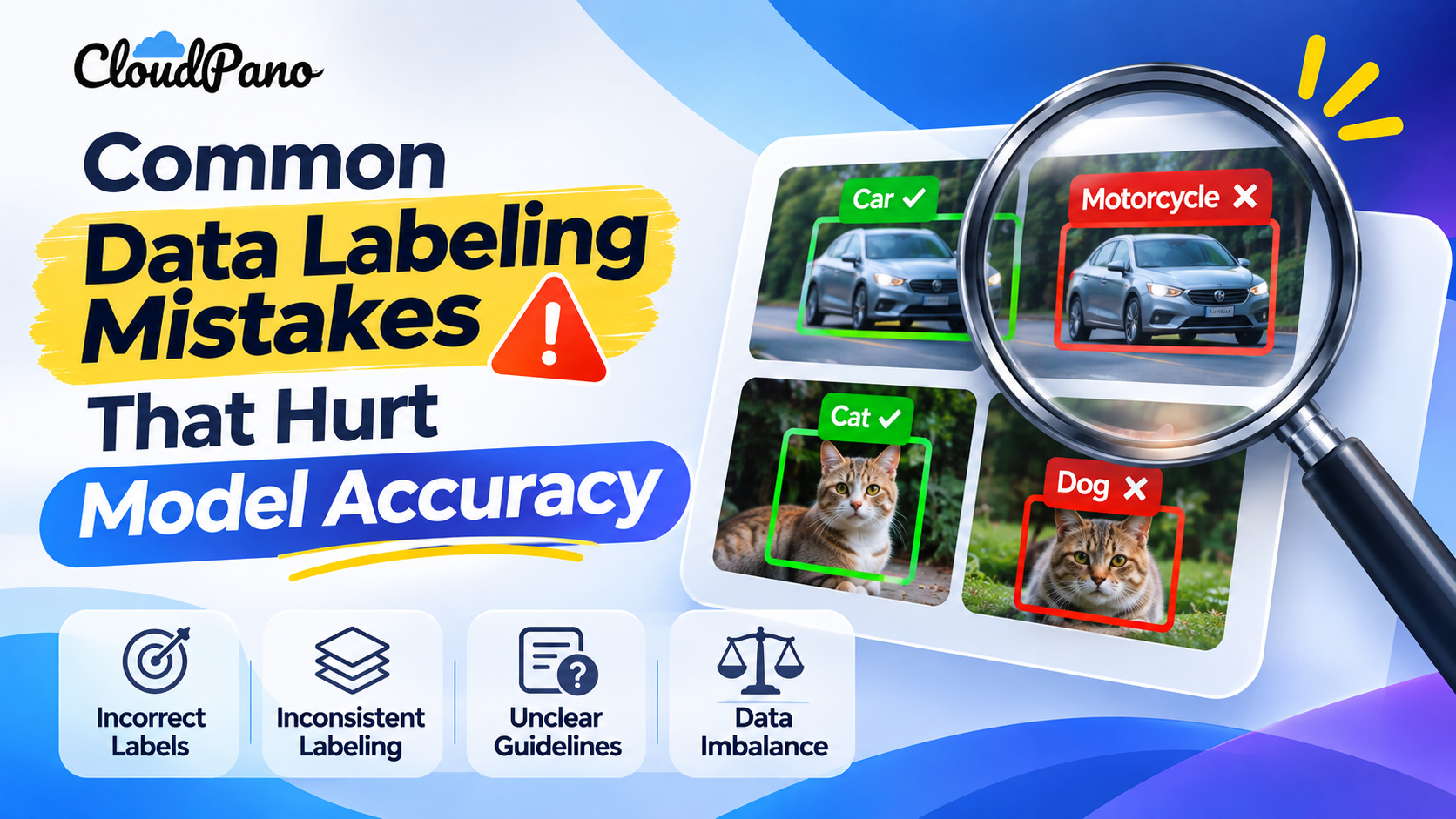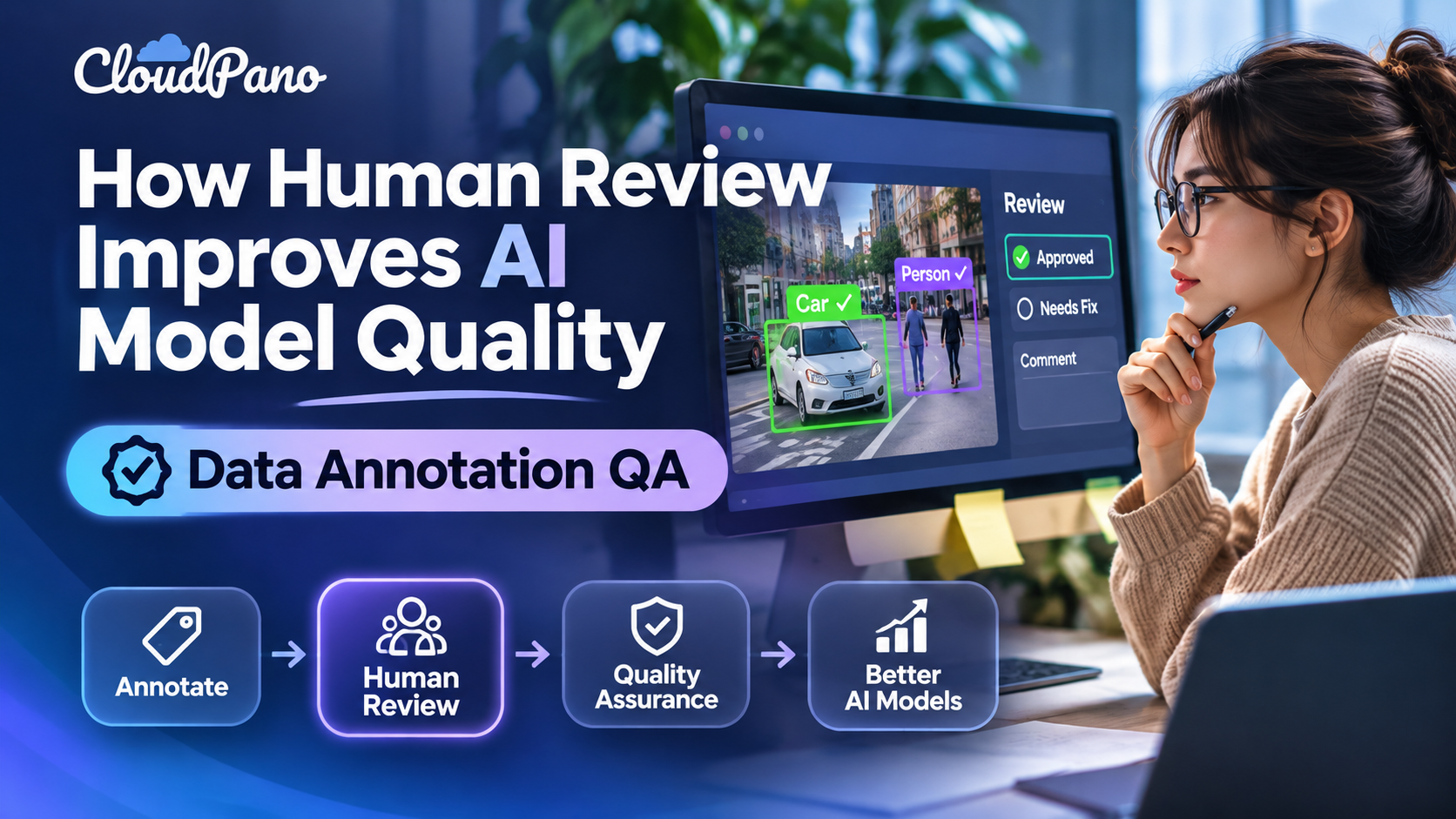
Human review improves AI model quality by identifying annotation errors, correcting inconsistent labels, resolving ambiguous data, and providing feedback that automated systems may overlook. Through data annotation quality assurance, human reviewers help ensure training datasets are accurate, consistent, and reliable. Combining human expertise with automated validation helps organizations reduce data quality issues, improve model performance, and develop more trustworthy AI systems.
Artificial intelligence models are only as reliable as the data used to train and evaluate them. While automated systems can process enormous datasets quickly, they cannot always recognize subtle errors, understand complex context, or make nuanced judgments with the consistency required for high-quality AI development.
This is where data annotation quality assurance and human review become essential.
Human reviewers help identify labeling mistakes, resolve ambiguous examples, validate AI-generated outputs, and ensure that training data meets established quality standards. Their involvement improves dataset reliability and provides valuable feedback for refining model behavior.
As organizations deploy AI in increasingly complex applications, human oversight remains an important part of building accurate, dependable, and responsible systems.
In this article, we'll explore how human review improves AI model quality, why annotation quality assurance matters, and the best practices organizations can follow to create more reliable AI training pipelines.
Data annotation quality assurance is the process of reviewing, validating, and improving labeled datasets to ensure that annotations are accurate, consistent, complete, and suitable for AI model training.
Data annotation involves assigning labels or structured information to raw data, such as images, videos, text, and audio. These labels help machine learning models recognize patterns and learn how to perform specific tasks.
For example, annotation teams may identify objects in images, classify customer sentiment, transcribe speech, or evaluate responses generated by large language models.
However, annotation errors can introduce misleading patterns into training datasets. If these mistakes remain undetected, models may learn incorrect associations that affect their predictions.
Data annotation quality assurance helps prevent these problems through structured validation processes, including human review, automated checks, and clear annotation guidelines.
A strong quality assurance workflow typically includes:
Together, these activities improve the reliability of training data and support more effective AI model development.
AI systems can automate many aspects of data processing, but human judgment remains valuable when tasks require contextual understanding, specialized knowledge, or interpretation of ambiguous information.
Human reviewers provide an additional layer of evaluation that automated quality checks may miss.
Automated validation tools can detect duplicate records, missing labels, formatting problems, and other predefined inconsistencies.
However, they may struggle with errors that require understanding the meaning of the data.
For example, an image annotation system might incorrectly classify a partially obscured bicycle as a motorcycle. A human reviewer can examine the visual context and determine whether the assigned label is appropriate.
Similarly, language models may generate responses that are grammatically correct but factually inaccurate or irrelevant to the user's question.
Human evaluation helps identify these problems before they become part of model training or evaluation workflows.
Consistency is critical for effective machine learning.
When different annotators interpret the same guidelines differently, the resulting dataset may contain contradictory labels.
Human quality reviewers help establish consistent annotation standards by comparing examples, clarifying instructions, and resolving disagreements.
For instance, sentiment analysis datasets may contain statements that could reasonably be interpreted as neutral or negative.
Without standardized guidelines, annotators may assign different labels to similar statements.
Reviewers can clarify the intended classification criteria, improving consistency across the dataset.
Real-world datasets frequently contain incomplete information, unusual scenarios, and examples that do not fit neatly into predefined categories.
Human reviewers can assess these situations using contextual reasoning and domain expertise.
This is particularly important in specialized applications such as healthcare, legal document processing, autonomous robotics, and technical language understanding.
For example, robotics datasets may contain complex interactions between objects, environments, and human actions. Reviewing these annotations often requires understanding both visual information and the intended task.
Organizations exploring these applications can benefit from studying 47 open egocentric and robotics datasets with licenses to understand the range of datasets available for AI development.
Human review does more than identify incorrect labels. It also creates feedback that can guide future improvements.
When reviewers repeatedly encounter similar errors, their findings can reveal weaknesses in annotation instructions, dataset coverage, or model behavior.
Development teams can use these insights to improve labeling guidelines, add targeted training examples, and refine evaluation methods.
This creates a continuous improvement cycle in which human feedback helps strengthen both the dataset and the AI system trained on it.
High-quality training data plays a major role in determining how well machine learning models perform on new examples.
Human review supports training data quality in several ways.
Label noise occurs when training examples contain incorrect or inconsistent annotations.
For example, if images of cats are repeatedly mislabeled as dogs, a classification model may learn unreliable patterns.
Human reviewers can identify and correct mislabeled examples, reducing unnecessary confusion during training.
However, the impact depends on the type of error, the proportion of affected data, and the model's training process. Correcting labels is most valuable when the corrections address meaningful weaknesses in the dataset.
A dataset may contain accurate labels while still failing to represent the situations a model will encounter after deployment.
Human reviewers can identify missing scenarios, underrepresented categories, and unusual examples that deserve additional attention.
For instance, an object detection dataset may perform well in daylight but contain relatively few nighttime images.
Reviewers can flag this coverage gap so data collection teams can expand the dataset.
Human-reviewed datasets are also valuable for evaluating AI models.
A carefully validated evaluation set provides a more trustworthy reference for measuring performance.
Without reliable ground-truth labels, evaluation results may be misleading.
Human review helps organizations determine whether model improvements reflect genuine progress or inconsistencies in the evaluation data.
Human feedback has become particularly important in the development of large language models (LLMs).
Unlike traditional classification systems, LLMs generate open-ended responses that may have multiple acceptable answers.
Evaluating these responses often requires considering factual accuracy, relevance, clarity, instruction-following, and safety.
One widely used approach is Reinforcement Learning from Human Feedback (RLHF).
RLHF uses human evaluations or preferences to help guide model optimization toward more desirable responses.
For example, reviewers may compare two AI-generated answers and identify which better addresses a user's request. These preferences can then contribute to the model improvement process.
To explore this approach in greater detail, read What Is RLHF? How Human Feedback Improves AI Models.
Human evaluation is also important when creating instruction-following datasets. Reviewers may assess whether prompts are clear, responses are accurate, and examples reflect the intended task.
Our guide on how prompt-response datasets are created explains how these training examples are developed and prepared.
Research such as Training Language Models to Follow Instructions with Human Feedback demonstrates how human preference data can contribute to training more helpful instruction-following models.
However, human feedback is not automatically objective or error-free. Reviewer disagreement, inconsistent preferences, and poorly designed evaluation criteria can introduce additional problems.
For this reason, human feedback systems also require quality assurance.
The most effective approach often combines both methods.
Automated systems can handle repetitive validation tasks, while human reviewers focus on complex examples, disagreements, and potentially consequential errors.
This combination is commonly called human-in-the-loop AI, where people contribute to specific stages of an automated workflow.
Organizations can improve annotation quality by developing a structured review process rather than relying on occasional manual inspections.
Detailed annotation instructions help reviewers understand how labels should be assigned.
Guidelines should include definitions, examples, edge cases, and procedures for handling uncertainty.
They should also be updated when reviewers identify recurring problems.
Some examples require more than one perspective.
Independent reviews can help identify inconsistent interpretations, especially in subjective tasks such as sentiment classification or AI response evaluation.
When reviewers disagree, an experienced adjudicator can examine the evidence and determine whether a final label is appropriate or whether uncertainty should be preserved.
Reviewing every annotation manually may be expensive and unnecessary.
Instead, organizations can prioritize examples that automated systems flag as uncertain, unusual, or potentially consequential.
This approach allows teams to allocate human expertise where it is most valuable.
Quality assurance should include measurable indicators.
Useful metrics include annotation accuracy against a validated reference set, inter-annotator agreement, error rates, correction frequency, and review turnaround time.
Teams should interpret these metrics carefully. High agreement does not necessarily mean annotations are correct, particularly when reviewers share the same misunderstanding.
Review findings should inform future data collection, annotation instructions, and model evaluation.
For example, if reviewers repeatedly identify incorrect object labels in low-light images, the team can introduce additional examples and refine its guidelines.
Research from Google on data cascades in machine learning highlights how neglected data quality problems can create downstream consequences throughout AI development.
research.google+1
Although human review offers important benefits, it introduces challenges that organizations must manage.
Reviewer fatigue can reduce attention and consistency during repetitive annotation tasks. Appropriate workloads, breaks, and task rotation can help address this problem.
Subjective judgments can create disagreement, particularly when evaluating language, cultural context, or open-ended responses. Clear evaluation criteria and reviewer calibration help improve consistency.
Scalability and cost are additional considerations. Large datasets may contain millions of examples, making comprehensive manual review impractical.
Organizations can address these limitations through automated screening, targeted sampling, expert escalation, and regular quality audits.
The goal is not to eliminate automation but to combine human expertise with efficient technical processes.
Human review also contributes to responsible AI development by helping teams identify inaccurate, misleading, or potentially harmful outputs.
For example, reviewers may discover that an AI system performs inconsistently across different demographic groups, languages, or environmental conditions.
These findings can help teams investigate dataset limitations and improve their evaluation procedures.
The NIST AI Risk Management Framework provides guidance for managing AI-related risks, including considerations involving human oversight, evaluation, and system trustworthiness.
However, human oversight alone does not guarantee fairness, accuracy, or safety. Effective governance also requires appropriate testing, documentation, accountability, and ongoing monitoring.
Human review remains a valuable component of reliable AI development.
By identifying annotation errors, resolving complex cases, improving dataset consistency, and providing meaningful feedback, human reviewers help organizations build stronger training and evaluation pipelines.
Effective data annotation quality assurance combines automated validation with targeted human expertise, clear standards, measurable quality indicators, and continuous improvement.
As AI systems become more capable and widely deployed, organizations that prioritize training data quality and thoughtful human oversight will be better positioned to develop accurate, reliable, and trustworthy models.
Data annotation quality assurance ensures that labeled datasets are accurate, consistent, and appropriate for machine learning. It helps detect annotation errors, resolve disagreements, and improve the reliability of AI training and evaluation data.
Human review can improve AI model accuracy by correcting mislabeled data, identifying missing examples, and providing feedback on model errors. Its effectiveness depends on the quality of the review process and whether the identified problems affect model performance.
AI can automate many annotation and validation tasks, but human reviewers remain valuable for ambiguous examples, specialized knowledge, and complex judgments. Hybrid workflows often provide a practical balance between efficiency and quality.
Data annotation involves assigning labels to raw information. Data annotation quality assurance evaluates those labels to ensure they follow established guidelines and accurately represent the data.
AI training data should be reviewed during dataset creation, before model training, and whenever significant changes occur. Additional reviews may be necessary when new data sources, annotation guidelines, or deployment conditions introduce quality risks.


Compact, ready to go anywhere
Interchangeable lens that’s upgradeable
Dual 1-inch sensors for improved clarity and low light performance
Dynamic range and 6K 360° capture
360° photo resolution at 21MP

8K 360° video recording for ultra-detailed visuals.
4K single-lens mode for traditional wide-angle shots.
Invisible selfie stick effect for drone-like perspectives.
2.5-inch touchscreen with Gorilla Glass protection.
Waterproof up to 33ft for underwater shooting.

360° photo resolution in 23MP
Slim design at 24 mm thick
Built-in image stabilization for smooth video capture.
Internal 19GB storage for photo and video storage.
Wireless connectivity for remote control and sharing.

60MP 360° still images for high-resolution photography.
5.7K 360° video recording at 30fps.
2.25-inch touchscreen for intuitive control.
USB Type-C port for fast charging and data transfer.
MicroSD card slot for expandable storage.


Try it free. No credit card required. Instant set-up.