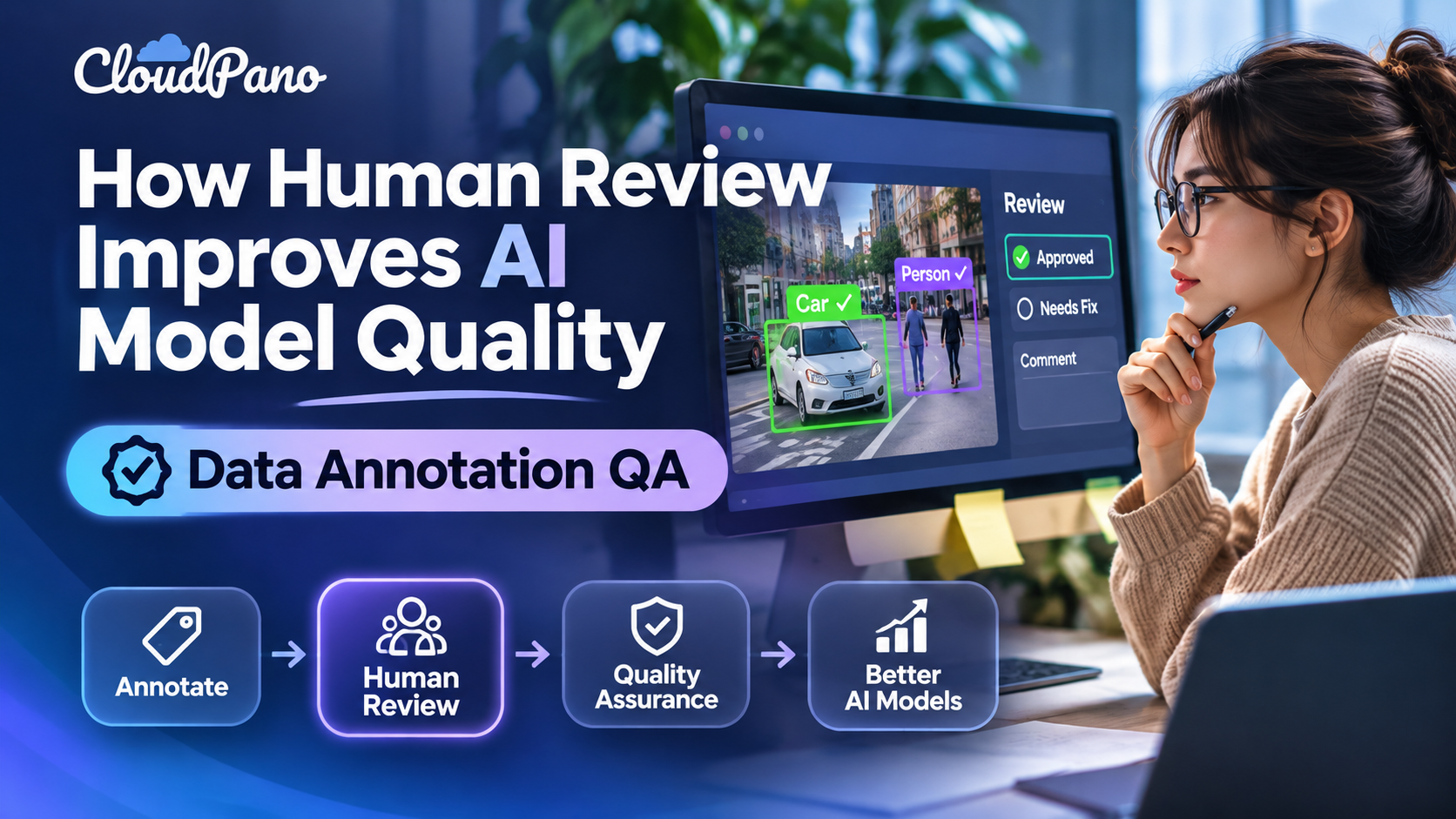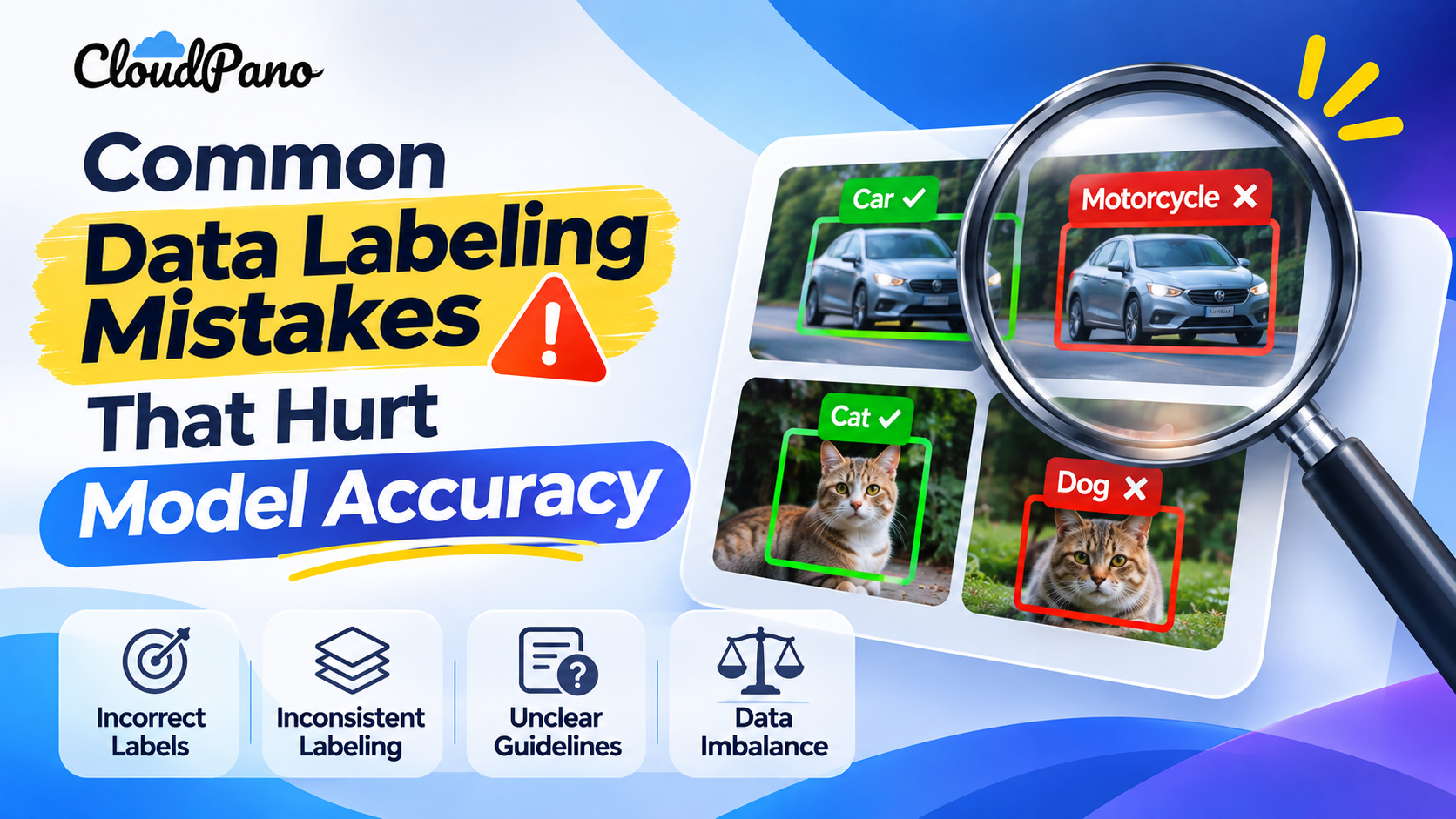
The most common data labeling mistakes include incorrect annotations, inconsistent labels, unclear guidelines, missing edge cases, dataset imbalance, and insufficient quality assurance. These errors can reduce AI model accuracy by introducing unreliable training signals. Professional data labeling services help prevent these problems through standardized annotation guidelines, trained reviewers, automated validation, and continuous quality monitoring.
Artificial intelligence models depend on high-quality training data to recognize patterns, make predictions, and generate reliable outputs. However, even sophisticated machine learning algorithms can struggle when the datasets used to train them contain inaccurate, inconsistent, or incomplete labels.
This is why data labeling services play an important role in AI development. Accurate labeling helps models understand the relationships between data points, while poor annotation practices can introduce errors that affect model performance.
From mislabeled images to inconsistent text classifications, seemingly minor annotation mistakes can create significant challenges during training and deployment.
According to Google Research's study on data cascades, overlooked data problems can produce compounding downstream consequences in machine learning systems.
Understanding these mistakes is essential for organizations seeking to improve AI accuracy, reduce costly rework, and build more dependable models.
Data labeling is the process of assigning meaningful annotations to raw information, including images, videos, audio recordings, and text.
These annotations help supervised machine learning models identify patterns and learn relationships between inputs and expected outputs.
For example, an image recognition model may require thousands of labeled photographs identifying vehicles, pedestrians, buildings, and traffic signs.
If the labels are incorrect, the model may learn misleading associations that reduce its ability to recognize objects accurately.
Professional data labeling services support AI development by providing structured annotation workflows, trained reviewers, and quality assurance procedures.
Accurate labeling contributes to:
However, annotation quality is not simply about labeling more data. It also requires clear instructions, representative datasets, and consistent validation.
One of the most common data labeling mistakes is inconsistency.
This occurs when annotators assign different labels to similar examples, even though the underlying data should be classified according to the same criteria.
For example, a sentiment analysis dataset may contain customer reviews expressing mild dissatisfaction.
One annotator might classify these reviews as negative, while another considers them neutral.
Without clear labeling guidelines, both interpretations may appear reasonable.
Inconsistent annotations introduce conflicting training signals.
The model may struggle to learn reliable distinctions between categories because similar examples receive different labels.
This can reduce classification consistency and make model behavior harder to predict.
Organizations should establish standardized annotation guidelines with clear definitions and examples.
Regular reviewer calibration, agreement measurements, and documented disagreement resolution can further improve consistency.
Quality-focused data labeling services typically incorporate these practices into their annotation workflows.
Incorrect labels are another major source of machine learning errors.
A mislabeled example occurs when an annotation does not accurately represent the underlying information.
For instance, a photograph of a bicycle might accidentally receive the label "motorcycle."
Similarly, a customer support message requesting a refund might be incorrectly categorized as a general inquiry.
When incorrect labels appear in training datasets, models may learn relationships that do not reflect reality.
This problem is commonly called label noise.
The impact depends on the number of incorrect labels, their distribution, and the learning algorithm.
Errors concentrated in important categories or difficult examples can be especially damaging.
Organizations can reduce labeling errors through:
Combining human review with automated validation helps detect errors before they affect model training.
Even experienced annotators can make mistakes when instructions are ambiguous.
Annotation guidelines define how data should be classified, what categories mean, and how unusual situations should be handled.
Without detailed instructions, reviewers may rely on personal interpretation.
For example, an object detection project might require annotators to identify partially visible objects.
If the guidelines do not explain whether heavily obstructed objects should be labeled, annotation results may vary considerably.
Unclear instructions can produce inconsistent annotations across teams and batches.
These inconsistencies become more difficult to correct as datasets grow.
Effective guidelines should include category definitions, visual examples, edge cases, and procedures for handling uncertainty.
They should also be updated when reviewers identify recurring disagreements.
According to Google Cloud's data labeling guidance, clear instructions, representative datasets, and rigorous quality control are important practices for maintaining annotation quality.
Machine learning datasets often contain many examples of common situations but relatively few unusual scenarios.
These uncommon examples are known as edge cases.
For autonomous driving systems, edge cases might include pedestrians crossing unexpectedly, unusual road markings, or vehicles operating in difficult weather conditions.
If these situations are missing or incorrectly labeled, models may struggle when encountering them in real-world environments.
A model can perform well on frequently occurring examples while making significant errors on rare but important situations.
Overall accuracy may conceal these weaknesses.
Organizations should identify challenging scenarios early and create targeted annotation guidelines.
Data collection teams can also expand dataset coverage to include unusual conditions.
For robotics and embodied AI applications, selecting appropriate datasets is particularly important.
CloudPano's guide to commercial AI training beyond EPIC-KITCHENS explores considerations for selecting datasets for commercial AI applications.
Not every annotation project requires the same level of expertise.
General-purpose image classification may be manageable with trained annotators, while medical imaging, legal document classification, and specialized robotics tasks may require subject-matter experts.
Assigning highly technical annotation work to reviewers without sufficient training can introduce systematic errors.
A medical imaging dataset, for example, may contain visual features that require professional clinical interpretation.
Without appropriate expertise, annotators may overlook important distinctions.
Similarly, specialized industrial datasets may require knowledge of machinery, operational procedures, or technical terminology.
Organizations should match reviewer qualifications to task complexity.
Professional data labeling services may use specialized annotation teams, expert escalation procedures, and additional training for complex projects.
Clear qualification standards help ensure that reviewers can interpret the information they are labeling.
Dataset imbalance occurs when some categories are represented much more frequently than others.
For example, a fraud detection dataset may contain thousands of legitimate transactions but relatively few fraudulent examples.
Although this imbalance may reflect real-world conditions, it can create challenges when training and evaluating models.
A model may achieve high overall accuracy by predicting the majority category while performing poorly on less common but important cases.
This makes accuracy alone an insufficient performance measure.
Metrics such as precision, recall, and F1 score can provide additional insight.
Organizations should examine category distributions before training.
Depending on the application, they may collect additional examples, adjust sampling strategies, or use suitable training techniques.
Annotation teams should also verify that minority categories are labeled accurately and consistently.
Automated labeling tools can accelerate dataset preparation by generating preliminary annotations.
However, machine-generated labels are not automatically correct.
An object detection model used for pre-labeling might consistently miss small objects or incorrectly classify partially obscured items.
If these errors are accepted without review, they can spread throughout the dataset.
Automated systems may produce systematic errors that affect large numbers of examples.
Because the annotations appear consistent, these problems can remain unnoticed until model evaluation reveals weaknesses.
A more reliable approach uses automated labeling for initial processing and human reviewers for validation.
Reviewers can prioritize uncertain predictions, unusual examples, and categories associated with higher error rates.
This human-in-the-loop approach balances efficiency with annotation quality.
Some organizations focus heavily on annotation speed while giving insufficient attention to quality assurance.
However, completing large labeling batches quickly does not guarantee that the resulting dataset is reliable.
Without regular validation, annotation mistakes can accumulate.
Effective quality assurance may include:
These procedures help organizations identify recurring problems before they affect larger portions of the dataset.
Large AI projects may involve multiple annotation teams working across different periods.
During these projects, labeling guidelines, category definitions, and business requirements may change.
If updates are not communicated properly, different dataset batches may follow different standards.
For example, an e-commerce classification project might introduce new product categories midway through annotation.
Without revisiting earlier labels, the final dataset may contain inconsistent classifications.
Organizations should use version-controlled guidelines and maintain records of annotation changes.
When category definitions change, previously labeled examples should be evaluated to determine whether they require updating.
Regular calibration sessions help teams apply the latest standards consistently.
Annotation quality should not be measured exclusively through reviewer agreement or internal quality scores.
A dataset can contain consistent labels while still failing to represent the conditions a model will encounter after deployment.
For example, a computer vision dataset may contain accurately labeled images captured under ideal lighting conditions.
However, the resulting model may struggle with blurry images, shadows, or unusual camera angles.
Organizations should analyze model errors and investigate whether they relate to annotation mistakes, missing examples, or dataset limitations.
Human reviewers can examine problematic predictions and identify potential causes.
For a deeper explanation of this process, explore CloudPano's guide on how to evaluate AI outputs with human review.
Continuous evaluation helps ensure that annotation practices support actual model requirements rather than simply meeting internal completion targets.
Reliable data labeling services help organizations reduce annotation errors through standardized workflows, trained reviewers, and structured quality control.
Rather than treating labeling as a one-time task, effective providers integrate quality assurance throughout the data preparation process.
A typical workflow includes:
Organizations should assess whether a labeling provider can document its quality procedures, demonstrate reviewer expertise, and adapt workflows to project requirements.
Selecting a data labeling provider involves more than comparing turnaround times or annotation costs.
Businesses should evaluate the provider's ability to maintain accuracy, consistency, security, and scalability.
Important considerations include annotation expertise, quality assurance methods, reviewer training, and support for complex data types.
Providers should also explain how they handle disagreements, monitor performance, and protect sensitive information.
For specialized AI projects, organizations may need additional requirements such as domain-qualified reviewers, detailed audit trails, or custom annotation guidelines.
The right provider should support the project's technical objectives while maintaining transparent quality standards.
Data labeling mistakes can undermine AI model accuracy even when organizations use sophisticated algorithms and advanced computing resources.
Inconsistent annotations, incorrect labels, unclear guidelines, missing edge cases, and inadequate quality assurance can introduce problems throughout the machine learning lifecycle.
Preventing these mistakes requires a combination of clear standards, trained reviewers, automated validation, and continuous performance monitoring.
Professional data labeling services can help organizations build more dependable training datasets by applying structured annotation and quality assurance processes.
Ultimately, improving AI accuracy begins with improving the information models learn from. Organizations that prioritize labeling quality are better positioned to develop reliable, scalable, and effective AI systems.
Common data labeling mistakes include incorrect labels, inconsistent annotations, unclear labeling instructions, missing edge cases, and inadequate quality assurance. These problems can introduce errors into AI training datasets and reduce model reliability.
Data labeling mistakes can cause AI models to learn incorrect patterns or struggle to distinguish between categories. Their impact depends on the type, frequency, and distribution of annotation errors.
Professional data labeling services help organizations prepare accurate and consistent training datasets through structured annotation workflows, trained reviewers, and quality assurance procedures.
Automated labeling can reduce manual workload and accelerate annotation, but human reviewers remain valuable for validating uncertain predictions, resolving ambiguous cases, and identifying systematic errors.
Businesses can improve labeling quality by creating clear guidelines, training annotators, measuring reviewer agreement, conducting regular audits, and incorporating feedback from model evaluation.


Compact, ready to go anywhere
Interchangeable lens that’s upgradeable
Dual 1-inch sensors for improved clarity and low light performance
Dynamic range and 6K 360° capture
360° photo resolution at 21MP

8K 360° video recording for ultra-detailed visuals.
4K single-lens mode for traditional wide-angle shots.
Invisible selfie stick effect for drone-like perspectives.
2.5-inch touchscreen with Gorilla Glass protection.
Waterproof up to 33ft for underwater shooting.

360° photo resolution in 23MP
Slim design at 24 mm thick
Built-in image stabilization for smooth video capture.
Internal 19GB storage for photo and video storage.
Wireless connectivity for remote control and sharing.

60MP 360° still images for high-resolution photography.
5.7K 360° video recording at 30fps.
2.25-inch touchscreen for intuitive control.
USB Type-C port for fast charging and data transfer.
MicroSD card slot for expandable storage.


Try it free. No credit card required. Instant set-up.