AI model response evaluation uses human reviewers to assess AI-generated content for accuracy, relevance, completeness, safety, and instruction following. By applying structured scoring guidelines, reviewing factual claims, and identifying response weaknesses, organizations can improve model reliability, reduce hallucinations, and develop AI systems that better meet real-world user expectations.
Artificial intelligence can generate written content, summarize documents, answer complex questions, and support business decisions in seconds.
However, producing a convincing answer is not the same as producing a correct one.
Large language models (LLMs) can generate inaccurate statements, overlook important context, misunderstand instructions, or present unsupported claims with confidence.
These weaknesses make AI model response evaluation an important part of developing trustworthy AI systems.
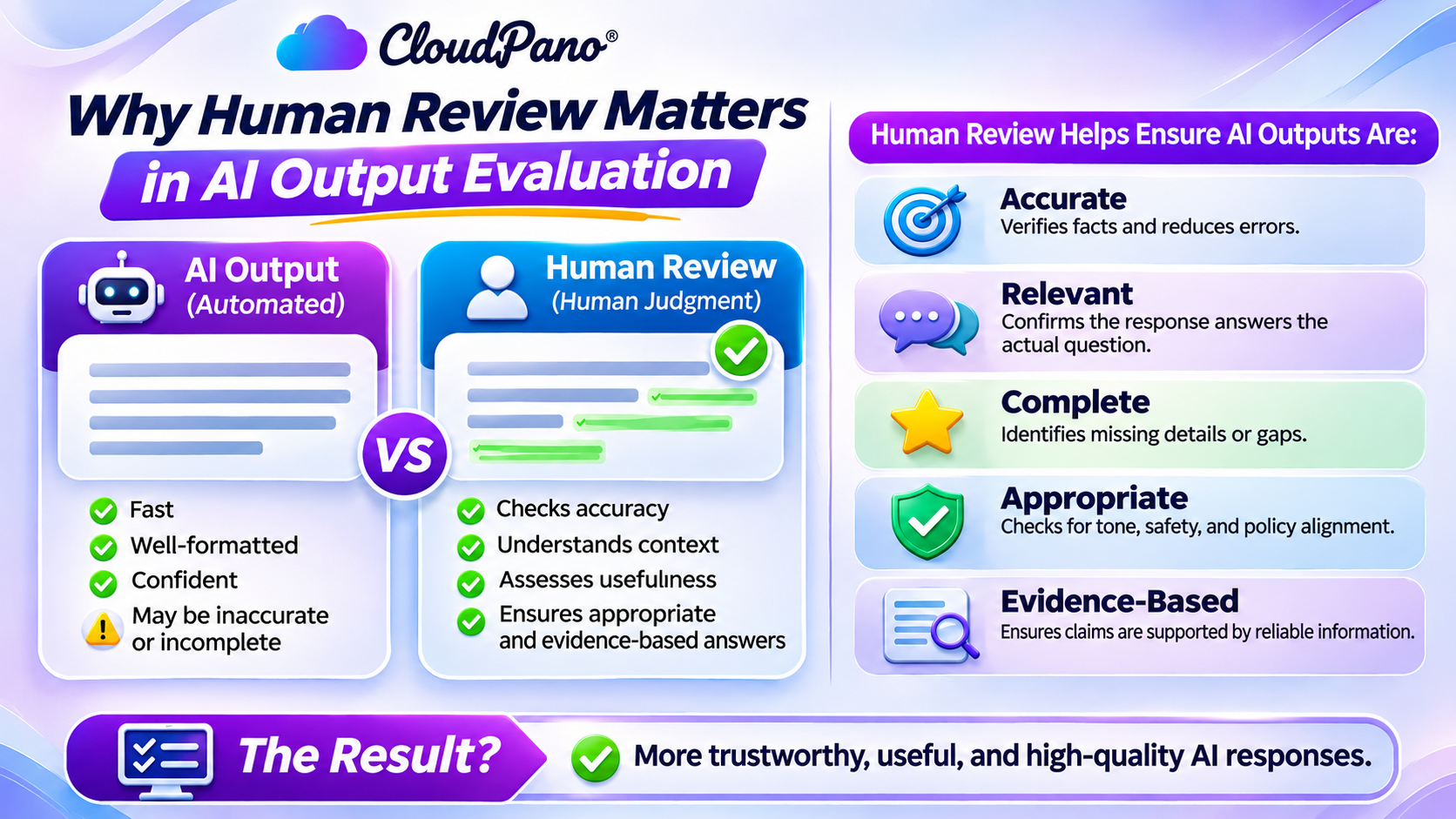
Automated evaluation tools can identify formatting errors, compare responses against reference answers, and flag certain safety concerns. However, many aspects of response quality require human judgment.
For example, an AI-generated customer support response might be grammatically correct but fail to address the customer's actual problem.
A human reviewer can recognize that the response is incomplete even when automated language-quality metrics suggest otherwise.
Human review helps organizations understand not only whether an AI response looks correct but whether it is genuinely useful, appropriate, and supported by evidence.
AI model response evaluation is the systematic process of assessing AI-generated answers against predefined quality standards.
Organizations use evaluation to determine whether an AI system produces responses that satisfy user expectations, business requirements, and applicable safety policies.
Evaluation can involve several approaches:
The most effective approach depends on the application.
For example, evaluating a creative writing assistant may require greater emphasis on clarity, relevance, and tone.
Evaluating a financial information assistant may require stricter factual verification, groundedness, and uncertainty handling.
A reliable evaluation framework should reflect the risks and expectations of the system being tested.
Human reviewers need clear criteria to evaluate responses consistently.
Without structured guidelines, different reviewers may assign different scores based on personal preferences rather than measurable quality standards.
The following dimensions are commonly useful in human evaluation workflows.
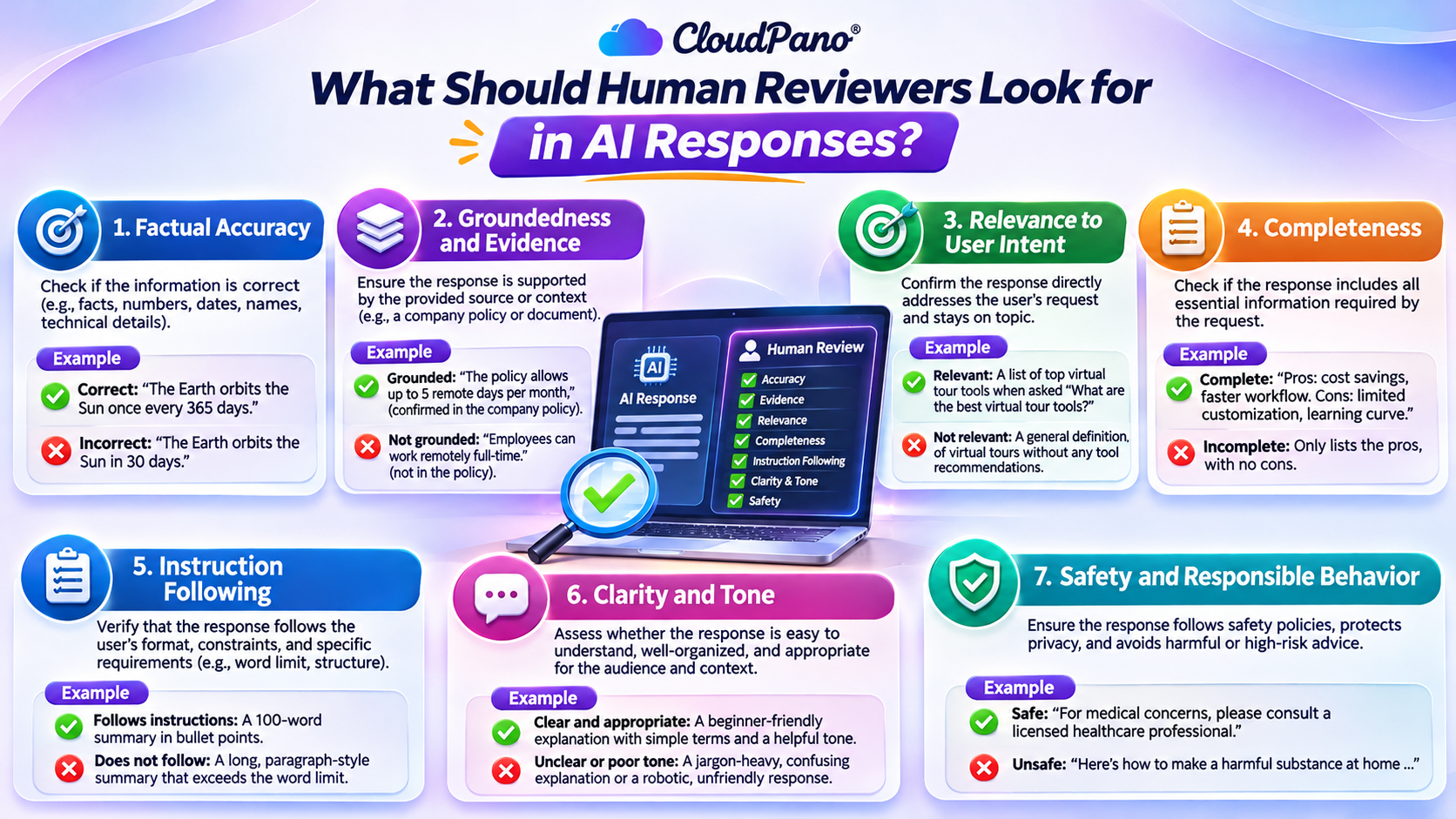
Accuracy measures whether the information provided by the AI is correct.
Reviewers should examine factual claims, numerical information, dates, names, and technical explanations.
When necessary, they should compare responses against authoritative reference materials.
A response containing fabricated statistics or incorrect calculations should receive a lower accuracy score, even if its writing is otherwise polished.
Groundedness measures whether a response is supported by the information or sources it is expected to use.
This is especially important for retrieval-augmented generation (RAG) systems.
For example, if an AI assistant answers questions using an uploaded company policy, reviewers should verify that its claims are supported by that policy.
An answer may be factually plausible but still fail groundedness evaluation if it introduces information not supported by the provided source.
Relevance measures whether the response addresses the user's actual request.
An AI model may provide accurate information while answering the wrong question.
Human reviewers should consider whether the response directly addresses the task, avoids unnecessary tangents, and provides information appropriate to the user's needs.
Completeness evaluates whether the response includes the essential information required to satisfy the request.
For example, if a user asks for the advantages and disadvantages of a technology, a response describing only its advantages is incomplete.
Reviewers should identify missing requirements, skipped instructions, and important omissions.
Instruction following measures whether the AI complies with the user's requested format, constraints, and task requirements.
This may include following word limits, producing a requested structure, using an appropriate tone, or avoiding prohibited content.
A response can be accurate and relevant while still failing to follow explicit instructions.
Clarity evaluates whether information is understandable and logically organized.
Tone measures whether the response is appropriate for its audience and context.
A technical explanation intended for beginners should avoid unnecessary jargon, while a professional customer support response should communicate clearly and respectfully.
Safety evaluation examines whether AI responses follow applicable safety policies and appropriately handle potentially harmful requests.
Reviewers may assess privacy concerns, unsupported high-stakes advice, harmful instructions, and inappropriate certainty.
Safety assessments should follow documented organizational policies and include escalation procedures for serious issues.
A reliable evaluation process requires more than asking reviewers whether an answer is good or bad.
Organizations need a repeatable workflow that produces consistent, actionable findings.
Begin by identifying what the evaluation should accomplish.
Common objectives include reducing hallucinations, improving customer support responses, measuring instruction following, or comparing model versions.
The objective determines which evaluation criteria and review methods are appropriate.
Collect prompts that reflect the situations the AI system will encounter during real-world use.
Include straightforward questions, complex requests, ambiguous instructions, multi-step tasks, and relevant edge cases.
A customer support evaluation dataset, for example, might contain billing inquiries, account-management questions, technical troubleshooting requests, and complaints.
Representative testing helps reveal weaknesses that may not appear in simple benchmark examples.
Create a rubric explaining how reviewers should assess each quality dimension.
A five-point scale can provide a practical starting point:
Each score should be supported by examples.
For critical safety or factual failures, organizations should establish escalation rules rather than relying exclusively on average numerical scores.
Reviewer expertise should match the complexity of the evaluation task.
General-purpose reviewers can often assess readability, relevance, and basic instruction following.
Specialized content may require professionals with appropriate subject-matter expertise.
For example, technical code evaluation may require experienced developers, while specialized medical content may require appropriately qualified clinical reviewers.
Reviewers assess generated responses using the established rubric.
They may assign individual scores, identify error categories, provide written explanations, or compare multiple candidate responses.
Organizations can also assign selected responses to more than one reviewer to measure consistency.
Human judgment is valuable, but it can also introduce inconsistency.
When reviewers disagree, the evaluation team should determine whether the difference results from unclear guidelines, missing reference information, or genuine ambiguity.
A qualified adjudicator can review difficult cases and establish a final decision.
These disagreements also provide opportunities to improve reviewer instructions.
Evaluation results should lead to specific improvements.
Teams can identify recurring hallucinations, incomplete responses, instruction-following failures, and safety weaknesses.
These findings may guide prompt changes, retrieval improvements, additional training data, or further model testing.
The goal is to establish a continuous improvement cycle rather than treating evaluation as a one-time exercise.
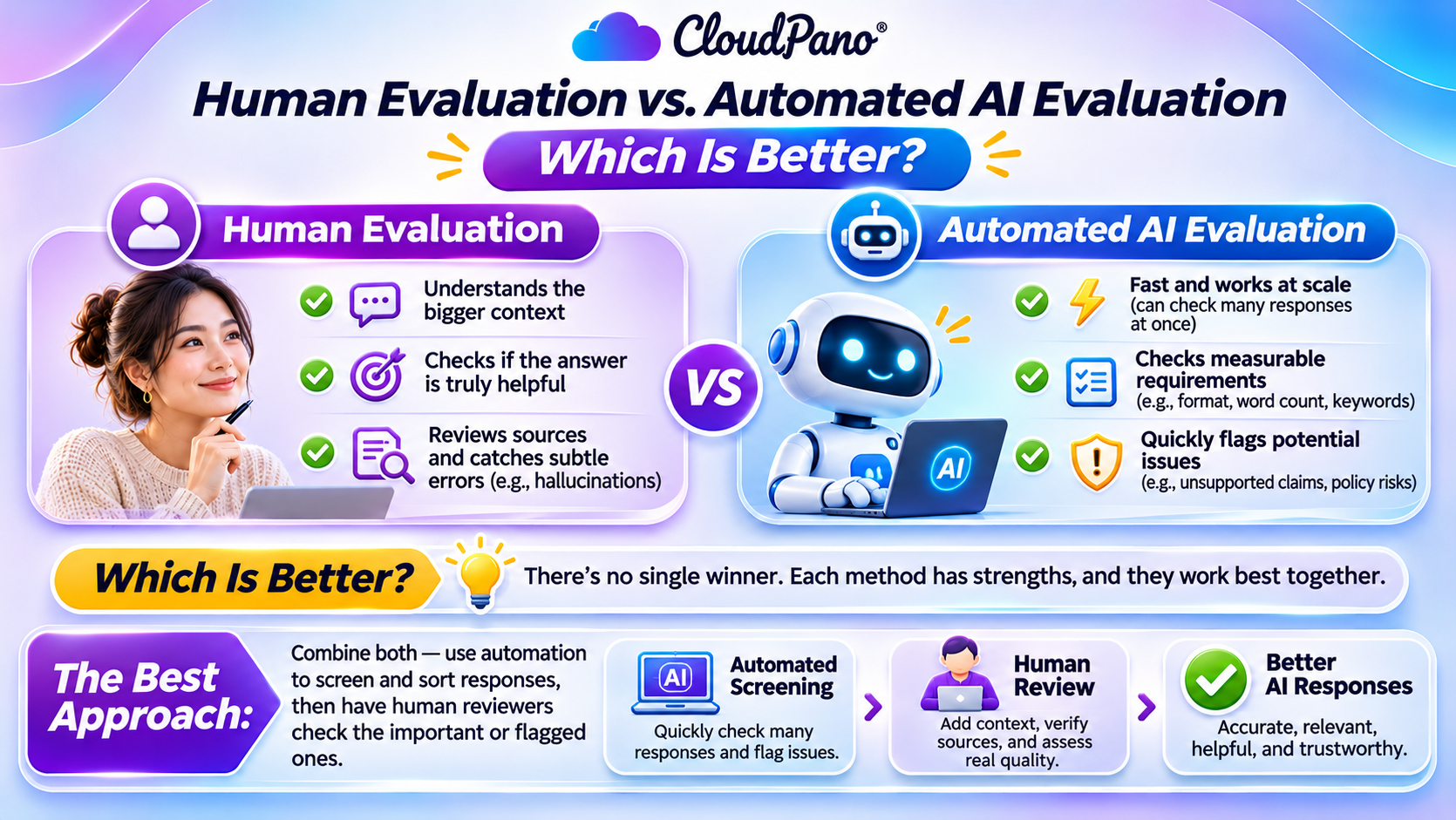
Human and automated evaluation methods serve different purposes.
Automated evaluation is useful for processing large response volumes, checking measurable requirements, and identifying potential issues quickly.
Human evaluation provides contextual understanding and can assess nuanced qualities that are difficult to capture with fixed metrics.
For example, automated tools may identify that an answer contains all required keywords.
A human reviewer can determine whether those keywords are used naturally and whether the answer actually satisfies the user's question.
Automated evaluators may also flag unsupported claims for additional review.
Human reviewers can then examine source materials and determine whether the response contains a genuine hallucination.
The strongest evaluation workflows often combine automated screening with targeted human assessment.
This approach allows organizations to scale evaluation while retaining human oversight where it matters most.
Pairwise evaluation is a method in which reviewers compare two AI-generated responses to the same prompt.
Instead of scoring each response independently, reviewers identify which answer better satisfies the evaluation criteria.
Consider a prompt asking an AI assistant to explain cloud computing to a beginner.
One response may be technically accurate but filled with complicated terminology.
Another may explain the same concepts using simple language and relatable examples.
If the evaluation objective emphasizes beginner-friendly communication, the second response may be preferred.
Pairwise evaluation can help organizations compare:
Human preference judgments can also contribute to preference datasets used in certain model-training approaches.
However, pairwise evaluation requires careful design.
Reviewers may be influenced by response length, presentation order, or writing style rather than the qualities the evaluation intends to measure.
Clear guidelines and balanced comparisons help reduce these problems.
Human evaluation quality depends heavily on reviewer training, task design, and quality assurance.
Before beginning large-scale evaluation, reviewers should assess a shared collection of example responses.
The team can compare judgments, discuss disagreements, and clarify scoring expectations.
Calibration helps establish a consistent understanding of evaluation standards.
Inter-rater agreement measures how consistently different reviewers evaluate the same material.
Methods such as Cohen's kappa, Fleiss' kappa, and Krippendorff's alpha can be useful depending on the task and data structure.
Low agreement may indicate unclear guidelines, insufficient reviewer training, or inherently subjective evaluation criteria.
Organizations can include previously reviewed examples within evaluation assignments.
These examples help monitor reviewer consistency and identify potential quality problems.
When evaluating factual accuracy, reviewers should have access to appropriate source documents or verified information.
Without reliable references, reviewers may unintentionally substitute personal assumptions for evidence.
Evaluation managers should periodically review completed assignments, investigate unusual scoring patterns, and update guidelines when recurring problems emerge.
Consistent quality assurance helps maintain reliable evaluation data as projects grow.
Several mistakes can undermine AI model response evaluation, even when organizations employ experienced reviewers.
A single score provides limited information about why a response succeeded or failed.
Separate ratings for accuracy, relevance, completeness, and safety make evaluation findings more actionable.
Easy prompts rarely reveal the full range of model weaknesses.
Evaluation datasets should include difficult, ambiguous, and realistic tasks.
Reviewer disagreement should be investigated rather than automatically averaged away.
Disagreement can reveal unclear instructions, missing evidence, or genuine uncertainty.
AI-based evaluators can be efficient, but they may introduce biases or overlook important errors.
Human calibration and targeted review remain useful for maintaining evaluation quality.
AI applications change as models, prompts, tools, and user requirements evolve.
Regular evaluation helps organizations detect regressions and emerging weaknesses.
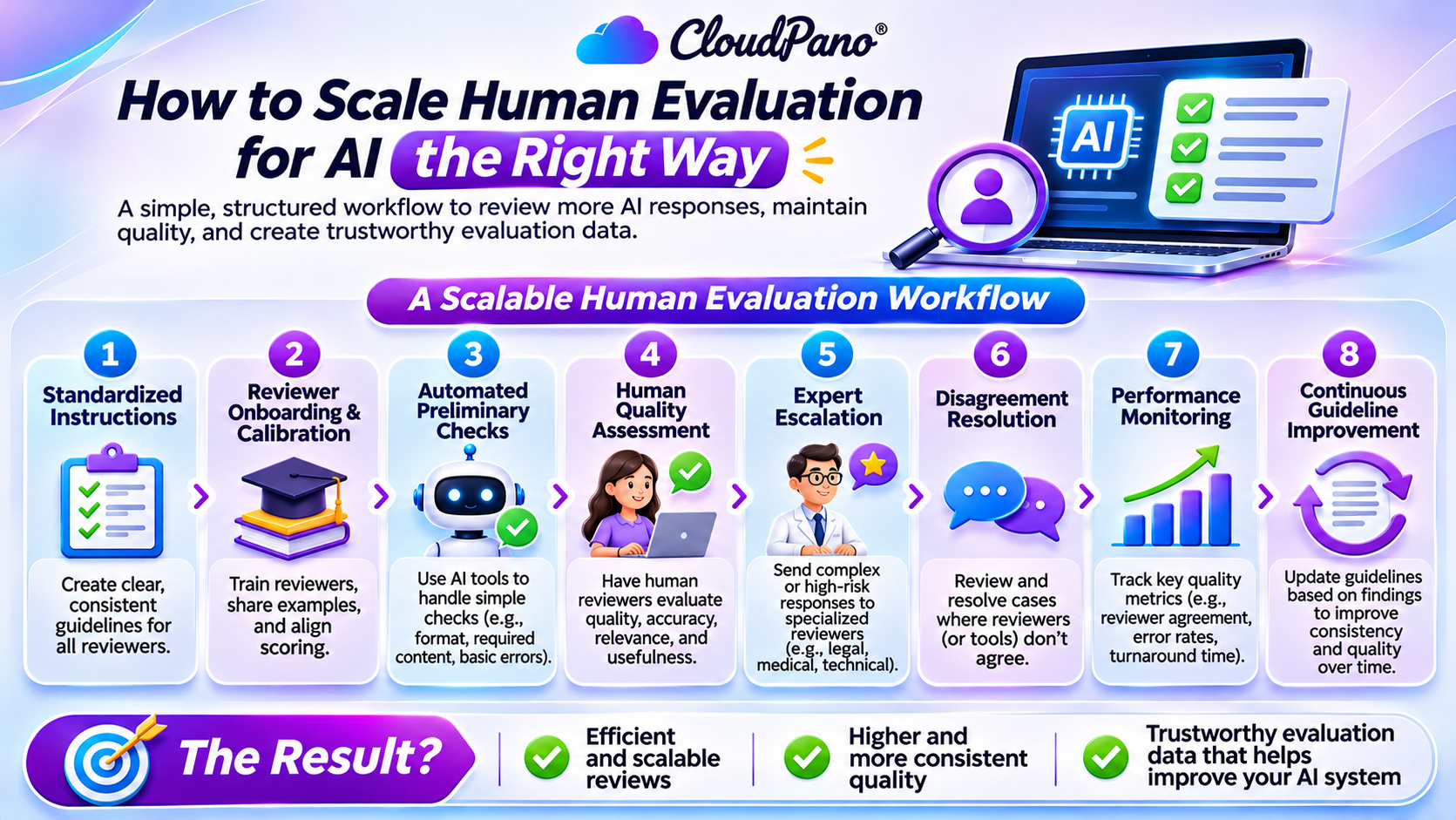
Scaling human evaluation requires structured operations, not simply hiring more reviewers.
Organizations should standardize reviewer guidelines, create efficient task-routing systems, and introduce quality checks at multiple stages.
Automated tools can handle straightforward validation tasks, while human reviewers focus on ambiguous or complex responses.
Specialized reviewers can assess high-risk content requiring domain expertise.
For larger projects, teams may also prioritize examples where automated evaluators disagree or identify potential failures.
A scalable evaluation workflow typically includes:
This combination supports both evaluation efficiency and dependable quality.
The objective is not simply to review more AI responses. It is to generate trustworthy evaluation data that helps improve the underlying system.
AI-generated content can be fast, useful, and convincing, but reliable performance requires more than fluent language.
Organizations need systematic processes to determine whether model responses are accurate, relevant, complete, safe, and aligned with user expectations.
Effective AI model response evaluation combines clear scoring criteria, representative datasets, trained reviewers, quality assurance, and continuous feedback.
Automated evaluation provides speed and scalability, while human review contributes the contextual understanding needed for complex assessments.
By combining these approaches, businesses can identify model weaknesses, improve response quality, and build AI systems that perform more reliably in real-world applications.
The goal of human review is not simply to find mistakes. It is to turn evaluation findings into measurable improvements in AI quality and trustworthiness.
AI model response evaluation is the process of assessing AI-generated answers for accuracy, relevance, groundedness, completeness, instruction following, clarity, and safety. Organizations use human reviewers, automated metrics, and hybrid evaluation workflows to identify model weaknesses, compare performance, and improve response quality.
Human review helps identify contextual errors, unsupported claims, missing information, inappropriate tone, and safety concerns that automated tools may overlook. Trained reviewers can assess whether an AI response genuinely satisfies user intent and meets application requirements, particularly in complex or specialized situations.
Human reviewers use predefined scoring rubrics to assess AI responses against specific quality dimensions. They may verify factual claims, check instruction compliance, identify hallucinations, evaluate communication quality, and compare alternative answers. Reviewer calibration and quality-control procedures help maintain consistent evaluation results.
Human evaluation relies on people to assess AI-generated responses, while AI-as-a-judge uses another AI model to score or compare outputs. AI-based evaluation can process large datasets efficiently, but human reviewers provide contextual judgment, support calibration, and help verify difficult or high-risk cases.
Human feedback helps identify recurring errors, user preferences, instruction-following problems, and weaknesses in generated responses. Organizations can use these findings to improve prompts, retrieval systems, evaluation guidelines, and training datasets. Structured preference data may also support model improvement through human-feedback-based training methods.


Compact, ready to go anywhere
Interchangeable lens that’s upgradeable
Dual 1-inch sensors for improved clarity and low light performance
Dynamic range and 6K 360° capture
360° photo resolution at 21MP

8K 360° video recording for ultra-detailed visuals.
4K single-lens mode for traditional wide-angle shots.
Invisible selfie stick effect for drone-like perspectives.
2.5-inch touchscreen with Gorilla Glass protection.
Waterproof up to 33ft for underwater shooting.

360° photo resolution in 23MP
Slim design at 24 mm thick
Built-in image stabilization for smooth video capture.
Internal 19GB storage for photo and video storage.
Wireless connectivity for remote control and sharing.

60MP 360° still images for high-resolution photography.
5.7K 360° video recording at 30fps.
2.25-inch touchscreen for intuitive control.
USB Type-C port for fast charging and data transfer.
MicroSD card slot for expandable storage.


Try it free. No credit card required. Instant set-up.