
Common data labeling mistakes include incorrect annotations, inconsistent guidelines, missing edge cases, class imbalance, poor reviewer training, and inadequate quality assurance. These problems can introduce misleading patterns into training datasets and reduce model reliability. Organizations can improve labeling quality through clear instructions, representative samples, expert review, and continuous monitoring of annotation errors.
Artificial intelligence models depend on accurate, consistent, and representative training data. Even advanced machine learning algorithms can struggle when the information used to train them contains incorrect labels, missing annotations, or inconsistent instructions.
For organizations developing computer vision systems, large language models (LLMs), robotics applications, or predictive AI, data labeling quality directly affects how reliably models learn and perform.
However, labeling mistakes are not always obvious.
A dataset may contain thousands of annotations and still produce disappointing model results because the labels are inconsistent, important edge cases are missing, or reviewers interpret instructions differently.
Professional data labeling services can help organizations manage annotation workflows, but outsourcing alone does not guarantee quality. Reliable results require clear standards, appropriate expertise, effective quality assurance, and continuous monitoring.
This guide explores the most common data labeling mistakes, explains how they affect model accuracy, and provides practical ways to prevent them.
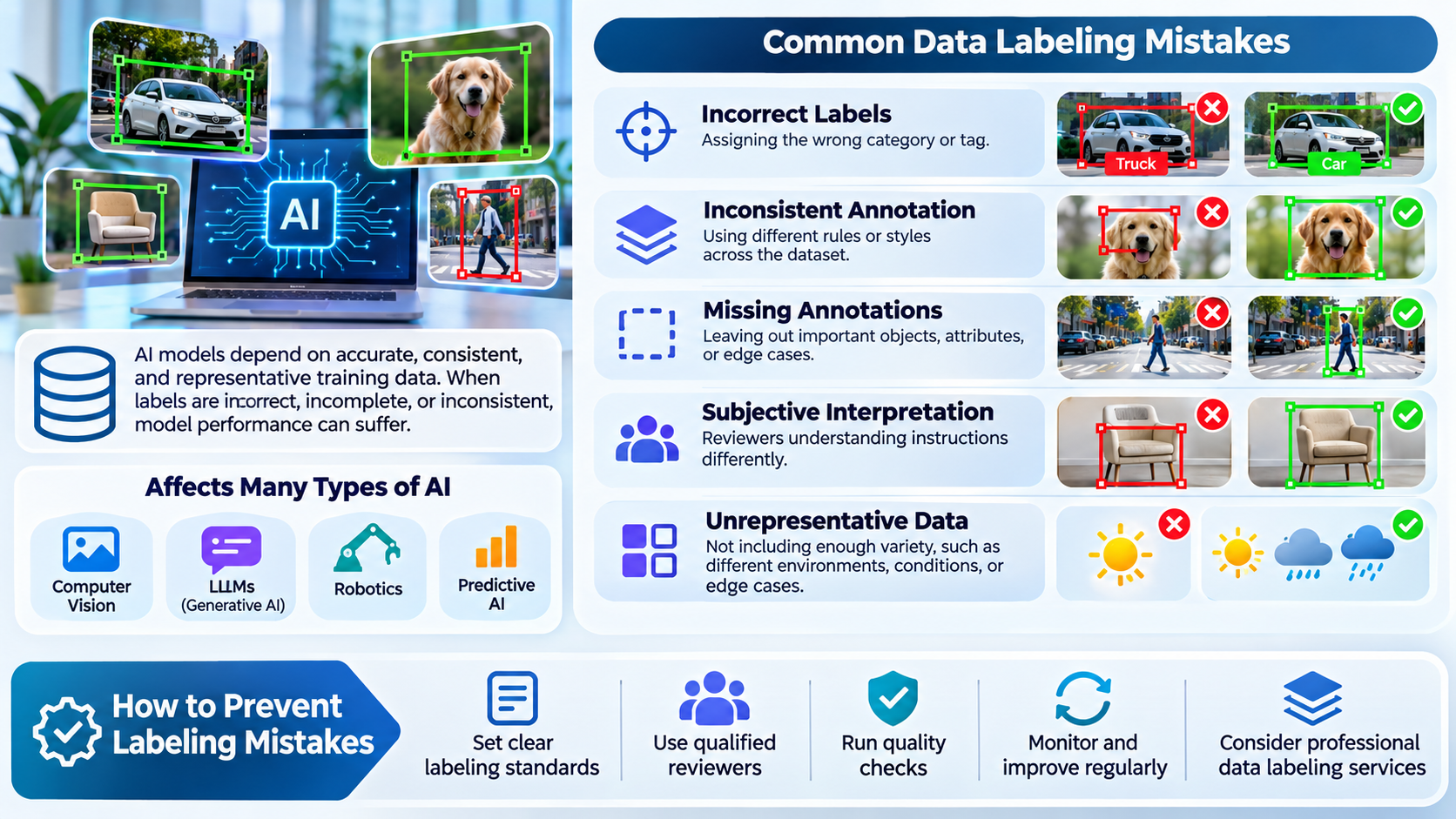
Data labeling converts raw information into structured examples that machine learning systems can use for training and evaluation.
For computer vision, this may involve identifying vehicles, pedestrians, damaged objects, or specific regions within images.
For natural language processing, labeling may involve classifying sentiment, identifying entities, or evaluating generated responses.
For robotics, annotations may describe object positions, physical actions, and interactions over time.
When these labels are accurate, models receive clearer learning signals.
When labels are incorrect or inconsistent, models may learn patterns that do not reflect the intended task.
Imagine training an AI model to distinguish scratches, dents, and undamaged vehicle panels.
If annotators repeatedly classify reflections as scratches, the model may begin treating reflective surfaces as evidence of damage.
Adding more images with the same labeling problem may reinforce the mistake rather than correct it.
The solution is to improve annotation definitions, reviewer training, and quality checks.
This demonstrates why labeling quality should be treated as a core part of AI development.
One of the most common mistakes is allowing annotators to interpret labeling categories differently.
For example, one reviewer may classify a small vehicle scratch as cosmetic damage, while another may categorize it as significant damage.
If both interpretations appear throughout the dataset, the model receives conflicting training examples.
How to prevent it:
Create detailed annotation guidelines with clear definitions, visual examples, and instructions for ambiguous cases.
Update these guidelines whenever recurring disagreements reveal unclear requirements.
Even experienced reviewers need training when working with unfamiliar datasets.
Without proper onboarding, annotators may misunderstand project-specific requirements or apply different standards.
This becomes especially problematic in specialized applications involving medical images, legal documents, scientific data, or robotics.
How to prevent it:
Use representative training tasks before production begins.
Ask reviewers to label the same examples, compare their results, and discuss disagreements.
Repeat calibration sessions when instructions change or quality metrics decline.
AI models often perform well on common examples but struggle with unusual situations.
A vehicle detection model may recognize cars in daylight but fail in heavy rain, nighttime conditions, or partially obstructed scenes.
If these scenarios are missing from the dataset, the model may not learn how to handle them.
How to prevent it:
Include representative edge cases during dataset planning.
Review production failures to identify scenarios that need additional examples.
Avoid assuming that a large dataset automatically provides sufficient diversity.
Class imbalance occurs when certain categories appear much more frequently than others.
For example, a dataset may contain 90,000 images of undamaged vehicles but only 10,000 images showing damage.
A model trained on this distribution may become better at identifying the majority category while missing important minority cases.
However, imbalance is not always a problem by itself. The appropriate distribution depends on the model's purpose and expected operating conditions.
How to prevent it:
Monitor class distributions and evaluate performance separately for important categories.
Consider targeted data collection, appropriate sampling strategies, and task-specific evaluation metrics.
Automated annotation tools can accelerate labeling by generating preliminary predictions.
However, model-generated labels may contain systematic mistakes.
For example, an automated image labeling system may consistently overlook small objects or incorrectly classify unusual shapes.
If these predictions are accepted without review, errors can spread throughout the dataset.
How to prevent it:
Use human-in-the-loop workflows where appropriate.
Validate automated annotations against reviewed examples and prioritize human inspection of uncertain or high-risk predictions.
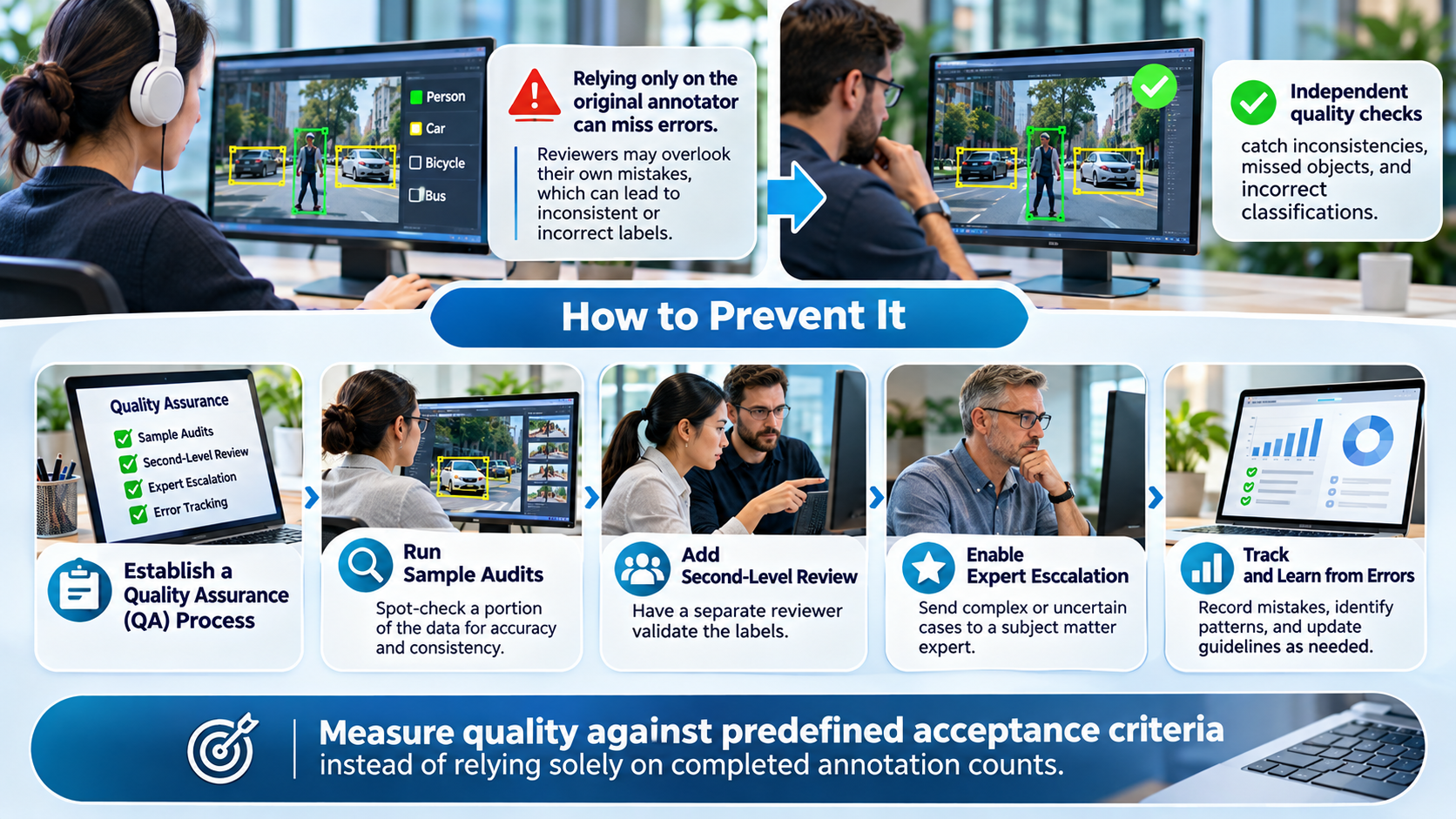
Some annotation projects rely entirely on the original annotator to confirm whether labels are correct.
This creates a risk because reviewers may overlook their own mistakes.
Independent quality checks help identify inconsistencies, missed objects, and incorrect classifications.
How to prevent it:
Establish a quality assurance process that includes sample audits, second-level review, expert escalation, and error tracking.
Measure quality against predefined acceptance criteria rather than relying solely on completed annotation counts.
Poorly designed label taxonomies can create confusion even when annotators follow instructions carefully.
For example, an image classification project might include categories such as “damaged,” “slightly damaged,” and “cosmetic issue” without explaining how they differ.
Reviewers may assign different labels to similar examples because the categories overlap.
How to prevent it:
Define categories before production begins.
Provide positive and negative examples for each label.
If categories cannot be distinguished reliably, reconsider the taxonomy or introduce a structured escalation process.
Disagreements are common in subjective or technically complex labeling tasks.
For example, two reviewers evaluating an LLM response may disagree about whether an answer is sufficiently helpful or factually supported.
Ignoring these disagreements can create inconsistent datasets.
How to prevent it:
Introduce a documented disagreement-resolution process.
Use expert adjudication for difficult cases and update the labeling guidelines when recurring disagreements reveal ambiguous criteria.
Data leakage occurs when information from training data improperly influences evaluation results.
For example, nearly identical images from the same video may appear in both training and test datasets.
The model may achieve strong evaluation scores because it has already encountered highly similar examples.
This can create an overly optimistic impression of real-world performance.
How to prevent it:
Separate datasets carefully, using appropriate grouping by source, subject, session, or collection environment.
Check for duplicate and near-duplicate examples.
Keep evaluation datasets independent from training workflows where required.
Annotation requirements often change as AI models improve and new failure cases emerge.
A labeling schema that worked during early development may become insufficient for more advanced applications.
Without ongoing monitoring, datasets can accumulate outdated labels or inconsistent interpretations.
How to prevent it:
Regularly review model failures, update annotation instructions, and reassess dataset quality.
Treat labeling as a continuous improvement process rather than a task that ends when the first dataset is delivered.
Data labeling mistakes can influence several aspects of AI performance.
Incorrect annotations may teach the model to associate features with the wrong categories.
This can increase classification errors and reduce reliability.
Datasets that lack representative examples may produce models that perform well during development but struggle in unfamiliar environments.
Incorrect reference labels can distort model evaluation.
A correct model prediction may be marked wrong, while an incorrect prediction may appear acceptable.
Poor annotations often lead to repeated data cleaning, relabeling, additional model training, and extended debugging.
These costs can exceed the initial savings from inexpensive annotation workflows.
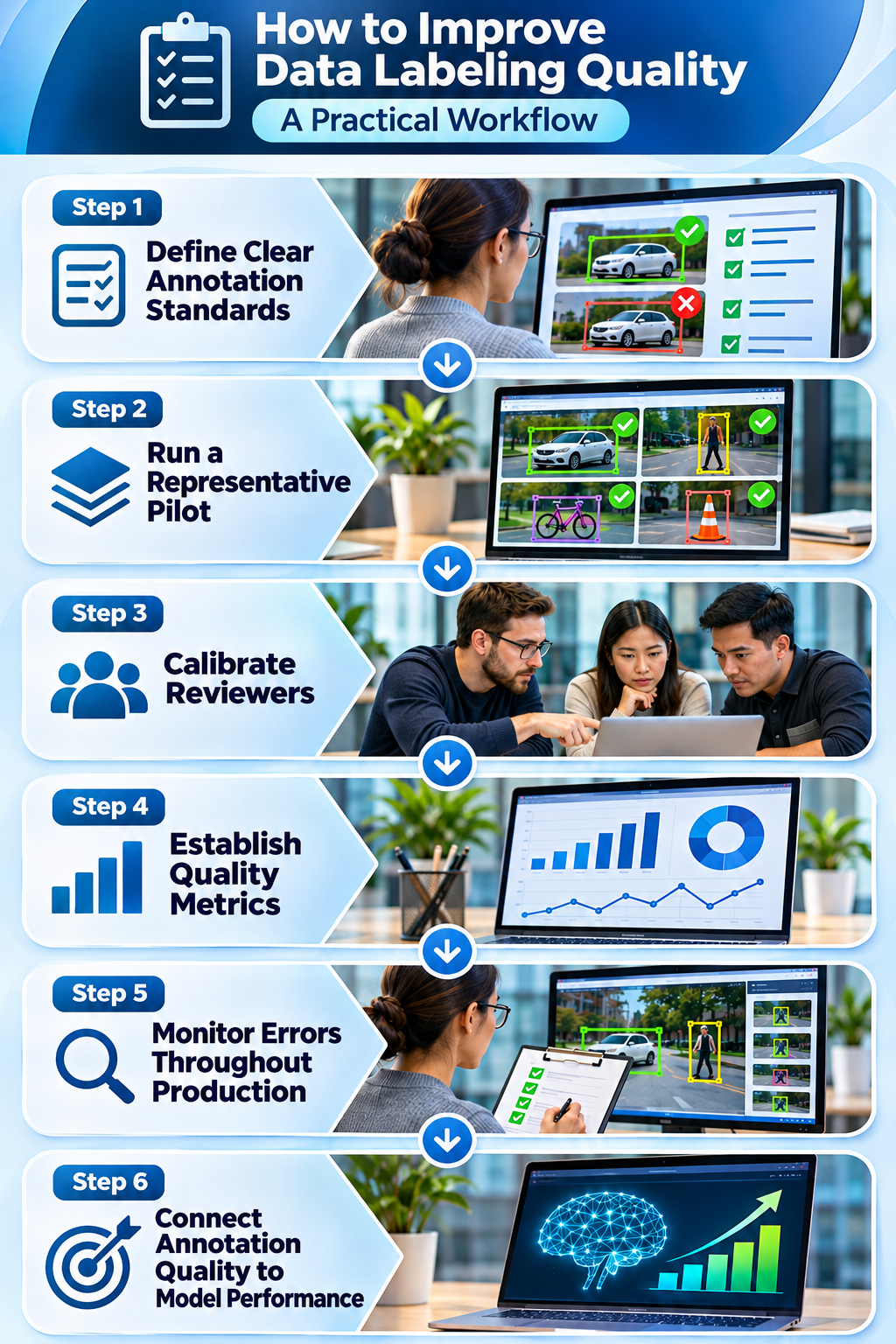
Organizations can reduce annotation errors by implementing a structured quality management process.
Document each label category, its intended meaning, and the rules for applying it.
Include examples of correct annotations, common mistakes, and ambiguous cases.
Before labeling the complete dataset, select a sample containing common examples and difficult cases.
Use the pilot to test whether annotators understand the instructions.
Have multiple reviewers annotate selected examples independently.
Compare their decisions and resolve disagreements before scaling production.
Choose metrics appropriate for the annotation task.
These may include classification accuracy against reviewed reference labels, inter-annotator agreement, segmentation overlap, or expert adjudication results.
Conduct regular quality audits and track recurring error categories.
Use findings to improve training materials, instructions, and reviewer feedback.
Evaluate whether labeling improvements lead to better model behavior.
If performance remains weak, investigate other possible causes, including data coverage, model architecture, evaluation design, and deployment conditions.
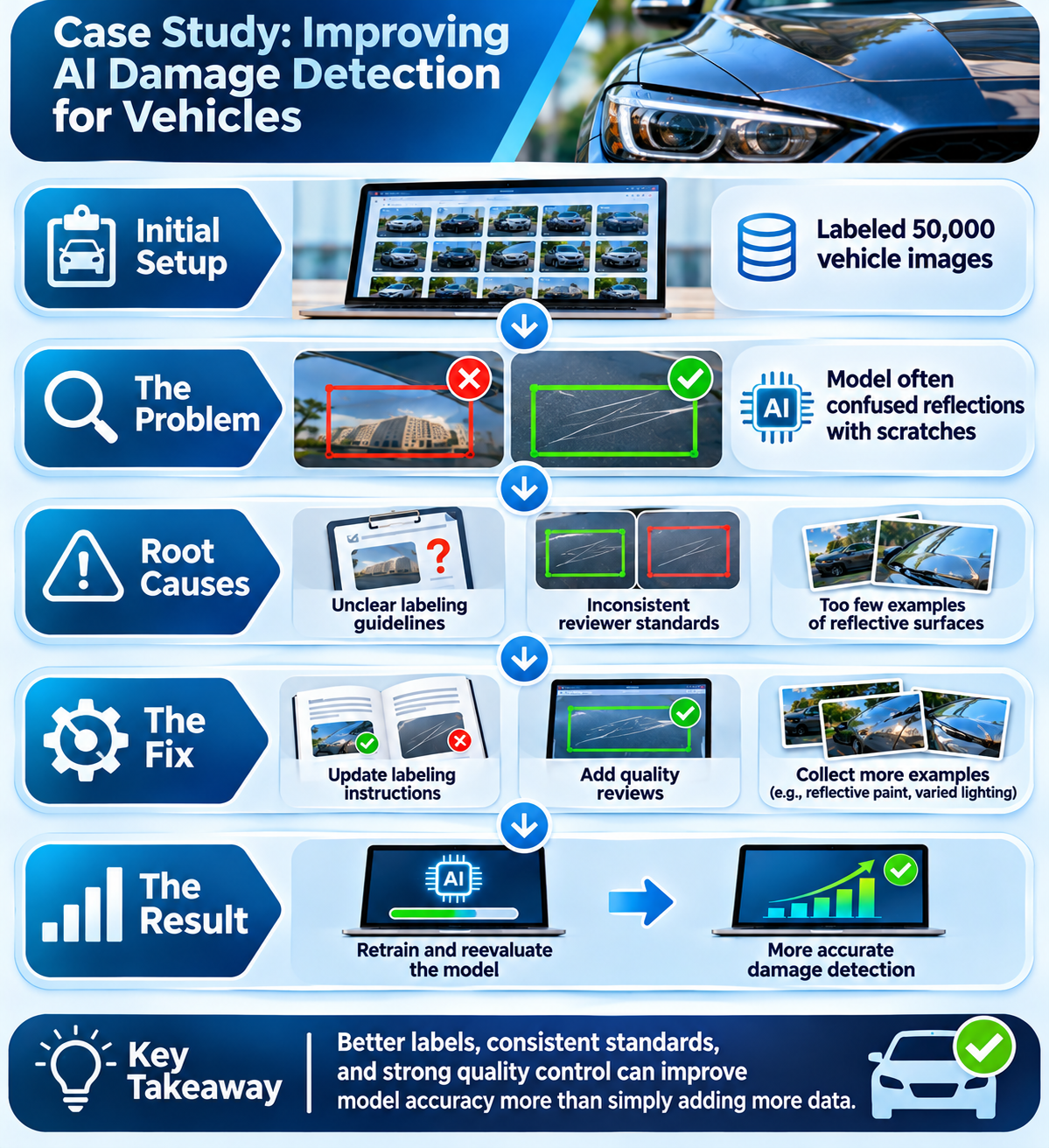
Consider an automotive AI company developing a system that detects scratches and dents.
The company initially labels 50,000 vehicle images.
During model testing, engineers discover that the system frequently mistakes reflections for scratches.
A quality review reveals three problems:
The company updates its labeling instructions, introduces clearer visual examples, and adds targeted quality reviews.
It also collects additional examples involving reflective paint and challenging lighting.
After correcting the annotations, the team retrains and reevaluates the model using a separate test dataset.
This process helps determine whether the revised labeling standards improve real-world damage detection.
The important lesson is that collecting more data is not always the solution. Sometimes the existing data needs better definitions, more consistent annotations, and stronger quality control.
Reliable data labeling services can support organizations by providing trained annotation teams, structured quality assurance, specialized reviewers, and scalable workflows.
Depending on the provider, services may include image and video annotation, text classification, audio transcription, robotics labeling, and LLM evaluation.
However, choosing an external provider does not eliminate the need for internal oversight.
Organizations should verify reviewer qualifications, security practices, annotation guidelines, and quality metrics.
When evaluating data labeling services, prioritize providers that demonstrate:
A representative pilot can help determine whether a provider meets your project's quality requirements before production begins.
Data labeling mistakes can undermine model performance even when organizations invest heavily in advanced algorithms and large datasets.
Inconsistent guidelines, incorrect annotations, missing edge cases, and weak quality assurance can introduce errors that become difficult to identify later in development.
The most effective approach combines clear annotation standards, trained reviewers, representative datasets, independent quality checks, and continuous improvement.
Whether your organization manages annotation internally or works with professional data labeling services, prioritize the accuracy and consistency of the final dataset.
The goal is not simply to produce more labels. It is to create trustworthy training and evaluation data that helps AI systems perform reliably in real-world conditions.
Common mistakes include incorrect labels, inconsistent annotation guidelines, missing edge cases, unclear categories, inadequate reviewer training, and insufficient quality assurance. These problems can introduce misleading learning signals into datasets. Organizations can reduce errors by establishing clear instructions, running pilot projects, calibrating reviewers, and conducting regular quality checks.
Incorrect labels can teach AI models to associate inputs with the wrong outputs. This may increase prediction errors, reduce generalization, and distort evaluation results. The impact depends on the number, distribution, and severity of mistakes. Systematic labeling errors can be especially harmful because they repeatedly reinforce incorrect patterns.
Automated labeling can reduce repetitive work and accelerate dataset preparation, but it does not eliminate the need for quality assurance. Automated predictions may contain systematic errors or struggle with ambiguous examples. Human review is particularly useful for complex tasks, specialized domains, and cases where incorrect annotations could have significant consequences.
Companies can measure annotation quality using reviewed reference labels, inter-annotator agreement, error rates, segmentation overlap, and expert adjudication. The most appropriate metrics depend on the task. Quality monitoring should also track recurring mistakes, correction requirements, and whether annotation improvements contribute to better model performance.
Annotation guidelines establish consistent definitions and rules for applying labels. Without clear instructions, reviewers may interpret categories differently and create conflicting examples. Effective guidelines include positive and negative examples, edge cases, escalation procedures, and updates based on recurring disagreements. They help improve consistency across reviewers and annotation batches.


Compact, ready to go anywhere
Interchangeable lens that’s upgradeable
Dual 1-inch sensors for improved clarity and low light performance
Dynamic range and 6K 360° capture
360° photo resolution at 21MP

8K 360° video recording for ultra-detailed visuals.
4K single-lens mode for traditional wide-angle shots.
Invisible selfie stick effect for drone-like perspectives.
2.5-inch touchscreen with Gorilla Glass protection.
Waterproof up to 33ft for underwater shooting.

360° photo resolution in 23MP
Slim design at 24 mm thick
Built-in image stabilization for smooth video capture.
Internal 19GB storage for photo and video storage.
Wireless connectivity for remote control and sharing.

60MP 360° still images for high-resolution photography.
5.7K 360° video recording at 30fps.
2.25-inch touchscreen for intuitive control.
USB Type-C port for fast charging and data transfer.
MicroSD card slot for expandable storage.


Try it free. No credit card required. Instant set-up.