To choose the right AI data labeling company, evaluate its annotation expertise, quality assurance processes, data security, scalability, pricing, and experience with your AI application. Look for providers that use clear annotation guidelines, qualified reviewers, and measurable quality standards. Before signing a long-term agreement, run a representative pilot project to verify annotation accuracy, communication, and delivery performance.
Artificial intelligence depends on high-quality data to produce accurate and reliable results. Whether you're developing a computer vision model, evaluating a large language model (LLM), or training an autonomous robotics system, the quality of your annotations directly influences how effectively your AI system performs.
However, choosing the right AI data labeling company can be challenging. Different providers offer different levels of expertise, annotation capabilities, quality assurance, and scalability.
Some companies specialize in image and video annotation, while others focus on text, audio, robotics, or human evaluation for generative AI. Finding the right partner means looking beyond the number of labels a provider can produce and understanding how well its services align with your specific AI development requirements.
This guide explains what to look for in an annotation provider, how to evaluate its capabilities, and which questions to ask before making a long-term commitment.
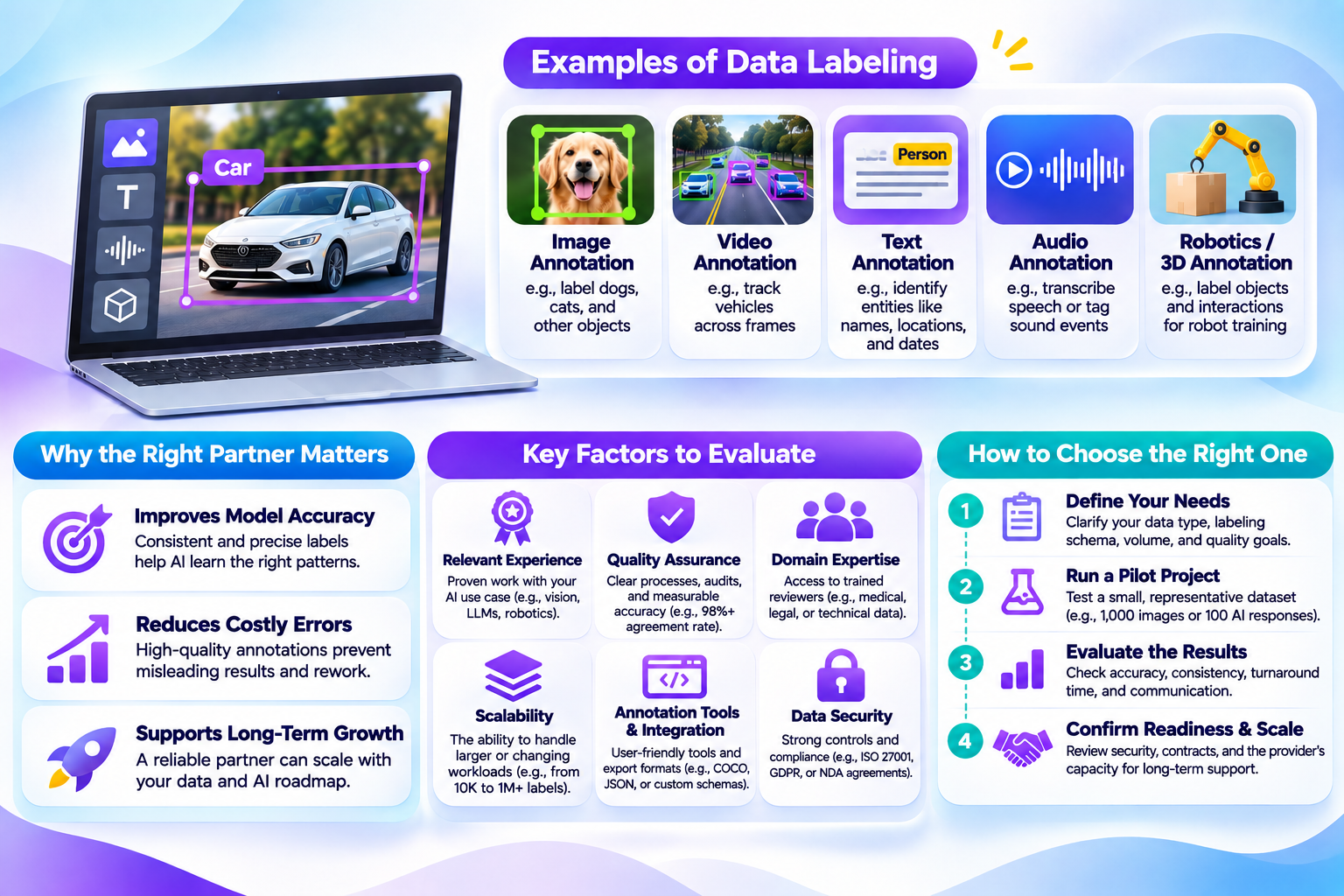
An AI data labeling company transforms raw data into structured, annotated datasets that machine learning systems can use for training, testing, and evaluation.
This process, known as data annotation, involves identifying and labeling meaningful information within images, videos, text, audio, and other types of data.
For example, an autonomous vehicle model may require thousands of annotated images showing pedestrians, vehicles, traffic signs, and road boundaries.
Similarly, an LLM evaluation project may require human reviewers to assess AI-generated responses for accuracy, relevance, instruction following, and safety.
The purpose of data labeling is to provide reliable information that helps developers train models and evaluate their performance.
Annotation companies may support several types of data, depending on their expertise and technology.
Image Annotation
Image annotation involves identifying objects, regions, and visual features using bounding boxes, polygons, semantic segmentation, classification, or keypoint labeling.
Video Annotation
Video annotation adds structured information to moving footage. Common tasks include object tracking, action recognition, temporal segmentation, and frame-by-frame labeling.
Text Annotation
Text annotation supports natural language processing applications through named entity recognition, sentiment analysis, intent classification, and document categorization.
Audio Annotation
Audio annotation includes speech transcription, speaker identification, timestamp labeling, and sound event classification.
LLM Annotation and Evaluation
LLM evaluation involves assessing AI-generated responses for factual accuracy, helpfulness, relevance, safety, and instruction following. It may also include preference ranking and specialized expert review.
3D and Sensor Annotation
Robotics and autonomous systems often require point cloud labeling, spatial annotations, object detection, and alignment between multiple sensor inputs.
The best annotation provider is one that understands the data types and technical requirements of your specific application.
High-quality annotations provide a dependable foundation for AI development.
When training labels are inaccurate or inconsistent, models may learn incorrect patterns. Similarly, unreliable evaluation labels can lead developers to misunderstand a model's strengths and weaknesses.
These problems can become more expensive as datasets grow.
A reliable annotation partner helps reduce these risks through standardized workflows, clear labeling instructions, qualified reviewers, and continuous quality monitoring.
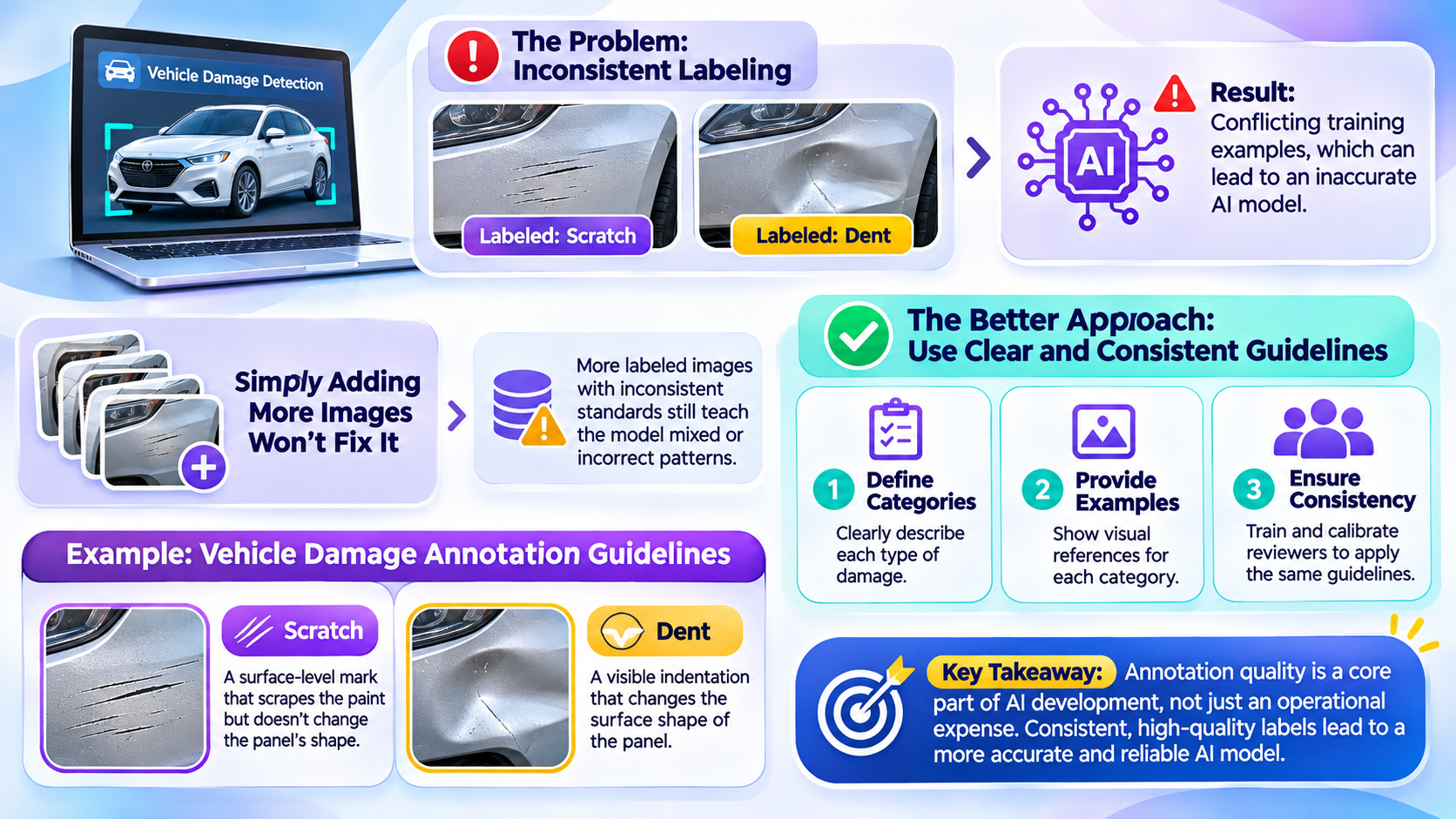
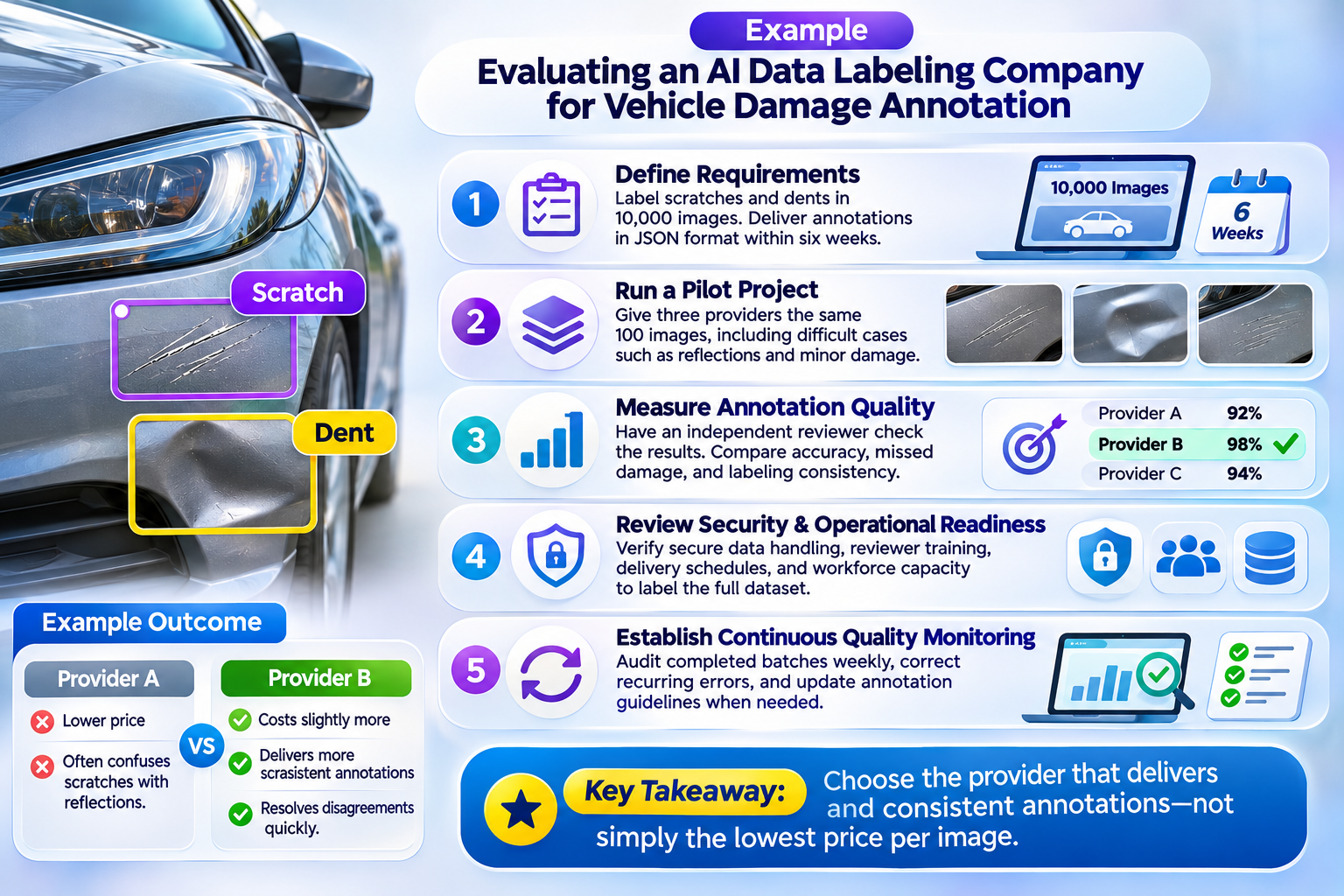
Consider a computer vision model designed to identify vehicle damage.
If annotators inconsistently distinguish scratches from dents, the model receives conflicting training examples.
Adding more annotated images may not solve the problem because the underlying labeling standards remain inconsistent.
A better approach is to define each damage category clearly, provide examples, and ensure reviewers apply the same guidelines.
This demonstrates why annotation quality should be treated as a core part of AI development rather than simply an operational expense.
Not every AI data labeling company has experience with the same technologies or industries.
A provider specializing in basic image classification may not have the expertise needed to annotate complex robotics footage or evaluate legal reasoning generated by an LLM.
Before selecting a provider, review its experience with projects similar to yours.
Ask about supported data types, previous use cases, annotation methods, and how the company handles technically difficult examples.
Relevant experience can improve onboarding efficiency and reduce the need for repeated guideline revisions.
Quality assurance is one of the most important factors when evaluating annotation services.
A dependable provider should have a documented process for measuring accuracy, identifying inconsistencies, and correcting errors.
Common quality control methods include independent reviews, benchmark tasks, random audits, expert validation, and inter-annotator agreement analysis.
However, agreement between reviewers does not always mean the annotations are correct. Multiple annotators may make the same mistake when instructions are unclear.
Strong annotation workflows combine measurable quality checks with expert judgment and ongoing improvements to labeling guidelines.
Some annotation projects require more than general labeling experience.
Healthcare datasets may involve medical terminology, while financial applications may require knowledge of accounting or regulatory concepts. Robotics projects may involve complex physical interactions and spatial relationships.
For these tasks, specialized reviewers can provide more accurate and meaningful annotations.
Ask potential providers how they recruit qualified experts, verify credentials, conduct onboarding, and manage difficult cases.
Although expert annotation may cost more, it can provide greater value when incorrect labels create significant downstream risks.
AI datasets may contain sensitive information, including customer records, internal documents, confidential business data, or proprietary research.
Before sharing information with an annotation provider, evaluate its security practices.
Important considerations include encryption, secure file transfers, role-based access controls, confidentiality agreements, data retention policies, and incident response procedures.
If your project involves regulated information, determine which legal and contractual requirements apply.
Security certifications such as ISO/IEC 27001 can provide useful evidence of established controls, but their scope and validity should be verified.
An annotation provider may perform well during a small pilot but struggle when production volume increases.
Scaling successfully requires more than hiring additional annotators.
The provider must maintain consistent guidelines, reviewer training, quality assurance, and project management as workloads grow.
Ask how the company handles sudden increases in annotation volume, multilingual projects, specialized reviewer shortages, and changing deadlines.
A scalable partner should also support recurring annotation needs as your AI models evolve.
Efficient annotation depends on having the right technology for the task.
Image annotation may require segmentation editors and bounding-box tools. Video projects may need frame navigation, object tracking, and temporal labeling.
LLM evaluation workflows may require side-by-side response comparisons, scoring rubrics, and disagreement resolution systems.
Before choosing a provider, confirm that its annotation tools support your data formats and delivery requirements.
For example, computer vision projects may require JSON or COCO-compatible annotations, while other applications may use custom schemas.
Clear integration requirements can reduce the time spent preparing labeled data for your machine learning pipeline.
Annotation costs vary depending on dataset size, task complexity, reviewer qualifications, quality requirements, and delivery schedules.
Simple classification tasks may be priced per item, while specialized video annotation or expert LLM evaluation may involve hourly or project-based fees.
Instead of comparing providers solely by their advertised rates, evaluate the total cost of obtaining accepted, usable annotations.
This includes initial labeling, quality review, corrections, project management, and integration.
A low-cost service may become expensive if your internal team spends significant time identifying and correcting annotation errors.
Even experienced annotation providers can struggle when communication and project coordination are inconsistent.
Look for a company that assigns a clear project owner, establishes milestones, provides regular updates, and maintains a process for resolving questions.
Effective project management is particularly important when annotation guidelines evolve during production.
A reliable partner should identify unclear instructions early and address them before they affect large portions of the dataset.
Strong communication helps maintain quality, reduce delays, and keep annotation projects aligned with development goals.
Selecting an annotation provider should involve a structured evaluation process.
The following steps can help you compare potential partners and reduce project risk.
Begin by documenting your dataset type, labeling schema, expected volume, delivery format, quality standards, and project timeline.
Include representative examples and difficult edge cases so providers understand the full scope of the work.
Clear requirements make it easier to compare proposals and establish realistic expectations.
Before committing to a large annotation contract, ask shortlisted providers to complete a pilot using a representative dataset.
The sample should include straightforward examples as well as ambiguous or technically challenging cases.
Provide the same instructions to each provider so you can compare results fairly.
A pilot allows you to evaluate annotation quality, communication, turnaround time, and the provider's ability to follow instructions.
Evaluate pilot results against predefined acceptance criteria.
Depending on the task, relevant measurements may include label accuracy, reviewer agreement, segmentation overlap, error rates, or expert adjudication outcomes.
Do not rely entirely on self-reported provider accuracy.
Review a meaningful sample independently and document recurring errors.
This gives your team a clearer understanding of whether the provider can meet production requirements.
Before expanding the project, verify contractual requirements, data access controls, delivery processes, and escalation procedures.
Confirm that the provider has sufficient workforce capacity and appropriate quality controls for your expected volume.
Security and operational readiness should be assessed before sensitive datasets are transferred.
Annotation requirements may change as developers discover new edge cases or identify weaknesses in model performance.
Create a feedback process that allows your team to update instructions, review difficult examples, and monitor quality throughout production.
Regular quality checks help ensure that annotation standards remain consistent as the project grows.
Automated annotation tools can improve efficiency by generating preliminary labels, detecting objects, transcribing speech, or suggesting classifications.
Human reviewers can then validate and correct these outputs.
This combination is commonly called human-in-the-loop annotation.
Although automation can reduce repetitive work, it can also introduce systematic errors.
For example, a model that consistently fails to detect small objects may produce incomplete labels across thousands of images.
Human review is particularly valuable for ambiguous cases, specialized datasets, and tasks where annotation mistakes could have significant consequences.
The best workflow depends on task complexity, model performance, acceptable error rates, and available review resources.
One of the most common mistakes is choosing an annotation company based entirely on price.
Another is beginning large-scale production before annotation guidelines have been tested with real examples.
Organizations may also underestimate the importance of edge cases, disagreement resolution, security requirements, and ongoing quality monitoring.
Avoid assuming that experience with one data type automatically translates into expertise across every annotation category.
Finally, remember that a successful pilot does not guarantee consistent performance at scale.
Continue monitoring annotation quality throughout the project rather than treating evaluation as a one-time activity.
Choosing the right AI data labeling company is about establishing a reliable foundation for your AI development process.
The strongest annotation providers do more than deliver labeled datasets. They help define clear annotation standards, manage complex cases, maintain reviewer consistency, protect sensitive information, and adapt to changing project requirements.
Before making a long-term commitment, evaluate relevant expertise, run a representative pilot, and measure the quality of accepted annotations.
Whether you're developing a computer vision model, evaluating an LLM, or building a robotics application, the objective remains the same: obtaining reliable, well-documented data that supports meaningful model improvement.
The best annotation partner is not necessarily the cheapest or largest. It's the one that consistently delivers accurate, usable data aligned with your specific AI requirements.
Look for relevant annotation experience, measurable quality assurance, trained reviewers, strong data security, transparent pricing, and scalable operations. A reliable AI data labeling company should understand your specific use case and provide clear documentation of its annotation process. Running a pilot project can help verify performance before making a long-term commitment.
AI data labeling costs depend on dataset size, annotation complexity, reviewer expertise, and quality requirements. Basic classification tasks may cost less than detailed video annotation or expert LLM evaluation. Request an itemized quote covering labeling, quality review, corrections, and delivery to understand the total cost of usable annotations.
Human review helps identify incorrect annotations, resolve ambiguous examples, and evaluate tasks that require contextual understanding. Automated tools can accelerate labeling, but their outputs may contain systematic errors. Combining automation with trained reviewers and structured quality assurance can improve annotation reliability, particularly for complex or high-impact applications.
Some annotation providers support multiple data types, but their capabilities may vary. A company experienced in image annotation may not have the same expertise in speech processing, robotics, or LLM evaluation. Request relevant examples, tool specifications, and pilot results for each required data type before selecting a provider.
Measure annotation quality using criteria appropriate to your task, such as accuracy against reviewed reference labels, inter-annotator agreement, segmentation overlap, or expert assessment. Track recurring error types and correction rates throughout production. Quality evaluation should reflect the intended AI application rather than relying on a single generic accuracy score.


Compact, ready to go anywhere
Interchangeable lens that’s upgradeable
Dual 1-inch sensors for improved clarity and low light performance
Dynamic range and 6K 360° capture
360° photo resolution at 21MP

8K 360° video recording for ultra-detailed visuals.
4K single-lens mode for traditional wide-angle shots.
Invisible selfie stick effect for drone-like perspectives.
2.5-inch touchscreen with Gorilla Glass protection.
Waterproof up to 33ft for underwater shooting.

360° photo resolution in 23MP
Slim design at 24 mm thick
Built-in image stabilization for smooth video capture.
Internal 19GB storage for photo and video storage.
Wireless connectivity for remote control and sharing.

60MP 360° still images for high-resolution photography.
5.7K 360° video recording at 30fps.
2.25-inch touchscreen for intuitive control.
USB Type-C port for fast charging and data transfer.
MicroSD card slot for expandable storage.


Try it free. No credit card required. Instant set-up.