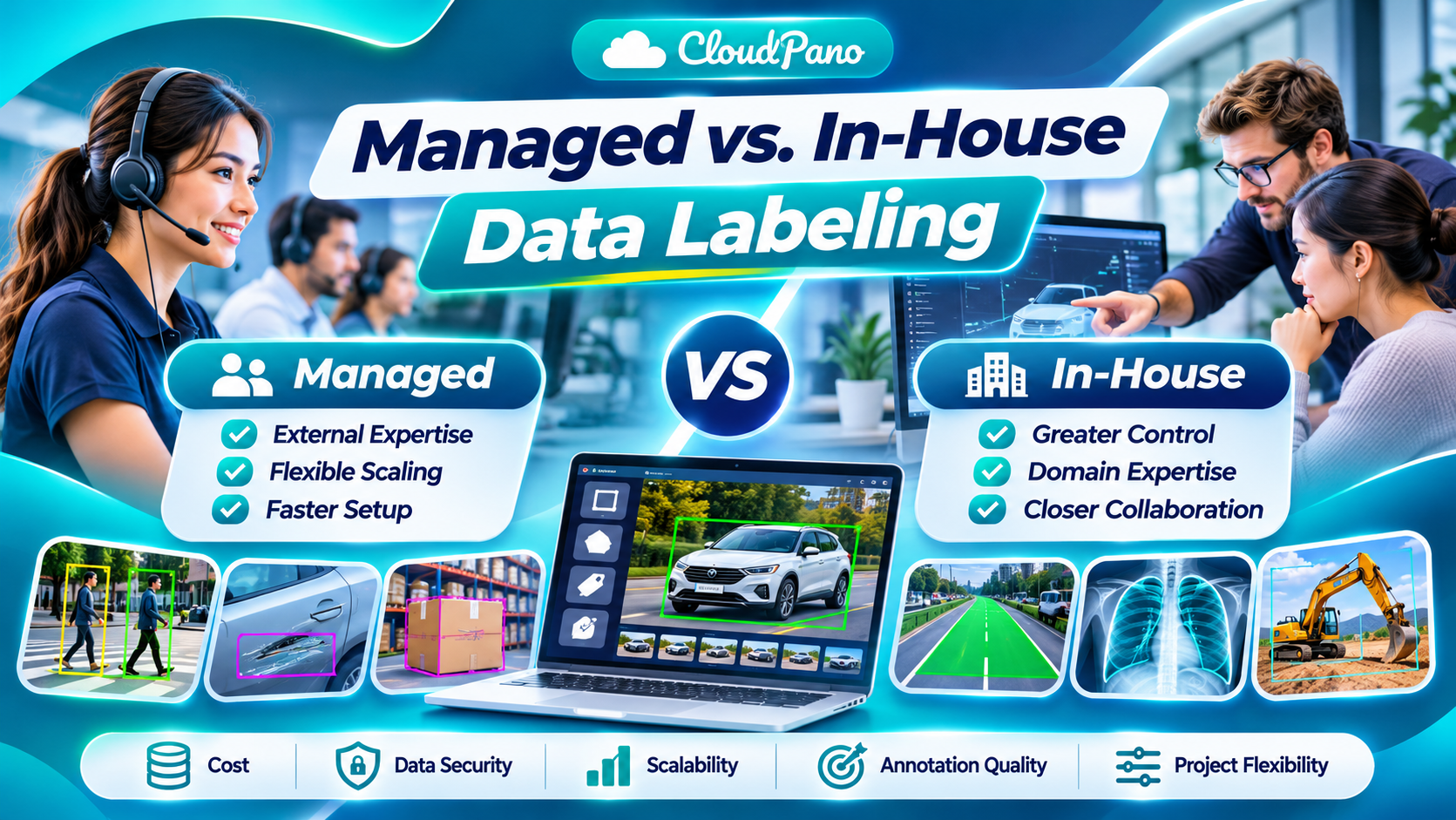
Managed vs in-house labeling compares outsourcing data annotation to a specialized provider with building and managing an internal annotation team. Managed services offer flexible capacity, established workflows, and external expertise, while in-house labeling provides greater direct control over data, reviewers, and quality standards. The best choice depends on project scale, security requirements, budget, and annotation complexity.
Building a reliable artificial intelligence system requires more than a powerful model. It also depends on accurate, consistent, and well-organized training data.
Whether you're developing computer vision applications, evaluating large language models (LLMs), or training robotics systems, data annotation plays an important role in model performance.
One of the biggest decisions AI teams face is whether to manage annotation internally or outsource the work to a specialized provider.
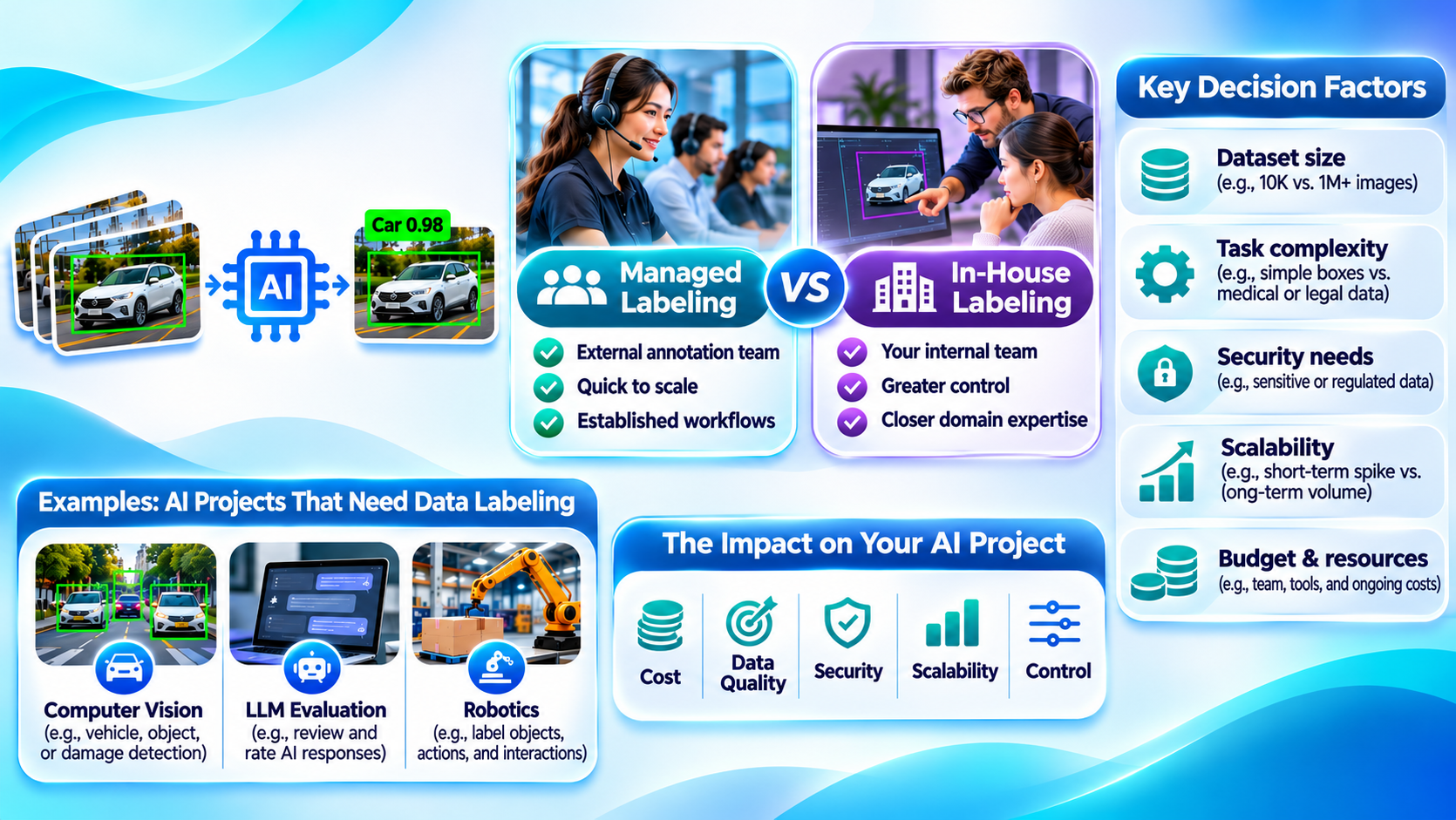
The managed vs in-house labeling decision affects project costs, data quality, security, scalability, and the amount of control your organization has over its annotation workflows.
In-house labeling provides direct oversight and closer collaboration with internal experts. Managed labeling services offer external annotation capacity, established workflows, and potentially faster scaling.
Neither approach is automatically better.
The right choice depends on your dataset, project complexity, internal resources, security requirements, and long-term AI development goals.
This guide explains how both approaches work, their advantages and limitations, and how to determine which model fits your organization.
An internal annotation workflow generally includes:
For example, a healthcare AI company developing a specialized diagnostic model may use qualified internal reviewers to annotate sensitive medical information.
Keeping the work internal can simplify collaboration with clinical experts and provide direct oversight of sensitive data.
However, internal operations also require ongoing investment in people, management, technology, and training.
Understanding the differences between these approaches helps organizations make a more informed decision.
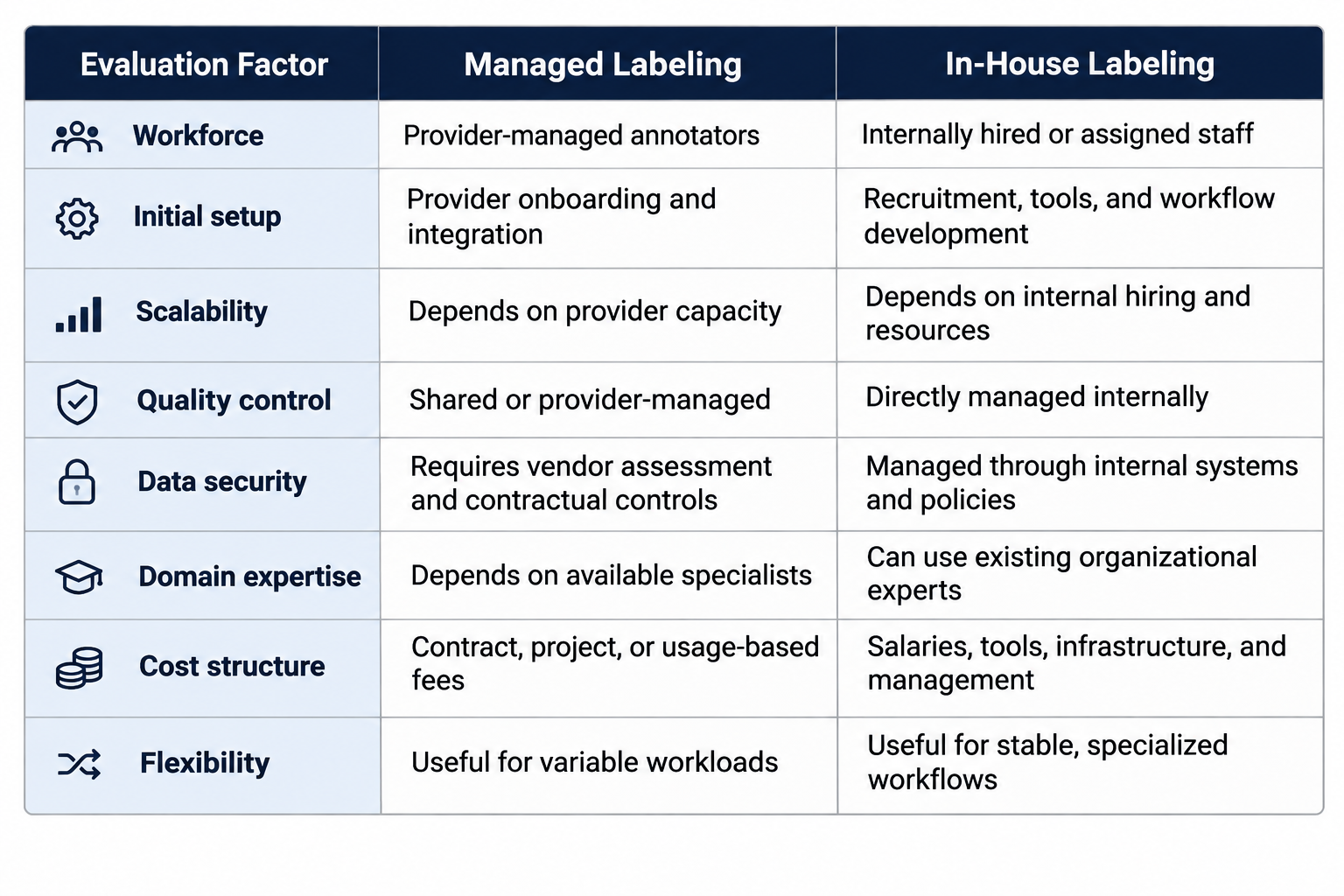
The best option is not determined by a single factor. Organizations should consider the complete operational requirements of their AI projects.
One major advantage of managed annotation is the ability to increase labeling capacity without building a large permanent workforce.
A company may need 5,000 annotated images during one development phase and 500,000 during another.
An external provider may be better positioned to accommodate these fluctuations, depending on its available workforce and infrastructure.
This flexibility is particularly valuable for projects with changing annotation volumes.
Experienced managed providers often have existing processes for reviewer onboarding, quality audits, task assignment, and disagreement resolution.
These capabilities can reduce the operational work required to launch an annotation project.
However, organizations should verify these processes rather than assuming every provider follows the same standards.
Managing annotators requires coordination, training, productivity monitoring, and quality supervision.
Outsourcing these responsibilities can allow machine learning teams to spend more time on model development, evaluation, and experimentation.
This does not eliminate the need for internal oversight.
The customer still needs to define requirements, review results, and monitor whether the delivered annotations meet expectations.
Managed labeling introduces dependencies that organizations should evaluate carefully.
External teams may need additional time to understand specialized annotation requirements.
Communication delays can slow guideline updates or disagreement resolution.
There may also be concerns involving sensitive data, contractual obligations, vendor reliability, and long-term costs.
For highly specialized projects, qualified reviewers may be difficult or expensive for providers to recruit.
A successful managed labeling relationship therefore requires clear documentation, reliable communication, and measurable service expectations.
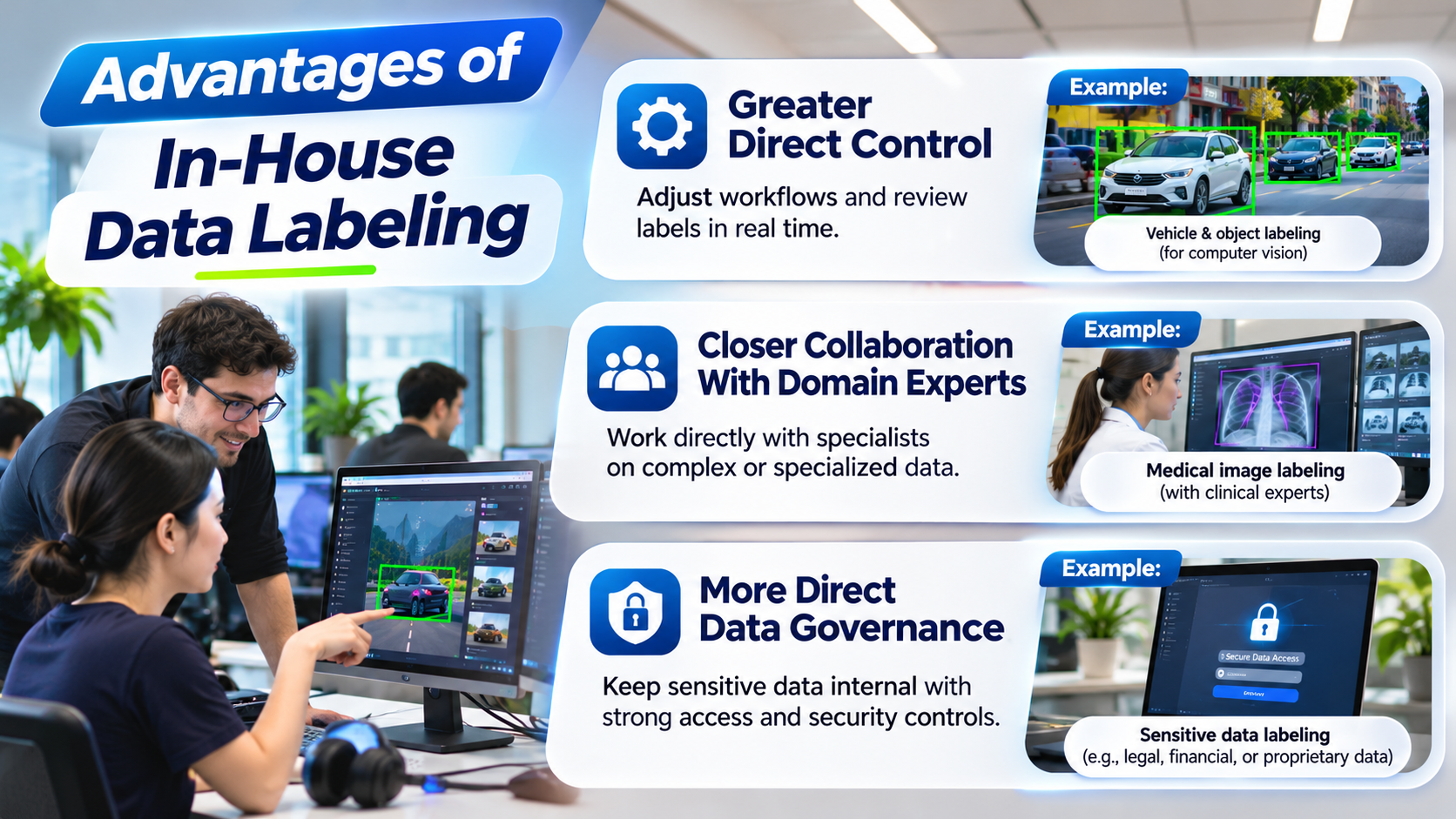
Internal annotation teams operate within the organization's existing management structure.
Project leaders can directly adjust workflows, review difficult cases, and coordinate with engineers.
This can be valuable when labeling requirements change frequently during model development.
Some annotation tasks require specialized knowledge that is difficult to transfer through written instructions alone.
Examples include medical image interpretation, complex legal classification, scientific research data, and advanced robotics applications.
Internal teams can collaborate closely with existing subject-matter experts to resolve ambiguous examples.
Keeping annotation operations internal can reduce the need to transfer sensitive datasets to external organizations.
However, internal labeling does not automatically guarantee security.
Organizations still need appropriate access controls, monitoring, retention policies, and employee training.
Building an internal annotation operation can be expensive and time-consuming.
Organizations must recruit employees, develop training materials, select tools, and establish quality assurance procedures.
Workload fluctuations also create challenges.
If annotation demand declines, permanent staffing costs may remain. If demand suddenly increases, recruitment and onboarding can delay delivery.
Another limitation is operational distraction.
Machine learning engineers may spend significant time managing annotation problems rather than improving models.
For organizations without established annotation operations, these hidden costs can become substantial.
The managed vs in-house labeling cost comparison should focus on total cost of ownership rather than the advertised price per annotation.
Managed labeling expenses may include:
Internal annotation expenses may include:
Imagine an AI company needs 100,000 images labeled over six months.
A managed provider offers a per-image rate that includes annotation and basic quality review.
An internal team requires hiring annotators, purchasing software, and assigning a project manager.
The managed option may have lower initial setup costs, while the internal option could become more economical if the organization maintains a predictable workload over several years.
The comparison should also account for correction rates and accepted annotation quality.
A cheaper workflow is not necessarily more cost-effective if it creates substantial rework.
Neither managed nor in-house labeling guarantees higher quality.
Quality depends on annotation guidelines, reviewer expertise, task complexity, and the effectiveness of quality assurance.
A strong annotation program should include:
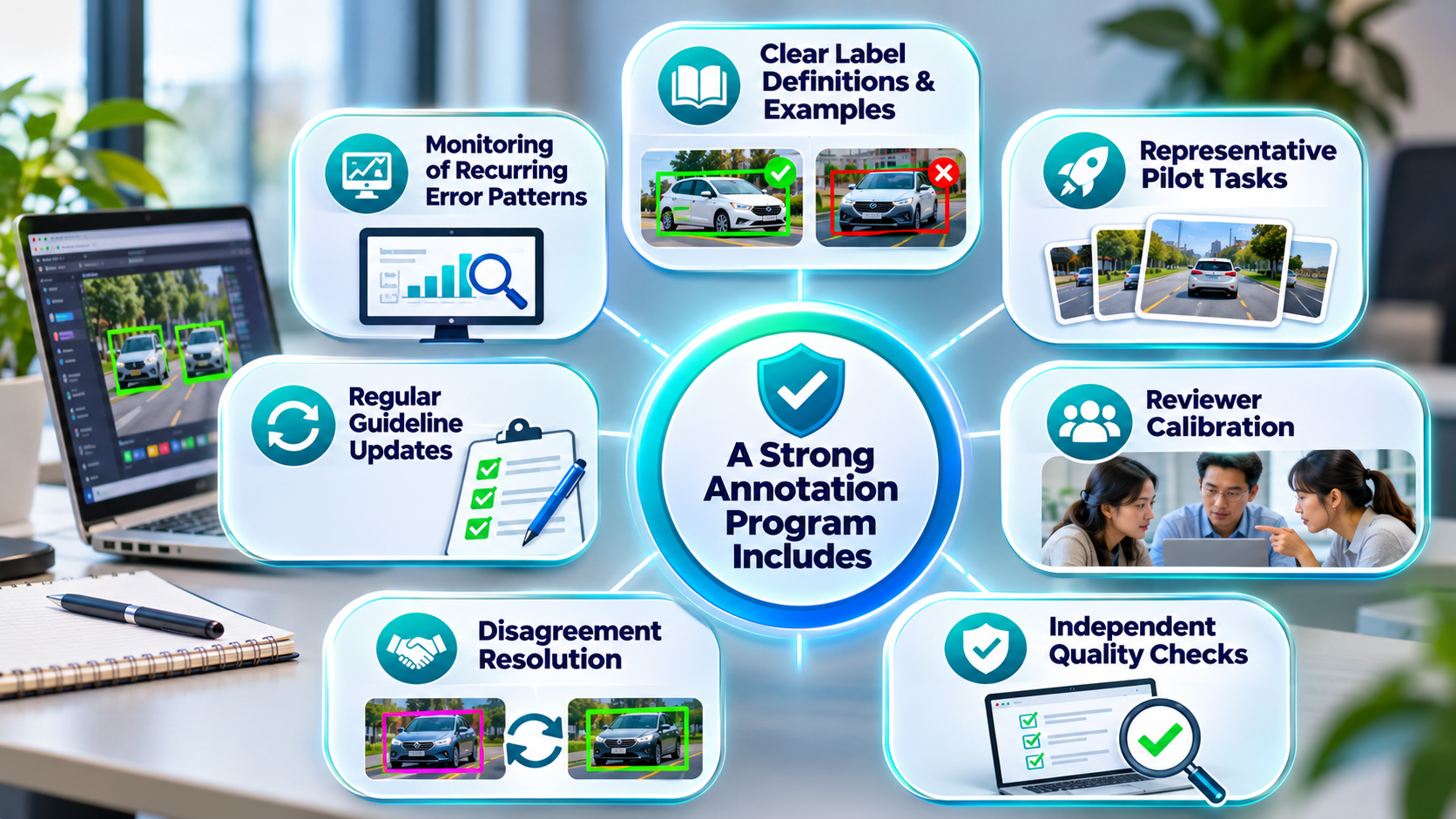
Consider a computer vision model trained to identify scratches and dents.
If internal annotators consistently confuse reflections with scratches, an in-house workflow may produce unreliable labels.
An external provider could make the same mistakes if its reviewers lack clear instructions.
The solution is not simply changing where the annotation work happens.
The team needs precise category definitions, visual examples, expert review, and consistent quality checks.
This demonstrates why annotation quality should remain a central consideration in every sourcing decision.
Managed labeling may be appropriate when an organization has a large or fluctuating annotation workload.
It can also be useful when internal teams lack annotation management experience or need additional capacity to meet project deadlines.
Common applications include large image classification projects, video object tracking, speech transcription, document labeling, and routine LLM evaluation.
Before selecting a provider, request a representative pilot and review its security controls, quality processes, and operational capacity.
In-house annotation may be preferable when datasets are highly sensitive, annotation requirements change rapidly, or tasks depend heavily on proprietary domain knowledge.
It may also make sense for organizations with stable, long-term annotation demand and established internal operations.
For example, a robotics research team may maintain internal reviewers for complex manipulation sequences that require continuous collaboration with researchers.
The decision should reflect operational needs rather than a general preference for outsourcing or internal staffing.
Many AI organizations can benefit from combining both models.
A hybrid approach assigns different responsibilities based on complexity, security, and available expertise.
For example, an external provider might label straightforward objects in video footage, while internal specialists review ambiguous interactions and validate difficult cases.
Automated pre-labeling tools may also assist both groups by generating preliminary annotations for human review.
A robotics company could structure its process as follows:
This approach can provide additional capacity while preserving internal oversight of specialized decisions.
Before making a decision, evaluate five practical questions.
Simple, repeatable tasks may be easier to outsource.
Specialized tasks requiring frequent expert judgment may benefit from internal review.
Large or unpredictable workloads may favor flexible managed capacity.
Stable, recurring workloads may justify investment in an internal team.
Evaluate data sensitivity, regulatory obligations, contractual restrictions, and the controls available under each model.
Compare total costs, including management, quality review, infrastructure, corrections, and long-term commitments.
Projects with rapidly evolving labeling schemas may require close coordination between annotators and model developers.
A hybrid arrangement can sometimes provide that flexibility without requiring every task to remain internal.
The managed vs in-house labeling decision should be based on your organization's specific AI development requirements.
Managed services can provide flexible annotation capacity and reduce internal operational responsibilities. In-house teams offer direct control, close collaboration, and access to organizational expertise.
For some organizations, a hybrid model provides the most practical balance.
Regardless of the approach, prioritize annotation accuracy, data security, reviewer consistency, and measurable quality assurance.
The goal is not simply to label more data at a lower cost. It is to create reliable datasets that help AI systems learn, improve, and perform consistently in real-world applications.
The main difference is who manages the annotation operation. Managed labeling uses an external provider to organize annotators, workflows, and quality assurance. In-house labeling relies on an organization's own employees and infrastructure. Both approaches can deliver high-quality data when supported by clear instructions, trained reviewers, and consistent quality checks.
Managed labeling can reduce recruitment and initial infrastructure costs, but it is not always cheaper. Pricing depends on annotation volume, complexity, provider fees, and review requirements. In-house operations may become economical for stable, long-term workloads. Organizations should compare total costs, including management, corrections, tools, and quality assurance.
Which approach is better for sensitive AI datasets? In-house labeling may offer more direct control over sensitive information because fewer external organizations need access to the data. However, managed providers can also implement strong security controls. The appropriate choice depends on applicable regulations, contractual restrictions, data handling requirements, and the effectiveness of each organization's security practices.
Some managed providers support specialized tasks involving medical data, robotics, multilingual content, or LLM evaluation. However, expertise varies significantly. Organizations should verify reviewer qualifications, request relevant project examples, and conduct a pilot before assigning complex work. Highly specialized tasks may still require internal expert oversight.
A hybrid labeling model combines external annotation services with internal reviewers or subject-matter experts. Organizations may outsource high-volume, repetitive tasks while keeping complex decisions and final quality checks internally. This approach can balance flexible capacity with domain expertise, provided responsibilities and acceptance criteria are clearly defined.


Compact, ready to go anywhere
Interchangeable lens that’s upgradeable
Dual 1-inch sensors for improved clarity and low light performance
Dynamic range and 6K 360° capture
360° photo resolution at 21MP

8K 360° video recording for ultra-detailed visuals.
4K single-lens mode for traditional wide-angle shots.
Invisible selfie stick effect for drone-like perspectives.
2.5-inch touchscreen with Gorilla Glass protection.
Waterproof up to 33ft for underwater shooting.

360° photo resolution in 23MP
Slim design at 24 mm thick
Built-in image stabilization for smooth video capture.
Internal 19GB storage for photo and video storage.
Wireless connectivity for remote control and sharing.

60MP 360° still images for high-resolution photography.
5.7K 360° video recording at 30fps.
2.25-inch touchscreen for intuitive control.
USB Type-C port for fast charging and data transfer.
MicroSD card slot for expandable storage.


Try it free. No credit card required. Instant set-up.