Egocentric Data for Smart Glasses and Wearable AI

Cloudpano
November 18, 2026
•
5 min read
Share this post

What kind of training data do smart glasses and wearable AI models need, and where can you legally get it?

Smart glasses training data is first-person video and sensor data recorded from the wearer's point of view: hands, objects, gaze and audio as the user sees and hears them. Most public egocentric datasets, including Meta's Aria sets, are licensed for non-commercial research only, so teams shipping a product usually commission consented capture they own the rights to.

Key Takeaways

  • Global AI glasses shipments rose 263% year over year in H1 2026, and display-less models made up 96% of them, so the demand for wearer-viewpoint data is no longer theoretical.
  • The Aria Everyday Activities license limits use to non-commercial research and bars redistribution of the data or works derived from it.
  • Ego4D's 3,670 hours were captured on seven different head-mounted cameras, including GoPros and action cams, not on the glasses your product will ship on.
  • Wearable AI needs more than frames: synchronized hands, head motion, gaze, audio and scene context, all time-aligned.
  • Teams shipping a commercial model generally commission consented capture with written commercial rights rather than fine-tuning on a research set.

Egocentric Data for Smart Glasses and Wearable AI

You can buy AI glasses in a shopping mall, but you probably cannot legally train your glasses model on the datasets everyone cites. Global AI glasses shipments rose 263% year over year in the first half of 2026, with display-less models accounting for 96% of the total, according to Counterpoint Research — and the largest public first-person datasets behind that wave are still licensed for non-commercial research only.
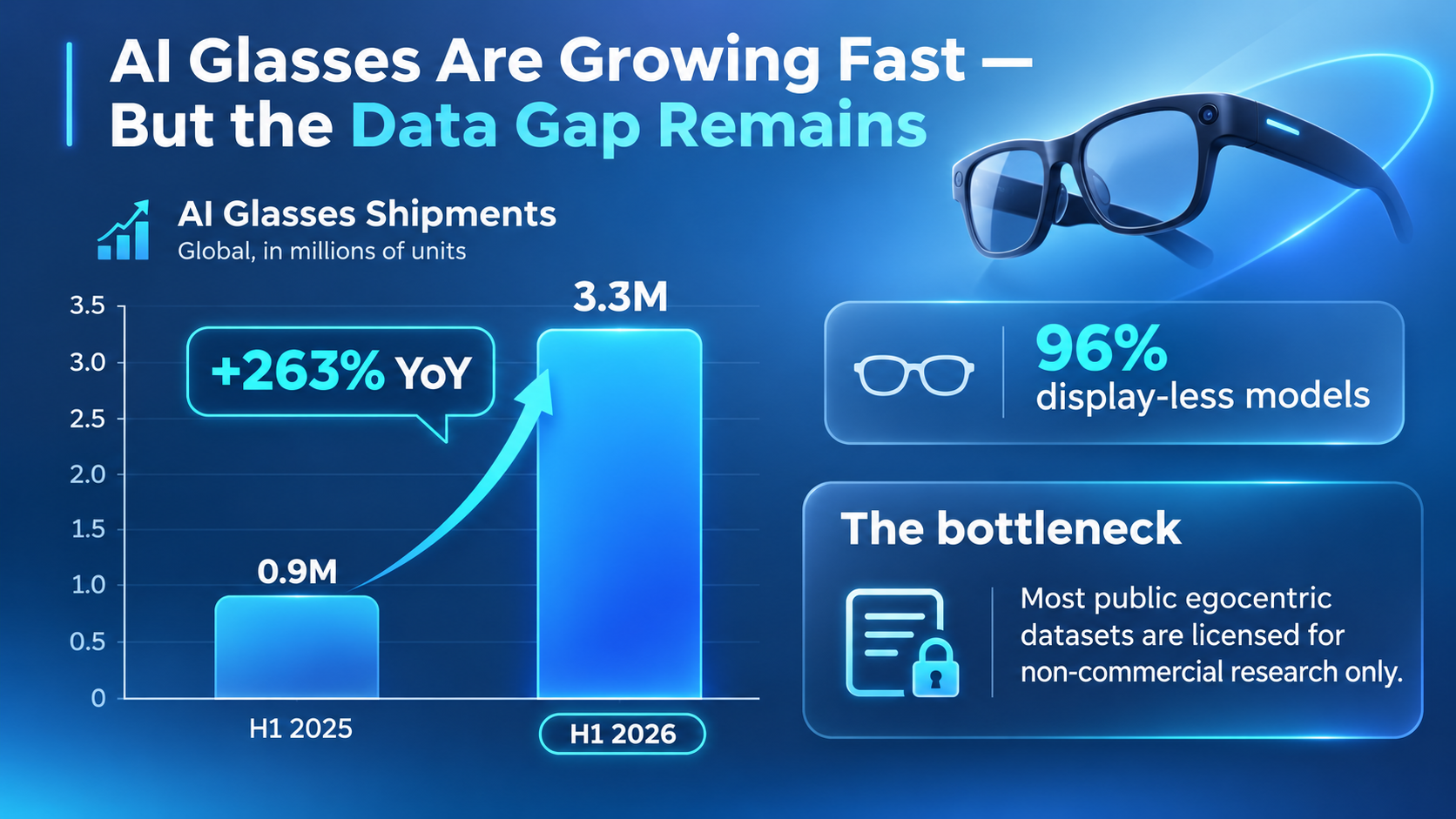
That gap is the whole problem with smart glasses training data. The research community solved the hard part years ago: there is a lot of high-quality egocentric video in the world, carefully annotated, captured with consent. What there is not much of is first-person data a company can put into a shipping product without breaching a license. This guide covers what wearable AI models need to learn, why the public sets will not get you there, and what commercially usable capture actually looks like.

What is egocentric data, and why do smart glasses need it?

Egocentric data is video and sensor data recorded from the point of view of the person doing the task, using a camera mounted on the head, chest or glasses. A smart glasses assistant sees exactly that view and nothing else, so a model trained on third-person footage is learning from a camera position its product will never occupy.

The difference is not cosmetic. From the wearer's viewpoint, hands enter the frame from the bottom, objects are held close and partially occluded, the camera moves whenever the head moves, and the most important thing in the scene is often what the wearer is looking at rather than what is centred. Those are the exact conditions an "what am I holding" or "what do I do next" feature has to handle. The same argument applies to multimodal models generally, which is why real-world video data matters more than more parameters.

Wearable camera video data also carries signals a fixed camera cannot produce:

  • Head motion: IMU traces that tell a model whether the wearer turned, bent down or walked, which disambiguates otherwise identical frames.
  • Gaze: eye-tracking that marks the object of attention. Meta's Aria Everyday Activities dataset ships a per-frame estimate of the wearer's eye gaze for this reason.
  • Spatial audio: multi-microphone capture that locates a speaker or a machine in the room, not just a mono track.
  • Scene geometry: SLAM trajectories and semi-dense point clouds that place the wearer inside a consistent 3D frame across a session.

Why can't you train a product on Ego4D or Project Aria data?

Because their licenses say you cannot. The best-known smart glasses datasets were built by and for research consortia, and their terms allow non-commercial research only — which is the whole reason this page exists.

The Aria Everyday Activities Dataset License Agreement is explicit about it:

  • Non-commercial only: use is limited to non-commercial research in a listed set of fields, defined as research not primarily directed toward "commercial advantage or private monetary compensation."
  • No product development: the agreement states you may not use the dataset to develop any product that is, or that you intend to make, available for commercial use.
  • No derivatives released: distributing the dataset, or materials and works derived from it, is prohibited without Meta's written permission — which is a problem if your model weights count as a derived work.
  • Employment doesn't change it: you may use it at a for-profit employer only if the use still fits the non-commercial clause, and your employer is bound by the same agreement.
  • Termination deletes your work: on termination you must delete the dataset and any works based on or created using it.

Ego4D sits in the same place. It is a 3,670-hour, 923-participant collection from 74 locations in 9 countries, released under a license agreement you must sign and have approved before you receive the data. We covered that agreement in detail in why most egocentric datasets aren't commercially licensed.

None of this makes the research sets bad. It makes them the wrong input for a commercial roadmap. A model fine-tuned on a research-only dataset carries a licensing question into every funding round, acquisition and enterprise security review it ever faces, and "we'll swap the data later" rarely survives contact with a retraining budget.

What does wearable AI actually have to learn?

It has to answer questions about the wearer's current situation, which is a harder target than labelling a clip. In practice that breaks into a handful of capabilities, each with its own data demands:
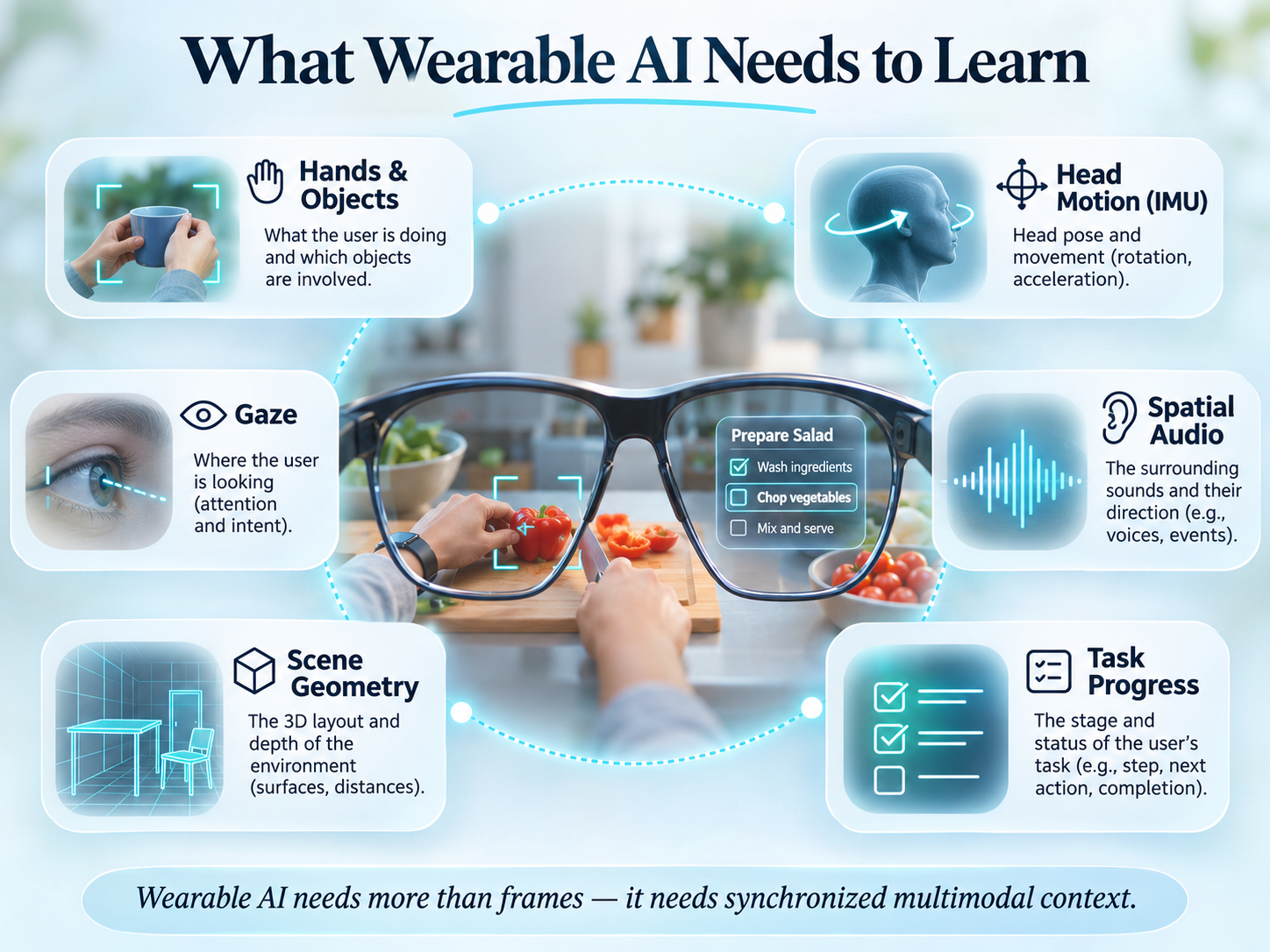
  • Recognising the active object: what is in the hands right now, through occlusion and motion blur, at arm's length rather than across a room.
  • Following a procedure: knowing which step of a task is underway and what comes next, which needs long untrimmed sessions, not three-second clips.
  • Grounding a question in the scene: "where did I put it" style recall, which depends on consistent spatial trajectories across a whole recording.
  • Knowing who is speaking and where: spatial audio plus the visual scene, time-aligned tightly enough to associate them.
  • Attention: separating what the wearer looked at from what merely passed through the frame.

There is a second, quieter problem: the device. Ego4D deliberately spread capture across seven different head-mounted cameras — GoPro, Vuzix Blade, Pupil Labs, ZShades, ORDRO EP6, iVue Rincon 1080 and Weeview — so that models would not overfit to one rig. That is good science, and it still means the footage does not look like what your glasses produce.

Research hardware has also moved. Meta's Aria Gen 2 glasses carry four SLAM cameras, one RGB camera and two eye-tracking cameras, plus PPG sensors and a contact microphone, with 6-8 hours of battery against the 1-2 hours of Gen 1. If your production device has one RGB camera and an IMU, a dataset recorded on a richer rig trains a model that expects inputs you will not have at inference time. Matching the capture rig to the shipping device matters as much as matching the viewpoint.

How do you source smart glasses training data you can ship?

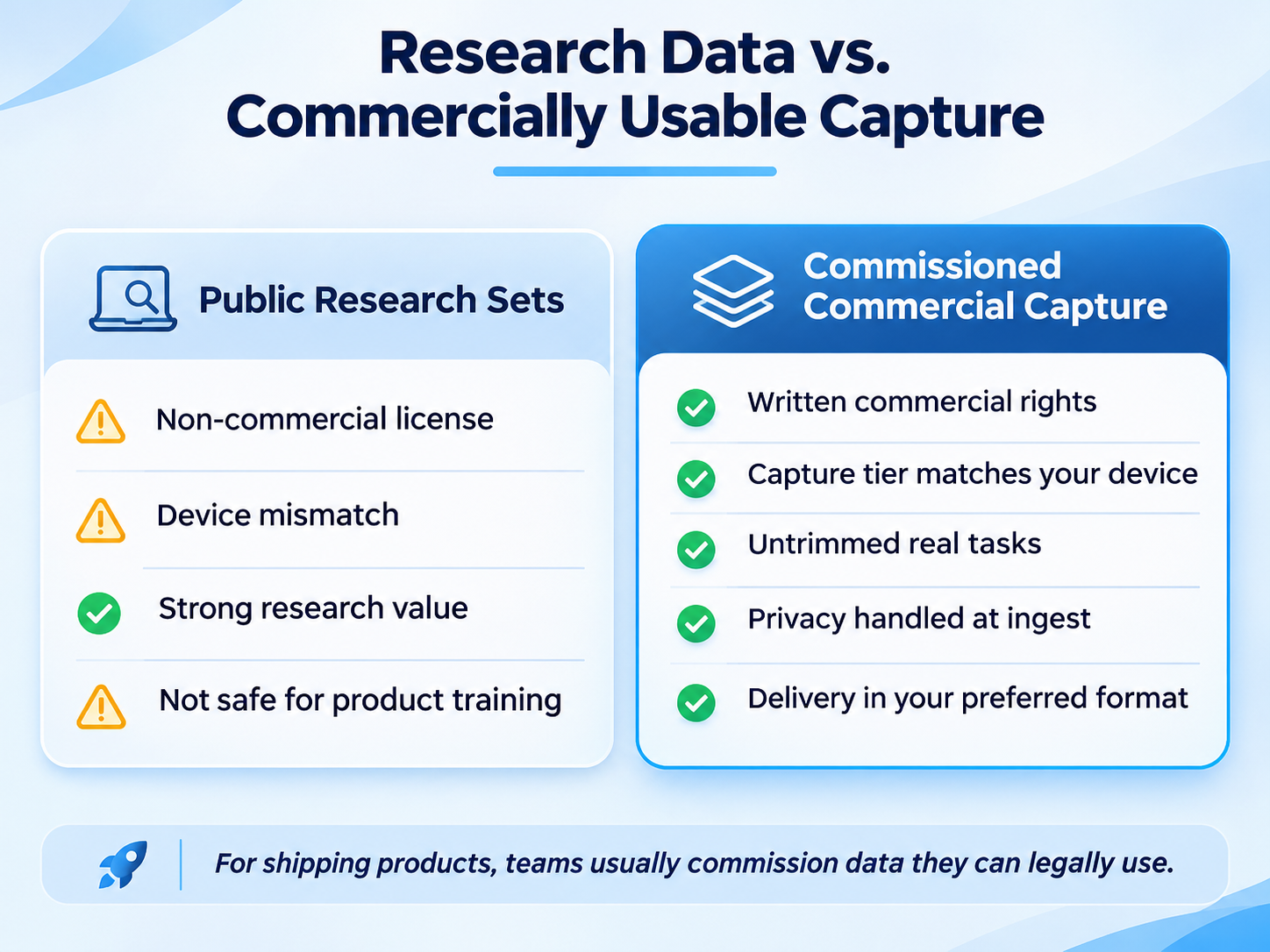
You commission it, with the rights written down before capture starts. A workable brief covers five things:
‍

  • Commercial rights in writing: contributor releases that permit commercial model training, held by the party selling you the data, not a research exemption you are hoping extends to you.
  • A capture tier that matches your device: a phone in a chest mount is enough for broad everyday coverage; a head rig matches the eye-line and adds IMU; a synchronized multi-camera rig is what manipulation work needs for 3D hand pose and contacts.
  • Real tasks, untrimmed: full sessions of the activity your product will sit inside, including the fumbles, rather than clean demonstrations.
  • Privacy handled at ingest: faces, plates and screens blurred before delivery, with a human reviewer confirming it.
  • Delivery in a format your stack reads: the sensor streams time-aligned on one clock, with the annotation layers you asked for.

That is the service Firsthand runs: paid contributors capturing first-person video to a written spec across phone, head-rig and multi-camera tiers, anonymized before anything ships, with the same QA bar at each tier.

What custom capture can't do for you

Being straight about the limits saves everyone a discovery call:

  • It is not instant. Commissioned capture is recorded after you brief it. Firsthand's stated median for a first batch is 48 hours, but a large, tightly specified collection runs on a schedule, not a download link.
  • It does not replicate Aria Gen 2. PPG sensors, contact microphones and research-grade eye tracking come from a device program, not a contributor's kit. If your research genuinely needs those streams, the Aria Research Kit is the honest answer — under its own terms.
  • It is not free. Contributors are paid hourly, which is the cost of owning the rights.
  • Published results elsewhere are not our benchmarks. The dataset scale, licensing and hardware figures in this article come from Meta, Counterpoint and the Ego4D consortium. None of those results were measured on Firsthand data, and we are not claiming otherwise.

The bottom line

The smart glasses market grew 263% year over year in H1 2026, and the data situation did not move with it. The public egocentric sets are excellent research assets and unusable product inputs: Aria's license confines use to non-commercial research and forbids redistributing derived works, and Ego4D's footage was captured on seven assorted head cameras rather than on anything you will ship. If you are building wearable AI for a product, the practical path is commissioned, consented, commercially licensed capture on hardware that resembles your own — briefed once, owned outright, and defensible in the diligence that follows.

🚀 Your All‑In‑One Virtual Experience Stack
🎬
PhotoAIVideo
Turn photos into scroll‑stopping AI videos.
Get Started →
🏡
Pictastic
Instantly stage listings with AI.
Try Staging →
🌀
CloudPano
Create stunning 360° tours in minutes.
Launch Tour →
💰
VirtualTourProfit
Build a profitable virtual tour business.
Learn More →
🤝
CloudPano Reseller
Resell AI visual software without building it.
Become a Reseller →
📹
iFirstHand
Custom first‑person video & sensor data for AI & robotics.
Get Data →
🏗️
AI Floor Plan Builder
Generate detailed floor plans with AI.
Build Now →
📐
3D Measure
Capture accurate floor plans & 3D measurements.
Measure Now →
🧠
AI Training Data
Custom AI training data services.
Learn More →

Frequently Asked Questions

What data do smart glasses collect?

It depends on the device, but research glasses collect far more than video. Meta's Aria Gen 2 carries four SLAM cameras, an RGB camera, two eye-tracking cameras, IMU, barometer, magnetometer, microphones, GNSS, PPG sensors and a contact microphone. Consumer AI glasses are usually narrower: one camera, microphones and motion sensors, with processing split between the glasses and a phone.

What is ego-centric data?

Egocentric data is video and sensor data recorded from the viewpoint of the person performing a task, using a head, chest or glasses-mounted camera. It captures hands, tools and objects as the wearer sees them, along with head motion and often gaze and audio. That viewpoint is what wearable assistants and embodied AI models have to operate from at inference time.

What is egocentric robot data?

It is first-person recordings used to teach robots manipulation and navigation, either from a human wearing a camera or from a camera on the robot itself. Human-worn capture is far cheaper to scale, since a person can record real tasks anywhere without a robot present, and the viewpoint transfers reasonably well to robots built around a head-mounted or chest-mounted camera.

Why are smart glasses not illegal?

Recording in public is broadly lawful in most jurisdictions, and glasses makers add capture indicators and privacy controls to stay within those rules. Dataset builders go further: Ego4D de-identified most footage before release, and Aria's public sets were captured with consented actors and had faces and license plates blurred by human annotation first.

Is egocentric video recording legit?

Paid first-person recording is a real and growing line of work, since commercial AI teams cannot use research-licensed datasets and must commission their own. A legitimate program says in writing what is recorded, how contributors are paid, how faces and screens are anonymized, and what rights the buyer receives. Programs that are vague about any of those are worth avoiding.

Sources

Share this post
Cloudpano

Choose The Right 360° Camera

Insta360 ONE RS 1-Inch 360 Edition

  • Compact, ready to go anywhere

  • Interchangeable lens that’s upgradeable

  • Dual 1-inch sensors for improved clarity and low light performance

  • Dynamic range and 6K 360° capture

  • 360° photo resolution at 21MP

Learn More

Insta360 X4

  • 8K 360° video recording for ultra-detailed visuals.

  • 4K single-lens mode for traditional wide-angle shots.

  • Invisible selfie stick effect for drone-like perspectives.

  • 2.5-inch touchscreen with Gorilla Glass protection.

  • Waterproof up to 33ft for underwater shooting.

Learn More

Ricoh Theta Z1

  • 360° photo resolution in 23MP

  • Slim design at 24 mm thick

  • Built-in image stabilization for smooth video capture.

  • Internal 19GB storage for photo and video storage.

  • Wireless connectivity for remote control and sharing.

Learn More

Ricoh Theta X

  • 60MP 360° still images for high-resolution photography.

  • 5.7K 360° video recording at 30fps.

  • 2.25-inch touchscreen for intuitive control.

  • USB Type-C port for fast charging and data transfer.

  • MicroSD card slot for expandable storage.

Learn More
Property Marketing
Allows potential buyers to explore properties in detail from anywhere, enhancing the real estate marketing process.
Automotive Spins
Create an interactive virtual showroom and engage affluent digital buyers with live 360º video calls, all through the CloudPano mobile app for a complete automotive sales solution.
Interactive Floor Plans
Create 2D and 3D floor plans with measurements in 4 minutes or less, all from your phone. Download the Floor Plan Scanner app and get your first scan free.

360 Virtual Tours With CloudPano.com. Get Started Today.

Try it free. No credit card required. Instant set-up.
Try it free
Latest posts

See our other posts

Interviews, tips, guides, industry best practices, and news.

Egocentric Data for Smart Glasses and Wearable AI

Smart glasses are shipping fast, but the egocentric datasets everyone cites are licensed for non-commercial research only. This guide explains what wearable AI needs, why the public sets block commercial training, and how to source data you can ship.
Read post

Why AI Agents Need Continuous Evaluation

Continuous evaluation is essential for maintaining reliable, accurate, and secure AI agents as models, tools, and user expectations evolve. This guide explores why ongoing testing matters, the key performance metrics to monitor, and how AI chatbot evaluation services help businesses detect hallucinations, improve task completion, and strengthen AI safety. Learn how automated testing, human review, and continuous monitoring work together to build trustworthy AI systems.
Read post

Data Annotation Pricing: A Pricing Breakdown

Understanding data annotation pricing is essential for businesses planning AI and machine learning projects. This guide breaks down annotation costs for images, videos, text, and audio while explaining the factors that influence pricing, including task complexity, dataset size, and quality requirements. Discover common pricing models, hidden expenses, and practical strategies to reduce annotation costs while maintaining high-quality training data.
Read post