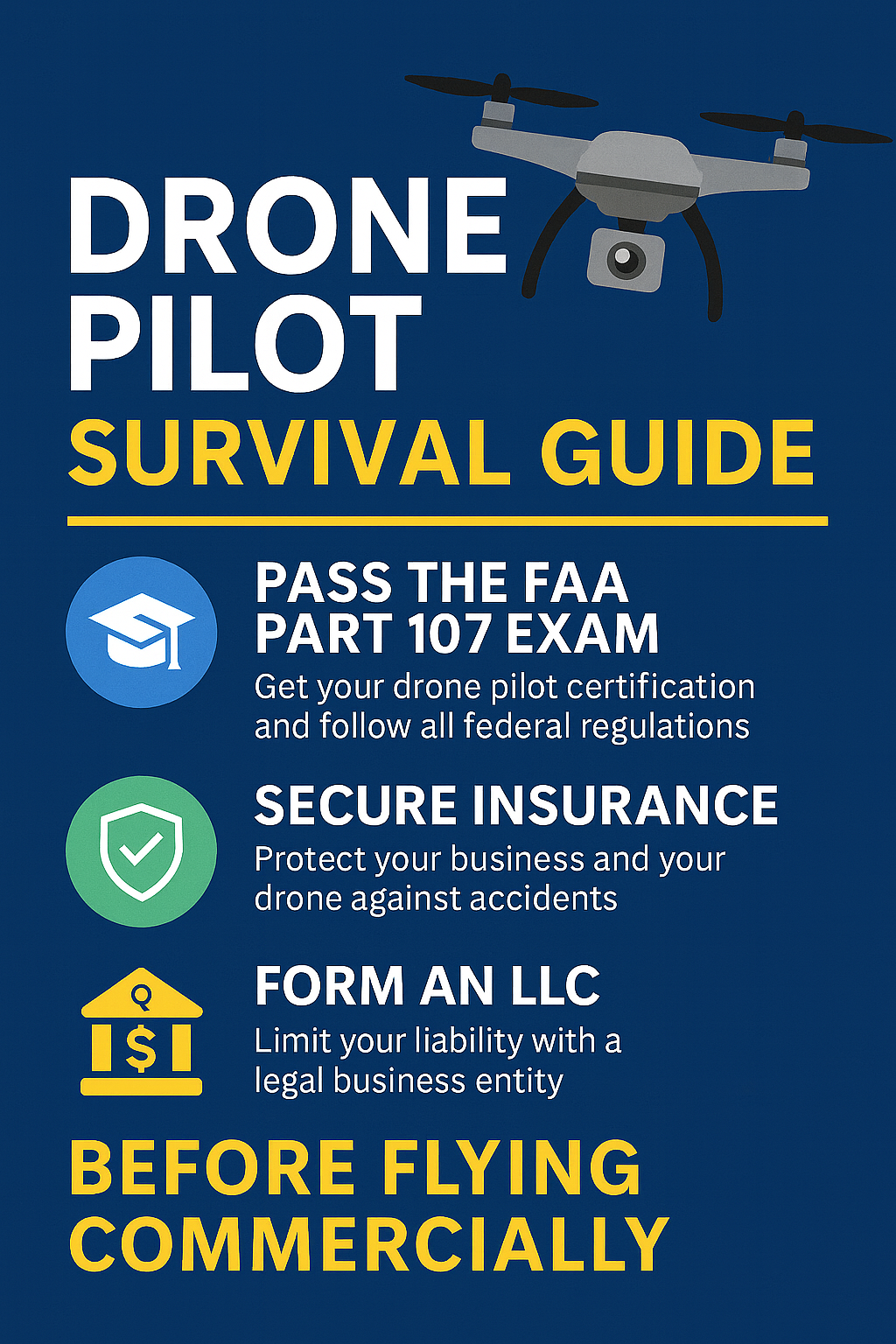
The Drone Pilot’s Survival Guide: FAA Part 107 Rules & Insurance Laws You Must Know Before Flying

Cloudpano
December 11, 2025
‱
5 min read
Share this post

The Drone Pilot’s Survival Guide: FAA Part 107 Rules & Insurance Laws You Must Know Before Flying đŸšâš–ïž

Starting a drone business? Whether you’re flying for real estate, construction, inspections, or creative media, one thing is clear: you need the right legal setup, insurance, and FAA approval before you take off. To get a clear breakdown of these requirements, check out this Drone Business Legal & Insurance Guide on YouTube

In this survival guide, we’ll break down the three critical steps every drone pilot must follow to stay compliant and profitable:

✅ Setting up an LLC for protection and professionalism
✅ Getting the right insurance coverage (liability + hull insurance)
✅ Passing the FAA Part 107 test so you can fly commercially

By the end, you’ll know exactly how to launch your drone business legally, safely, and profitably.

Why Legal Setup Matters for Drone Pilots📜

Flying drones commercially isn’t just about having cool footage—it’s about protecting yourself and your business. Imagine this:

You’re filming a wedding with your drone, and a sudden gust of wind causes it to crash into the venue’s cake table. Who’s responsible?

If you don’t have legal protection, you are—personally. That’s where setting up an LLC (Limited Liability Company) comes in.

Step 1: File an LLC 🏱

An LLC separates your personal assets from your business operations. This means if your drone causes damage or an accident happens, your business entity is responsible—not your personal bank account or home.

Benefits of an LLC for Drone Pilots:

  • ✅ Personal asset protection
  • ✅ Easier to open a business bank account
  • ✅ Ability to get an EIN (Employer Identification Number) for taxes
  • ✅ More professional when signing contracts with clients

💡 Pro Tip: You can file an LLC directly through your state’s Secretary of State website. In Texas, for example, you don’t need a third-party service. But if the process feels overwhelming, platforms like LegalZoom can simplify it for a small fee.

Once you have your LLC:

  • Open a business bank account
  • Apply for your EIN number (free via the IRS website)
  • Use it to issue W-9 forms when clients need tax documentation

👉 Having this setup makes it easy to work with enterprise clients and larger organizations that require professional compliance.

Step 2: Get Drone Insurance Coverage âœˆïžđŸ›Ąïž

Accidents happen. Even the best drone pilots crash sometimes. That’s why insurance is essential—not optional.

There are two main types of coverage every drone pilot should know:

1. General Liability Insurance 📑

This covers you if your drone damages property or injures someone. Many enterprise clients will ask for a Certificate of Insurance (COI) before they even consider hiring you.

2. Hull Insurance (a.k.a. Drone Equipment Insurance) đŸ“·

This covers your drone itself. If you crash or damage your drone, hull insurance ensures you can file a claim and replace it.

  • Example providers: SkyWatch, Global Aerospace
  • Essential for expensive drone setups like DJI Mavic 3, Inspire, or FPV rigs

💡 Pro Tip: Always carry your COI to show clients or authorities that you’re fully insured. It instantly increases your credibility.

Step 3: Pass the FAA Part 107 Exam 🎓

This is the big one. To legally fly a drone for commercial purposes in the U.S., you must pass the FAA Part 107 test.

What is Part 107?

The FAA Part 107 license proves you understand airspace regulations, weather, and safety protocols. Without it, you risk fines or even losing your drone if caught flying commercially without authorization.

Exam Details:

  • 📝 About 60 questions
  • 📊 Passing score: 70% or higher
  • đŸ’Č Cost: ~$175 per test attempt
  • ⏳ Must be renewed every 24 months

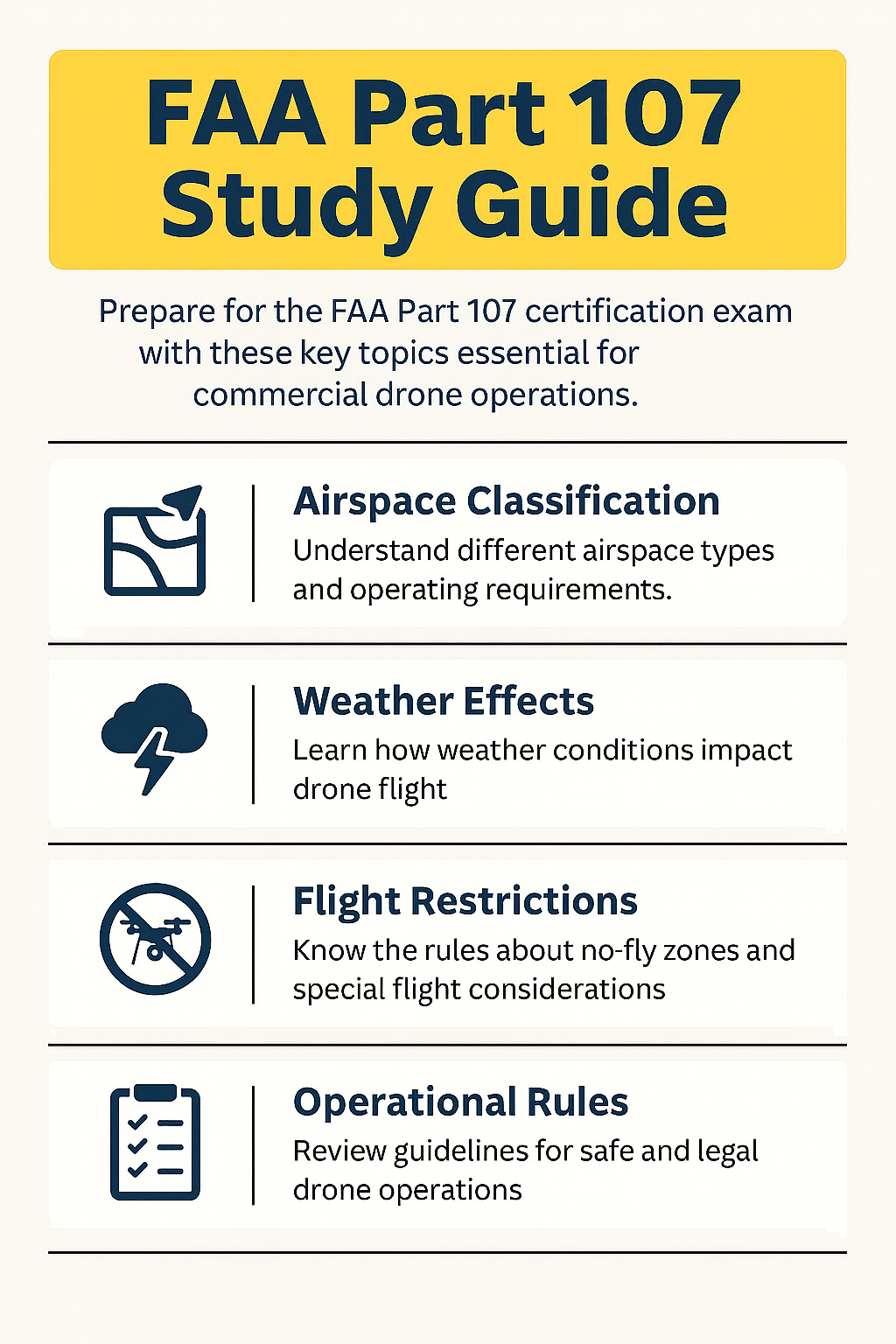
Topics Covered:

  • Airspace classifications
  • Weather conditions
  • Flight restrictions & safety guidelines
  • Drone operating rules (altitude, visibility, etc.)

👉 Once you pass, you’ll receive your Remote Pilot Certificate. Always carry this when flying commercially.

Field Tips for Staying Compliant 🚹

Here are a few real-world tips to keep yourself safe while operating:

  • ✅ Carry your Part 107 license with you during flights
  • ✅ Wear reflective gear or vests identifying yourself as a drone operator
  • ✅ Keep contracts or scope of work handy when flying for clients
  • ✅ Stay below 400 ft altitude unless authorized
  • ✅ Avoid flying over crowds or restricted areas without a waiver

These small steps help you look professional and avoid unnecessary confrontations with authorities.

What Happens If You Don’t Follow These Rules? ⚠

Skipping legal setup, insurance, or Part 107 compliance might save time in the short run—but it can cost you big.

  • No LLC → You risk losing your personal savings if sued.
  • No insurance → You cover all crash damage and equipment loss out of pocket.
  • No Part 107 → You face fines, legal trouble, and loss of credibility.

👉 Bottom line: Don’t cut corners. These three steps are non-negotiable if you’re serious about building a drone business.

Bonus: Get Clients First, Then Finalize Setup 💡

One of the best pieces of advice? Land a client first.

If someone is willing to pay for your services, that’s your green light to move quickly through your legal and insurance setup. You can even subcontract another licensed pilot at first while you’re completing your Part 107 certification.

This way, you’re earning revenue while working toward full compliance.

Anchor Resources for Drone Pilots 🔗

Here are some must-have tools and guides to help you succeed:
Final Thoughts: Your Survival Checklist 🚀

To sum it up, here’s your Drone Pilot Survival Guide Checklist:

✅ File your LLC → Protect your assets
✅ Get insurance coverage → Liability + hull insurance
✅ Pass FAA Part 107 exam → Stay compliant and professional
✅ Always carry documents → License, COI, contracts
✅ Start with clients → Subcontract if needed while you finalize setup

By following these steps, you’ll be ready to fly legally, scale your business, and land high-paying clients.

📱 Read More

✈ Ready to Take Off?

The drone industry is booming, and now is the perfect time to join. With the right legal foundation, insurance coverage, and FAA certification, you’ll not only avoid headaches—you’ll open the door to high-ticket projects in real estate, construction, inspections, and beyond.

🔔Get Started

👉 So what’s your next step? File your LLC, book your FAA exam, get insured, and start pitching clients. The sky isn’t the limit—it’s your new workplace. 🌍🚁

‍

Share this post
Cloudpano

Choose The Right 360° Camera

Insta360 ONE RS 1-Inch 360 Edition

  • Compact, ready to go anywhere

  • Interchangeable lens that’s upgradeable

  • Dual 1-inch sensors for improved clarity and low light performance

  • Dynamic range and 6K 360° capture

  • 360° photo resolution at 21MP

Learn More

Insta360 X4

  • 8K 360° video recording for ultra-detailed visuals.

  • 4K single-lens mode for traditional wide-angle shots.

  • Invisible selfie stick effect for drone-like perspectives.

  • 2.5-inch touchscreen with Gorilla Glass protection.

  • Waterproof up to 33ft for underwater shooting.

Learn More

Ricoh Theta Z1

  • 360° photo resolution in 23MP

  • Slim design at 24 mm thick

  • Built-in image stabilization for smooth video capture.

  • Internal 19GB storage for photo and video storage.

  • Wireless connectivity for remote control and sharing.

Learn More

Ricoh Theta X

  • 60MP 360° still images for high-resolution photography.

  • 5.7K 360° video recording at 30fps.

  • 2.25-inch touchscreen for intuitive control.

  • USB Type-C port for fast charging and data transfer.

  • MicroSD card slot for expandable storage.

Learn More
Property Marketing
Allows potential buyers to explore properties in detail from anywhere, enhancing the real estate marketing process.
Automotive Spins
Create an interactive virtual showroom and engage affluent digital buyers with live 360Âș video calls, all through the CloudPano mobile app for a complete automotive sales solution.
Interactive Floor Plans
Create 2D and 3D floor plans with measurements in 4 minutes or less, all from your phone. Download the Floor Plan Scanner app and get your first scan free.

360 Virtual Tours With CloudPano.com. Get Started Today.

Try it free. No credit card required. Instant set-up.
Try it free
Latest posts

See our other posts

Interviews, tips, guides, industry best practices, and news.

Property Manager Video Hub: Scaling Rental Visibility with AI Photo-to-Video Workflows

This article explains how property managers can use PhotoAIVideo to build a property manager video hub: a repeatable system for turning rental photos, amenity images, floor plans, exterior shots, and neighborhood visuals into reusable rental marketing videos. The main idea is that property managers do not just need more listing exposure. They need clearer visual answers that help renters decide whether to schedule a tour. PhotoAIVideo is positioned as a practical tool for creating: Unit availability videos Amenity highlight videos Neighborhood videos Tour reminder clips Leasing follow-up videos Owner marketing proof videos Social media rental teasers Application or availability reminder videos Key takeaways: Property managers already have the media they need; the challenge is organizing it and turning it into reusable video assets. A video hub helps teams create consistent videos across units, floor plans, amenities, communities, and owner updates. Rental videos can reduce friction by answering renter questions about layout, condition, amenities, parking, pet features, and community feel. One rental photo set can become multiple video outputs for listings, social media, email, text follow-up, tour reminders, and owner reporting. Photographers can sell AI rental video packages to property managers as an upsell. Brokerages with property management divisions can use the same workflow to standardize leasing content. The article ends with a step-by-step process, video hub framework, mistakes to avoid, visual recommendations, FAQs, and a CTA encouraging readers to use PhotoAIVideo to turn rental photos into a scalable video system for rental visibility.
Read post

YouTube Shorts Listing Teasers: The 3-Scene Structure for Higher Property Clicks

This article explains how real estate agents, photographers, brokerages, and property managers can use YouTube Shorts listing teasers to drive more property clicks and showing requests. The main idea is that a YouTube Short should not try to show the entire house. Instead, it should use a simple 3-scene structure: Scene 1: Hook — stop the scroll with the strongest property feature. Scene 2: Proof — show the visuals that support the hook. Scene 3: Click Path — tell the viewer what to do next. The article positions PhotoAIVideo as a practical tool for turning listing photos into short vertical videos for YouTube Shorts, Reels, open house promotion, and listing campaigns. Key takeaways: YouTube Shorts should create curiosity, not replace the full listing video. The strongest property feature should appear first, not necessarily the front exterior. Agents should build each Short around one click reason, such as backyard, kitchen, layout, neighborhood, open house, or price point. One listing can become multiple Shorts instead of one generic video. Photographers can offer YouTube Shorts teaser packs as a video upsell. Brokerages can standardize the 3-scene structure across agents. Property managers can use the same structure to promote rentals and tours. The article ends with practical scripts, visual recommendations, FAQs, a visual placement guide, and a CTA encouraging readers to use PhotoAIVideo to create YouTube Shorts listing teasers from property photos.
Read post

Video Retargeting for Listings: Turning Photo-Based AI Videos into Appointment Follow-Up

This article explains how Realtors, photographers, brokerages, and property managers can use photo-based AI videos as follow-up assets after someone shows interest in a listing. The main idea is that most real estate marketing focuses on getting the first click, but many buyers and sellers need multiple touchpoints before booking a showing or appointment. Video retargeting helps agents re-engage people who already clicked a listing, watched a Reel, opened an email, attended an open house, asked about a property, or went quiet after showing interest. PhotoAIVideo is positioned as a practical tool for turning listing photos into short follow-up videos, including: Feature reminder videos Layout explainer videos Neighborhood fit videos Open house recap videos Price update videos Seller proof videos Showing request videos Rental tour recovery videos Key takeaways: A first-touch listing video introduces the property, while a retargeting video answers the next likely question. Follow-up videos should be short, usually 10–30 seconds, and focused on one action. Agents should send different videos based on behavior, such as email clicks, open house attendance, listing views, or showing interest. A good video follow-up feels helpful, not pushy. Photographers can package retargeting video clips as an upsell. Brokerages can standardize video retargeting workflows across agents. Property managers can use the same strategy to recover rental leads and book tours. The article ends with a simple retargeting sequence, visual recommendations, FAQs, and a CTA encouraging readers to use PhotoAIVideo to turn listing photos into appointment-driving follow-up videos.
Read post