


.png)


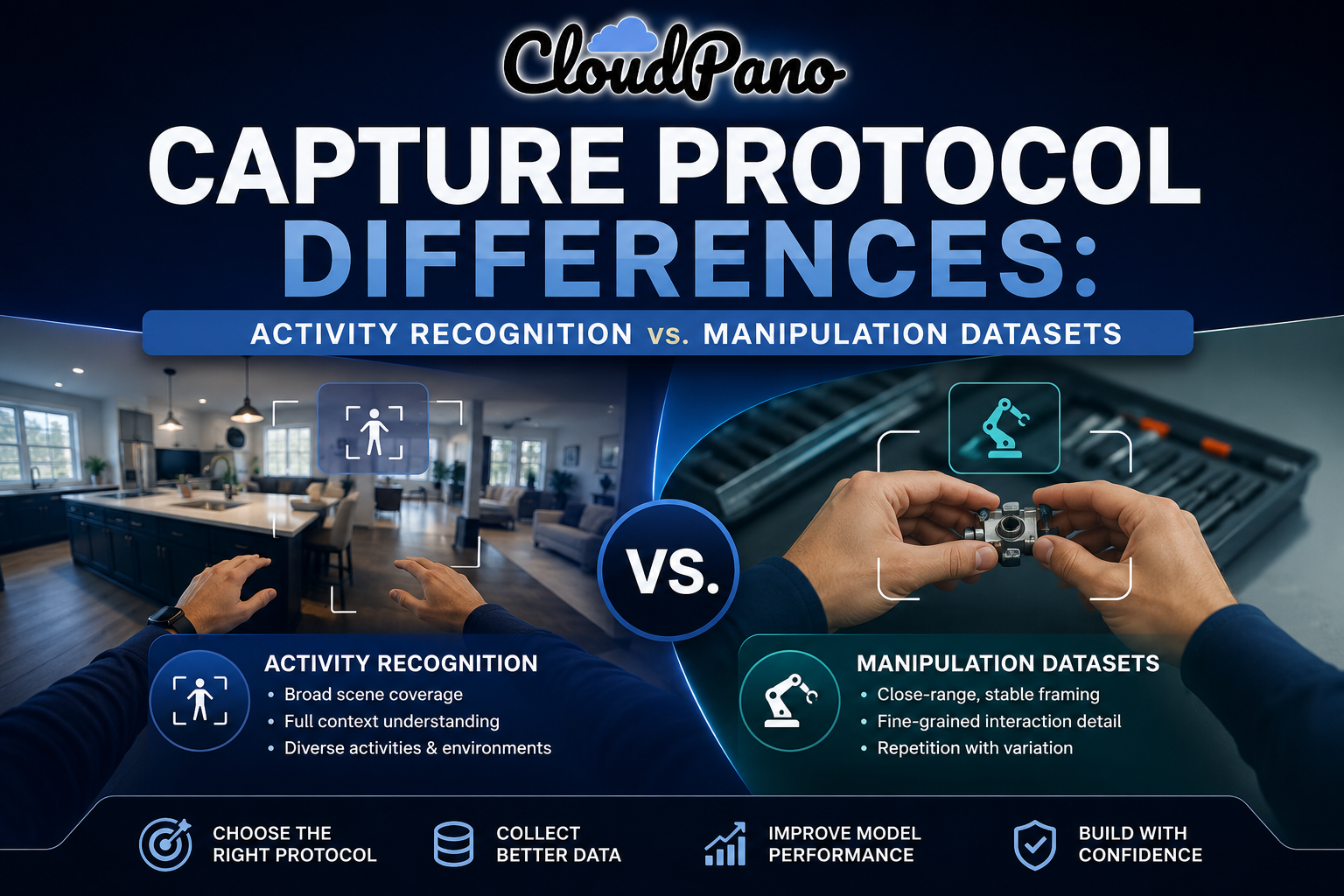
A protocol built to teach a model what kind of activity is happening in a scene and a protocol built to teach a robot exactly how to grasp an object are not the same protocol wearing different labels. Egocentric capture protocol design needs to diverge meaningfully depending on which of these use cases a project is actually targeting, since the specific detail each one needs from footage is genuinely different.
Activity Recognition Data Collection prioritizes breadth — enough activity types, scene variety, and situational diversity for a model to learn to distinguish between different kinds of behavior. Manipulation Dataset Capture prioritizes depth on a much narrower slice of activity — precise hand-object interaction detail that a broad activity-recognition protocol was never designed to capture.
Applying an activity-recognition protocol to a manipulation dataset effort, or vice versa, doesn't fail obviously during collection — it produces footage that looks reasonable but is missing exactly the detail the actual target use case needs, discovered only once annotation or training reveals the mismatch. Google Research's "Data Cascades" study documented how such gaps introduced early in a data pipeline compound into larger, harder-to-diagnose problems as a project progresses (Sambasivan et al., Google Research), and a protocol mismatched to its actual use case is exactly this kind of foundational error.
NIST's AI Risk Management Framework treats data fitness for the intended task as foundational to trustworthy AI, directly relevant to First-Person Capture Use Case Design needing to be built around the actual target application from the start, not adapted from a generic template (NIST AI RMF).
The stakes rise given how differently these two use cases have developed as distinct research and application areas. Stanford HAI's AI Index has tracked growing, increasingly specialized interest in both activity recognition and manipulation learning as separate strands of computer vision and robotics research (Stanford HAI, AI Index Report), and a protocol that doesn't reflect this specialization risks producing data that satisfies neither use case particularly well.
Egocentric capture protocol design diverges across a few specific dimensions depending on target use case.
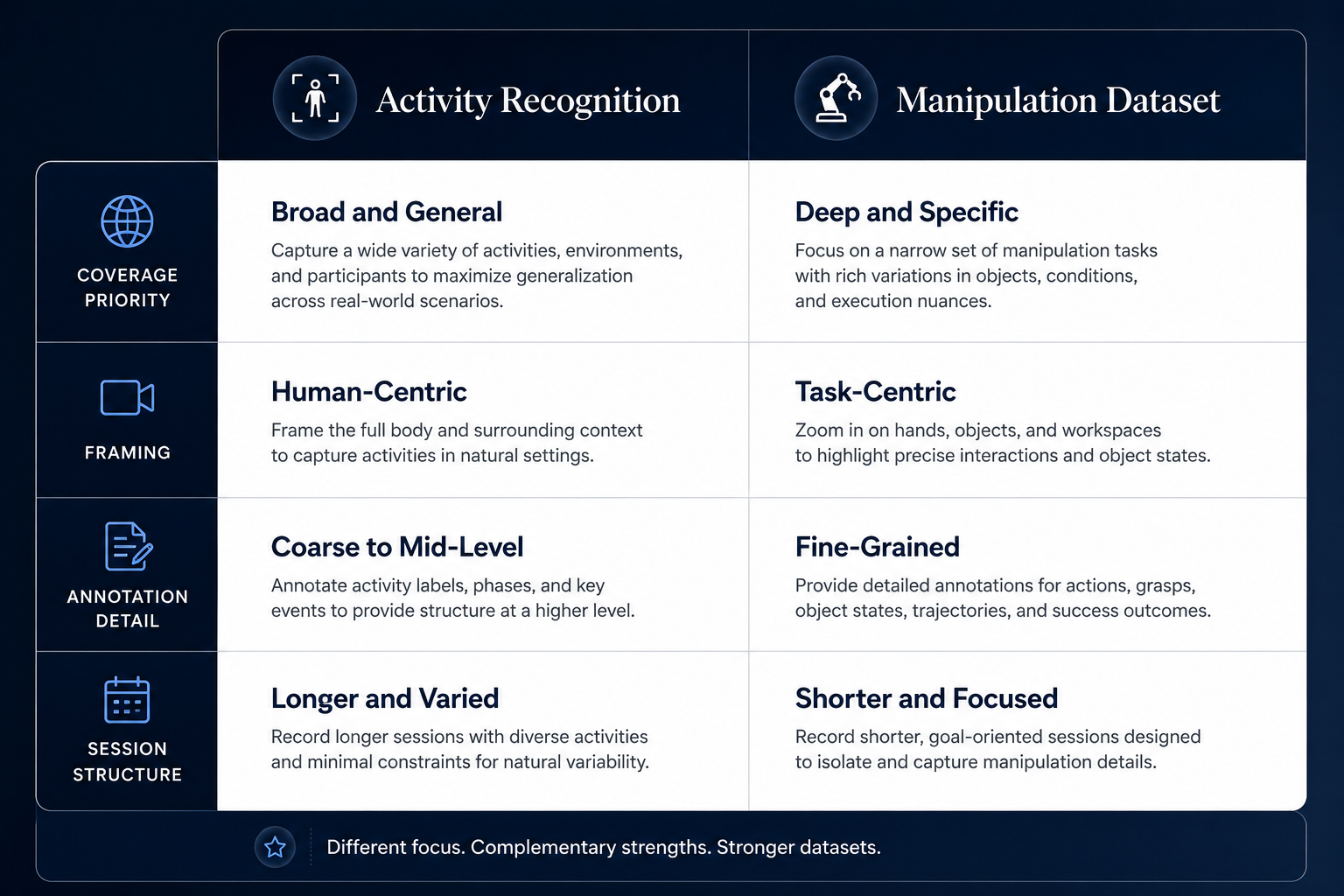
Activity and scene diversity versus interaction depth. Activity recognition protocols prioritize covering many different activity types and scenes; manipulation protocols prioritize deep, repeated coverage of a narrower set of specific object interactions.
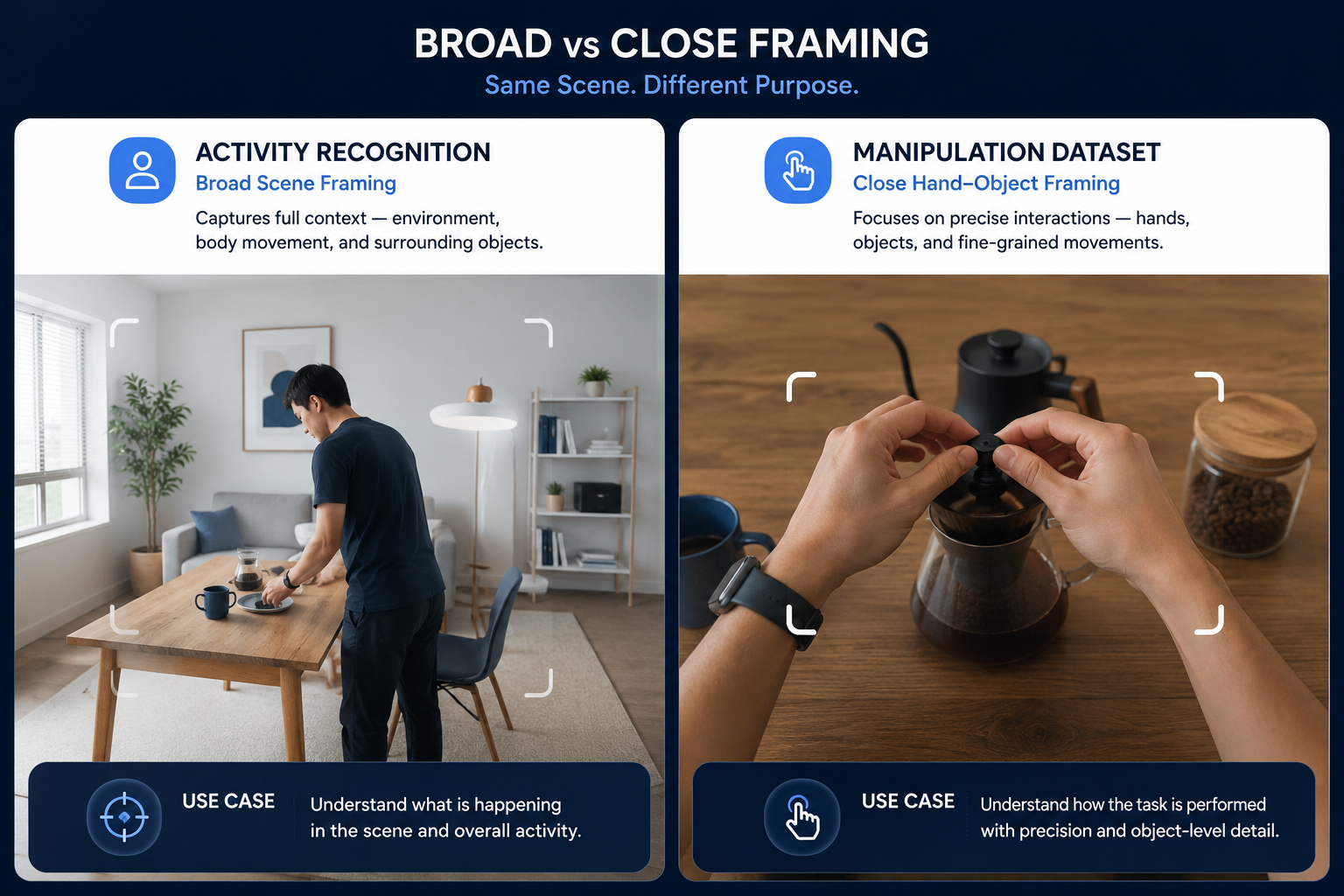
Framing priorities. Activity recognition benefits from framing that captures broader scene context to help distinguish activity type; manipulation datasets need close, stable framing on hands and objects, often at the expense of broader scene visibility.
Interaction annotation detail requirements. Manipulation datasets typically require far more granular interaction detail — grip type, contact point, object state — than activity recognition, which usually only needs activity-level labeling.
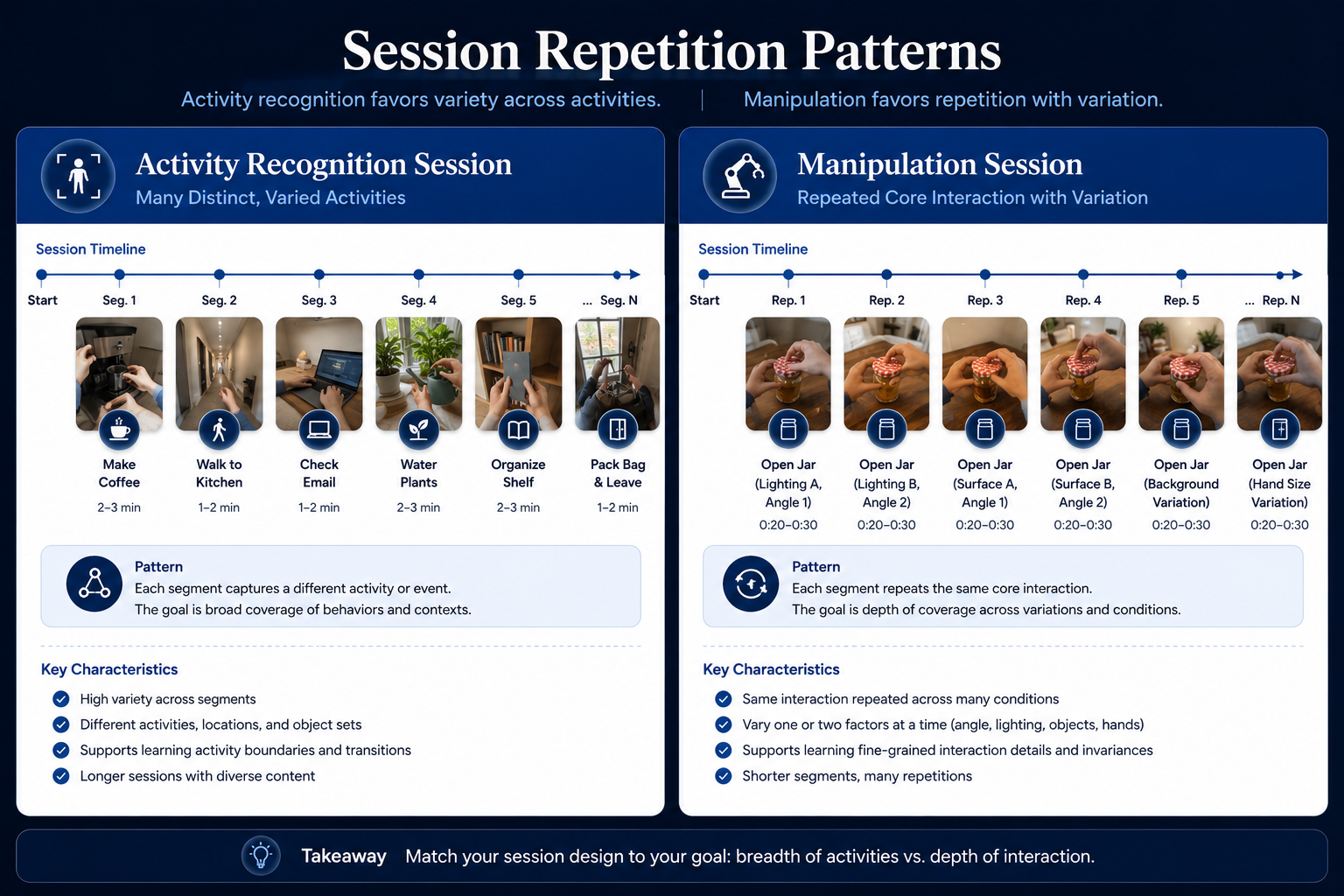
Session structure and repetition. Activity recognition protocols often favor varied, non-repeated activities across sessions; manipulation protocols frequently benefit from repeated variations of the same core interaction to build robust, generalizable grasp or manipulation data.
Understanding how these workflows operate as genuinely distinct protocol design problems — not a single generic egocentric capture template — is what determines whether a collection effort actually produces data matched to its specific target use case.

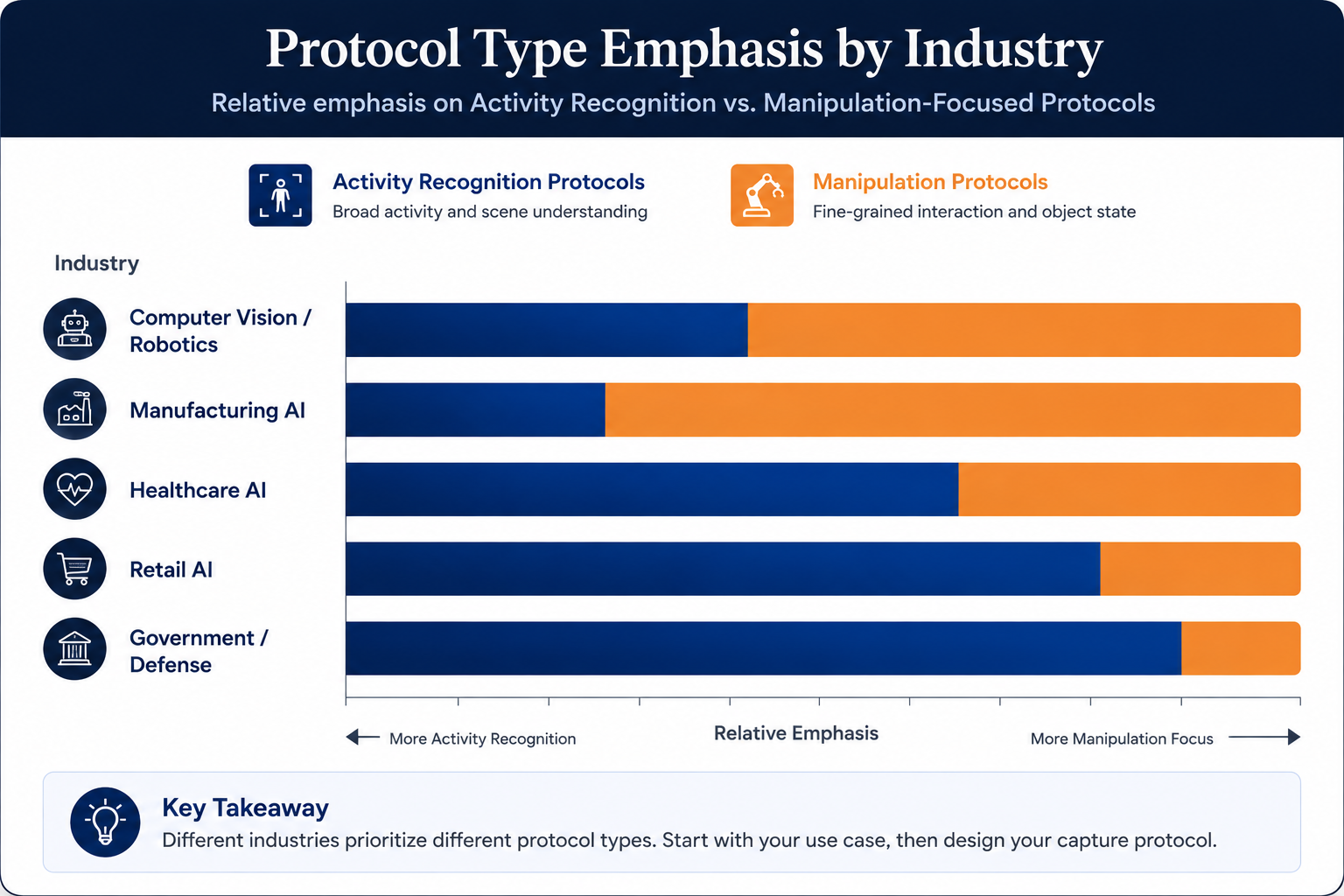
Activity recognition prioritizes broad activity and scene diversity with wider framing, while manipulation datasets prioritize close-range hand-object interaction detail with narrower, more stable framing and often more granular interaction annotation.
Coverage of many distinct activity types and environments, since the goal is helping a model distinguish between different kinds of behavior across varied situations.
Deep, repeated coverage of specific object interactions with precise hand positioning and contact detail, since the goal is teaching a model or robot exactly how to perform a physical interaction.
It's possible with deliberate design, but generally requires explicitly addressing both priorities rather than assuming a protocol optimized for one use case will naturally serve the other well.
Because activity recognition benefits from scene context that helps distinguish activity type, while manipulation datasets need close, stable framing on hands and objects, often at the expense of broader scene visibility.
Activity recognition protocols typically favor varied, non-repeated activities to build broad coverage, while manipulation protocols often benefit from repeated variations of the same core interaction to build robust, generalizable data.
Yes. Piloting the protocol and confirming it produces the specific detail and coverage the actual target task requires helps avoid discovering a mismatch only after a full-scale collection effort has concluded.
Egocentric capture protocol design genuinely needs to differ between activity recognition and manipulation dataset use cases, since these two targets prioritize fundamentally different things — breadth of activity and scene coverage versus depth of close-range interaction detail. Treating one generic protocol as suitable for both is a common way collection efforts end up with data that looks reasonable but doesn't actually serve the specific model task it was meant to support.
Activity Recognition Data Collection


Compact, ready to go anywhere
Interchangeable lens that’s upgradeable
Dual 1-inch sensors for improved clarity and low light performance
Dynamic range and 6K 360° capture
360° photo resolution at 21MP

8K 360° video recording for ultra-detailed visuals.
4K single-lens mode for traditional wide-angle shots.
Invisible selfie stick effect for drone-like perspectives.
2.5-inch touchscreen with Gorilla Glass protection.
Waterproof up to 33ft for underwater shooting.

360° photo resolution in 23MP
Slim design at 24 mm thick
Built-in image stabilization for smooth video capture.
Internal 19GB storage for photo and video storage.
Wireless connectivity for remote control and sharing.

60MP 360° still images for high-resolution photography.
5.7K 360° video recording at 30fps.
2.25-inch touchscreen for intuitive control.
USB Type-C port for fast charging and data transfer.
MicroSD card slot for expandable storage.
.png)

.png)

Try it free. No credit card required. Instant set-up.






.svg)


.svg)