


.png)


Deciding you need first-person video data is the easy part. Egocentric video capture that actually produces usable training data requires specific decisions most teams don't face with conventional fixed-camera collection — which hardware to use, how to structure a recording protocol, and how to handle the environmental and consent challenges that come with recording from a person's own viewpoint.
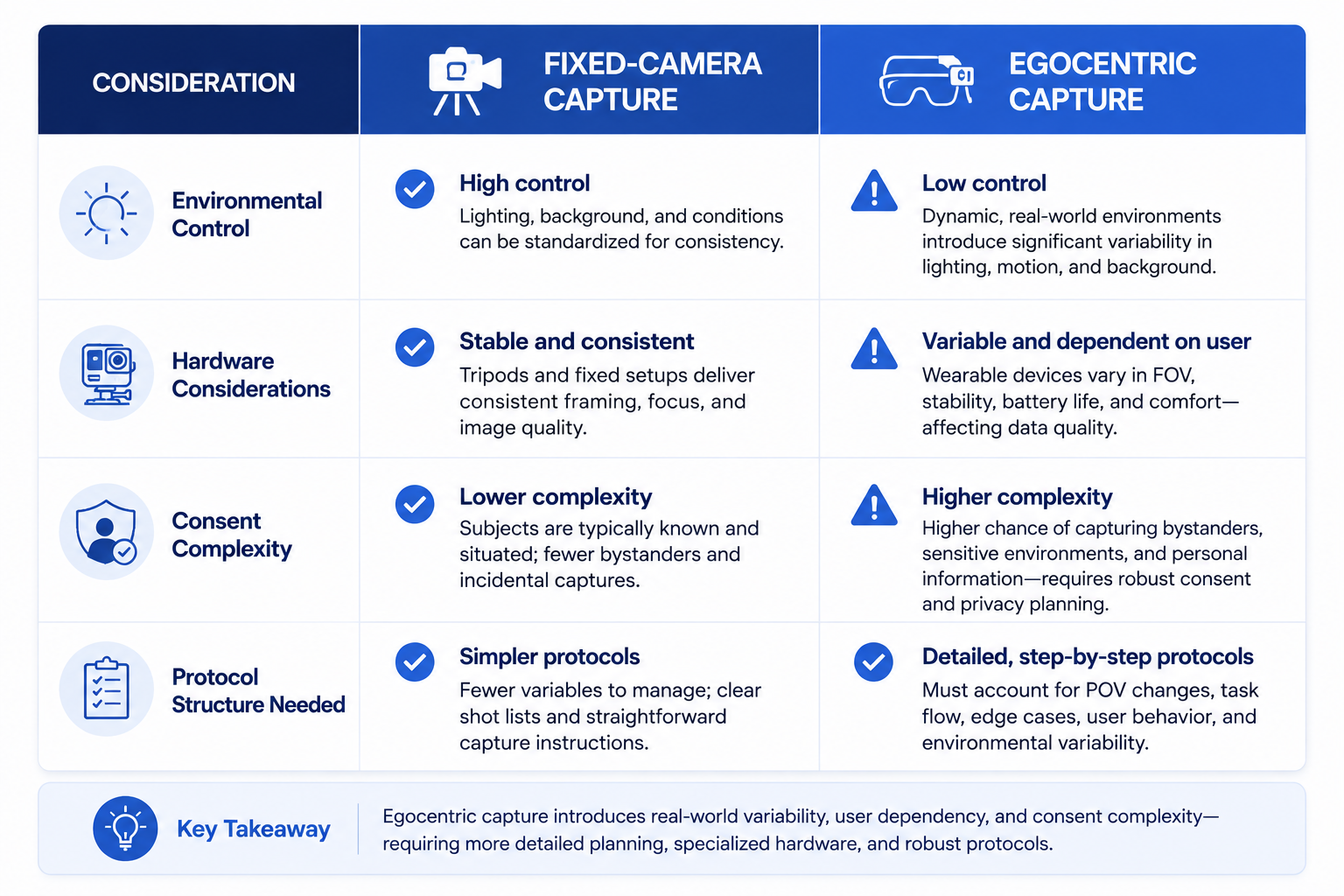
First-Person Video Recording at any meaningful scale is a genuinely different collection exercise than setting up a stationary camera and letting it run. The camera moves with the wearer, conditions shift constantly, and the people being recorded — including the wearer themselves — need to be accounted for differently than a fixed installation ever requires.
Capture decisions made poorly don't just produce lower-quality footage — they can make the resulting data unusable or unnecessarily expensive to annotate downstream, since problems introduced at capture propagate into every later stage of the pipeline. Google Research's "Data Cascades" study documented how issues that seem minor early in a data pipeline compound into much larger, harder-to-diagnose problems later (Sambasivan et al., Google Research), and capture-stage decisions are about as early as a data pipeline gets.
NIST's AI Risk Management Framework treats data fitness for the intended task as foundational to trustworthy AI, directly relevant to Wearable Camera Video capture, since hardware and protocol choices determine whether the resulting footage genuinely supports the model task it's meant to train (NIST AI RMF).
The stakes rise as interest in egocentric vision grows across research and industry. Stanford HAI's AI Index has tracked increasing attention to human activity recognition and wearable sensing applications (Stanford HAI, AI Index Report), and capture-stage mistakes at that scale are considerably more expensive to correct than issues caught before large-scale collection begins.
Egocentric Vision Datasets depend on decisions made across a few specific capture dimensions.
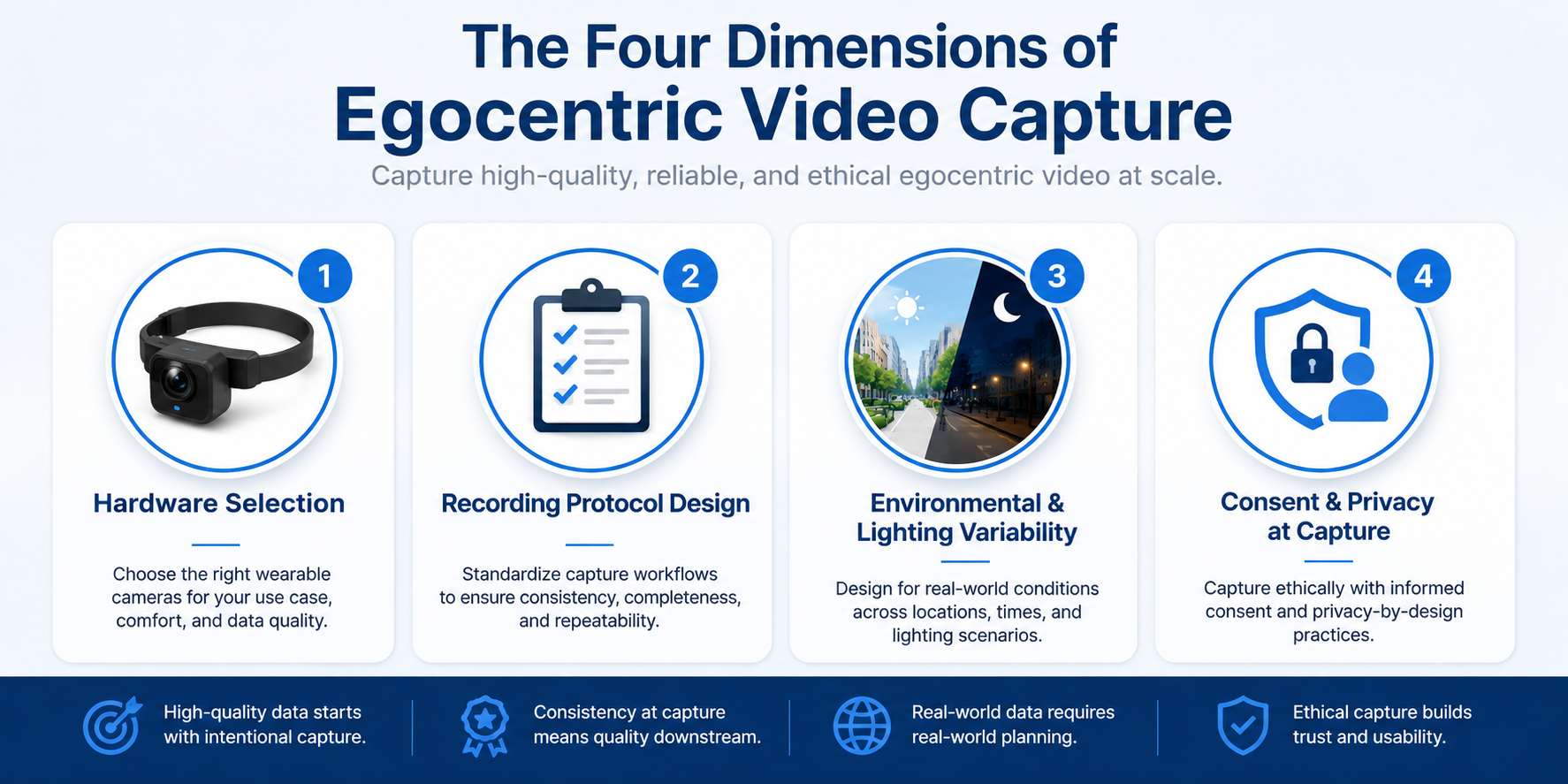
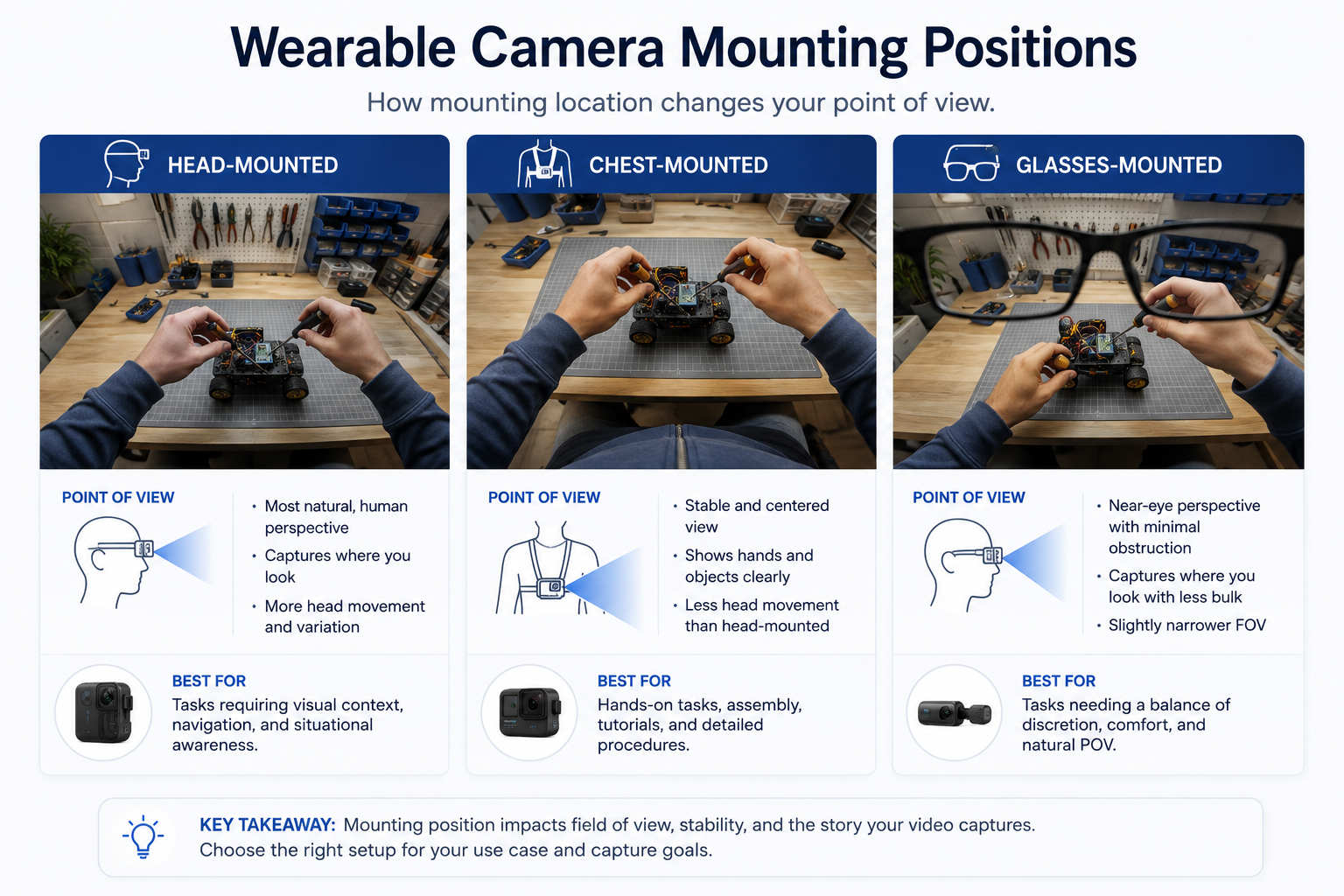
Hardware selection. Camera field of view, mounting position (head, chest, glasses-mounted), resolution, and battery life all affect what the resulting footage actually captures and for how long, and the right choice depends on the specific task the data needs to support.
Recording protocol design. A structured plan for what activities to capture, in what conditions, and for how long, rather than open-ended recording that produces footage without the specific coverage a training task requires.
Environmental and lighting variability. Egocentric capture happens wherever the wearer goes, meaning lighting, background, and motion conditions vary far more than a controlled, fixed-camera setup, requiring a protocol that accounts for this variability deliberately.
Consent and privacy at the point of capture. Both the wearer's own participation and any bystanders who may appear in footage need to be addressed as part of the capture process itself, not as an afterthought.
Understanding how these workflows operate as a deliberate collection design problem — not just "put a camera on someone and record" — is what actually determines whether the resulting footage supports the model task it's meant for.
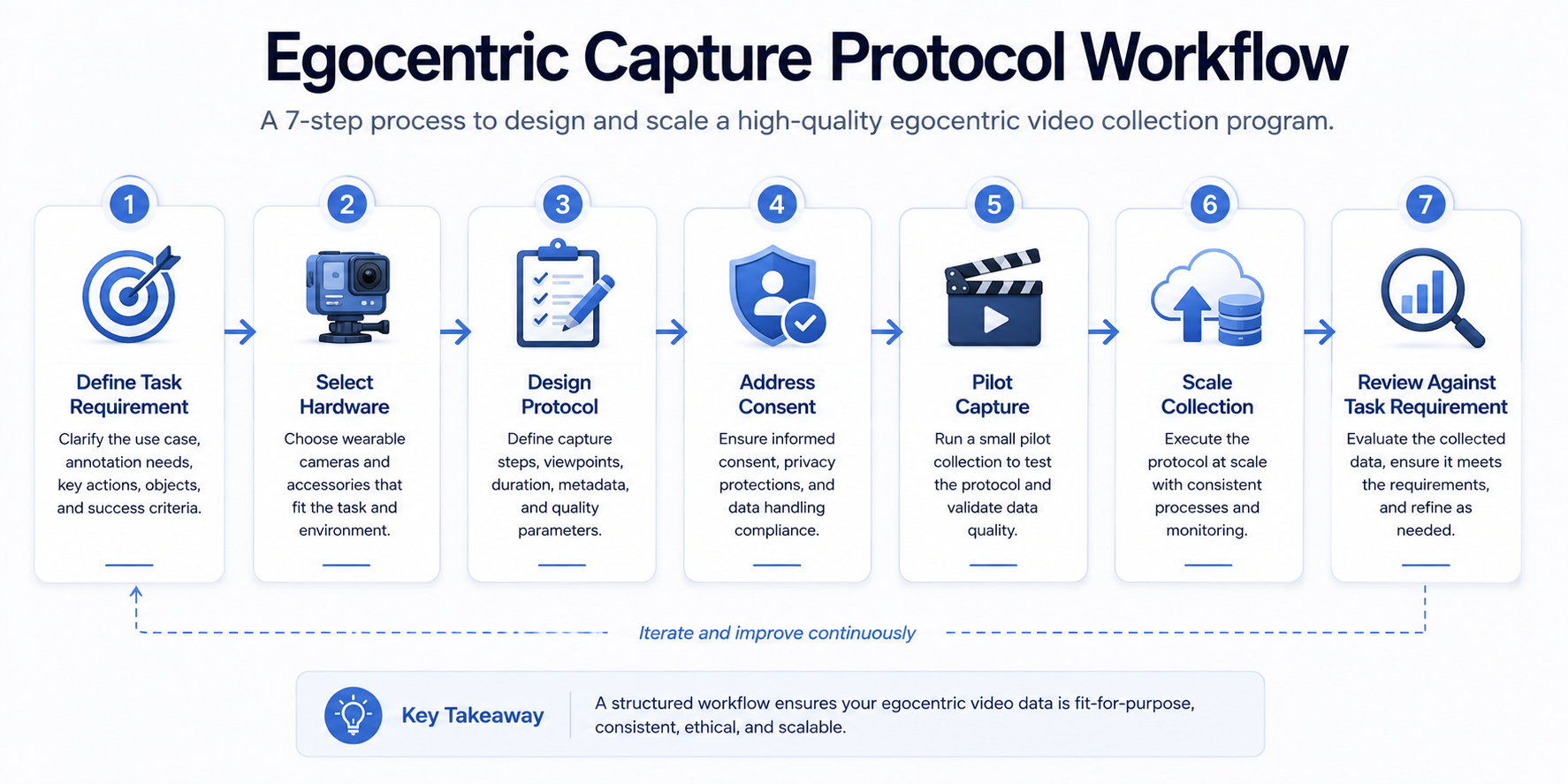

Deliberate hardware selection matched to the specific task, a structured recording protocol covering the right activities and conditions, and consent handling for both wearers and bystanders built into the capture plan.
The camera moves with the wearer, environmental conditions vary far more than a controlled setup, and consent considerations apply differently since the wearer and any bystanders are both part of the capture context.
Field of view, mounting position (head, chest, or glasses-mounted), resolution, and battery life, each of which should be matched to the specific activity or interaction the footage needs to capture.
Because open-ended recording often fails to capture the specific activity types, conditions, and duration a downstream training task actually requires, producing footage that doesn't transfer well to the intended model.
By addressing both wearer participation and potential bystander presence as part of the capture plan itself, rather than treating consent as something to resolve after footage already exists.
Yes. A small-scale pilot confirms that hardware, protocol, and consent handling genuinely work in practice before committing to the cost and effort of full-scale collection.
Well-captured footage with consistent coverage and quality is typically faster and cheaper to annotate than inconsistent recordings, since annotators spend less time working around gaps or unusable segments.
Egocentric video capture that actually produces usable training data requires treating collection as a deliberate design problem — matching hardware to the specific task, structuring a recording protocol around real coverage needs, and addressing consent from the start rather than after the fact. Getting capture right is what determines whether the resulting footage genuinely supports the model it's meant to train, and whether downstream annotation is efficient or unnecessarily costly.


Compact, ready to go anywhere
Interchangeable lens that’s upgradeable
Dual 1-inch sensors for improved clarity and low light performance
Dynamic range and 6K 360° capture
360° photo resolution at 21MP

8K 360° video recording for ultra-detailed visuals.
4K single-lens mode for traditional wide-angle shots.
Invisible selfie stick effect for drone-like perspectives.
2.5-inch touchscreen with Gorilla Glass protection.
Waterproof up to 33ft for underwater shooting.

360° photo resolution in 23MP
Slim design at 24 mm thick
Built-in image stabilization for smooth video capture.
Internal 19GB storage for photo and video storage.
Wireless connectivity for remote control and sharing.

60MP 360° still images for high-resolution photography.
5.7K 360° video recording at 30fps.
2.25-inch touchscreen for intuitive control.
USB Type-C port for fast charging and data transfer.
MicroSD card slot for expandable storage.
.png)

.png)

Try it free. No credit card required. Instant set-up.






.svg)


.svg)