Lighting and Environmental Conditions in Egocentric Video Collection

Cloudpano
August 2, 2026
5 min read
Share this post

Lighting and Environmental Conditions in Egocentric Video Collection

Planning for environmental variety in a capture protocol is one thing. Actually managing lighting and exposure quality as a wearer moves between conditions in real time is a different, more hands-on challenge. Egocentric capture environmental conditions shift constantly as a wearer moves — indoors to outdoors, bright to dim, static to fast-moving — in ways a fixed camera setup never has to contend with.

Wearable Camera Lighting Challenges compound specifically because the camera itself is moving through these transitions along with the wearer, rather than staying fixed in one lighting condition, which means exposure and quality issues that a stationary camera could be configured around become a continuously shifting problem in egocentric collection.

Why It Matters

Footage degraded by poor lighting management doesn't just look worse — it can become unusable for the specific visual detail a downstream training task actually needs, discovered only once annotation or model training reveals the gap. Google Research's "Data Cascades" study documented how such quality issues introduced early in a pipeline compound into larger, harder-to-diagnose problems later (Sambasivan et al., Google Research), and lighting-degraded footage discovered after collection is often far more costly to address than a real-time quality issue caught during capture.

NIST's AI Risk Management Framework treats data fitness for the intended task as foundational to trustworthy AI, directly relevant to First-Person Video Quality Control needing active monitoring during collection, not just planning for environmental diversity in advance (NIST AI RMF).

The stakes rise given how much egocentric collection increasingly occurs in genuinely variable, real-world environments rather than controlled settings. Stanford HAI's AI Index has tracked growing interest in activity recognition research conducted in naturalistic, real-world conditions (Stanford HAI, AI Index Report), and lighting quality issues at that scale can quietly degrade a large portion of a collection effort if not actively managed.

How It Works

POV Capture in Variable Conditions generally requires addressing a few specific quality challenges.
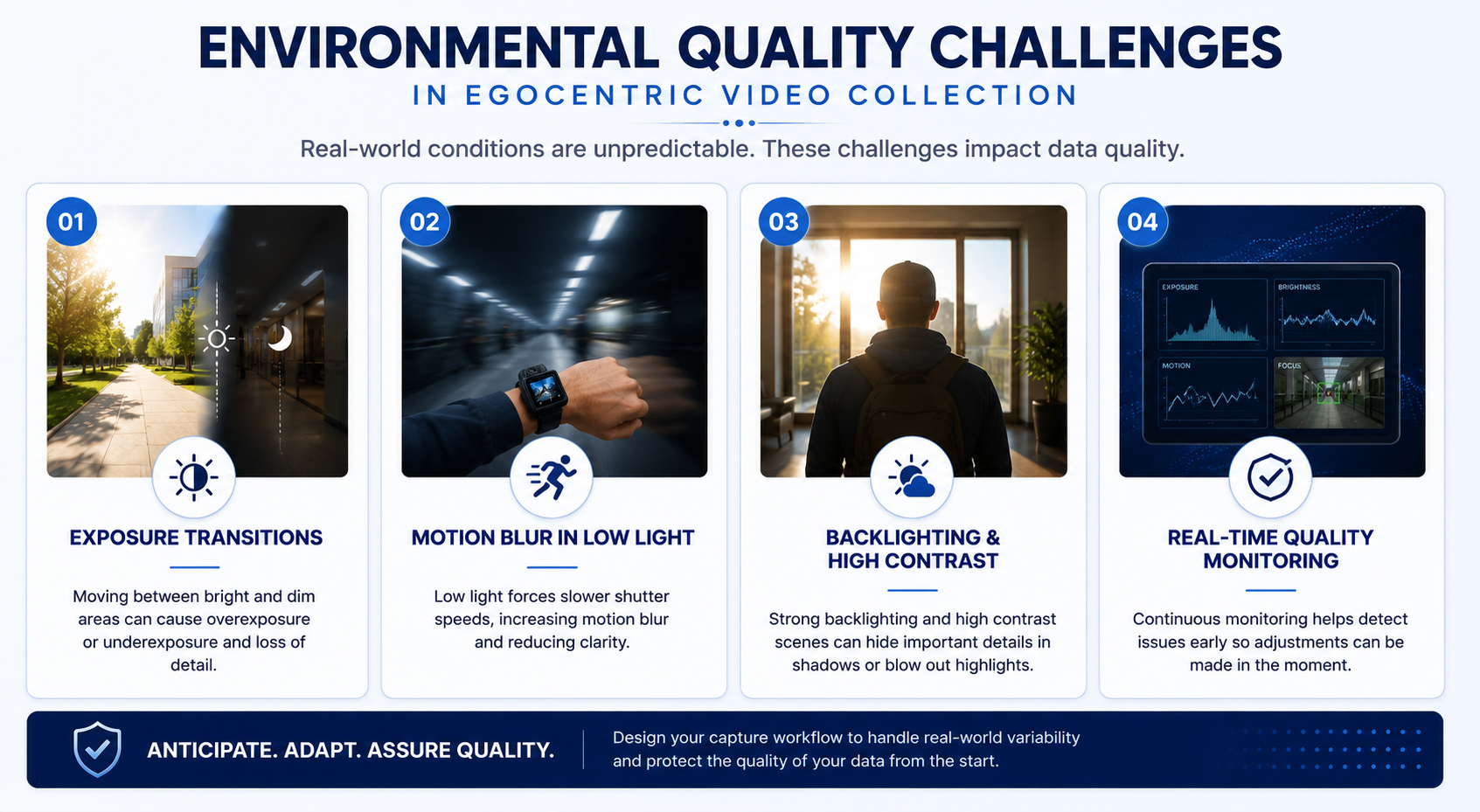
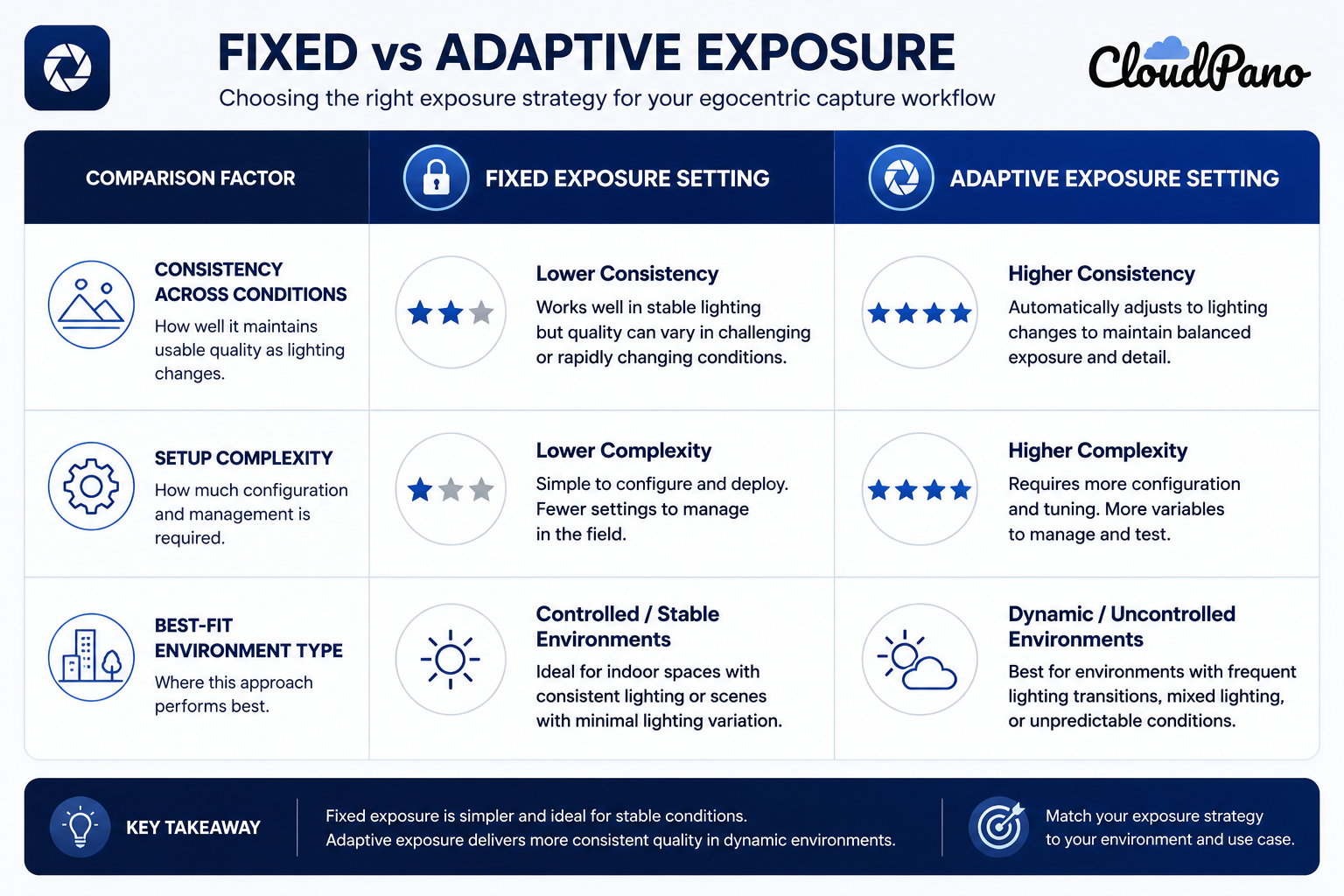
Exposure transitions between lighting conditions. Moving between bright outdoor light and dim indoor spaces creates exposure mismatches that a fixed camera setting can't handle well across both extremes, requiring either adaptive exposure settings or deliberate protocol accommodation.

Motion blur in low-light conditions. Lower light typically requires longer exposure times, which increases motion blur risk during egocentric capture's inherently more dynamic movement compared to a stationary camera.

Backlighting and high-contrast scenes. Scenes with strong backlighting or extreme contrast between bright and dark areas can obscure exactly the detail — hand-object interaction, facial expression, fine detail — that a training task often needs most.

Real-time quality monitoring during capture. Actively checking footage quality during a collection session, rather than discovering lighting or exposure problems only after the fact when data has already been captured.

Understanding how these workflows operate as an active, ongoing quality management challenge — not something fully solved by protocol planning alone — is what actually keeps egocentric footage usable across the real-world conditions collection inevitably encounters.

Step-by-Step Workflow

  • Identify the specific lighting transitions your collection environment will involve. Understand where and how often wearers will move between meaningfully different lighting conditions.
  • Configure camera exposure settings appropriate to the expected range of conditions. Select adaptive or condition-specific settings rather than a single fixed configuration unlikely to handle the full range well.
Comparison table of fixed vs adaptive exposure approaches for egocentric capture
  • Train wearers on basic awareness of lighting-sensitive moments. Provide simple guidance on activities or transitions where lighting quality is likely to be a particular concern.
  • Establish real-time quality monitoring during capture sessions where feasible. Build in a way to check footage quality during collection, not solely after the session has concluded.
  • Define quality thresholds for usable footage. Establish clear criteria for what level of exposure, blur, or contrast issue actually renders footage unusable for the intended task.
  • Review footage against those thresholds promptly after each session. Catch quality issues early enough to potentially recollect problematic segments rather than discovering them much later.
  • Adjust capture technique or equipment settings based on recurring quality issues. Treat persistent lighting problems as a signal to revise approach, not an unavoidable cost of collection.

Industry Use Cases

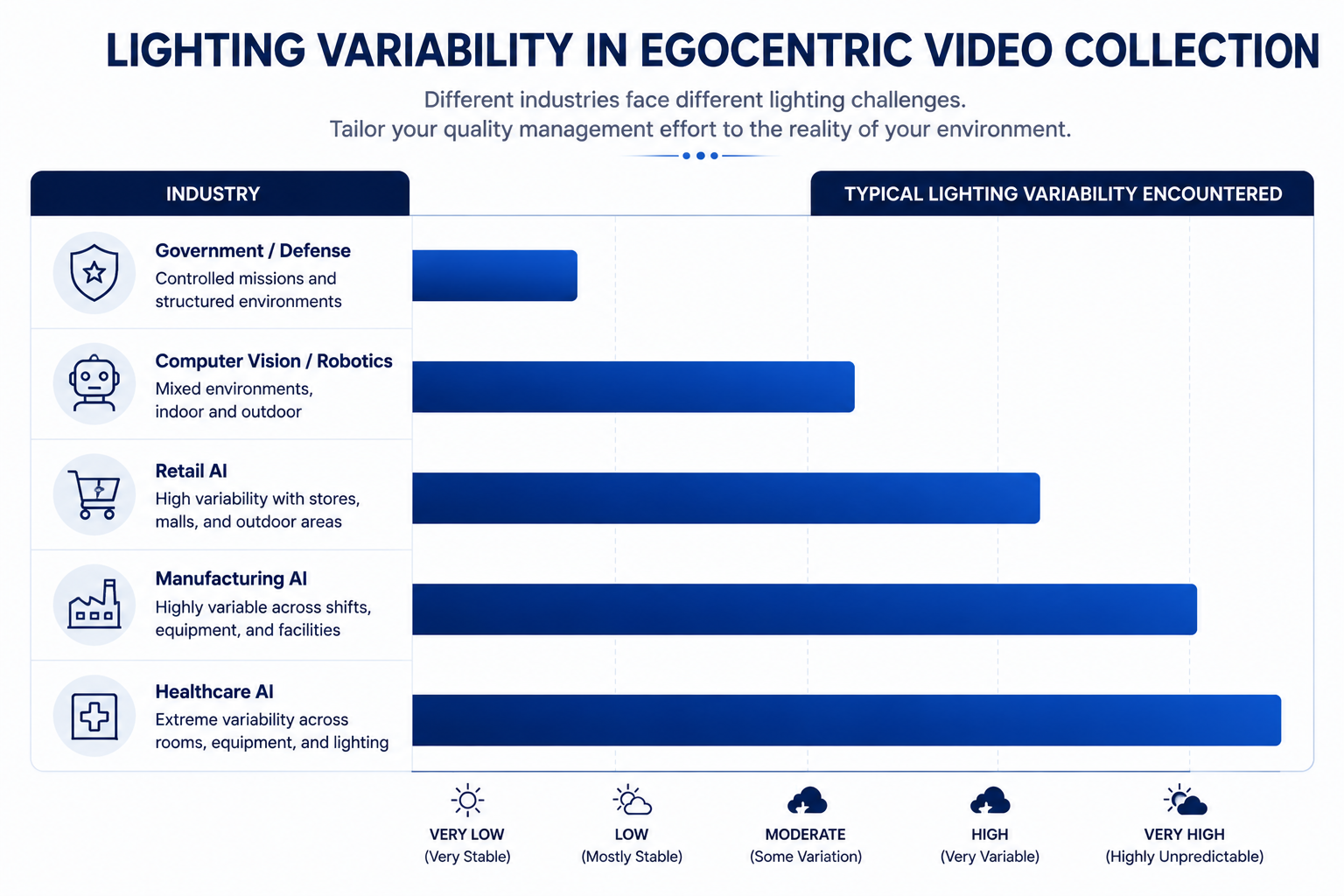
  • Computer vision / robotics: Lighting variability matters significantly for demonstration data collection occurring across varied real-world environments rather than controlled lab settings.
  • Manufacturing AI: Facility lighting can vary meaningfully between different areas of a production environment, requiring attention to consistent quality across zones.
  • Healthcare AI: Clinical settings often have more controlled, consistent lighting than field collection, though transitions between different clinical areas can still introduce variability.
  • Retail AI: In-store lighting varies by store design and location, making quality monitoring across a chain's different environments particularly relevant.
  • Government & defense: Field collection in this sector often involves genuinely extreme lighting variability, from bright outdoor conditions to dim interior spaces.
  • Autonomous vehicles: This specific wearable lighting management challenge has limited direct application, since vehicle-mounted camera systems handle lighting variability through different technical approaches.

Benefits

  • More consistently usable footage across real-world conditions. Active lighting and exposure management produces data that holds up across the actual variability collection encounters.
  • Earlier detection of quality problems. Real-time monitoring catches lighting-related issues while recollection is still possible, rather than after a session has fully concluded.
  • Reduced downstream annotation difficulty. Well-exposed, clear footage is easier and faster to annotate accurately than footage degraded by lighting or motion blur issues.
  • More predictable data quality outcomes. Establishing clear usability thresholds provides an objective basis for assessing footage rather than a subjective, inconsistent judgment.
  • Better return on collection effort. Addressing lighting challenges actively reduces the amount of captured data that ultimately proves unusable for its intended purpose.

Common Mistakes

  • Configuring a single fixed exposure setting for all conditions. Assuming one camera configuration will handle the full range of lighting transitions a wearer will actually encounter.
  • Not training wearers on lighting-sensitive moments. Leaving wearers without basic awareness of when and where lighting quality is likely to become a particular concern.
  • Skipping real-time quality monitoring where it's feasible. Only discovering lighting or exposure problems once a full session has already concluded and recollection is harder to arrange.
  • Not defining clear usability thresholds in advance. Relying on inconsistent, subjective judgment about whether footage quality is acceptable rather than objective criteria.
  • Treating lighting issues as an unavoidable cost rather than a solvable problem. Not adjusting technique or equipment settings even when the same quality issue recurs repeatedly.
  • Ignoring backlighting and high-contrast scenarios in protocol planning. Failing to anticipate scenes where extreme contrast will obscure the specific detail a task actually needs.

Best Practices

  • Identify the specific lighting transitions your collection environment will involve before configuring capture equipment.
  • Select adaptive or condition-specific exposure settings rather than relying on a single fixed configuration.
  • Train wearers on basic lighting awareness for activities or transitions where quality issues are likely.
  • Build real-time quality monitoring into capture sessions wherever feasible.
  • Define clear, objective usability thresholds for footage quality before collection begins.
  • Treat recurring lighting quality issues as a signal to adjust technique or equipment, not an unavoidable collection cost.

FAQ

What lighting challenges are specific to egocentric video collection?

Exposure transitions between different lighting conditions, motion blur in low light, and backlighting or high-contrast scenes that can obscure important visual detail, all compounded by the camera moving continuously with the wearer.

How is managing lighting in egocentric capture different from fixed-camera video?

A fixed camera can often be configured once for its stable environment, while an egocentric camera moves through changing lighting conditions with the wearer, requiring either adaptive settings or ongoing quality management.

Why does motion blur become more of a concern in low-light egocentric capture?

Because lower light typically requires longer exposure times, and egocentric capture's inherently more dynamic movement compared to a stationary camera increases the risk that motion blur will affect footage during those longer exposures.

Should footage quality be monitored during capture, or only reviewed afterward?

Monitoring during capture where feasible is preferable, since catching a lighting or exposure problem while a session is still underway allows for correction or recollection that isn't possible once the session has fully concluded.

What should usability thresholds for egocentric footage quality include?

Clear, objective criteria defining acceptable levels of exposure, blur, and contrast for the specific training task, established before collection begins rather than assessed inconsistently after the fact.

Can wearer training actually help address lighting-related quality issues?

Yes, to a degree. Basic awareness of lighting-sensitive moments and transitions can help wearers avoid or account for conditions likely to degrade footage quality, even without deep technical camera knowledge.

How should recurring lighting quality problems be addressed?

By treating them as a solvable issue requiring adjustment to capture technique, equipment settings, or protocol design, rather than accepting them as an unavoidable cost of egocentric collection.

Conclusion

Egocentric capture environmental conditions require active, ongoing quality management, not just protocol-level planning for environmental variety. Exposure transitions, motion blur risk, and high-contrast scenes all demand deliberate technique and real-time monitoring to keep footage usable across the genuinely variable conditions real-world collection encounters. Treating lighting management as a solvable, ongoing quality control problem — rather than an unavoidable cost — is what keeps a collection effort's usable data yield high.

🚀 Your All‑In‑One Virtual Experience Stack
🎬
PhotoAIVideo
Turn photos into scroll‑stopping AI videos.
Get Started →
🏡
Pictastic
Instantly stage listings with AI.
Try Staging →
🌀
CloudPano
Create stunning 360° tours in minutes.
Launch Tour →
💰
VirtualTourProfit
Build a profitable virtual tour business.
Learn More →
🤝
CloudPano Reseller
Resell AI visual software without building it.
Become a Reseller →
🚗
Auto CloudPano
Sell more vehicles with 360° experiences.
Explore Auto →
🏗️
AI Floor Plan Builder
Generate detailed floor plans with AI.
Build Now →
📐
3D Measure
Capture accurate floor plans & 3D measurements.
Measure Now →
🧠
AI Training Data
Custom AI training data services.
Learn More →
Share this post
Cloudpano

Choose The Right 360° Camera

Insta360 ONE RS 1-Inch 360 Edition

  • Compact, ready to go anywhere

  • Interchangeable lens that’s upgradeable

  • Dual 1-inch sensors for improved clarity and low light performance

  • Dynamic range and 6K 360° capture

  • 360° photo resolution at 21MP

Learn More

Insta360 X4

  • 8K 360° video recording for ultra-detailed visuals.

  • 4K single-lens mode for traditional wide-angle shots.

  • Invisible selfie stick effect for drone-like perspectives.

  • 2.5-inch touchscreen with Gorilla Glass protection.

  • Waterproof up to 33ft for underwater shooting.

Learn More

Ricoh Theta Z1

  • 360° photo resolution in 23MP

  • Slim design at 24 mm thick

  • Built-in image stabilization for smooth video capture.

  • Internal 19GB storage for photo and video storage.

  • Wireless connectivity for remote control and sharing.

Learn More

Ricoh Theta X

  • 60MP 360° still images for high-resolution photography.

  • 5.7K 360° video recording at 30fps.

  • 2.25-inch touchscreen for intuitive control.

  • USB Type-C port for fast charging and data transfer.

  • MicroSD card slot for expandable storage.

Learn More
Property Marketing
Allows potential buyers to explore properties in detail from anywhere, enhancing the real estate marketing process.
Automotive Spins
Create an interactive virtual showroom and engage affluent digital buyers with live 360º video calls, all through the CloudPano mobile app for a complete automotive sales solution.
Interactive Floor Plans
Create 2D and 3D floor plans with measurements in 4 minutes or less, all from your phone. Download the Floor Plan Scanner app and get your first scan free.

360 Virtual Tours With CloudPano.com. Get Started Today.

Try it free. No credit card required. Instant set-up.

Try it free
Latest posts

See our other posts

Interviews, tips, guides, industry best practices, and news.

Capture Protocol Differences: Activity Recognition vs. Manipulation Datasets

Egocentric capture protocol design should differ meaningfully depending on target use case: activity recognition prioritizes broad activity and scene diversity, while manipulation datasets prioritize close-range hand-object interaction detail and precise framing. Applying one use case's protocol assumptions to the other typically produces data that's mismatched to what the model actually needs.
Read post

Lighting and Environmental Conditions in Egocentric Video Collection

Egocentric capture environmental conditions create quality challenges general video collection guidance doesn't fully address — rapid lighting transitions, exposure mismatches between indoor and outdoor scenes, and motion blur in low light. Managing these requires real-time quality monitoring during capture, not just planning for environmental variety in advance.
Read post

Storage and Transfer Architecture for Continuous Egocentric Capture

Egocentric video data storage planning requires matching on-device capacity to actual session length, designing a transfer pipeline that can handle continuous high-volume video without bottlenecking, and deciding what processing happens at the edge versus after transfer. Underestimating any of these creates gaps or delays that compromise an otherwise well-designed collection effort.
Read post