


.png)


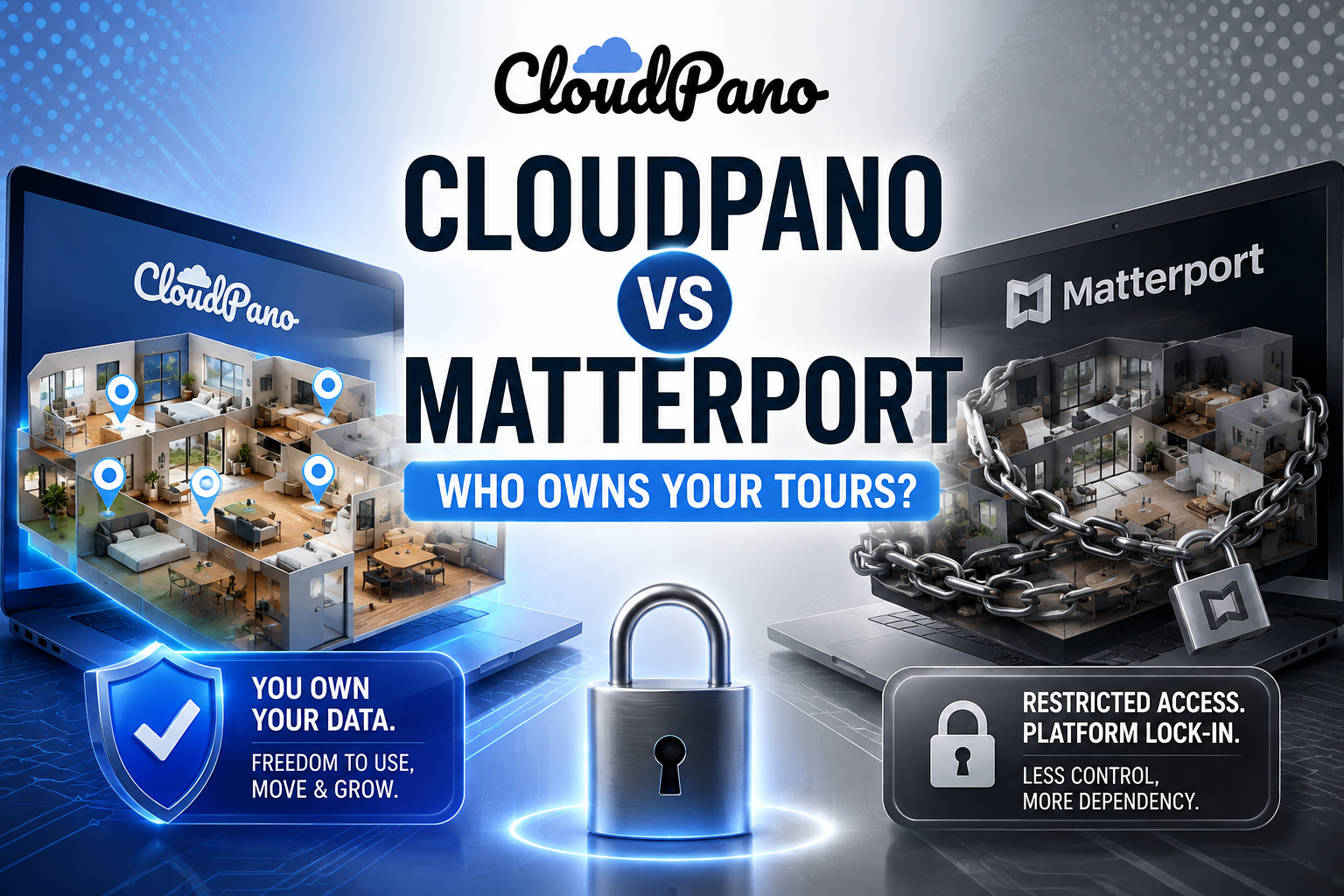
Most comparisons between virtual tour platforms focus on price and features at the moment of signup. Fewer ask a longer-lasting question: three or five years from now, who actually controls your content? This CloudPano vs Matterport comparison is built specifically around that question — not the features you'll use this month, but what genuine ownership and control look like over the life of a growing tour library.

Ownership sounds like a simple, binary question — either you own your content or you don't. In practice, it's more layered than that. You might technically own the underlying photos and capture data while having no practical way to use them without a specific platform's rendering infrastructure. You might own your account outright while still facing real friction if you ever want to leave. Genuine long-term ownership is really about how much practical control you retain over your own content as time goes on, not just what a contract says on day one.
At the moment you sign up for any platform, ownership questions rarely feel urgent — you're focused on getting your first tours live, not on an exit scenario you're not planning for. But the platforms genuinely differ in how that relationship evolves over time: how easily you can access historical content, whether older tours remain usable as pricing tiers change, and how much friction exists if you eventually do want to leave.
This is where a purely feature-and-price comparison, like the one covered in our main comparison guide, misses something important — a platform can be perfectly competitive on price and features while still creating more long-term lock-in than an alternative that's slightly less flashy on day one.
Matterport's ecosystem is built around proprietary capture hardware and rendering technology, which means your finished tours are closely tied to that specific platform's infrastructure for as long as you want them to remain live and interactive. This isn't unusual for the category, but it does mean that your practical ability to use your own content independently of the platform is more limited than a simple "you own your photos" framing might suggest.

This matters most for businesses with a growing library built up over years — the longer you've invested in a single platform's ecosystem, the more your practical flexibility depends on that platform's continued goodwill on pricing and terms, since switching later means rebuilding rather than simply relocating existing files.
CloudPano's more hardware-agnostic approach has an indirect benefit here: because it isn't built around a single proprietary capture ecosystem, your underlying source material is less tightly coupled to any one platform's continued existence or pricing decisions. This doesn't mean a finished CloudPano tour is instantly portable elsewhere either — the same general limitation around rendered, interactive tours applies broadly across this category — but the raw material feeding into those tours tends to remain more independently usable.
If you're evaluating matterport alternatives with an eye toward long-term flexibility rather than just today's feature set, ownership and portability deserve a place in that evaluation alongside price and functionality. A platform that's slightly more expensive but leaves you with more practical control over your content can be the better long-term bet, even if it looks like a wash on a feature-by-feature comparison.

This is really what it means to own your virtual tours in a meaningful sense: not just having your name on an account, but retaining enough practical independence from any single vendor's infrastructure that a future decision to switch, if you ever need to, isn't disproportionately costly or disruptive. To own your virtual tours in the sense that actually matters — full practical control, not just a name on an account — is what lets a business make a future switching decision based on what's genuinely best for them, rather than being effectively locked in by accumulated practical dependency on one vendor's infrastructure.
It's worth naming directly why ownership doesn't get weighted heavily during most initial platform decisions: it's simply not urgent yet. Nobody signing up for a virtual tour platform is thinking about a hypothetical departure years down the line — they're focused on getting their first tours live and working. This is completely understandable, but it also means the businesses most likely to feel friction around ownership are the ones who didn't think to check for it early, precisely because it wasn't on their radar at signup.
This is one of the reasons evaluating matterport alternatives through an ownership lens specifically — rather than just a feature or price lens — tends to be a step that gets skipped, even by otherwise careful buyers. It's not that people don't care about ownership; it's that the question doesn't feel pressing until you're already years into a relationship with a platform and considering a change, at which point your options are more constrained than they would have been at the outset.
On G2's virtual tour software category page, long-tenured reviewers occasionally reflect on this exact tension — noting that a platform's early appeal on price or features mattered less, years in, than how much friction they faced when circumstances changed and they considered switching.

A broader virtual tour software comparison approach, cross-referencing Capterra's category listings alongside community discussion on r/realtors, tends to surface this long-term perspective more than a single review or a features page ever will, since it takes accumulated experience over time to actually notice this kind of friction. Most standard virtual tour software comparison content, including much of what's published across this category, simply doesn't ask about ownership at all — it's worth actively seeking out the reviews and discussions that do, rather than assuming a general comparison article has already covered this angle for you.
"Isn't this a bit theoretical? I just need something that works right now."
That's a completely reasonable starting priority, and there's nothing wrong with weighting current fit heavily. The point isn't that ownership should override every other consideration — it's that it's worth being a deliberate factor in the decision rather than an afterthought you only think about once you're already deep into a platform and considering a change.
"Doesn't every platform have some degree of lock-in?"
To some extent, yes — this isn't a claim that any platform offers perfect, frictionless portability. It's a claim that the degree of lock-in varies meaningfully between platforms, and that variance is worth weighing explicitly rather than assuming it's roughly equal everywhere.

Price and feature comparisons matter, but they don't capture everything worth knowing before committing to a platform for years of accumulated content. Long-term ownership is about practical control, not just legal technicalities — and that control varies meaningfully based on how tightly a platform's ecosystem binds your content to its own infrastructure.
If long-term flexibility matters to you as much as today's feature set, it's worth weighing that explicitly before you commit, not after you've already built years of content around a platform that turns out to be harder to leave than expected. Our complete comparison guide covers the fuller feature-and-price picture, and our migration guide walks through what a switch actually involves if you decide ownership concerns are worth acting on. Whichever platform you land on, making that decision with ownership as an explicit factor — rather than an afterthought — is what separates a choice you'll still feel good about years later from one you'll eventually have to revisit under less favorable circumstances.


Compact, ready to go anywhere
Interchangeable lens that’s upgradeable
Dual 1-inch sensors for improved clarity and low light performance
Dynamic range and 6K 360° capture
360° photo resolution at 21MP

8K 360° video recording for ultra-detailed visuals.
4K single-lens mode for traditional wide-angle shots.
Invisible selfie stick effect for drone-like perspectives.
2.5-inch touchscreen with Gorilla Glass protection.
Waterproof up to 33ft for underwater shooting.

360° photo resolution in 23MP
Slim design at 24 mm thick
Built-in image stabilization for smooth video capture.
Internal 19GB storage for photo and video storage.
Wireless connectivity for remote control and sharing.

60MP 360° still images for high-resolution photography.
5.7K 360° video recording at 30fps.
2.25-inch touchscreen for intuitive control.
USB Type-C port for fast charging and data transfer.
MicroSD card slot for expandable storage.
.png)

.png)

Try it free. No credit card required. Instant set-up.






.svg)


.svg)