Choosing between Build AI and Firsthand requires evaluating data collection capabilities, task diversity, recording specifications, annotation quality, licensing rights, and pricing. Organizations looking for a Build AI alternative should prioritize providers that deliver validated first-person video data aligned with their model requirements, commercial objectives, and long-term training strategies.
The rapid development of robotics, embodied AI, and physical AI has created a growing demand for high-quality egocentric video data.
Unlike traditional image and video datasets, egocentric recordings capture the world from the perspective of the person performing an activity. This gives AI models valuable information about human movement, object manipulation, spatial relationships, and real-world decision-making.
However, finding the right egocentric data provider is not always straightforward.
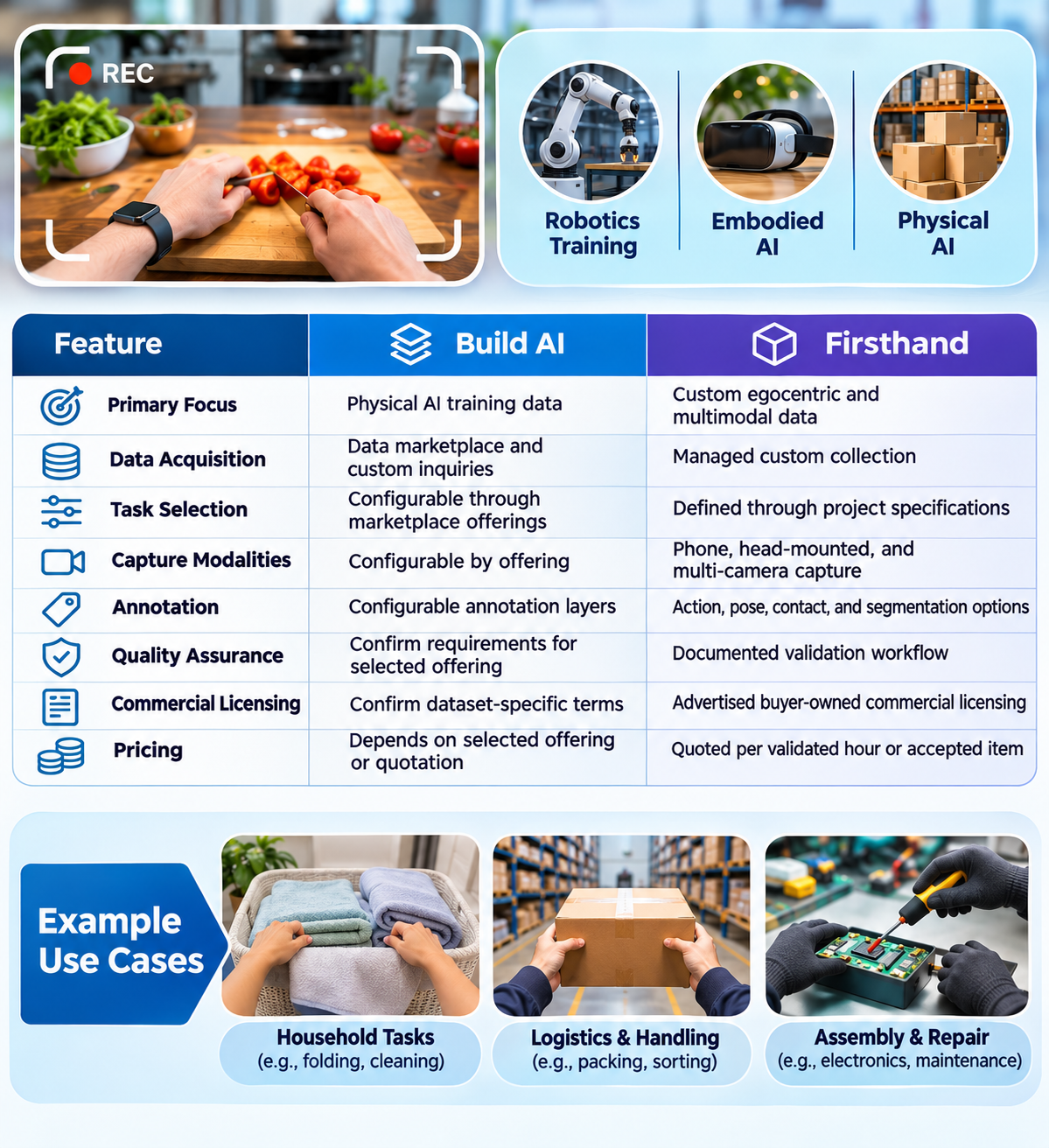
Build AI and Firsthand both operate within the physical AI training data market, but their offerings provide different starting points for data acquisition.
Some organizations prioritize access to existing training datasets, while others need custom recordings with specialized capture equipment, synchronized sensor streams, and detailed annotations.
For AI teams searching for a Build AI alternative, understanding these differences can help prevent expensive data acquisition mistakes and improve the relevance of training datasets.
This guide compares both providers across collection capabilities, customization, technical specifications, pricing, licensing, and quality assurance.
Egocentric video data refers to first-person recordings captured using head-mounted cameras, wearable devices, smart glasses, or chest-mounted recording equipment.
Instead of observing an activity from an external camera, AI models receive footage that closely reflects the perspective of the person performing it.
Common training applications include:
For example, first-person footage of someone preparing food can reveal how hands interact with utensils, how objects move throughout a task, and how different actions occur in sequence.
Additional information such as depth measurements, hand pose, and action annotations can make these recordings more useful for certain robotics applications.
Build AI is a physical AI data provider focused on making real-world training data available to robotics companies and AI developers.
Its platform offers a data marketplace where customers can browse, configure, and purchase egocentric training data based on their required tasks, capture modalities, and annotation layers.
Build AI also accepts inquiries for custom data collection requirements.
Build AI
Build AI's marketplace-based approach may appeal to organizations that want to explore available datasets before commissioning an entirely new collection.
Potential advantages include:
For organizations whose requirements align with available datasets, purchasing existing footage may reduce the time needed to begin experimentation.
However, buyers should confirm dataset specifications, commercial usage rights, quality standards, and delivery requirements before purchasing.
Firsthand is an AI training data provider specializing in custom egocentric video collection for robotics, embodied AI, and multimodal models.
Its collection workflow begins with a defined project specification covering activities, environments, recording conditions, and technical requirements.
Firsthand advertises multiple capture configurations, from smartphone-based recordings to synchronized multi-camera systems. Its robotics-focused services include collection, annotation, validation, and dataset delivery.
Firsthand+1
Firsthand may be particularly relevant for organizations that require training data collected specifically for their model's needs.
Its advertised capabilities include:
For organizations searching for a Build AI alternative, Firsthand provides a specification-driven collection approach that can be evaluated against existing dataset offerings.
The following comparison is based on the providers' publicly described services rather than independent performance testing.
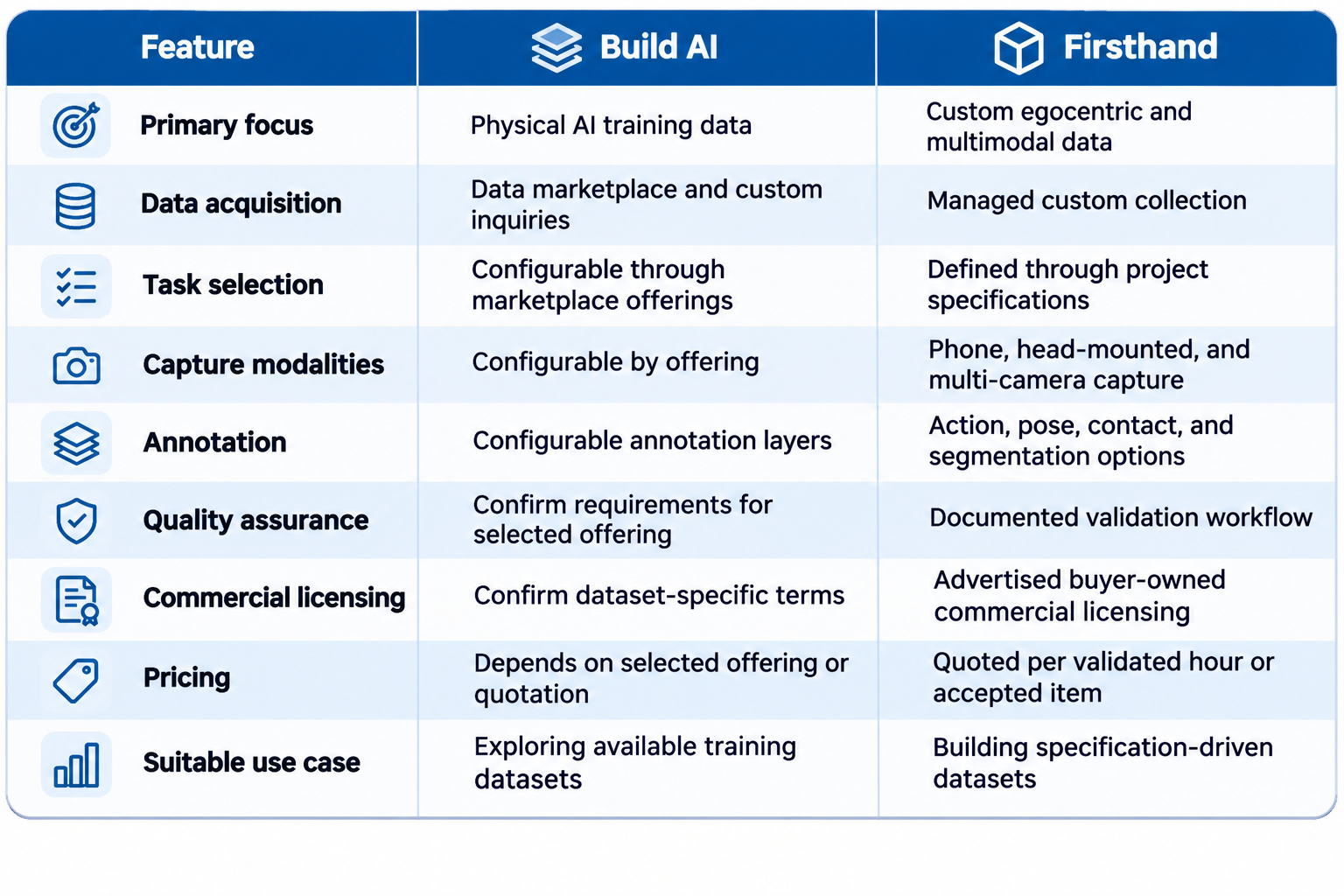
Both providers may be suitable depending on the project. The important distinction is how each offering aligns with the buyer's actual training requirements.
Build AI provides a marketplace through which teams can select available training data and configure their requirements.
Firsthand emphasizes managed collection based on a written specification.
For example, a robotics company developing a warehouse sorting system may need recordings of people identifying packages, opening containers, and organizing items under different working conditions.
An existing dataset may already contain suitable activities. If it does not, commissioning a targeted collection may provide better task coverage.
The decision should depend on the availability and relevance of existing footage.
Not every AI model requires the same recording setup.
Some applications can learn from standard first-person RGB video, while advanced robotics systems may benefit from synchronized depth, wrist-camera views, and motion information.
Firsthand publicly describes multiple capture tiers, including smartphone-based recording and specialized multi-camera configurations. Build AI allows buyers to select capture modalities through its data marketplace.
Firsthand+1
Buyers should compare camera resolution, frame rates, sensor accuracy, calibration, and synchronization requirements.
Annotation determines how effectively certain training systems can interpret recorded activities.
For robotics projects, useful annotations may include object classifications, temporal action boundaries, hand trajectories, contact events, and segmentation masks.
Build AI offers configurable annotation layers. Firsthand describes robotics annotation services that align structured labels with synchronized recording streams.
Build AI+1
Organizations should inspect actual annotations rather than relying exclusively on feature descriptions.
Customization becomes particularly valuable when existing datasets do not represent a model's intended deployment conditions.
A household robotics model may need recordings of cleaning, cooking, and organizing objects. An industrial robot may require specialized demonstrations involving tools, components, and workplace procedures.
When evaluating a Build AI alternative, determine whether the provider can accommodate specific environments, task variations, participant requirements, sensor configurations, and acceptance criteria.
Both providers offer pathways for custom requirements, but the scope and cost should be confirmed individually.
Large datasets are only valuable when their contents meet the intended training requirements.
Firsthand describes a validation workflow covering task acceptance, recording synchronization, calibration, annotation accuracy, coverage, and consent documentation.
Firsthand
For either provider, buyers should request quality-control reports, rejection criteria, representative samples, and procedures for correcting unsuitable recordings.
A smaller, relevant dataset may deliver greater value than a larger collection containing substantial amounts of unusable or repetitive footage.
Egocentric video data pricing depends on collection volume, recording equipment, annotation complexity, task requirements, and licensing.
Build AI's marketplace provides a starting point for evaluating configurable data offerings. Firsthand describes project-specific quotations based on validated hours or accepted deliverables.
Build AI+1
A reliable financial comparison requires equivalent project specifications.
Consider two hypothetical providers supplying first-person footage for a robotics project.
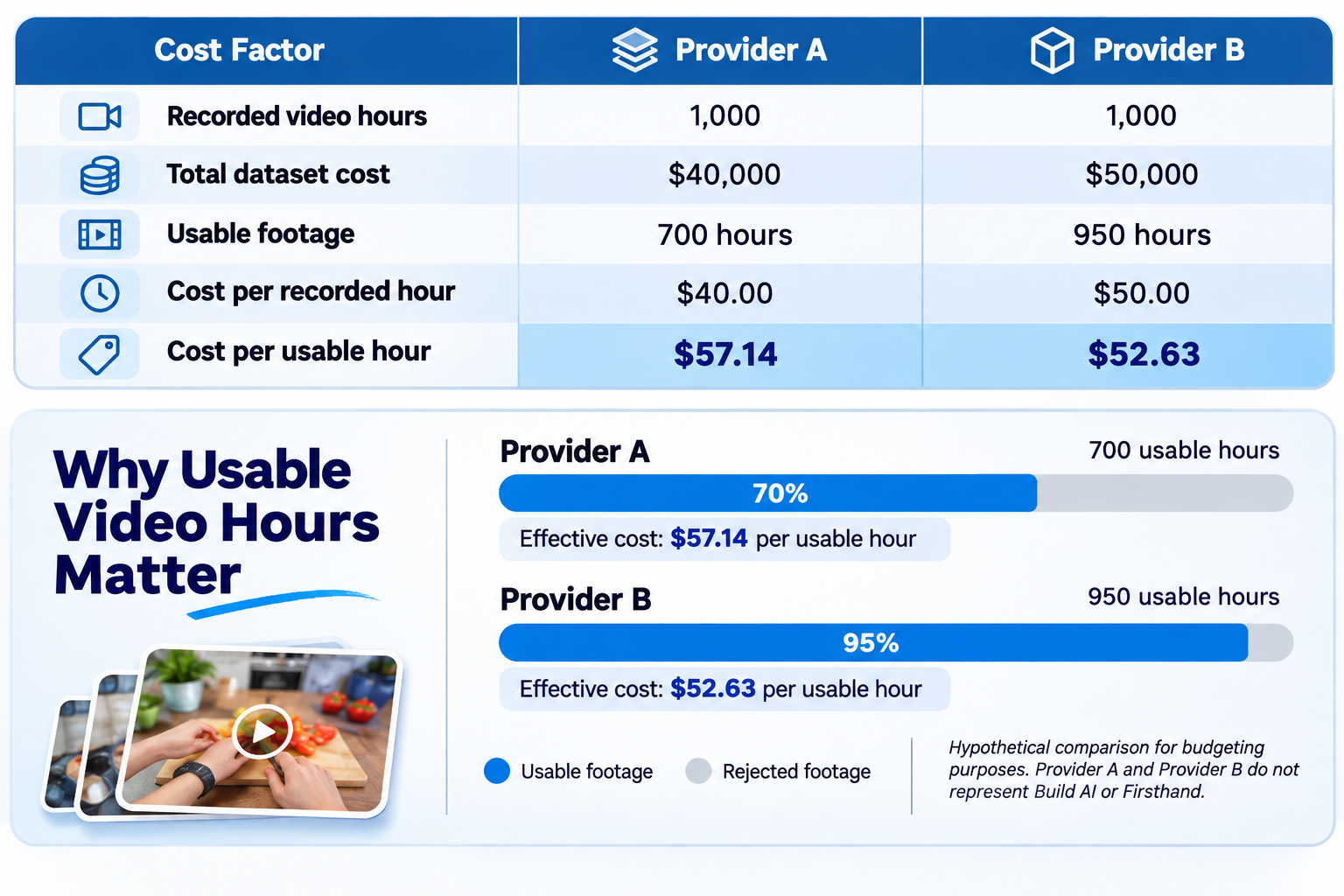
Although Provider B charges more per recorded hour, its effective cost per usable hour is lower.
This example demonstrates why organizations should evaluate total acquisition costs instead of relying solely on advertised hourly rates.
Licensing should be a central consideration when purchasing AI training data.
Egocentric recordings may contain identifiable individuals, private environments, computer screens, and sensitive information.
Organizations should confirm whether their agreements cover:
Firsthand advertises documented contributor releases and privacy-related review procedures. Buyers should examine the actual contractual terms offered by both providers before making a decision.
Firsthand
Publicly available footage should never automatically be assumed to carry unrestricted commercial training rights.
Advantages ✅
Considerations ⚠️
Advantages ✅
Considerations ⚠️
Firsthand is a relevant Build AI alternative for teams whose requirements extend beyond available dataset configurations and into custom, validated collection.
However, neither approach is universally better. Actual suitability depends on the training objective.
Before committing to a large data acquisition project, define a consistent evaluation process.
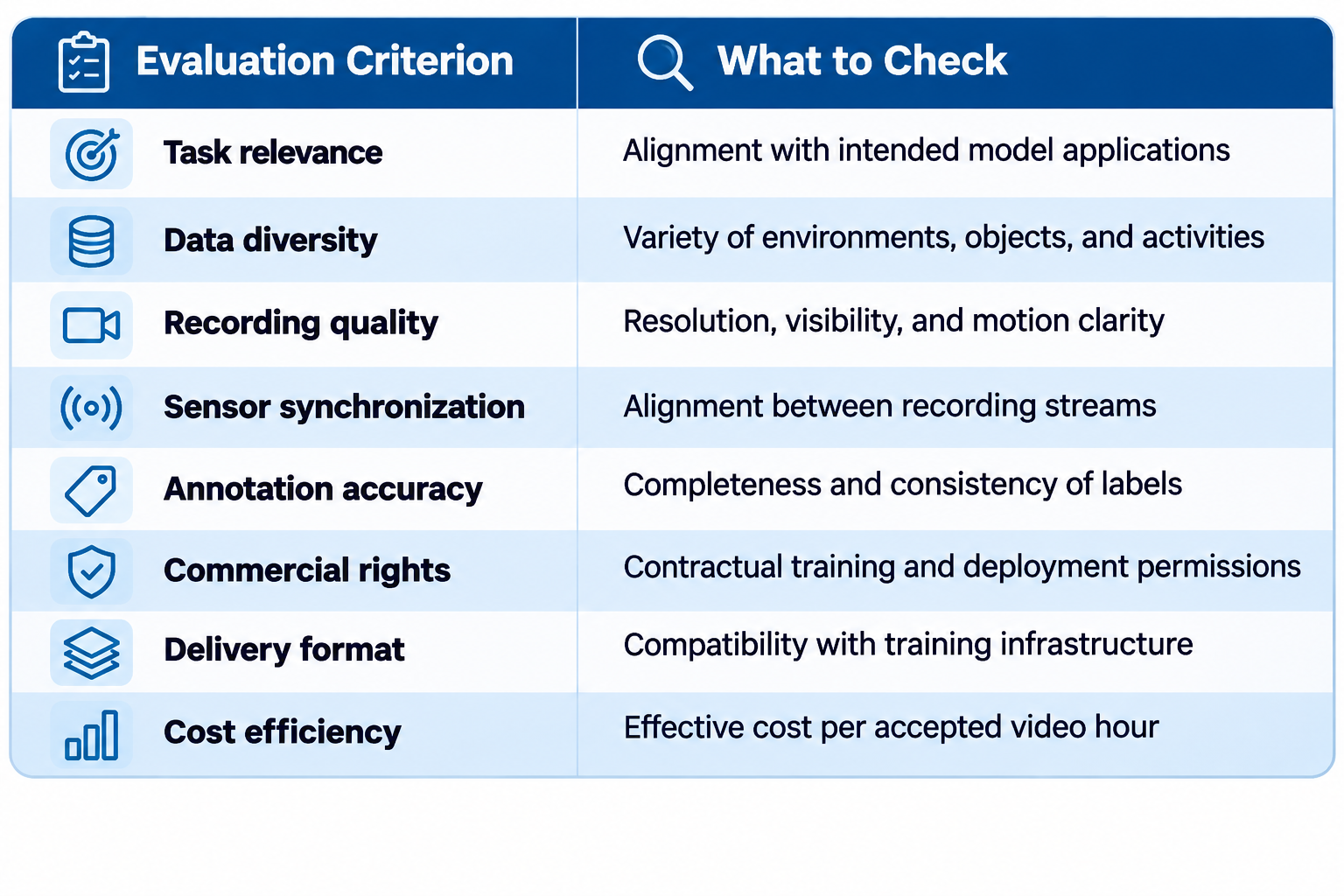
Begin with a small pilot collection using representative tasks.
Evaluate the incoming data, identify integration challenges, and test whether the footage contributes meaningfully to downstream model performance before scaling.
Build AI and Firsthand represent two relevant options for organizations acquiring egocentric training data for physical AI, robotics, and embodied intelligence.
Build AI offers a marketplace-oriented approach to exploring and configuring training datasets, while Firsthand provides managed collection tailored to project-specific requirements.
The most effective provider is the one that delivers relevant, validated, legally licensed data compatible with your training infrastructure.
If you are searching for a Build AI alternative that supports custom egocentric video collection, specialized recording configurations, and structured quality assurance, Firsthand is worth evaluating.
Explore Firsthand's custom egocentric video data collection services to discuss your training requirements and request a project-specific quotation.
Build AI offers a marketplace for configurable physical AI training datasets alongside custom collection inquiries. Firsthand emphasizes managed egocentric data collection based on written project specifications, including specialized capture configurations, annotation, and quality validation. Buyers should compare the specific deliverables available from each provider.
Firsthand is a relevant Build AI alternative for organizations requiring custom egocentric video collection, synchronized multimodal recordings, and documented validation procedures. Its suitability depends on project requirements, collection volume, budget, delivery timelines, and the technical specifications needed for the intended AI model.
Neither provider can be universally classified as more affordable without comparing equivalent project quotations. Pricing depends on data availability, recording specifications, annotation complexity, licensing, and collection volume. Organizations should calculate the total cost per usable video hour rather than comparing advertised prices alone.
Yes. Egocentric video can help robotics models learn human activities, object interactions, and task sequences. Depending on the training approach, additional information such as depth, hand pose, contact events, and robot-specific action demonstrations may be necessary to support effective robotic manipulation and policy learning.
Existing datasets may be suitable for initial experimentation or broad pretraining requirements. Custom collection can address specialized tasks, environments, recording specifications, and annotation needs. Many AI teams combine both approaches to balance acquisition costs, training coverage, and model-specific requirements.


Compact, ready to go anywhere
Interchangeable lens that’s upgradeable
Dual 1-inch sensors for improved clarity and low light performance
Dynamic range and 6K 360° capture
360° photo resolution at 21MP

8K 360° video recording for ultra-detailed visuals.
4K single-lens mode for traditional wide-angle shots.
Invisible selfie stick effect for drone-like perspectives.
2.5-inch touchscreen with Gorilla Glass protection.
Waterproof up to 33ft for underwater shooting.

360° photo resolution in 23MP
Slim design at 24 mm thick
Built-in image stabilization for smooth video capture.
Internal 19GB storage for photo and video storage.
Wireless connectivity for remote control and sharing.

60MP 360° still images for high-resolution photography.
5.7K 360° video recording at 30fps.
2.25-inch touchscreen for intuitive control.
USB Type-C port for fast charging and data transfer.
MicroSD card slot for expandable storage.


Try it free. No credit card required. Instant set-up.