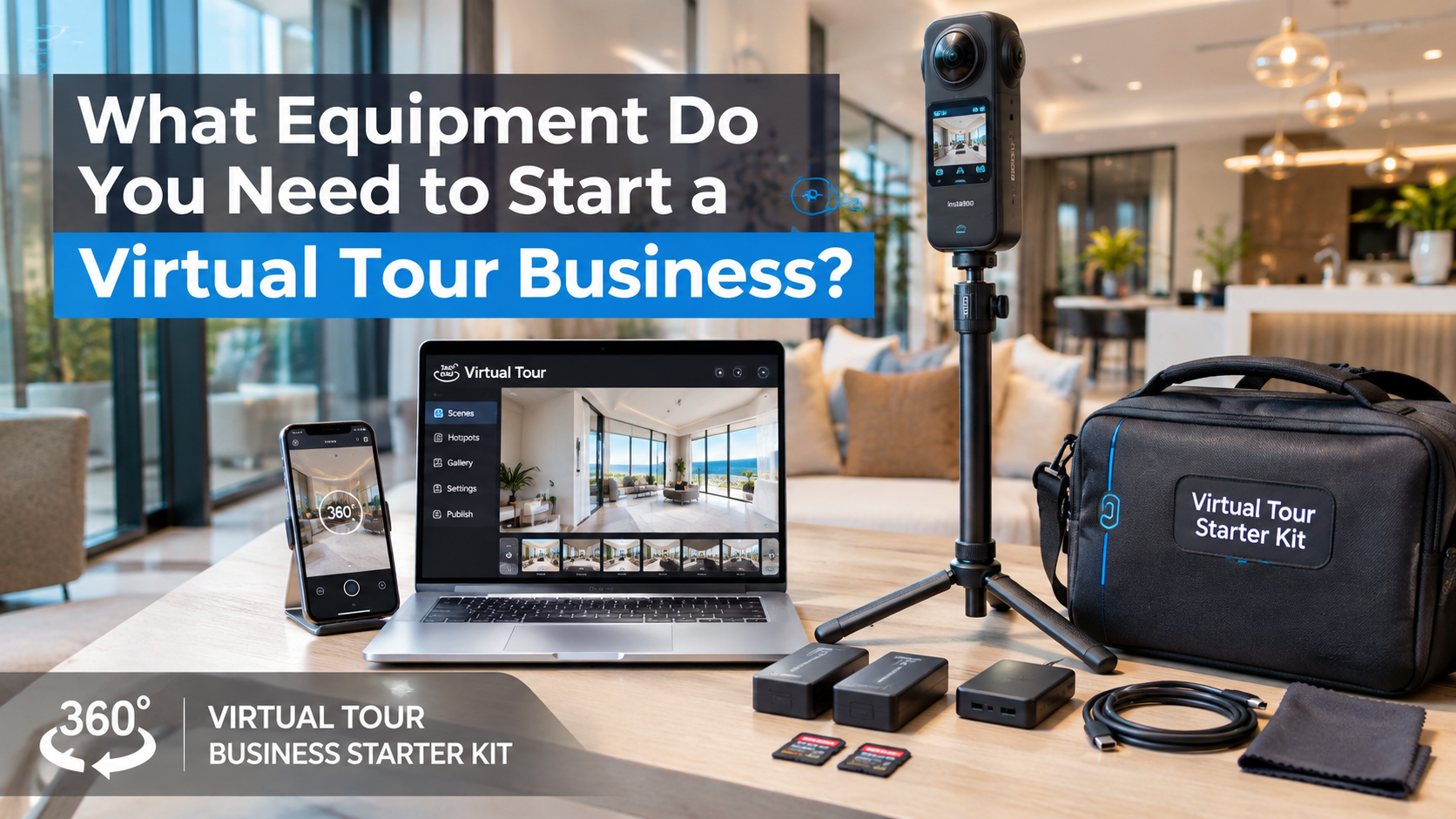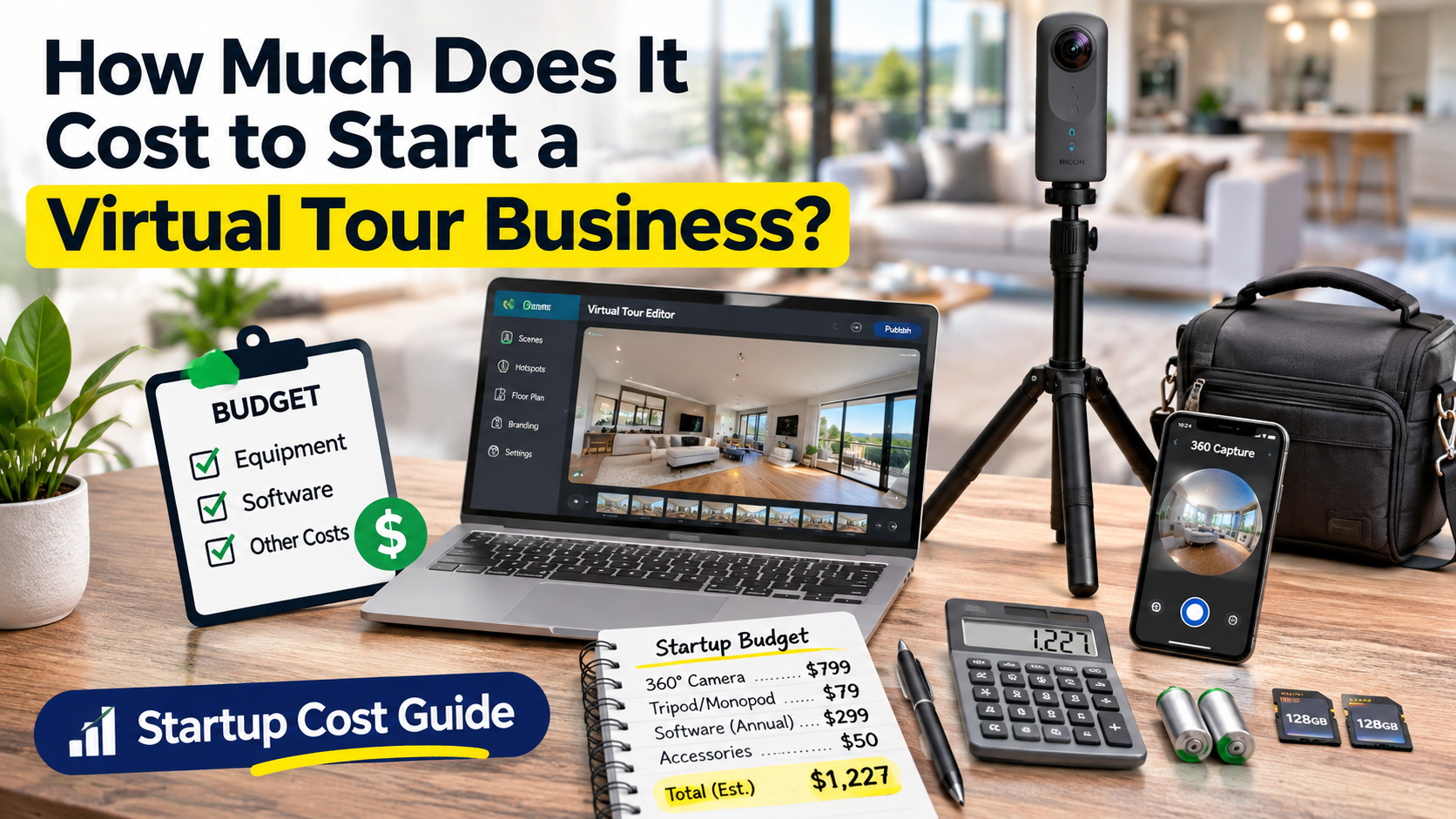
Yes. You can start a virtual tour business with less than $1,000 by purchasing an affordable 360-degree camera, using your existing computer and smartphone, choosing cost-effective virtual tour software, and attracting clients through organic marketing, referrals, and direct outreach.
Starting a virtual tour business can be an attractive opportunity for photographers, entrepreneurs, real estate professionals, and individuals looking to build a flexible service-based business.
Virtual tours help businesses showcase properties, facilities, and commercial spaces through immersive online experiences. From real estate listings and hotels to senior living communities and educational institutions, organizations can use interactive virtual tours to engage potential customers remotely.
But how much does it cost to start a virtual tour business?
Unlike many traditional businesses, virtual tour services do not necessarily require a physical office, expensive machinery, or a large team. With affordable 360-degree cameras and accessible virtual tour software, entrepreneurs can launch their businesses with a relatively manageable initial investment.
This guide breaks down the startup costs, ongoing expenses, equipment requirements, pricing strategies, and potential profitability of a virtual tour business.
The estimated cost to start a virtual tour business ranges from $500 to $1,500 for a beginner setup, $1,500 to $3,500 for a professional setup, and $5,000 or more for an advanced business offering specialized photography and 3D scanning services.
Startup expenses typically include a 360-degree camera, tripod, virtual tour software, storage accessories, business registration, and basic marketing. Entrepreneurs who already own a computer and smartphone can significantly reduce their initial investment.
The total investment required depends on your equipment preferences, target market, service offerings, and business goals.
The following table provides estimated startup budgets for different business levels. All figures are in US dollars.
These figures are illustrative planning estimates and assume you already own a suitable computer and smartphone.
The U.S. Small Business Administration's business planning resources recommend identifying startup expenses and estimating when a business can become profitable before committing to significant investments.
A 360-degree camera is generally the largest equipment expense when starting a virtual tour business.
These cameras capture spherical photographs that allow viewers to explore spaces interactively. Modern consumer and professional 360 cameras have made virtual tour photography more accessible to independent entrepreneurs.
Entry-level and mid-range cameras may cost approximately $300–$600, while professional photography-focused models can require a larger investment.
For example, the Insta360 X5 had an original launch price of $549.99, according to the official Insta360 X5 announcement.
When selecting a camera, consider:
Beginners should prioritize reliable image quality and an efficient photography workflow rather than purchasing the most expensive camera available.
A stable tripod or monopod is essential for capturing consistent panoramic photographs.
Most virtual tour photographers prefer compact stands with a minimal footprint to reduce the amount of equipment visible at the bottom of the image.
Additional photography accessories may include:
You do not need to purchase every accessory immediately. Start with the items necessary for your first projects and expand your equipment kit as your workload increases.
Reliable accessories can help prevent interrupted photography sessions, equipment damage, and unnecessary return visits to client locations.
Virtual tour software is one of the most important investments in a virtual tour business.
A dedicated platform allows entrepreneurs to transform panoramic photographs into interactive virtual experiences that can be shared, embedded, and delivered to clients.
Software costs may range from approximately $30 to $100 or more per month, depending on subscription features, hosting capacity, and business requirements.
When comparing virtual tour platforms, look for features such as:
Entrepreneurs can explore CloudPano's virtual tour software for entrepreneurs to discover how a dedicated platform can support virtual tour creation, professional client delivery, business branding, and scalable operations.
Selecting the right software can help reduce production time while creating additional opportunities for recurring hosting revenue.
Most entrepreneurs can use an existing laptop or desktop computer to create and manage virtual tours.
A computer with sufficient memory, reliable storage, and a stable internet connection is generally suitable for standard browser-based virtual tour creation.
However, photographers working with high-resolution panoramas, RAW images, or video may benefit from more powerful equipment.
If you need to purchase a computer, budget approximately $500–$1,500 or more, depending on your editing requirements.
Photo editing software is another potential expense.
Free applications such as GIMP provide image retouching and editing capabilities without requiring a paid subscription.
Premium editing applications may offer additional features that improve productivity, particularly for photographers managing multiple client projects.
When starting, free editing tools and existing computer equipment can help keep your operating expenses manageable.
A professional online presence helps potential clients understand your services, review completed projects, and contact your business.
Your website does not need to be complicated. A simple website featuring sample virtual tours, service descriptions, contact information, and pricing guidance can be sufficient.
Common website and branding expenses include:
Entrepreneurs with limited budgets can initially use social media profiles, online portfolios, and shareable virtual tour links to showcase their services.
Once the business generates consistent revenue, investing in a dedicated website can support search engine visibility and customer acquisition.
Depending on your location, you may need to register your business, obtain relevant permits, and purchase appropriate insurance.
Business registration fees vary considerably between countries, states, and business structures.
Potential expenses include:
Insurance is particularly worth considering because virtual tour photographers often work inside residential properties and commercial facilities.
Accidental property damage, equipment theft, or client disputes can create unexpected financial expenses.
Always verify applicable local requirements before accepting commercial photography assignments.
A virtual tour business needs a consistent strategy for attracting paying clients.
Fortunately, entrepreneurs do not necessarily need a large advertising budget to secure their first projects.
Affordable customer acquisition strategies include contacting local real estate agents, approaching hotels and restaurants, attending business networking events, creating demonstration tours, publishing educational social media content, and requesting client referrals.
Paid marketing can be introduced once you identify the customer segments most likely to purchase your services.
A beginner might allocate $50–$200 toward initial marketing, while an established business may spend several hundred dollars each month depending on its growth strategy.
Prioritize marketing activities that generate measurable inquiries and paying customers rather than spending heavily on general brand awareness.
Startup expenses represent only part of the total investment. Entrepreneurs must also account for recurring costs.
Actual expenses depend on project volume, software requirements, travel distances, and local business conditions.
A home-based virtual tour business can generally avoid commercial rent and other office-related costs, making it easier to maintain low overhead.
Virtual tour pricing depends on property size, photography complexity, customization requirements, travel expenses, and the local market.
The following figures represent illustrative service pricing rather than universal industry rates.
Additional services can include professional photography, floor plans, virtual staging, custom branding, and promotional videos.
You can also offer Google Maps photography services. The Google Maps Photo Sphere publishing guidelines explain requirements for panoramic imagery. Connected Street View tours may require additional publishing tools and workflows.
Your pricing should cover photography time, editing, transportation, software, equipment depreciation, taxes, and your desired profit margin.
The time required to recover your investment depends on your service pricing, project expenses, and ability to attract customers.
Consider the following example:
In this scenario, four completed projects generate enough contribution to recover the initial equipment and startup investment before recurring overhead, taxes, and owner compensation.
The Small Business Administration's break-even calculator provides a useful resource for estimating how many sales are required to cover business expenses.
For a realistic profitability forecast, account for both monthly overhead and the value of your working time.
Yes. Virtual tour businesses can generate recurring revenue by offering services that continue after the initial photography project.
Common recurring revenue opportunities include virtual tour hosting, annual maintenance, seasonal photography updates, property portfolio management, multimedia updates, and ongoing commercial service agreements.
For example, if 20 clients each pay $25 per month for virtual tour hosting and maintenance, the business generates $500 in monthly recurring revenue before expenses.
Recurring services can help create more predictable income while strengthening long-term client relationships.
Entrepreneurs can minimize financial risk by starting with essential equipment and upgrading gradually.
Consider these cost-saving strategies:
Avoid purchasing expensive cameras, drones, or specialized scanning systems until customer demand justifies the additional investment.
The cost to start a virtual tour business is relatively manageable compared with many businesses that require physical premises, extensive equipment, or employees.
With an estimated beginner investment of $500–$1,500, entrepreneurs can purchase essential photography equipment, access professional virtual tour software, and begin marketing their services.
The most effective approach is to start with a practical budget, focus on acquiring paying clients, and gradually reinvest revenue into business improvements.
By combining professional virtual tour creation, competitive pricing, efficient workflows, and recurring service offerings, entrepreneurs can build a scalable business while maintaining control over their startup and operating expenses.
A beginner can start a virtual tour business with approximately $500–$1,500, assuming they already own a compatible computer and smartphone.
A virtual tour business can be profitable when service pricing covers photography, editing, transportation, software, marketing, and administrative expenses. Recurring hosting revenue may improve long-term profitability.
Yes. Virtual tour photography can be offered as a part-time service. Entrepreneurs can schedule photography appointments around existing employment and gradually expand as customer demand increases.
A 360-degree camera is typically the largest initial equipment expense, while virtual tour software, transportation, and marketing contribute to ongoing operating costs.
No. Most independent virtual tour photographers can operate from home, travel to client locations for photography, and create and deliver completed virtual tours online.
U.S. Small Business Administration – Calculate Your Startup Costs
https://www.sba.gov/business-guide/plan-your-business/calculate-your-startup-costs
Provides guidance on calculating startup expenses, estimating operating costs, and preparing a business budget.
2. Insta360 – Official Insta360 X5 Announcement
https://www.insta360.com/blog/news/insta360-launches-X5-360-action-cam.html
Provides information about 360-degree camera capabilities, equipment specifications, and historical launch pricing.
3. GIMP – GNU Image Manipulation Program
https://www.gimp.org/
Provides information about free, open-source photo editing software that can help entrepreneurs reduce startup and operating expenses.
4. Google Maps Help – Create and Publish Photo Spheres
https://support.google.com/maps/answer/7012050
Explains panoramic photography and publishing requirements relevant to virtual tour service offerings.
5. U.S. Small Business Administration – Break-Even Calculator
https://bec.www.sba.gov/
Provides resources for calculating break-even points, evaluating profitability, and determining the sales volume needed to recover business investments.


Compact, ready to go anywhere
Interchangeable lens that’s upgradeable
Dual 1-inch sensors for improved clarity and low light performance
Dynamic range and 6K 360° capture
360° photo resolution at 21MP

8K 360° video recording for ultra-detailed visuals.
4K single-lens mode for traditional wide-angle shots.
Invisible selfie stick effect for drone-like perspectives.
2.5-inch touchscreen with Gorilla Glass protection.
Waterproof up to 33ft for underwater shooting.

360° photo resolution in 23MP
Slim design at 24 mm thick
Built-in image stabilization for smooth video capture.
Internal 19GB storage for photo and video storage.
Wireless connectivity for remote control and sharing.

60MP 360° still images for high-resolution photography.
5.7K 360° video recording at 30fps.
2.25-inch touchscreen for intuitive control.
USB Type-C port for fast charging and data transfer.
MicroSD card slot for expandable storage.


Try it free. No credit card required. Instant set-up.