Egocentric video data costs depend on collection requirements, participant compensation, recording equipment, annotation complexity, quality assurance, and licensing rights. For preliminary budgeting, basic collection may be modeled at tens of dollars per usable hour, while specialized, densely annotated datasets can cost hundreds of dollars or more. Actual AI training data pricing requires project-specific quotations.
Egocentric video data is becoming increasingly important in robotics, embodied AI, multimodal learning, and computer vision.
Unlike traditional video captured from a fixed camera or third-person perspective, egocentric video records activities from the viewpoint of the person performing them. This allows AI systems to observe how people interact with objects, navigate environments, and complete everyday tasks.
However, collecting thousands of hours of reliable first-person footage requires more than distributing cameras and asking participants to record their activities.
Organizations must consider participant recruitment, equipment, data collection protocols, privacy protection, annotation, quality assurance, and licensing.
Understanding AI training data pricing helps research teams and AI companies establish realistic budgets while ensuring their datasets meet technical and commercial requirements.
This guide explains how egocentric video data is priced, what influences hourly collection costs, and how organizations can evaluate the true value of a dataset.
Egocentric video data consists of first-person recordings captured using wearable cameras, head-mounted devices, smart glasses, or other body-mounted recording equipment.
These recordings allow AI systems to observe human activities from a perspective that closely reflects how people experience their surroundings.
Common applications include:
For example, a participant wearing a head-mounted camera might record themselves preparing a meal, assembling furniture, organizing household objects, or operating equipment.
These recordings can provide valuable training examples for AI systems learning how physical tasks are performed.
There is no universal hourly rate for egocentric video data. Pricing depends heavily on the intended application and the level of processing required.
The following table provides illustrative budgeting scenarios rather than verified industry-average prices or provider quotations.
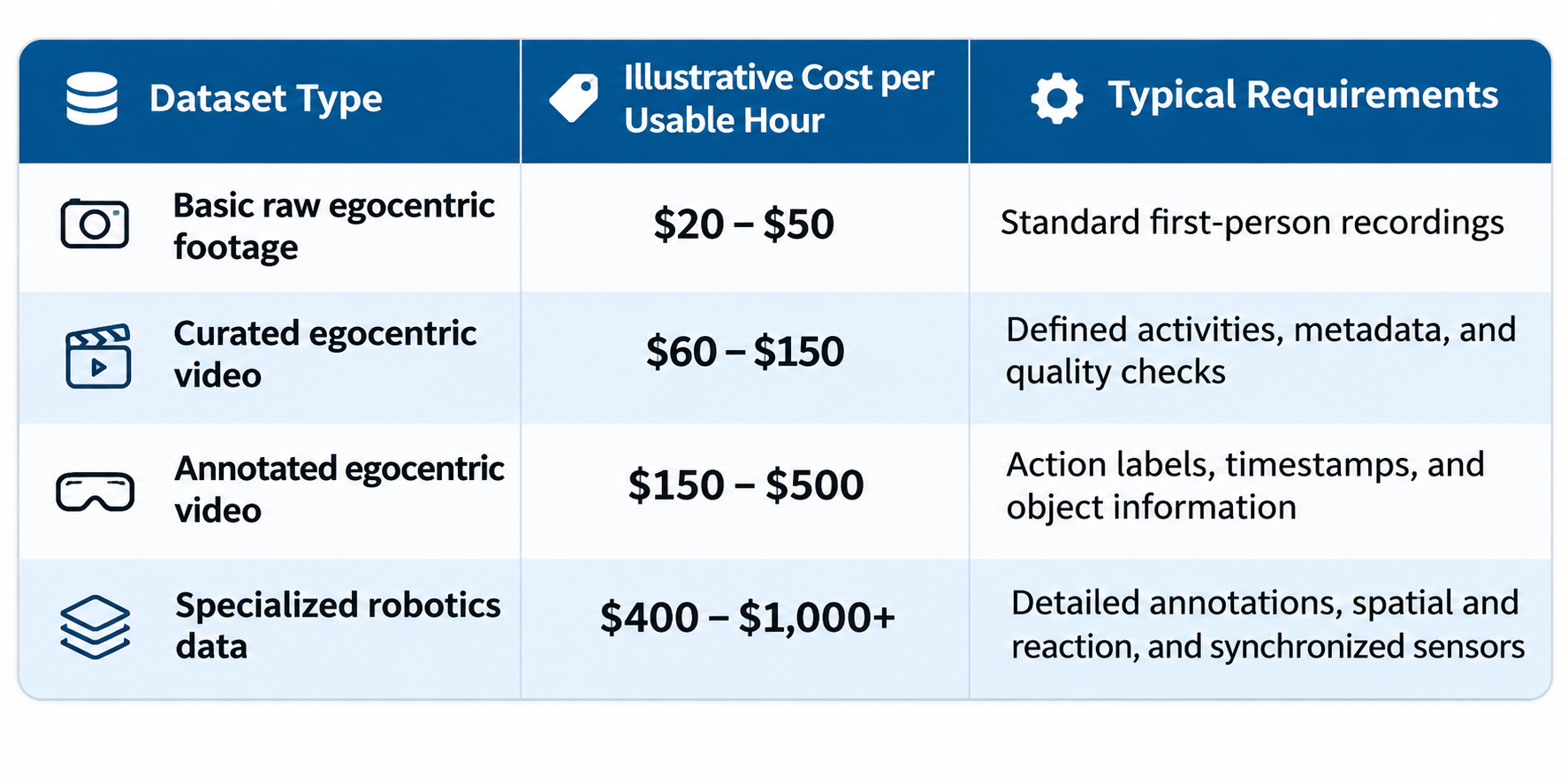
These ranges are hypothetical planning assumptions. Actual costs may fall outside them depending on geography, participant requirements, equipment, annotation density, and licensing terms.
When evaluating AI training data pricing, organizations should request a detailed breakdown of what is included in each usable video hour.
Egocentric video collection depends on people performing activities while wearing recording equipment.
Recruitment costs vary according to participant location, availability, experience, and task requirements.
Recording everyday household activities may require relatively straightforward recruitment. Collecting footage of specialized manufacturing procedures or technical equipment operation may require experienced professionals.
Participant onboarding, training, scheduling, and compensation all contribute to the final cost.
Basic egocentric datasets may require only a wearable camera capable of recording high-quality video.
More advanced datasets may require:
Each additional recording requirement introduces equipment, calibration, maintenance, and data-processing expenses.
Recording ordinary household activities is different from collecting structured demonstrations in industrial, healthcare, or laboratory environments.
Specialized environments may require additional permissions, supervision, safety procedures, or access arrangements.
Task complexity also affects the amount of preparation required before recording begins.
For example, collecting footage of someone folding laundry is generally less operationally demanding than capturing a technician performing a multi-stage equipment assembly.
Annotation can represent a substantial portion of the total dataset budget.
Raw footage may be sufficient for some self-supervised learning applications. Other projects require detailed information about what happens throughout each recording.
Common annotation types include:
The more detailed the annotations, the greater the potential cost.
One hour of footage does not necessarily require only one hour of annotation. Dense frame-level labeling may require many hours of human work, automated assistance, and expert validation.
Not every recorded hour becomes usable training data.
Footage may contain excessive motion blur, poor lighting, incomplete tasks, camera obstructions, or missing sensor information.
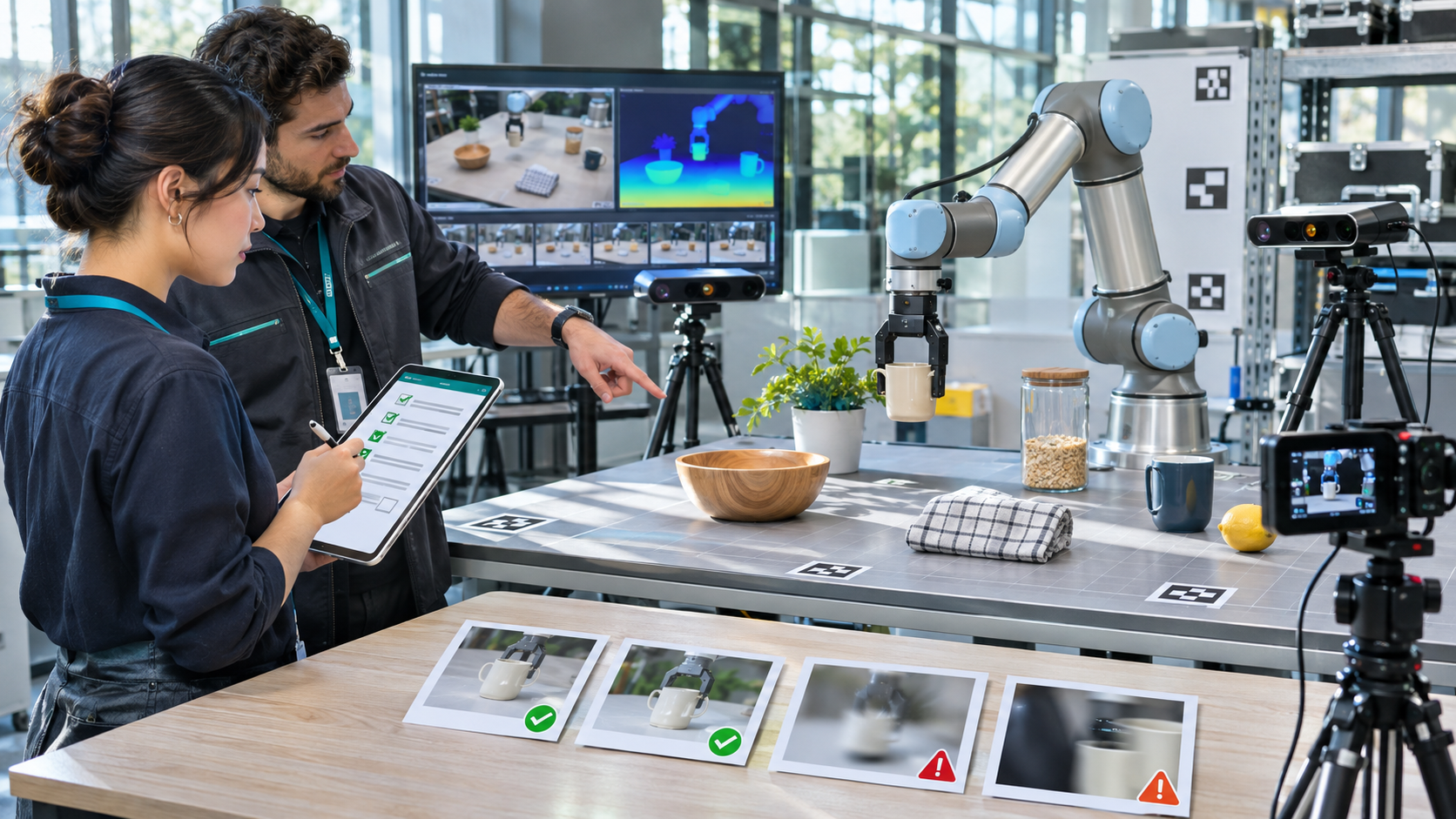
A reliable data collection workflow should identify and remove unsuitable recordings before delivery.
Quality assurance may include checking recording resolution, task completion, camera positioning, annotation accuracy, synchronization, and dataset completeness.
These processes increase upfront costs but help prevent unsuitable data from entering the training pipeline.
Licensing is an important but sometimes overlooked component of egocentric video pricing.
Organizations should confirm whether a dataset permits commercial model training, internal research, fine-tuning, redistribution, and the intended use of resulting models.
First-person recordings may also contain identifiable individuals, private environments, computer screens, or sensitive information.
Participant consent, privacy protection, and appropriate data-handling procedures should be included in the collection budget.
A lower-priced dataset may provide limited value if its licensing terms prevent the intended commercial application.
The amount of processing included in a dataset directly affects its price.
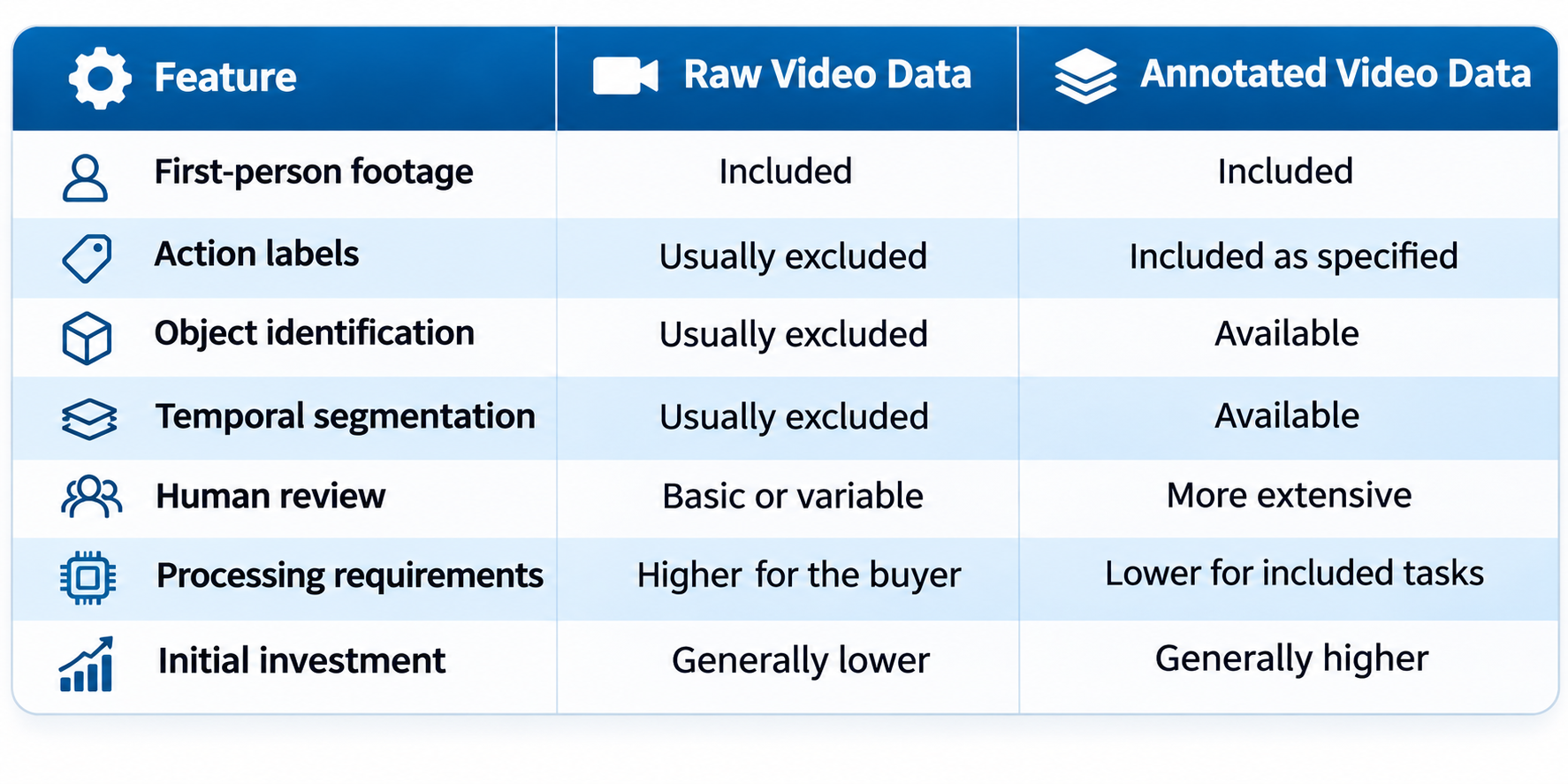
Raw video may be suitable for organizations with their own annotation infrastructure or models designed for self-supervised learning.
Annotated datasets can be more practical for teams that need structured training examples without building an extensive internal labeling operation.
Some providers publish hourly rates, while others offer customized quotations based on project requirements.
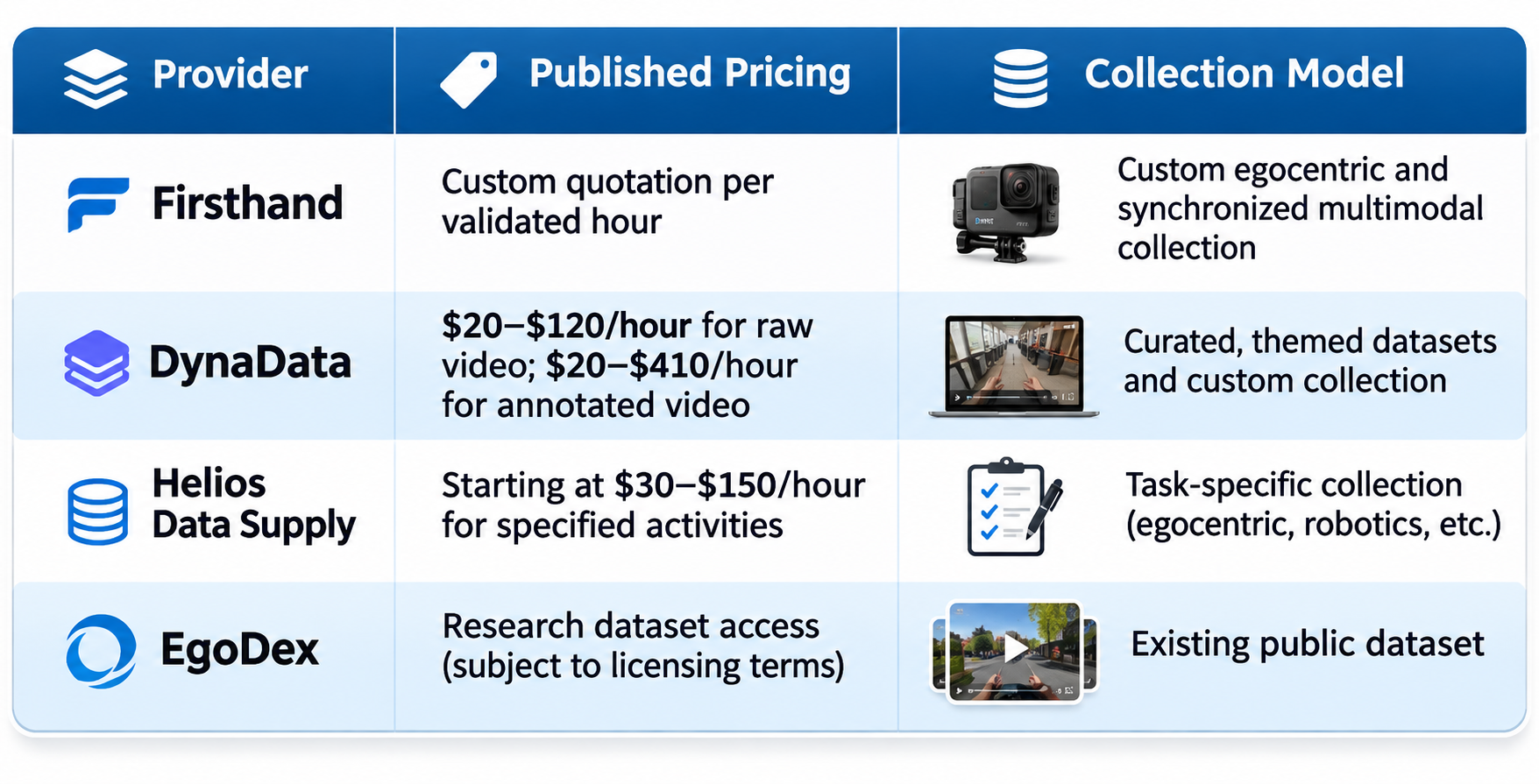
These examples are based on providers' published information and are not directly equivalent packages. Capture specifications, annotation coverage, exclusivity, and licensing conditions differ.
Firsthand+3
When comparing providers, determine whether the quoted price includes collection, annotations, validation, metadata, and commercial training rights.
The advertised hourly rate does not always represent the complete cost of preparing data for model training.
A practical budgeting formula is:
Total dataset cost = Collection + Annotation + Quality assurance + Licensing + Data preparation
Consider an AI company developing a robotic manipulation model that requires 1,000 hours of annotated first-person footage.
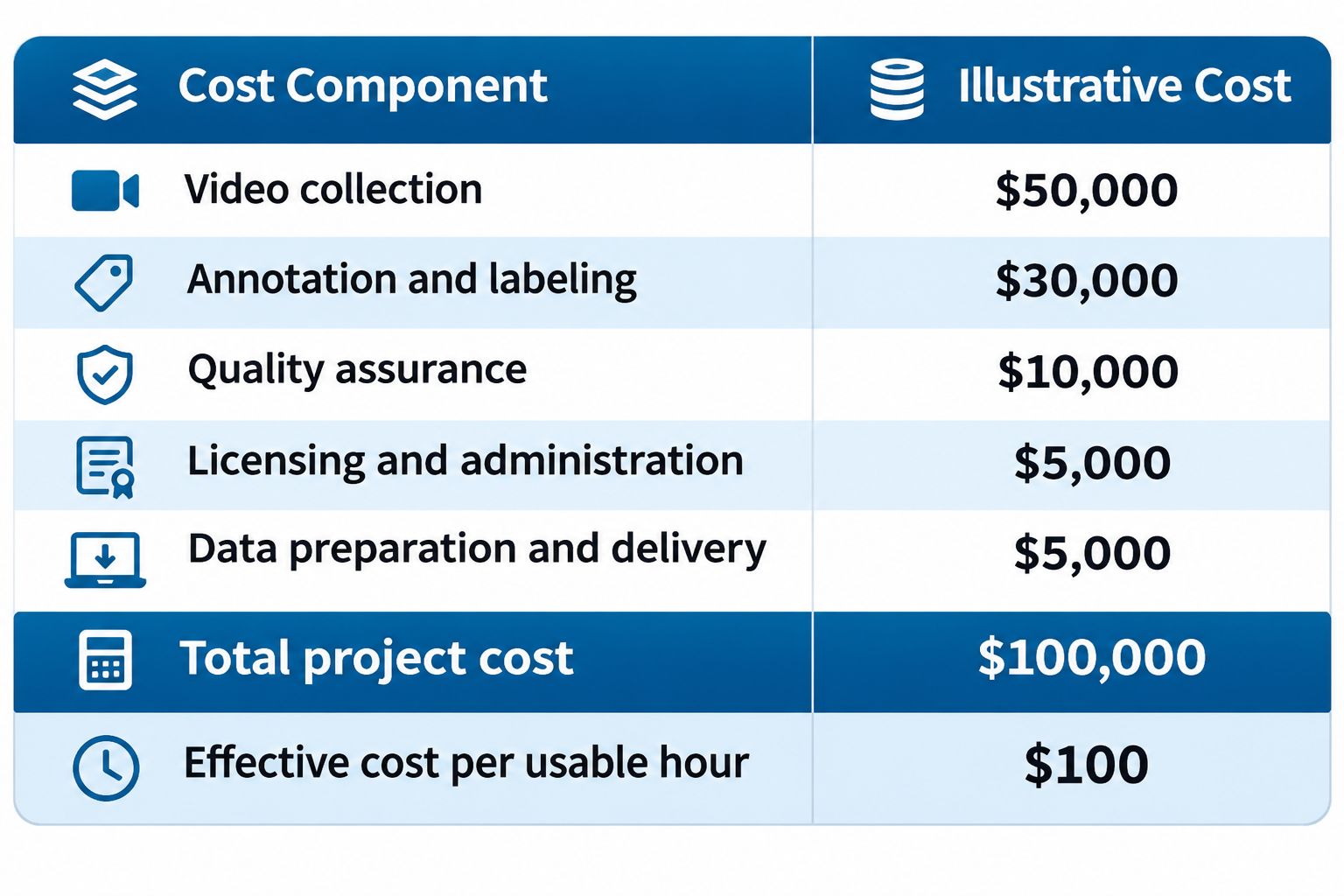
These figures are hypothetical and do not represent a specific provider quotation.
This approach to AI training data pricing helps organizations understand the complete investment rather than focusing exclusively on recording expenses.
One of the most important distinctions in egocentric data collection is the difference between recorded and validated footage.
Recorded hours represent everything participants capture. Validated hours represent footage that meets the project's acceptance criteria.
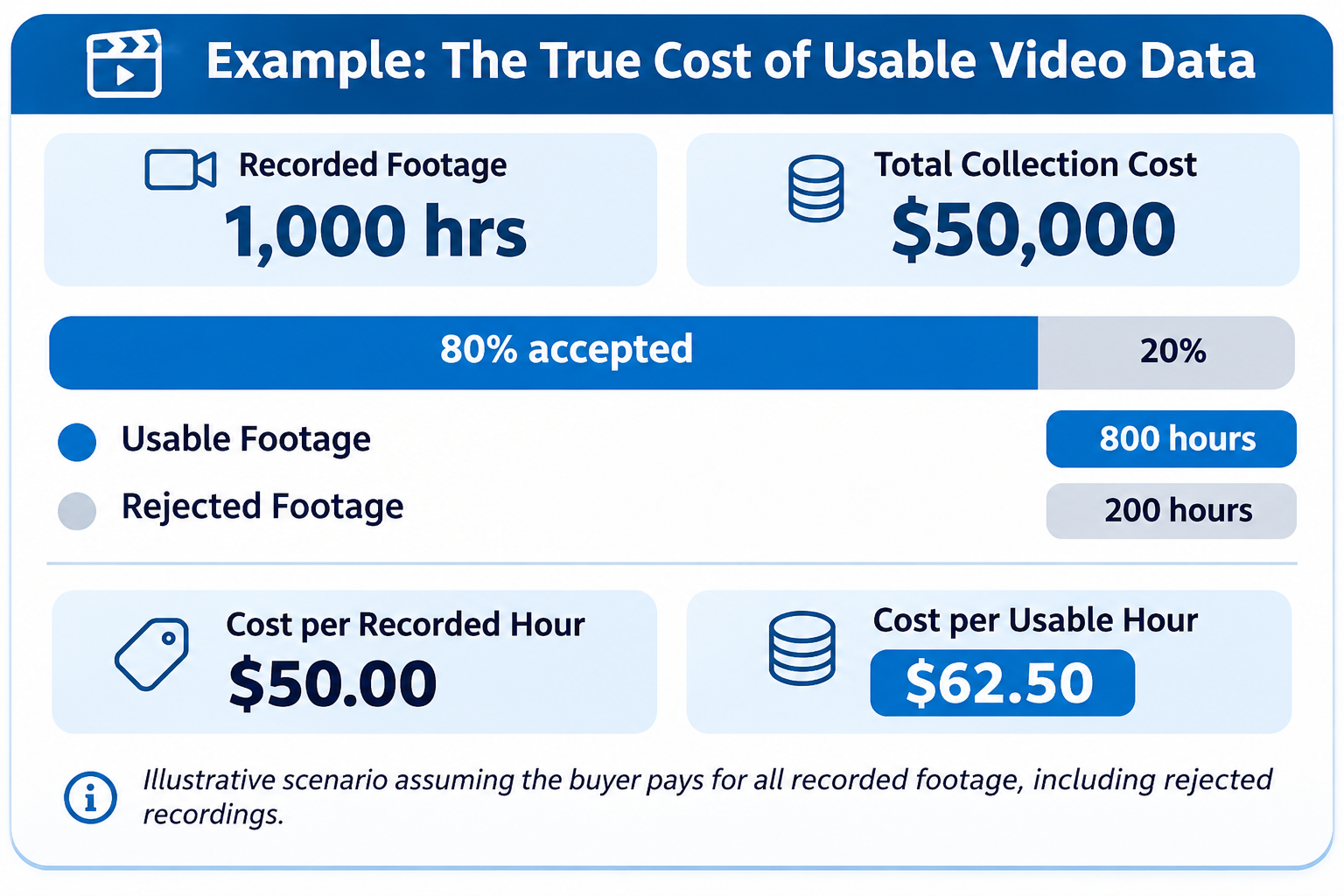
Although the original collection rate is $50 per recorded hour, the effective cost increases to $62.50 per usable hour.
Organizations should establish acceptance criteria before collection begins and clarify whether rejected recordings are billable.
Public datasets such as Ego4D provide valuable resources for exploring first-person perception and developing AI models.
Ego4D includes more than 3,600 hours of egocentric footage, with annotations and additional sensor modalities available for portions of the dataset.
Ego4D
However, existing datasets may not cover every task, environment, recording specification, or licensing requirement.
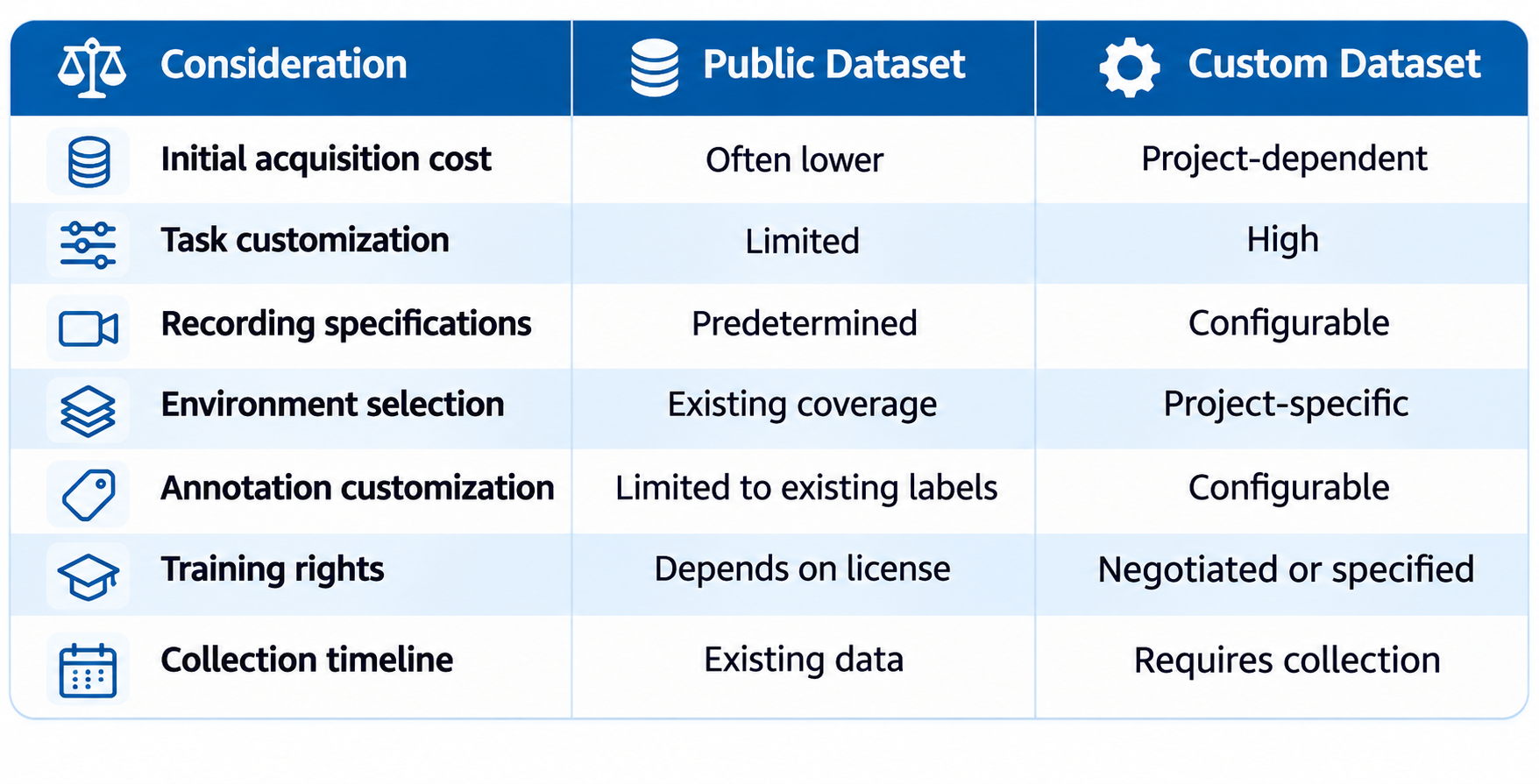
A combination of public and custom datasets can help organizations balance development costs with model-specific requirements.
When evaluating dataset providers, organizations should also account for expenses beyond the advertised collection rate.
These may include cloud storage, data transfer, video transcoding, annotation corrections, privacy redaction, dataset reformatting, and internal engineering work.
For large multimodal datasets, synchronized depth, pose, and motion data can further increase storage and infrastructure requirements.
Ignoring these expenses can lead to significant differences between the initial dataset budget and the final cost of model-ready training data.
Reducing costs should not mean collecting lower-quality data.
Organizations can improve their investment through several practical strategies:
A well-designed collection specification helps prevent expensive rework and unnecessary data acquisition.
A reliable provider should explain exactly how footage is collected, validated, annotated, licensed, and delivered.
Firsthand, for example, offers custom egocentric datasets for robotics and embodied AI, with pricing based on project specifications and validated video hours rather than a universal hourly rate.
Firsthand
Its collection model allows organizations to define their required tasks, environments, capture modalities, and delivery requirements.
When evaluating AI training data pricing, request sample footage and a detailed quotation before committing to a large collection program.
Explore Firsthand's egocentric video datasets to evaluate collection capabilities for your next AI training project.
The cost of egocentric video data depends on much more than recording duration.
Participant recruitment, specialized equipment, annotations, quality assurance, privacy protection, and commercial licensing all influence the final investment.
The most effective approach to AI training data pricing is to calculate the cost per usable, legally licensed, model-ready video hour.
By selecting a reliable collection provider and establishing clear dataset requirements, AI companies can reduce unnecessary expenses while acquiring high-quality training data that supports robotics, embodied AI, and multimodal model development.
Ready to build a first-person video dataset tailored to your model?
Explore Firsthand's custom egocentric video data collection services to discuss your requirements and request a project-specific estimate.
The cost depends on recording specifications, annotation requirements, licensing, and collection complexity. Some existing commercial datasets are advertised at $20–$40 per hour, while certain task-specific collections start at $90–$150 per hour. Specialized custom collection typically requires an individual quotation.
Annotated video requires additional processing to identify actions, objects, timestamps, hand movements, and other relevant information. Depending on annotation density, the process may involve automated labeling, human reviewers, domain experts, and multiple quality-control stages.
It depends on the dataset's license. Public availability does not automatically grant commercial training rights. Organizations should review the applicable license agreement, permitted uses, redistribution restrictions, and relevant participant-consent requirements before incorporating footage into commercial AI development.
Existing datasets can be less expensive because collection has already occurred. However, custom footage may offer better alignment with specific tasks, environments, camera configurations, and annotation requirements. The most cost-effective option depends on how closely the available data matches the model's needs.
Companies should define their target usable video hours, recording specifications, annotation requirements, quality standards, and licensing needs. Running a pilot collection can help establish realistic costs, identify potential quality issues, and improve budget estimates before scaling the project.


Compact, ready to go anywhere
Interchangeable lens that’s upgradeable
Dual 1-inch sensors for improved clarity and low light performance
Dynamic range and 6K 360° capture
360° photo resolution at 21MP

8K 360° video recording for ultra-detailed visuals.
4K single-lens mode for traditional wide-angle shots.
Invisible selfie stick effect for drone-like perspectives.
2.5-inch touchscreen with Gorilla Glass protection.
Waterproof up to 33ft for underwater shooting.

360° photo resolution in 23MP
Slim design at 24 mm thick
Built-in image stabilization for smooth video capture.
Internal 19GB storage for photo and video storage.
Wireless connectivity for remote control and sharing.

60MP 360° still images for high-resolution photography.
5.7K 360° video recording at 30fps.
2.25-inch touchscreen for intuitive control.
USB Type-C port for fast charging and data transfer.
MicroSD card slot for expandable storage.


Try it free. No credit card required. Instant set-up.