


.png)


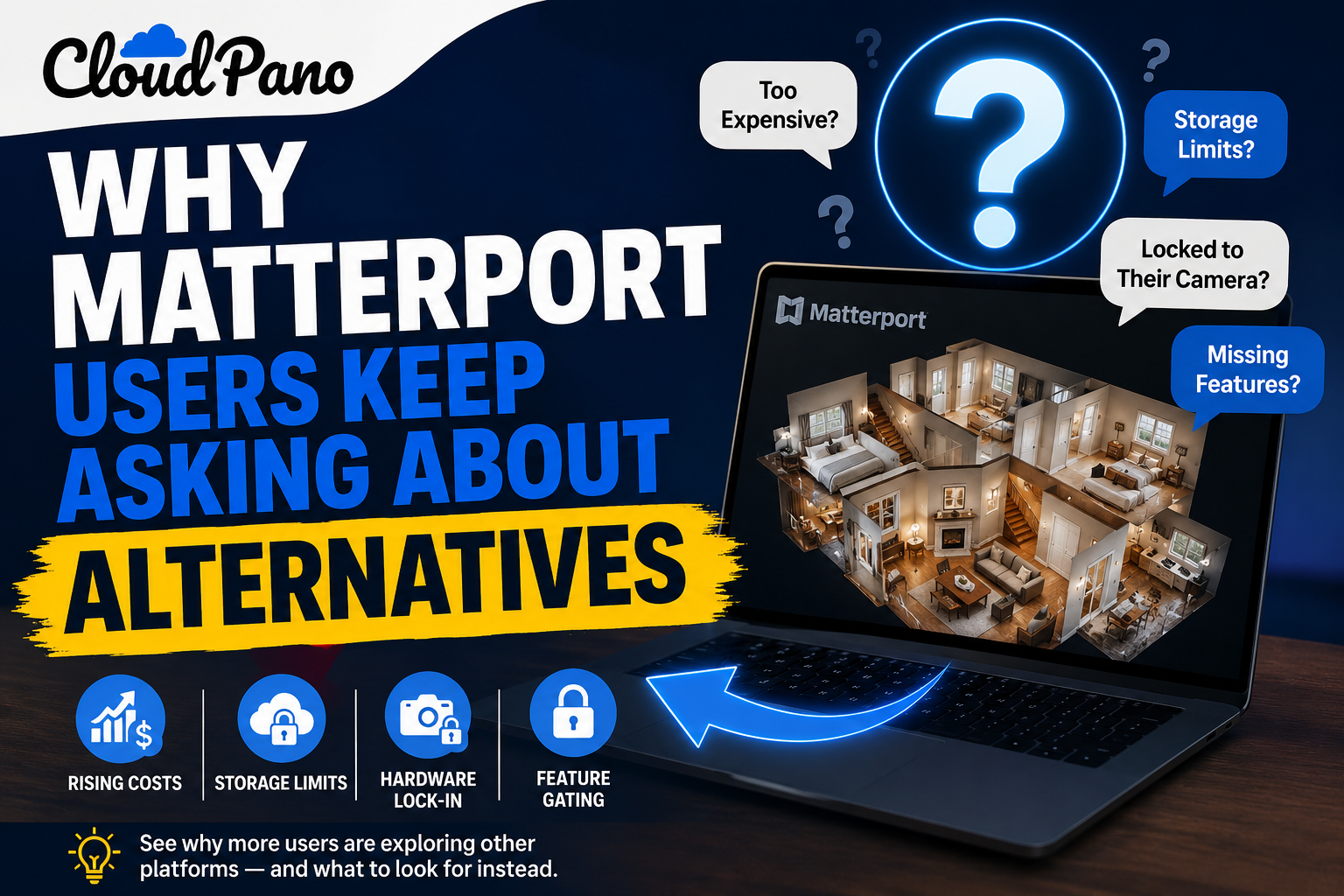
If you've found yourself quietly searching for alternatives to a platform you're already using, it can feel like an odd position to be in — you're not necessarily ready to switch, you're just curious whether the frustration you're feeling is unusual or widely shared. It turns out Matterport complaints cluster around a handful of specific, recurring themes, which is worth knowing whether you're seriously considering a change or just trying to understand your own reaction better.
Matterport has a large, established user base, which naturally means a large volume of feedback exists — some of it glowing, some of it frustrated. What's notable isn't that complaints exist (every widely-used platform has them), but that they tend to cluster around the same few specific issues rather than being scattered randomly across every possible aspect of the product. That clustering is actually useful information: it suggests structural patterns worth understanding, rather than isolated bad experiences.

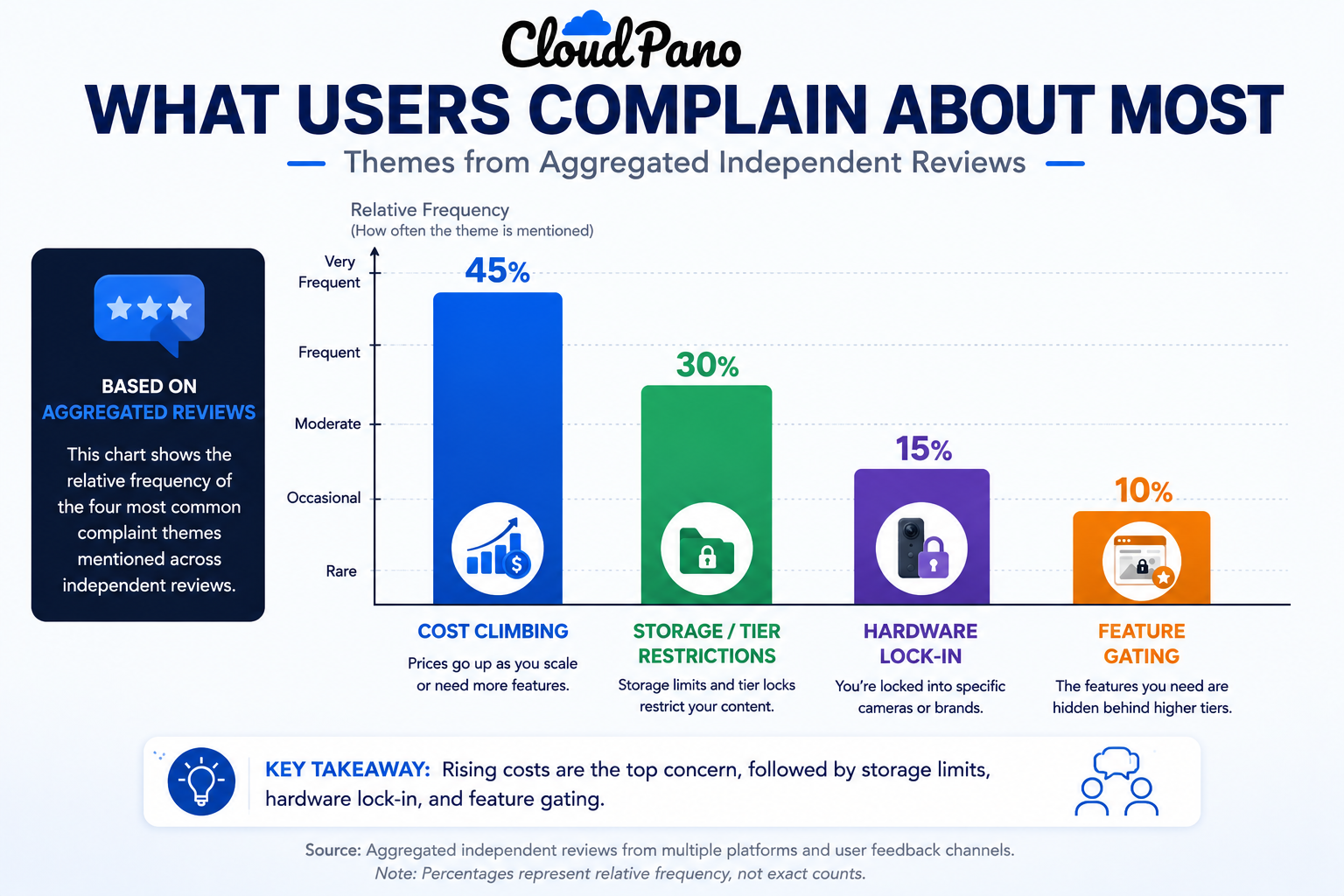
Across independent reviews and community discussion, Matterport problems tend to fall into a few recurring categories rather than an endless, unstructured list:
Cost that climbs faster than expected. This is probably the single most commonly cited theme — a pricing structure that ties cost to a growing library of tours, meaning cost pressure increases over time even without a dramatic change in usage pattern.
Storage and tier restrictions. Related to cost, but distinct: complaints about needing to upgrade a full plan tier to accommodate a relatively modest increase in tour volume, rather than a smaller incremental charge.
Hardware lock-in. Frustration from users who've invested in camera equipment outside Matterport's own ecosystem and find compatibility more limited than expected.
Feature gating. Specific features assumed to be standard turning out to require a higher tier — analytics depth and team seat limits come up particularly often in this category.
Beyond the broad themes above, a few specific Matterport limitations come up repeatedly enough to be worth naming directly:
Team and account management can feel restrictive for businesses that grow past a small, single-user setup, particularly around permission granularity for agencies managing multiple clients under one account.
Export and data portability, covered in more depth in our dedicated article on this topic, is more limited than many users initially assume — the finished interactive tour generally doesn't transfer cleanly to another platform, even if some underlying source material does.
Bandwidth and delivery behavior under real traffic conditions is another area where expectations and reality sometimes diverge, particularly for high-traffic listings or widely-shared tours.
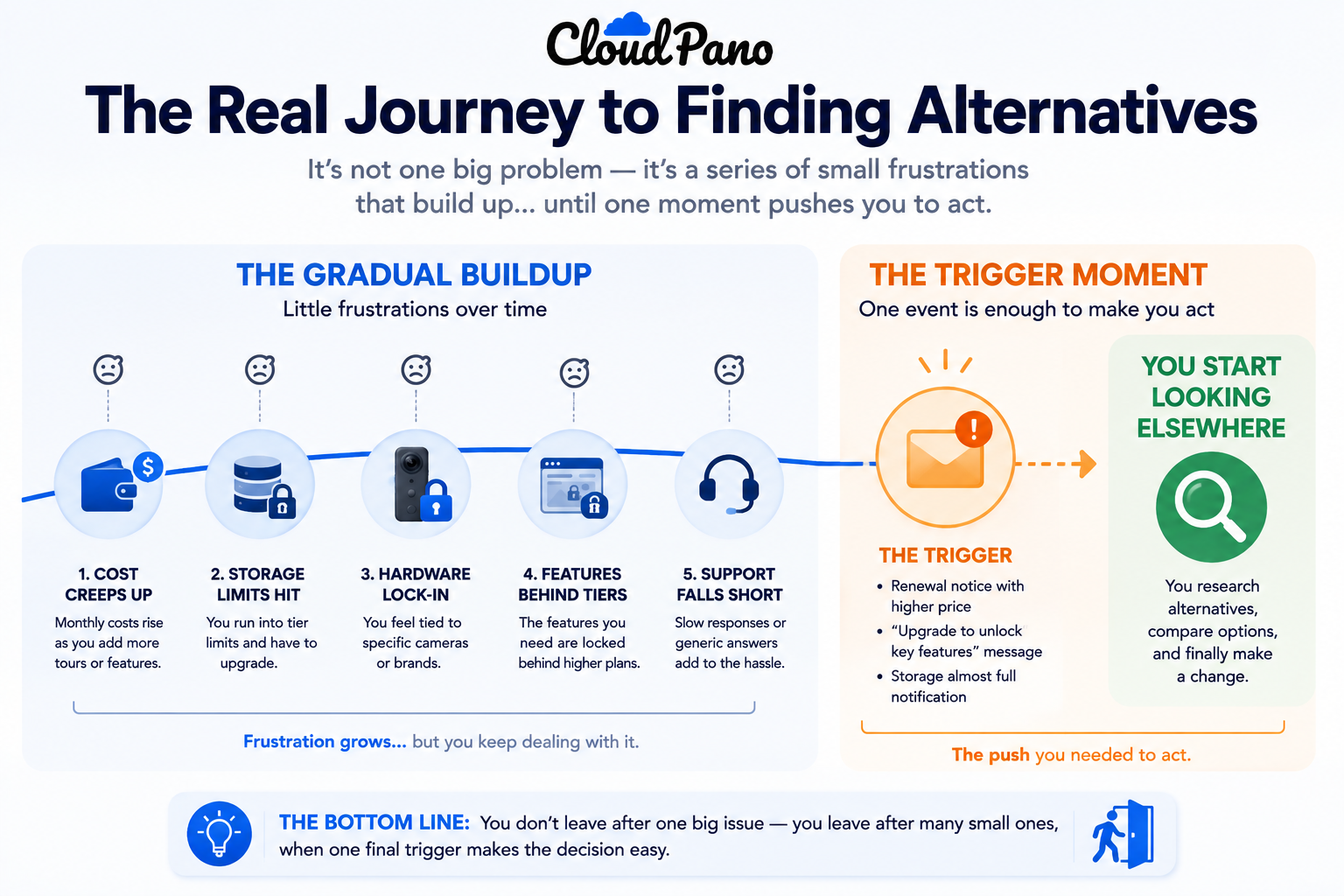
Understanding why leave Matterport actually happens, rather than just staying frustrated, is useful context. It's rarely a single dramatic incident — it's typically an accumulation of the themes above reaching a point where the ongoing friction outweighs the comfort of staying with a familiar platform. A renewal notice with a higher-than-expected price often serves as the final trigger, even when the underlying frustration had been building for a while beforehand.
This pattern — slow accumulation, sudden trigger — is worth recognizing in your own situation if you're trying to figure out whether your current frustration is a passing annoyance or something more structural.
One notable thing about these themes is how consistently they show up across otherwise very different businesses — a solo real estate agent, a hospitality brand, a museum, and an agency managing dozens of clients don't have much in common day to day, yet they tend to report strikingly similar frustrations once their tour volume or team size grows past a certain point. This consistency is itself informative: it suggests these aren't quirks of any particular industry or use case, but structural properties of how the platform is built and priced.
This is also why why leave Matterport discussions tend to sound so similar across completely unrelated online communities — a real estate forum and a hospitality industry group, despite having almost nothing else in common, frequently surface the same handful of complaints once someone in either group starts actively comparing notes with others who've hit a similar wall.
It's worth stepping back from the specific list above to make one broader point: recognizing that your experience fits a recognized pattern of Matterport complaints is more useful than trying to resolve each individual frustration one at a time. Someone who successfully negotiates a better rate at renewal, for instance, has addressed the cost symptom without necessarily addressing the underlying structural pattern — the same tension is likely to resurface at the next renewal, or the one after that, since the pricing model itself hasn't changed.
This is why understanding these as a pattern, rather than a series of unrelated one-off frustrations to be individually managed, matters. It reframes the question from "how do I fix this specific problem" to "does the underlying structure of this platform actually fit how my business operates," which is a more useful question to be asking if you're several renewal cycles into a relationship with any platform, not just Matterport specifically.
On G2's Matterport review page, the recurring themes above show up consistently across many independent reviewers, which is a stronger signal than any single review in isolation — patterns that repeat across dozens of unrelated reviewers are more reliable than one person's specific experience.
Community discussions on r/Matterport and r/realtors offer a more informal, ongoing version of the same pattern — users regularly discussing the same handful of frustrations, often independently arriving at similar conclusions about where the platform falls short for their specific use case.
Capterra's Matterport listing similarly reflects these same recurring themes when filtered for critical reviews specifically, reinforcing that this isn't a fringe reaction but a fairly consistent pattern across a meaningful share of the user base.

"If it's this widely criticized, why does Matterport still have so many users?"
Because these complaints, while real and recurring, aren't universal or necessarily dealbreakers for every business. Matterport still offers genuine strengths — brand recognition, capture quality, an established ecosystem — that outweigh these frustrations for plenty of users, particularly those with stable, modest tour volume and equipment already matched to its ecosystem. The complaints are worth taking seriously, not as a verdict that the platform is universally bad, but as signals about who it fits well and who it doesn't.
"Does having some of these complaints mean I should definitely switch?"
Not automatically. It means these are worth checking against your own specific situation. If your tour volume is growing, if you've hit a tier upgrade that felt disproportionate, or if you've run into a feature gate that surprised you, that's a meaningful signal. If none of these themes resonate with your actual experience, your frustration might be circumstantial rather than structural.
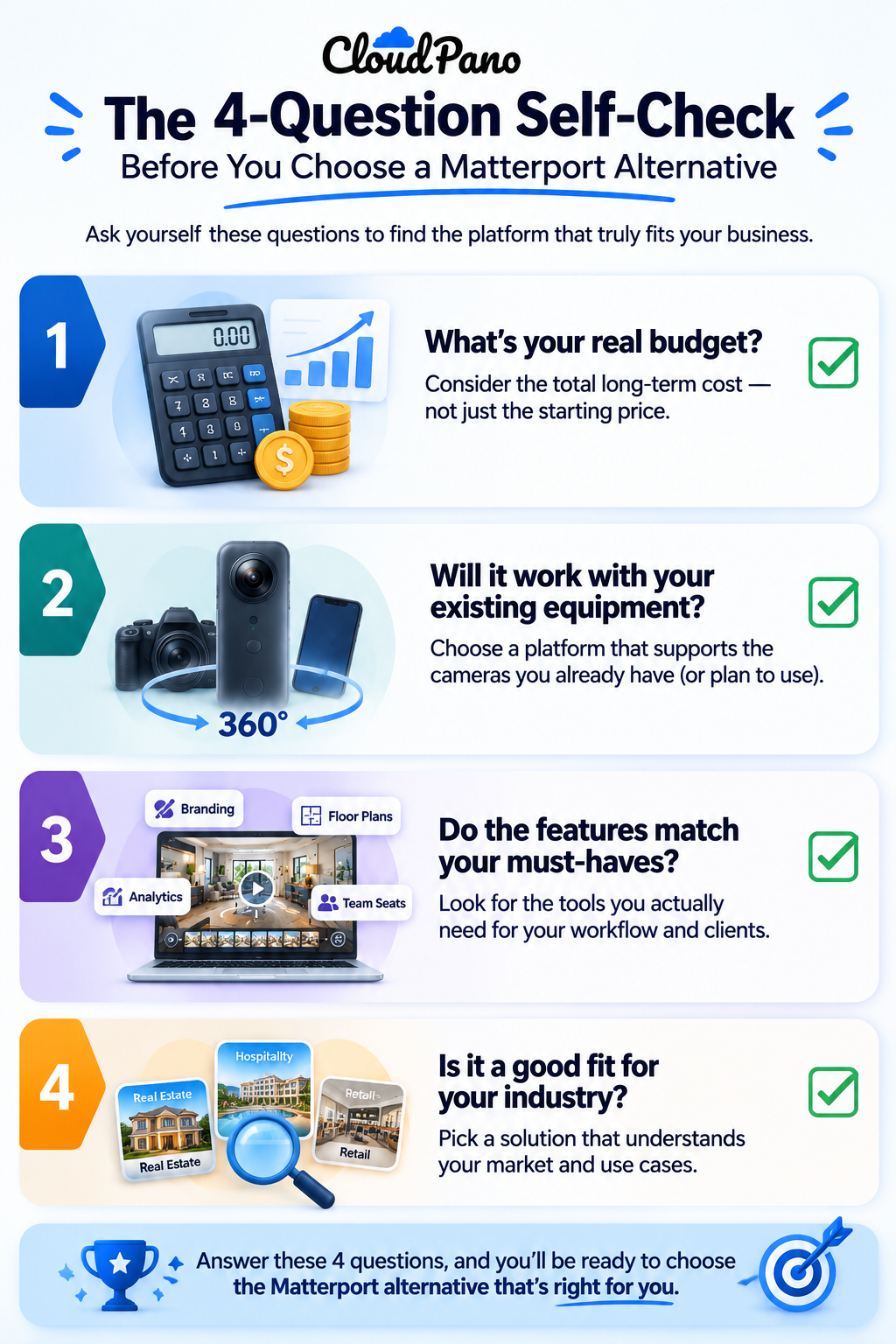
If you're trying to figure out whether your own frustration fits this broader pattern:
Answering yes to two or more suggests your frustration is part of a recognized, common pattern rather than an isolated issue — worth taking seriously as you decide what to do next.
If you've been wondering whether your frustration with Matterport is unusual, the honest answer is: probably not. The most common complaints cluster around cost predictability, tier restrictions, hardware lock-in, and feature gating — recurring themes across a large volume of independent, unrelated feedback. Recognizing your own experience in these patterns doesn't obligate you to switch anything, but it does mean you're not overreacting to something imagined.
If these patterns sound familiar and you're curious what else is out there, our guide on choosing the right Matterport alternative walks through a framework for evaluating your options properly, rather than just picking whatever's ranked first on a generic list. And if it turns out your frustration is mostly about cost specifically, our deeper look at how Matterport's pricing model actually works is worth reading before you decide anything.


Compact, ready to go anywhere
Interchangeable lens that’s upgradeable
Dual 1-inch sensors for improved clarity and low light performance
Dynamic range and 6K 360° capture
360° photo resolution at 21MP

8K 360° video recording for ultra-detailed visuals.
4K single-lens mode for traditional wide-angle shots.
Invisible selfie stick effect for drone-like perspectives.
2.5-inch touchscreen with Gorilla Glass protection.
Waterproof up to 33ft for underwater shooting.

360° photo resolution in 23MP
Slim design at 24 mm thick
Built-in image stabilization for smooth video capture.
Internal 19GB storage for photo and video storage.
Wireless connectivity for remote control and sharing.

60MP 360° still images for high-resolution photography.
5.7K 360° video recording at 30fps.
2.25-inch touchscreen for intuitive control.
USB Type-C port for fast charging and data transfer.
MicroSD card slot for expandable storage.
.png)

.png)

Try it free. No credit card required. Instant set-up.







.svg)


.svg)