


.png)



Better data can improve AI performance by giving a model relevant examples, consistent labels, and coverage of the conditions it will face in real use. A bigger model may provide more capacity, but it cannot reliably compensate for missing examples or a misleading evaluation set. Model size and data both matter; teams should diagnose the source of errors before deciding where to invest.
When an AI system makes a mistake, it is tempting to look for a more powerful model. Maybe the current model needs more parameters, a newer architecture, or a larger training run.
Sometimes it does. But a bigger model cannot learn an example it has never encountered. It cannot reliably resolve contradictory labels, and it cannot tell a team that its test dataset bears little resemblance to the people or conditions the product will meet after launch.
That is why data quality can matter more than model size for a specific AI project. The question is not simply how much data a team has. It is whether that data represents the task, describes it accurately, and gives the team a dependable way to measure progress.
Research on model scaling shows that model size, training data, and compute all influence performance. In Google DeepMind’s compute-optimal language model research, a smaller model trained on substantially more data outperformed a much larger model trained with the same compute budget on nearly every task the researchers measured. That result does not mean smaller models always win. It shows why investing in model size alone can be the wrong allocation of resources. Google DeepMind
For teams building a useful AI product, the practical lesson is straightforward: investigate the data before assuming that a larger model will solve the problem.
Better data is data that helps a model learn and perform the intended task more reliably. It is not necessarily the cleanest-looking dataset or the dataset with the most records.
A useful training dataset has several qualities:
These qualities work together. A dataset can have accurate labels yet still be unsuitable because it contains only easy examples. Another can have impressive variety but inconsistent annotations that make the intended answer unclear.
The standard is not perfection. It is fitness for the job the model must do.
Imagine a computer vision model designed to identify safety hazards in workplace video. Its training footage shows well-lit rooms, unobstructed cameras, and workers wearing clearly visible equipment. During deployment, it encounters dim storage areas, crowded scenes, unusual camera angles, and equipment partly hidden behind other objects.
A larger model might extract more from the examples it was given. But scaling the model does not create the missing footage of those difficult conditions. If the team has not captured or evaluated them, it may not even know how often the system fails there.
This is a coverage problem. The next useful step is to identify which real-world conditions are absent and gather relevant examples.
The same issue appears in other fields. A speech system trained mostly on quiet recordings may struggle in noisy environments. A document model trained on neat digital forms may struggle with photographed paperwork. A customer support classifier may perform well on common requests while repeatedly mishandling a rare but important issue.
In each case, “train a bigger model” skips a more specific question: What does the model need to see to perform this task well?
For a closer look at how data moves from collection and annotation through quality checks and validation, see The AI Training Data Pipeline Explained.
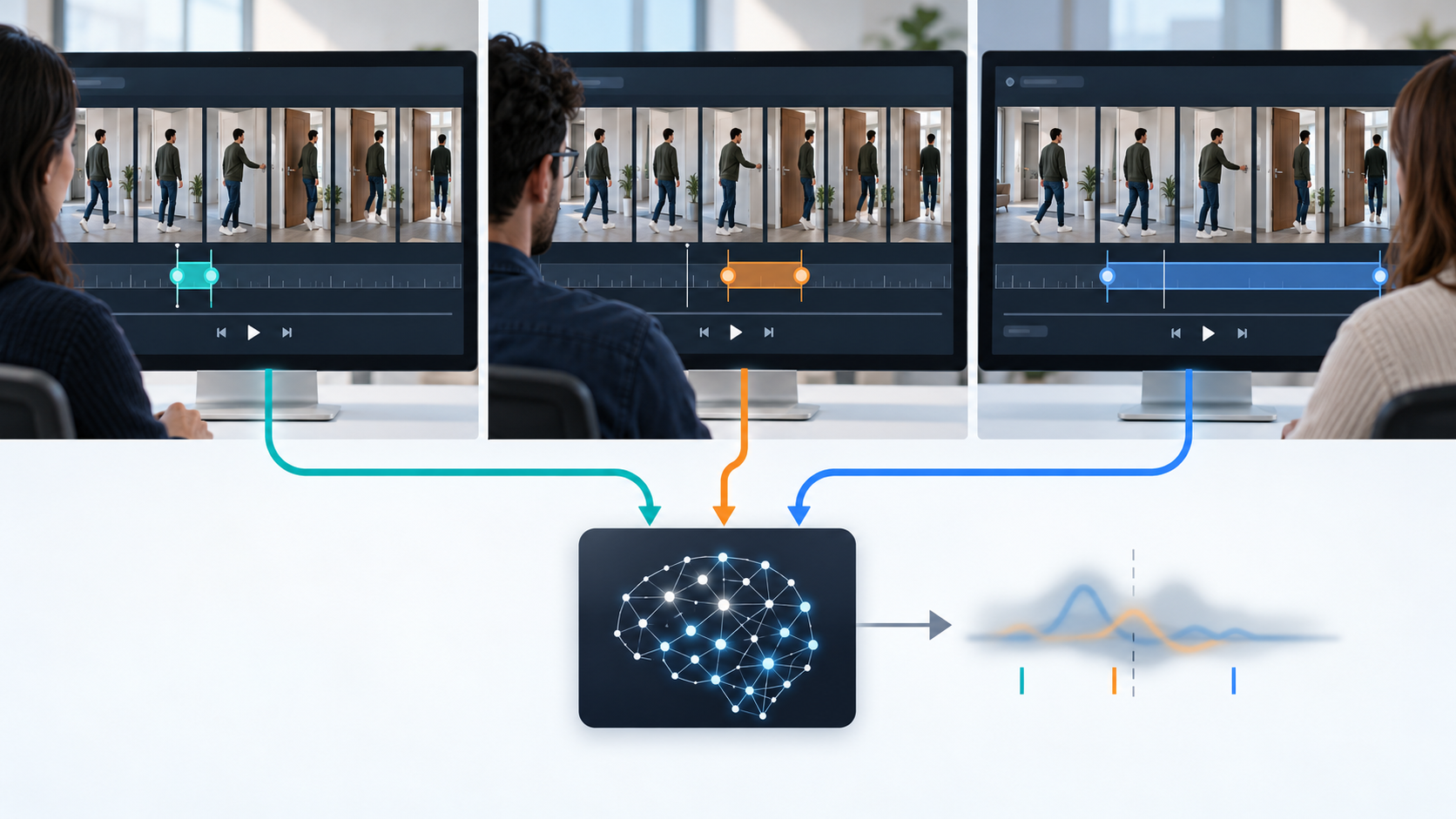
Coverage is only part of the problem. For supervised learning, the labels attached to examples also matter.
Suppose a team is teaching a model to recognize when someone opens a door in a video. One annotator marks the moment a hand touches the handle. Another marks the moment the door begins to move. A third marks the entire sequence, from approaching the door to walking through it.
All three may believe they are labeling “door opening.” To the model, however, those labels describe different events. Adding more similarly inconsistent examples can make the dataset larger without making the task clearer.
A stronger dataset starts with a precise definition. The team might decide that the event begins when the door first moves and ends when the person releases it. Annotators can then work from the same rule, reviewers can check difficult cases, and the model can learn a more consistent target.
This does not mean every disagreement has an easy answer. Some examples are genuinely ambiguous. Those cases should be recorded and resolved deliberately, especially when they affect an important product decision. A clear annotation guide, review process, and record of edge cases are often more useful than another round of model tuning.
Teams planning that work can use CloudPano’s guide to data annotation types and tools to distinguish among classifications, bounding boxes, timestamps, and other forms of labeling.
Dataset size matters. Models often need substantial amounts of data to learn useful patterns, and a small dataset may leave too much variation unseen. But counting records tells only part of the story.
Picture two video datasets with the same number of clips. One contains many near-identical recordings from a single camera in one building. The other contains fewer repeated scenes and more variation in viewpoint, lighting, location, and behavior. If the product must work across different buildings, the second dataset may be more informative despite having the same number of files.
Repetition can also hide gaps. A dashboard might report hundreds of thousands of images while a rare failure condition appears only a handful of times. Until the team breaks performance down by relevant conditions, the headline count can create false confidence.
Large-scale research gives teams a reason to examine dataset composition carefully. The DataComp benchmark was designed to study how image–text dataset choices affect trained models while using standardized training and evaluation procedures. The FineWeb research documents how filtering and deduplication decisions affect web-text datasets used for language model training. Neither result provides a universal recipe for every AI application, but both treat data preparation as a consequential part of model development. papers.neurips.cc
The goal is not to discard data simply because a smaller dataset sounds more efficient. It is to understand which records add useful information, which repeat what the model already sees, and which may introduce avoidable errors.
A model can score well overall and still fail where people need it most.
Consider an evaluation set made up mostly of straightforward examples. A high average score may look reassuring, while performance on low-light footage, unfamiliar accents, or partially obscured objects remains poor. If those conditions occur in the product, the average is an incomplete description of quality.
Better evaluation data makes failures visible. Teams can group examples by conditions that matter to the application, then compare results across those groups. For a video model, those groups might include camera angle, lighting, scene complexity, and action duration. For a document model, they might include scan quality, language, document layout, and handwritten versus typed content.
The important choice is to define these groups around actual use, rather than creating a checklist that looks thorough but has little connection to deployment.
Teams should also keep training, validation, and test data appropriately separated. If near-duplicate examples appear across them, a model may seem to perform better than it does on genuinely new material. The final evaluation set needs to challenge the system in ways that reflect its intended use.
“Accuracy needs to improve” is a goal, but it is not a diagnosis. Data analysis can turn it into a set of questions a team can act on:
The answer determines what to do next. A coverage gap may call for new collection. Inconsistent ground truth may call for an annotation guide and review. Poor results across well-represented, consistently labeled cases may justify changes to the model or training approach.
This is why data work is part of the engineering process, not merely preparation before “real” model development. A team that can describe a failure precisely can spend its next training cycle on a specific improvement.
For an overview of how collection, labeling, validation, and evaluation fit together, see What Are AI Training Data Services?.
The argument for better data has a limit: data quality does not make model capacity irrelevant.
Some tasks require stronger reasoning, broader language ability, or the ability to handle more complex inputs than a particular model can provide. A team may have well-designed data and still find that its chosen model cannot learn the required patterns at an acceptable level.
Data volume matters too. Google DeepMind’s compute-optimal training findings illustrate that model size and training tokens should be considered together within the training budget. Earlier OpenAI research on neural language model scaling likewise found relationships among model size, dataset size, and compute. These are findings about model training, not proof that any one data intervention will outperform any model upgrade on every task. Google DeepMind
A sensible decision is therefore based on evidence from the application. If failures cluster around missing or mislabeled cases, improve the data. If performance remains limited on a representative, carefully evaluated dataset, test whether a different model or training strategy helps.
The point is to avoid using model size as a substitute for diagnosis.
Teams do not need to rebuild an entire dataset at once. A focused improvement cycle can start with the errors the current system already makes.
Write down what the model must predict or produce, where it will be used, and which mistakes matter most. “Recognize activities in video” is broad; “identify the start and end of specific activities in indoor footage” is easier to collect, label, and evaluate against.
Review a sample of incorrect predictions. Group them by meaningful variables such as location, lighting, device, language, scene type, or user behavior. Look for patterns rather than treating every error as an isolated case.
Compare what is in the dataset with what appears in deployment. Check whether a large record count is dominated by similar examples. Identify important conditions that are missing or thinly represented.
Sample annotated examples, including difficult ones. Check whether the labels follow the written rules and whether those rules are clear enough for another annotator to apply. Resolve recurring disagreements and document the decision.
Collect or select examples that address the gaps found in the audit. If the model struggles with an unusual viewpoint, gather that viewpoint. If it fails on a particular document layout, include that layout. Targeted additions give the team a clearer hypothesis to test than simply adding another batch of general data.
Measure overall performance and performance on the conditions identified as important. Keep the test set separate from training, and check for duplicates that could make the result misleading.
After the data changes are evaluated, test whether a model upgrade offers additional value. Compare results on the same relevant measures, alongside the costs of training, deployment, and maintenance.
This process creates a useful feedback loop: observe failures, improve the data or model for a stated reason, and measure whether the change helped.
An AI dataset is not finished simply because the first model has launched. New users, devices, locations, and behaviors can reveal cases that were absent from the original collection. Definitions may change as a product becomes more precise about what it needs to detect or generate.
That makes data quality an ongoing practice. Teams need a way to capture failures, decide which examples are valuable, update labeling rules, and evaluate the next version against real use. The work may be less visible than announcing a bigger model, but it directly shapes whether the system performs its job.
Better data matters more than bigger models when the main obstacle is what the model is being shown, taught, or measured against. A larger model can be valuable once those foundations are sound. Before investing in one, find out whether the current model is missing the examples and guidance it needs to succeed.
It can in a particular application, especially when the existing model’s errors come from missing examples, inaccurate labels, or a mismatch between training data and real use. The result should be tested rather than assumed.
No. Additional data can help when it adds useful coverage or volume. Repeated, irrelevant, or incorrectly labeled examples may add little value and can make problems harder to identify.
Common signs include recurring errors under specific conditions, disagreement between annotators, large numbers of near-duplicates, missing edge cases, and a gap between test results and performance after launch.
Start by reviewing model failures. Check whether the dataset covers those cases, audit labels and annotation rules, add targeted examples, and measure the result on a separate test set that reflects real use.
Consider a bigger or different model when representative data and dependable evaluation show that the current model still cannot meet the task’s requirements. Compare the gain with its training and operating costs.


Compact, ready to go anywhere
Interchangeable lens that’s upgradeable
Dual 1-inch sensors for improved clarity and low light performance
Dynamic range and 6K 360° capture
360° photo resolution at 21MP

8K 360° video recording for ultra-detailed visuals.
4K single-lens mode for traditional wide-angle shots.
Invisible selfie stick effect for drone-like perspectives.
2.5-inch touchscreen with Gorilla Glass protection.
Waterproof up to 33ft for underwater shooting.

360° photo resolution in 23MP
Slim design at 24 mm thick
Built-in image stabilization for smooth video capture.
Internal 19GB storage for photo and video storage.
Wireless connectivity for remote control and sharing.

60MP 360° still images for high-resolution photography.
5.7K 360° video recording at 30fps.
2.25-inch touchscreen for intuitive control.
USB Type-C port for fast charging and data transfer.
MicroSD card slot for expandable storage.
.png)

.png)

Try it free. No credit card required. Instant set-up.






.svg)


.svg)