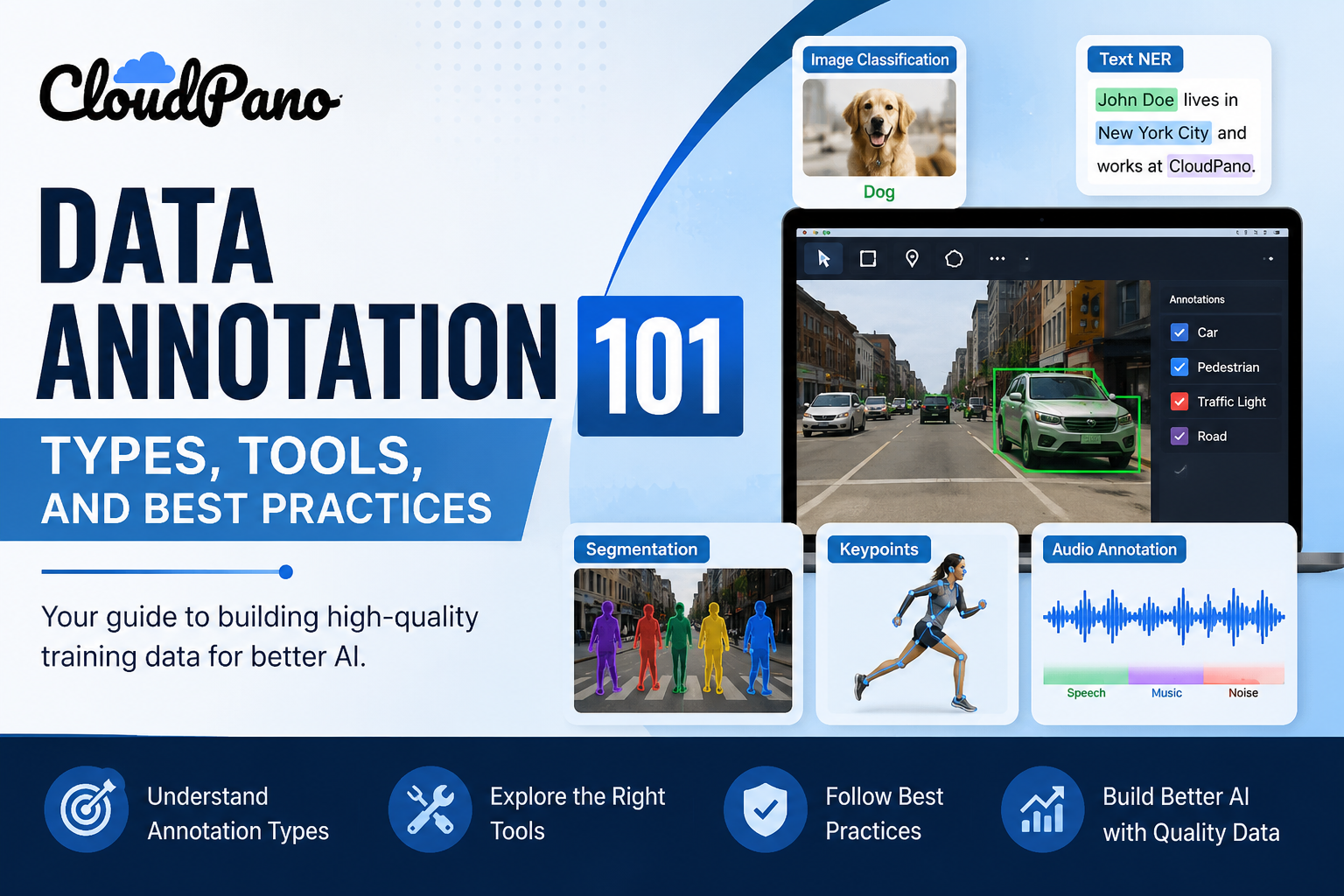
Data Annotation 101: Types, Tools, and Best Practices

Cloudpano
July 17, 2026
5 min read
Share this post

Data Annotation Types and Tools: A Practical Guide for AI Teams

Every supervised machine learning model is only as good as the labels behind it. Before a computer vision system can detect a pedestrian or an LLM can flag toxic text, a human — or a human-supervised pipeline — has to tell the model what "correct" looks like. That process is data annotation, and understanding data annotation types and tools is the first real decision point for any AI team building a training dataset.

This guide breaks down the major annotation types, the tools built for each, and the pricing models that determine what a dataset will actually cost — information that gets glossed over in most introductory content but that shapes budget and timeline decisions from day one.

Why It Matters

Annotation quality has a direct, measurable relationship to model performance. A dataset with inconsistent labels doesn't just underperform — it can actively teach a model the wrong pattern, and that error compounds every time the model retrains on similar data.

This is why organizations like the National Institute of Standards and Technology treat data quality as a core pillar of AI risk management, not an afterthought. Their AI Risk Management Framework explicitly calls out training data provenance and labeling consistency as risk factors that need documentation, not just execution.

Cost is the second reason this matters. AI data collection cost varies enormously depending on annotation type, data modality, and required accuracy — and teams that don't map this out early tend to blow through their budget by the pilot stage.

  • Simple classification tasks cost far less per unit than pixel-level segmentation
  • Domain expertise (medical, legal, technical) adds a premium regardless of tool
  • Quality assurance passes (multi-annotator consensus, expert review) can double effective cost per label
Bar chart comparing relative AI training data pricing across annotation types

How It Works

Data annotation follows a consistent underlying logic even though the surface work looks different across modalities:

  1. Raw data is ingested — images, video, text, audio, LiDAR point clouds, or sensor logs
  2. A task schema is defined — what labels exist, what counts as an edge case, what the annotator should do when data is ambiguous
  3. Annotators (human, AI-assisted, or hybrid) apply labels using this type of data annotation work through a dedicated tool
  4. Quality control reviews the output — spot-checks, consensus scoring, or automated validation rules
  5. Labeled data is exported in a model-ready format (COCO JSON, YOLO, CoNLL, etc.)
Infographic showing eight common data annotation types and tools for AI

The tool layer matters because different annotation types demand different interfaces. A bounding-box tool for object detection looks nothing like a transcript-alignment tool for speech data, and using the wrong tool for the task slows annotators down and introduces error.
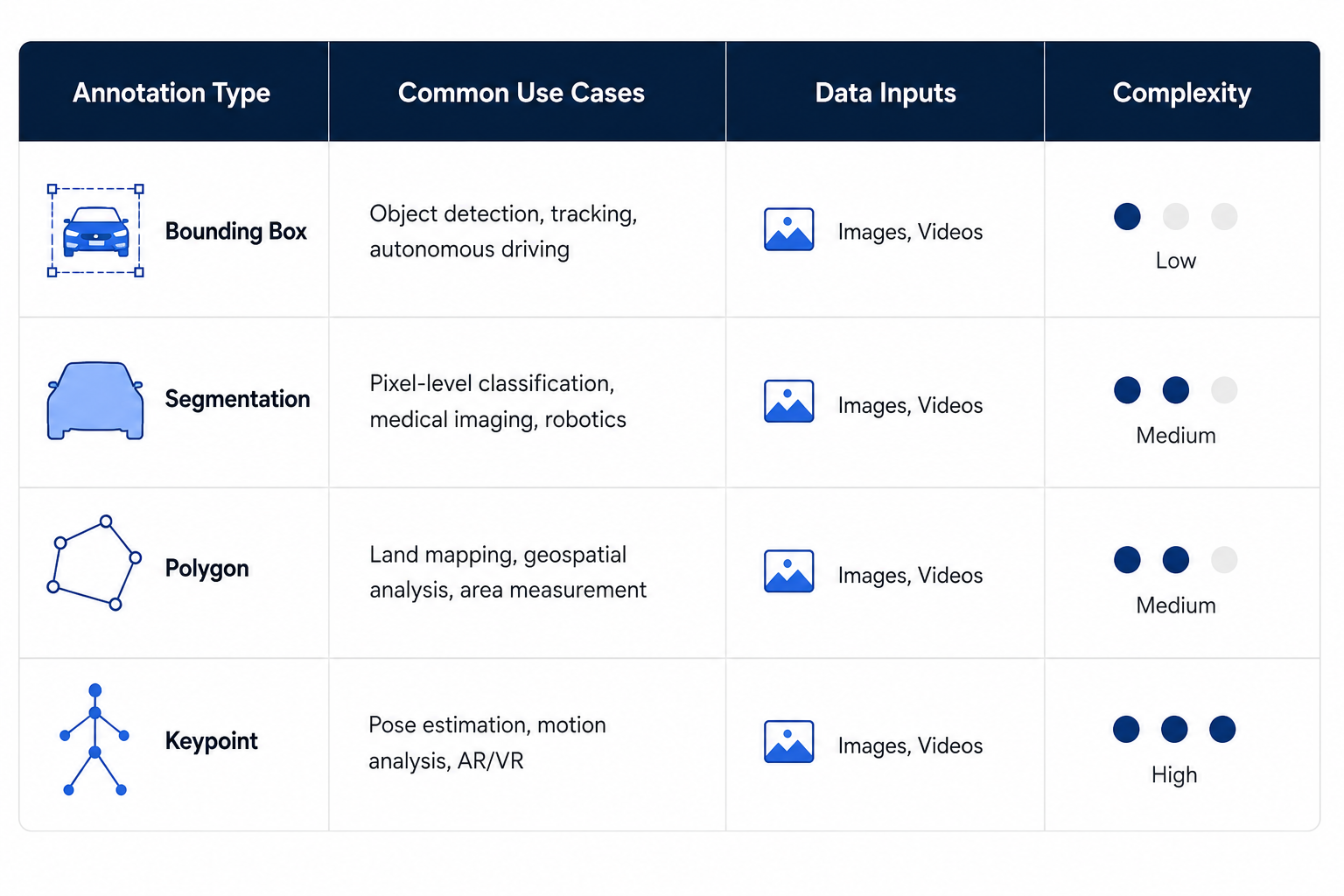
Comparison table of data annotation tools by category and pricing model

🏷️ Common Annotation Types Reference

A quick reference for what each annotation type captures and where it's used.

Type What It Captures Typical Use Case
📦 Bounding box Rectangular object location Object detection, retail shelf audits
🎯 Semantic segmentation Pixel‑level class boundaries Autonomous driving, medical imaging
🔷 Polygon annotation Irregular object shapes Agriculture, satellite imagery
📍 Keypoint / landmark Specific points on a subject Pose estimation, facial analysis
📝 Named entity recognition Entities within text NLP, document processing
❤️ Sentiment / intent labeling Emotional or intent tags Chatbots, customer service AI
🎤 Audio transcription & diarization Speech‑to‑text, speaker separation Voice assistants, call center AI
🌐 3D point cloud annotation Object location in 3D space Robotics, LiDAR‑based AV systems

Step-by-Step Workflow

A production annotation pipeline generally moves through these stages, regardless of which vendor or internal team runs it:

  1. Define the taxonomy. Lock down label definitions and edge-case rules before annotation starts — ambiguity here is the single biggest cause of rework.
  2. Pilot on a small batch. Run 100–500 samples through the full pipeline to surface schema gaps.
  3. Select tooling. Match the tool to the annotation type — a general-purpose platform for mixed workloads, or a specialized tool for high-volume single-type work.
  4. Scale annotation. Route data to trained annotators or annotation teams, with clear escalation paths for edge cases.
  5. Run QA passes. Use inter-annotator agreement scoring, gold-standard test sets, or expert review depending on stakes.
  6. Export and validate in-model. Confirm the label format matches your training pipeline before committing to full-scale production.

Industry Use Cases

  • Autonomous vehicles: 3D point cloud and semantic segmentation annotation for lane detection, obstacle recognition, and sensor fusion validation.
  • Healthcare AI: Pixel-level segmentation on radiology images, where labeling errors carry outsized clinical risk and often require annotators with medical training.
  • Retail AI: Bounding box and classification work for shelf-monitoring, inventory tracking, and visual search.
  • Robotics: Keypoint and 3D annotation to train grasping, navigation, and manipulation models.
  • LLM development: Text classification, NER, and preference/ranking annotation (RLHF-style comparisons) used to fine-tune and align language models.
  • Government & defense: Geospatial and satellite imagery annotation, typically requiring cleared annotators and strict chain-of-custody documentation.

Research from Stanford's AI Index has repeatedly noted that the gap between frontier model capability and deployed model performance often comes down to training data quality rather than architecture — reinforcing that annotation investment is not a back-office cost center but a performance lever.

Benefits

Investing properly in annotation type selection and tooling pays off in a few concrete ways:
  • Higher model accuracy from consistent, well-defined labels
  • Faster iteration cycles because rework from ambiguous labeling is minimized
  • Lower long-term cost — fixing a bad dataset after deployment is more expensive than doing it right the first time
  • Easier compliance documentation for regulated industries (healthcare, defense, finance) where labeling provenance may be audited

Common Mistakes

  • Choosing a tool before defining the taxonomy. Teams often buy or build tooling first, then discover it can't handle their specific edge cases.
  • Treating all annotation types as equally priced. AI training data pricing varies by complexity — assuming a flat per-label rate leads to budget overruns once segmentation or expert-review tasks enter the mix.
  • Skipping pilot batches. Jumping straight to full-scale annotation without testing the schema on a small sample is the most common source of costly rework.
  • Underestimating QA overhead. Multi-annotator consensus and expert review add real time and cost that needs to be budgeted, not treated as a rounding error.
  • Ignoring data drift. Labeling standards that made sense at project start can go stale as edge cases accumulate; without periodic taxonomy review, label quality degrades over time.

Best Practices

  • Match annotation type to model requirements before evaluating tools — don't reverse the order
  • Build a clear, written taxonomy with example edge cases, not just label names
  • Use gold-standard test sets to measure annotator accuracy continuously, not just at project kickoff
  • Budget for QA as a fixed percentage of total annotation cost, not an afterthought
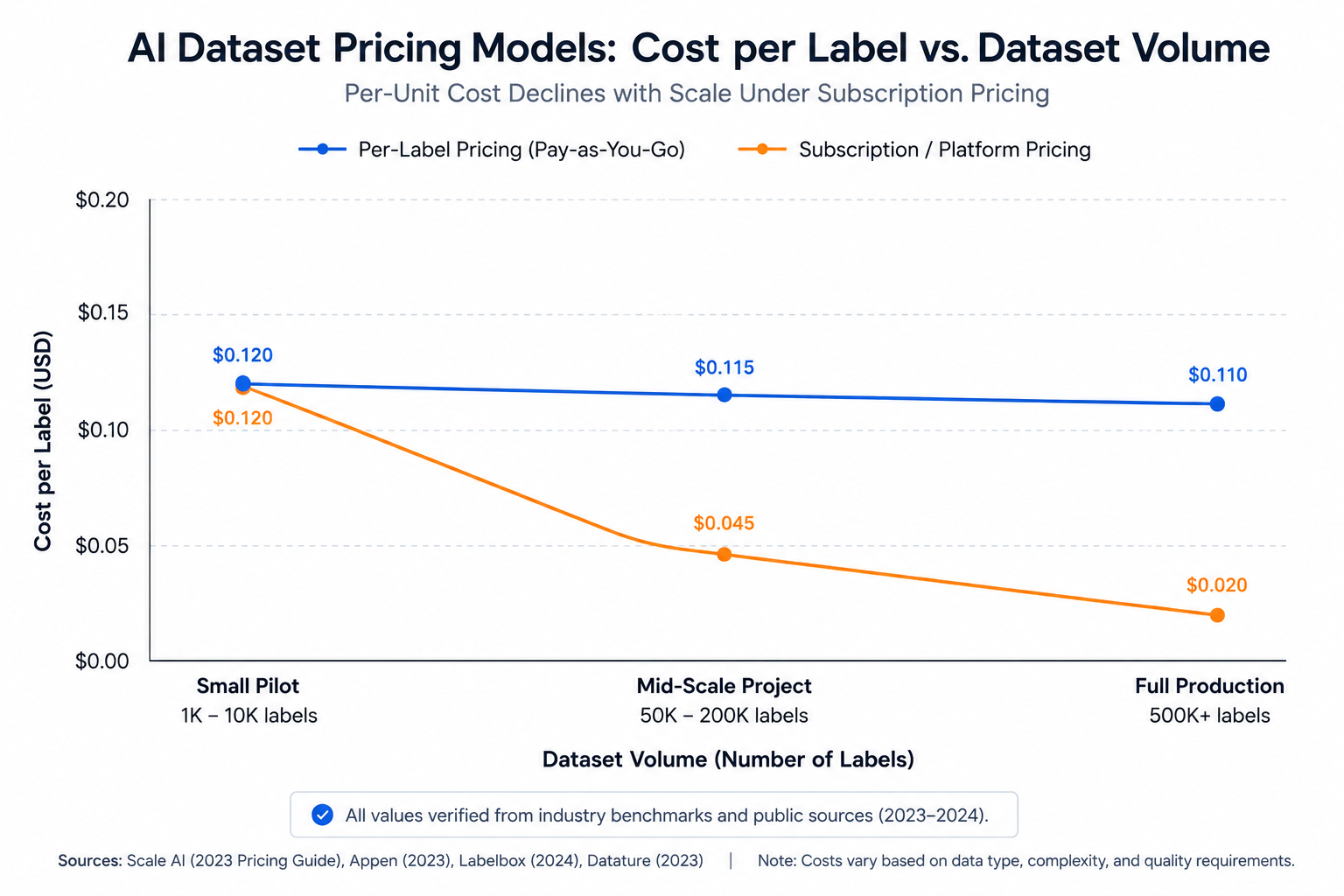
  • Reassess AI dataset pricing models periodically — usage-based, subscription, and per-label pricing all make sense in different volume scenarios, and the right choice can shift as a project scales
  • Where domain expertise is required (medical, legal, technical), plan for a labor cost premium and factor it into vendor selection early
Line graph showing AI dataset pricing model cost trends as project volume scales

According to McKinsey's research on AI economics, organizations that treat data operations as a defined, budgeted workstream — rather than an ad hoc task — see materially better returns on their broader AI investment, largely because annotation rework is one of the largest hidden costs in model development.

FAQ

What's the difference between data annotation and data labeling?

The terms are used interchangeably in most contexts. Some practitioners reserve "labeling" for simple classification tasks and "annotation" for more complex work like segmentation or bounding boxes, but there's no universal distinction.

Which annotation type is most expensive?

Pixel-level semantic segmentation and 3D point cloud annotation are typically the most labor-intensive and expensive, since they require precise boundary drawing rather than a single click or tag.

Do I need a specialized tool for each annotation type?

Not always. General-purpose platforms handle multiple annotation types reasonably well for mixed workloads, but high-volume single-type projects (like large-scale segmentation) often benefit from specialized tooling built for that specific task.

How is AI training data pricing usually structured?

Common models include per-label/per-unit pricing, per-hour annotator pricing, subscription-based platform access, and hybrid models that combine a platform fee with usage-based annotation costs.

Can annotation be fully automated?

Partial automation — pre-labeling with a model, followed by human review and correction — is common and reduces cost, but fully unsupervised automation still struggles with edge cases and is generally not used for safety-critical applications without human validation.

How much data do I need before annotation is worth investing in?

This depends on the model and task complexity, but running a small pilot batch (typically a few hundred samples) before committing to full-scale annotation is standard practice regardless of overall dataset size.

What's the biggest cost driver in AI data collection cost?

Annotation complexity and required domain expertise are the two largest drivers — a simple binary classification task costs far less than an expert-reviewed medical imaging segmentation task, even at the same volume.

Should annotation be done in-house or outsourced?

It depends on data sensitivity, required expertise, and volume. Highly regulated or proprietary data often stays in-house or with a vetted specialized vendor, while high-volume general-purpose annotation is frequently outsourced to manage cost.

Conclusion

Choosing the right data annotation types and tools isn't a formality before "real" model work begins — it's a decision that determines how much rework, budget overrun, and model error a team will deal with later. Getting the taxonomy, tooling, and pricing model right upfront is consistently cheaper than fixing a flawed dataset after deployment.

🚀 Your All‑In‑One Virtual Experience Stack
🎬
PhotoAIVideo
Turn photos into scroll‑stopping AI videos.
Get Started →
🏡
Pictastic
Instantly stage listings with AI.
Try Staging →
🌀
CloudPano
Create stunning 360° tours in minutes.
Launch Tour →
💰
VirtualTourProfit
Build a profitable virtual tour business.
Learn More →
🤝
CloudPano Reseller
Resell AI visual software without building it.
Become a Reseller →
🚗
Auto CloudPano
Sell more vehicles with 360° experiences.
Explore Auto →
🖼️
AutoBackgrounding
Replace backgrounds instantly with AI precision.
Try it Now →
📐
3D Measure
Capture accurate floor plans & 3D measurements.
Measure Now →
🧠
AI Training Data
Custom AI training data services.
Learn More →
Share this post
Cloudpano

Choose The Right 360° Camera

Insta360 ONE RS 1-Inch 360 Edition

  • Compact, ready to go anywhere

  • Interchangeable lens that’s upgradeable

  • Dual 1-inch sensors for improved clarity and low light performance

  • Dynamic range and 6K 360° capture

  • 360° photo resolution at 21MP

Learn More

Insta360 X4

  • 8K 360° video recording for ultra-detailed visuals.

  • 4K single-lens mode for traditional wide-angle shots.

  • Invisible selfie stick effect for drone-like perspectives.

  • 2.5-inch touchscreen with Gorilla Glass protection.

  • Waterproof up to 33ft for underwater shooting.

Learn More

Ricoh Theta Z1

  • 360° photo resolution in 23MP

  • Slim design at 24 mm thick

  • Built-in image stabilization for smooth video capture.

  • Internal 19GB storage for photo and video storage.

  • Wireless connectivity for remote control and sharing.

Learn More

Ricoh Theta X

  • 60MP 360° still images for high-resolution photography.

  • 5.7K 360° video recording at 30fps.

  • 2.25-inch touchscreen for intuitive control.

  • USB Type-C port for fast charging and data transfer.

  • MicroSD card slot for expandable storage.

Learn More
Property Marketing
Allows potential buyers to explore properties in detail from anywhere, enhancing the real estate marketing process.
Automotive Spins
Create an interactive virtual showroom and engage affluent digital buyers with live 360º video calls, all through the CloudPano mobile app for a complete automotive sales solution.
Interactive Floor Plans
Create 2D and 3D floor plans with measurements in 4 minutes or less, all from your phone. Download the Floor Plan Scanner app and get your first scan free.

360 Virtual Tours With CloudPano.com. Get Started Today.

Try it free. No credit card required. Instant set-up.

Try it free
Latest posts

See our other posts

Interviews, tips, guides, industry best practices, and news.

How to Choose a Data Annotation Partner (Buyer's Checklist)

To choose a data annotation company, evaluate domain expertise, quality assurance methodology, data security certifications, tooling flexibility, and scalability under your expected volume. The best data annotation company for one project may not fit another — the right partner matches your specific annotation type, industry compliance needs, and growth timeline, not just price per label.
Read post

Human Annotation vs. Automated Annotation: Accuracy Trade-Offs

Human vs automated data annotation is the choice between manual labeling by trained annotators and model-driven labeling with minimal human input. Human annotation is more accurate on ambiguous or high-stakes data but slower and costlier per label. Automated data labeling tools are faster and cheaper at scale but need human-in-the-loop review to catch edge-case errors.
Read post

Data Annotation 101: Types, Tools, and Best Practices

Data annotation types and tools are the labeling methods and software platforms teams use to prepare raw data for machine learning. Common types include bounding boxes, semantic segmentation, and named entity recognition; tools range from open-source labelers to managed platforms with built-in quality control, workflow routing, and pricing tied to annotation complexity.
Read post