


.png)


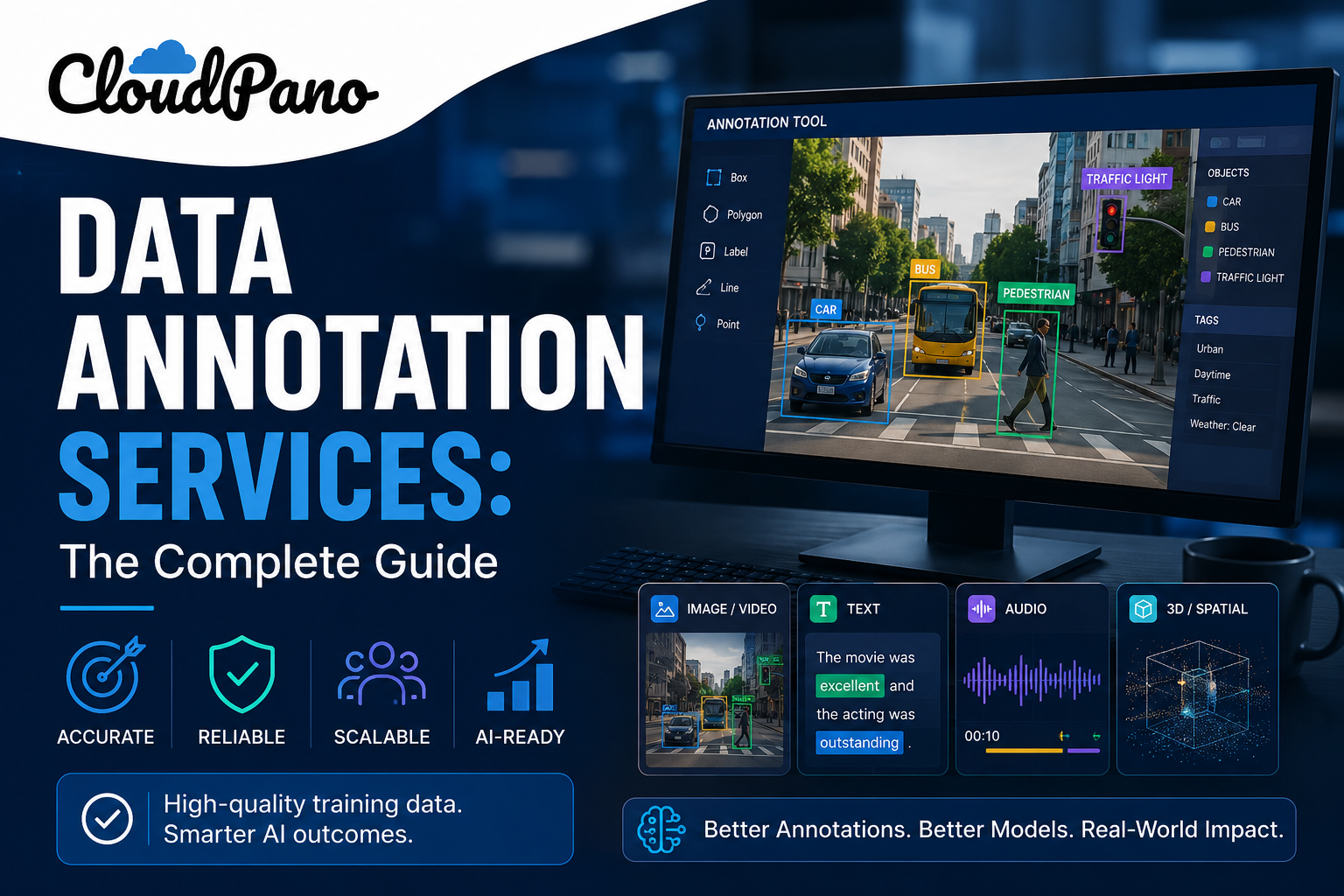
Data annotation services are the process of labeling raw data—images, video, text, or audio—so that machine learning models can learn to recognize patterns and make accurate predictions. Every AI system, from self-driving cars to chatbots, depends on annotated datasets to understand what it's looking at or reading. Whether a company builds this capability in-house or works with a data annotation company, the goal is the same: turn unstructured raw data into structured, machine-readable training data.
This guide covers what data annotation services actually involve, the main types of annotation work, how to decide between building an internal team and outsourcing, and what to look for in a data annotation outsourcing partner.
At its core, data annotation is a labeling task. A human annotator (or, increasingly, a human working alongside AI-assisted tooling) reviews a piece of raw data and attaches meaning to it: drawing a bounding box around a car in an image, tagging the sentiment of a customer review, transcribing spoken audio, or marking the boundaries of a room in a 3D scan. That labeled output becomes the annotated dataset a machine learning model trains on.
The quality of that labeling directly influences the quality of the resulting model. A computer vision model trained on inconsistent or inaccurate bounding boxes is likely to make inconsistent predictions in production. This is why data annotation is often considered one of the most critical steps in the machine learning pipeline. Industry analysts and AI researchers have consistently identified poor data quality as a leading cause of underperforming AI systems and delayed deployments. Source: Zha et al., ACM Computing Surveys, 2025
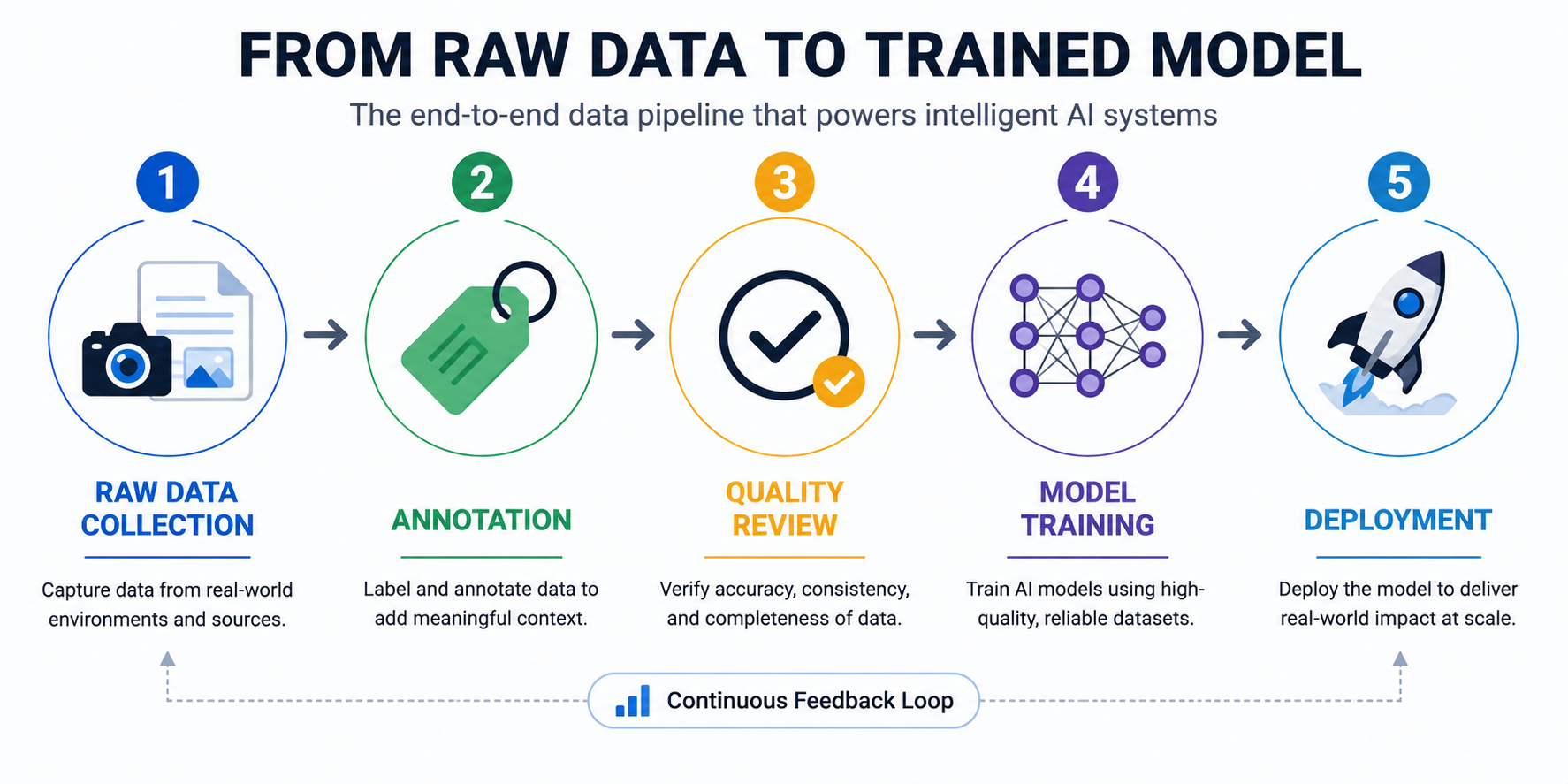
It's tempting to think of data annotation as a numbers game—more labeled examples equals a better model. In practice, consistency and accuracy matter more than raw volume. A smaller, carefully verified dataset frequently outperforms a larger one riddled with mislabeled examples, missed objects, or inconsistent labeling conventions between annotators.
This is part of why human verification has become a standard second layer in serious annotation workflows: a first-pass annotator labels the data, and a separate reviewer checks that work before it's accepted into the training set. Providers who build structured metadata into every annotation—consistent tagging conventions, timestamps, source attribution, and confidence scores—make it far easier for downstream teams to audit and reuse datasets later, rather than starting from scratch every time requirements shift.
Most data annotation services fall into a handful of broad categories, though the right one depends entirely on what the underlying AI model needs to learn.
Image and video annotation covers bounding boxes, polygon segmentation, keypoint tagging, and object tracking across video frames. This is foundational for computer vision applications like autonomous vehicles, retail analytics, and robotics. Providers working with real-world video capture—rather than only synthetic or stock imagery—can produce datasets that better reflect the lighting, angles, and clutter of real environments, which tends to generalize better to production conditions.
Text annotation includes sentiment labeling, named entity recognition, intent classification, and text summarization tagging—work that underpins chatbots, search relevance, and content moderation systems.
Audio annotation involves transcription, speaker diarization (identifying who is speaking when), and sound event tagging, which feeds voice assistants and call-center analytics tools.
3D and spatial data annotation is a newer but fast-growing category, covering point cloud labeling and 3D scene understanding for use cases like indoor mapping, real estate technology, and spatial AI. This is a more specialized service than 2D image annotation and generally requires providers with purpose-built tooling for room- and space-level labeling.
Each of these categories has its own tooling requirements, annotator training needs, and quality benchmarks, which is part of why many organizations find it easier to work with a dedicated data annotation company rather than assembling every capability internally.

One of the first strategic decisions a team faces is whether to build an internal annotation team or work with an external data annotation company. Neither option is universally correct—the right choice depends on data volume, timeline, budget, and how specialized the labeling task is.
Building in-house gives a team direct control over annotator training and data security, and it can make sense for small, ongoing projects where institutional knowledge about the data is valuable to retain. But it also means absorbing the cost of hiring, training, and managing annotators, plus building or licensing annotation tooling—overhead that rarely scales well when project volume spikes or requirements shift quickly.
Data annotation outsourcing, by contrast, gives teams access to a scalable provider network that can flex up or down with project demand, along with tooling and QA processes that have already been built and refined across many client engagements. The trade-off is less direct day-to-day control and a greater reliance on the provider's own quality standards and security practices.
Not all providers are built the same way, and the differences show up in dataset quality down the line. A few questions are worth asking before committing to a data annotation outsourcing partner:
Does the provider verify annotations with a human review step, or rely solely on automated checks? Automated QA can catch some errors, but nuanced labeling tasks—like distinguishing similar object classes or judging ambiguous sentiment—generally still need a human reviewer in the loop.
Can the provider handle your specific data type at scale? A provider that's strong in text annotation isn't necessarily equipped for 3D spatial data or real-world video capture. Ask for examples of past work in your specific domain.
Does the provider deliver structured metadata alongside the raw labels? Datasets that come with consistent, well-documented metadata are dramatically easier to maintain, audit, and reuse as your model requirements evolve—versus flat label files with no context.
How does the provider scale? Projects rarely stay a fixed size. A provider backed by a scalable network of trained annotators can absorb a sudden increase in data volume without a corresponding collapse in quality or turnaround time.
What security and compliance practices are in place? Especially for sensitive data (healthcare, financial, biometric), ask directly about data handling, access controls, and any relevant certifications before sharing raw data.

Regardless of provider, most rigorous annotation workflows follow a similar shape. It starts with defining a labeling taxonomy—the exact set of categories, tags, or attributes annotators will apply, along with clear edge-case rules (what counts as a "partially visible" object, for instance). A small pilot batch is then annotated and reviewed jointly with the client to calibrate expectations before scaling up.
From there, the bulk of the dataset moves through full-scale annotation, followed by a quality review layer—often a second independent pass, sometimes combined with automated consistency checks. Finally, the finished, verified dataset is delivered along with its structured metadata, ready to be ingested into a model training pipeline.
According to MarketsandMarkets, the AI training dataset market is expanding as organizations invest more heavily in machine learning and generative AI, increasing demand for high-quality data collection, annotation, and management services that support model development.
The terms are used interchangeably in most industry contexts. Both refer to the process of tagging raw data with the information a machine learning model needs to learn from it. Some practitioners use "labeling" more narrowly for simple classification tasks and reserve "annotation" for more complex work like bounding boxes or segmentation, but this distinction isn't consistently applied across the industry.
Cost varies widely based on data type, task complexity, required accuracy, and volume. Simple text classification tasks are typically far less expensive per unit than complex 3D spatial annotation or detailed video object tracking. Most data annotation companies price per unit of labeled data (per image, per minute of video or audio, per document) rather than a flat rate, so cost estimates should be requested based on your specific dataset and taxonomy.
Timelines depend heavily on dataset size and annotation complexity. A pilot batch used to calibrate taxonomy and quality expectations might take a few days, while full-scale projects involving hundreds of thousands of labeled examples can take several weeks to a few months, particularly when multiple QA passes are built into the workflow.
Some annotation work—particularly simple, high-confidence classification—can be pre-labeled with AI-assisted tools and then verified by a human reviewer, which speeds up throughput. Fully automated annotation without human verification is generally not recommended for tasks where labeling errors are costly, since automated tools still struggle with ambiguous or edge-case data that a trained human annotator would catch.
There's no universal answer. In-house annotation offers more direct control and may suit small, highly specialized, ongoing projects. Outsourcing to a data annotation company tends to make more sense for larger volumes, tighter timelines, or when a project needs access to established QA processes and a scalable annotator network without the overhead of building that infrastructure internally.
Choosing the right approach to data annotation—whether in-house or outsourced—comes down to matching your project's data type, scale, and quality requirements to the right process and partner. For teams building AI systems that depend on real-world visual or spatial data, working with a provider that combines real-world video capture, structured metadata, human verification, and a scalable annotator network can materially shorten the path from raw data to a production-ready model.
If you're evaluating providers for your next AI training data project, explore CloudPano's AI training data services to see how a dedicated data annotation partner can support your dataset needs.


Compact, ready to go anywhere
Interchangeable lens that’s upgradeable
Dual 1-inch sensors for improved clarity and low light performance
Dynamic range and 6K 360° capture
360° photo resolution at 21MP

8K 360° video recording for ultra-detailed visuals.
4K single-lens mode for traditional wide-angle shots.
Invisible selfie stick effect for drone-like perspectives.
2.5-inch touchscreen with Gorilla Glass protection.
Waterproof up to 33ft for underwater shooting.

360° photo resolution in 23MP
Slim design at 24 mm thick
Built-in image stabilization for smooth video capture.
Internal 19GB storage for photo and video storage.
Wireless connectivity for remote control and sharing.

60MP 360° still images for high-resolution photography.
5.7K 360° video recording at 30fps.
2.25-inch touchscreen for intuitive control.
USB Type-C port for fast charging and data transfer.
MicroSD card slot for expandable storage.
.png)

.png)

Try it free. No credit card required. Instant set-up.







.svg)


.svg)