


.png)


Robotics AI training data collection is the process of capturing how hands, tools, and objects physically interact in real environments — often from a first-person (egocentric) camera perspective — so robotic systems can learn to perceive, grasp, and manipulate objects the way a human would. This typically means recording video of real hand-object interactions across many environments, then labeling and structuring that footage so a model can learn generalizable manipulation and perception skills, rather than just recognizing an object in a photo.
For teams building robotic perception, manipulation, or grasping models, this is one of the harder data collection problems in AI — it requires physical capture, careful annotation of contact points and object states, and enough variety to avoid a robot that only works in the exact conditions it was trained on. Here's how the process actually works and what tends to trip teams up.
Most computer vision data collection focuses on recognizing what's in a scene — is there a chair, a person, a car. Robotics data collection has to go further: it needs to capture how objects are handled, grasped, moved, and released, often from the perspective of the hand or robot arm doing the interacting. That's a fundamentally different data problem, because the model isn't just learning to classify objects — it's learning physical dynamics, contact points, and sequences of motion.
This is part of why general-purpose image datasets, while useful for early prototyping, tend to fall short for robotics applications on their own. Robotics models need data that reflects contact, force, grip variation, and the countless small physical realities of manipulating real objects — details that are difficult to infer from static, third-person images.
For a foundational look at data collection methods before diving into the robotics-specific requirements below, see our guide to AI data collection, which covers the broader landscape this article builds on.
First-person or egocentric data capture involves recording video from a camera positioned at or near the point of interaction — mounted on a person's head, chest, or hand — rather than from a fixed, third-person angle. This perspective is valuable for robotics because it closely mirrors what a robot's own onboard camera would see: hands entering the frame, objects being reached for, grip and release happening close to the lens.
Large-scale egocentric datasets have become an important area of research in robotics and computer vision. Ego4D, a large-scale first-person video dataset developed by Meta AI in collaboration with universities and research institutions worldwide, has become a widely used benchmark for research in egocentric perception, embodied AI, and robotics.
Why first-person data matters for robotics specifically:
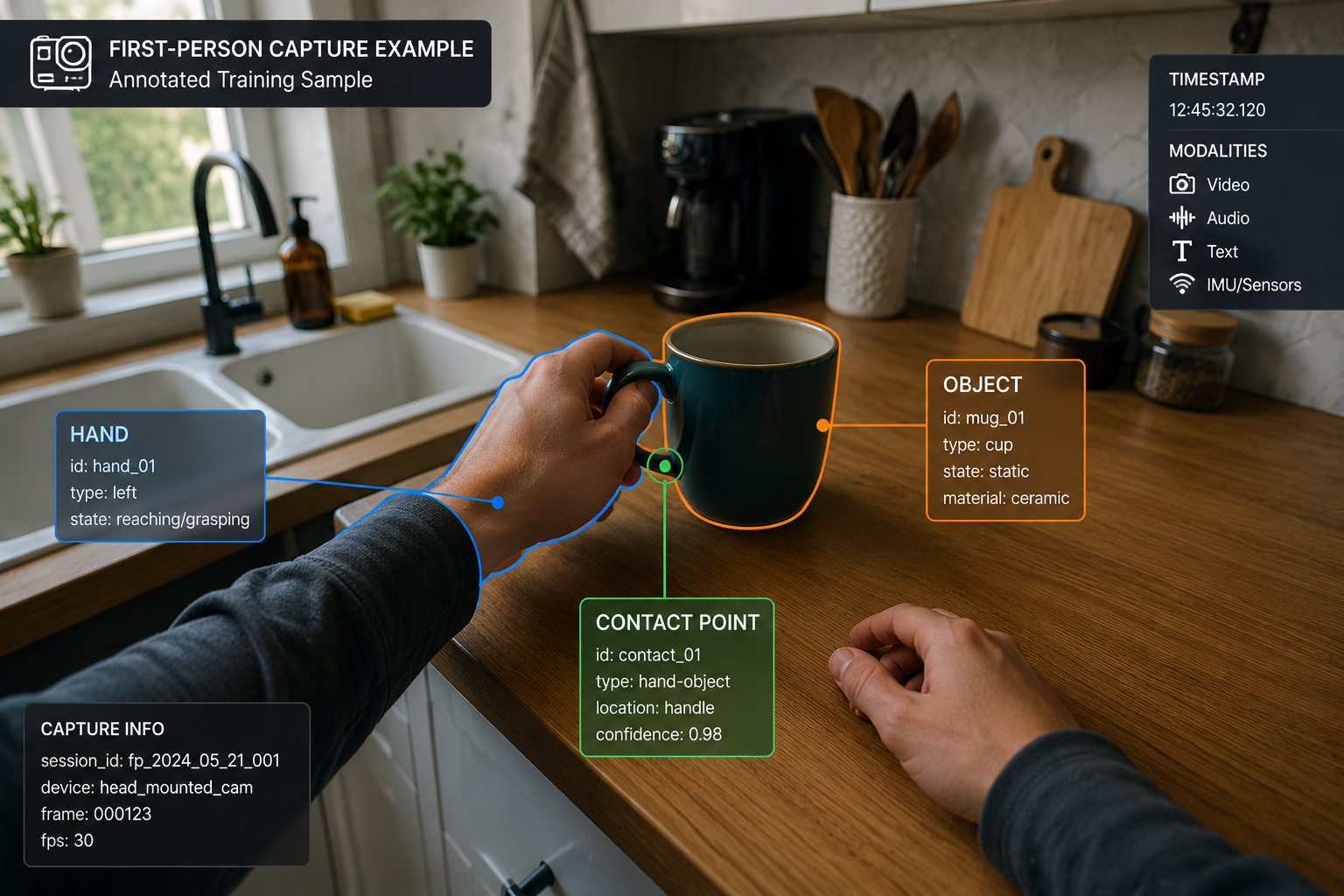
Object interaction data goes a step further than first-person footage alone — it specifically captures the sequence of an object being approached, grasped, manipulated, and released, often labeled with details like grip type, contact point, object state (open/closed, full/empty), and outcome (successful grasp vs. failed attempt).
This kind of data is what allows robotic manipulation models to learn generalizable skills — how to grip an unfamiliar mug versus a familiar one, how grip strategy changes for a full glass versus an empty one — rather than memorizing a single demonstrated interaction.
What object interaction datasets typically capture:
Building a usable robotics training dataset generally follows this sequence:
Teams building robotics training data generally choose between a few sourcing paths, each with different tradeoffs.
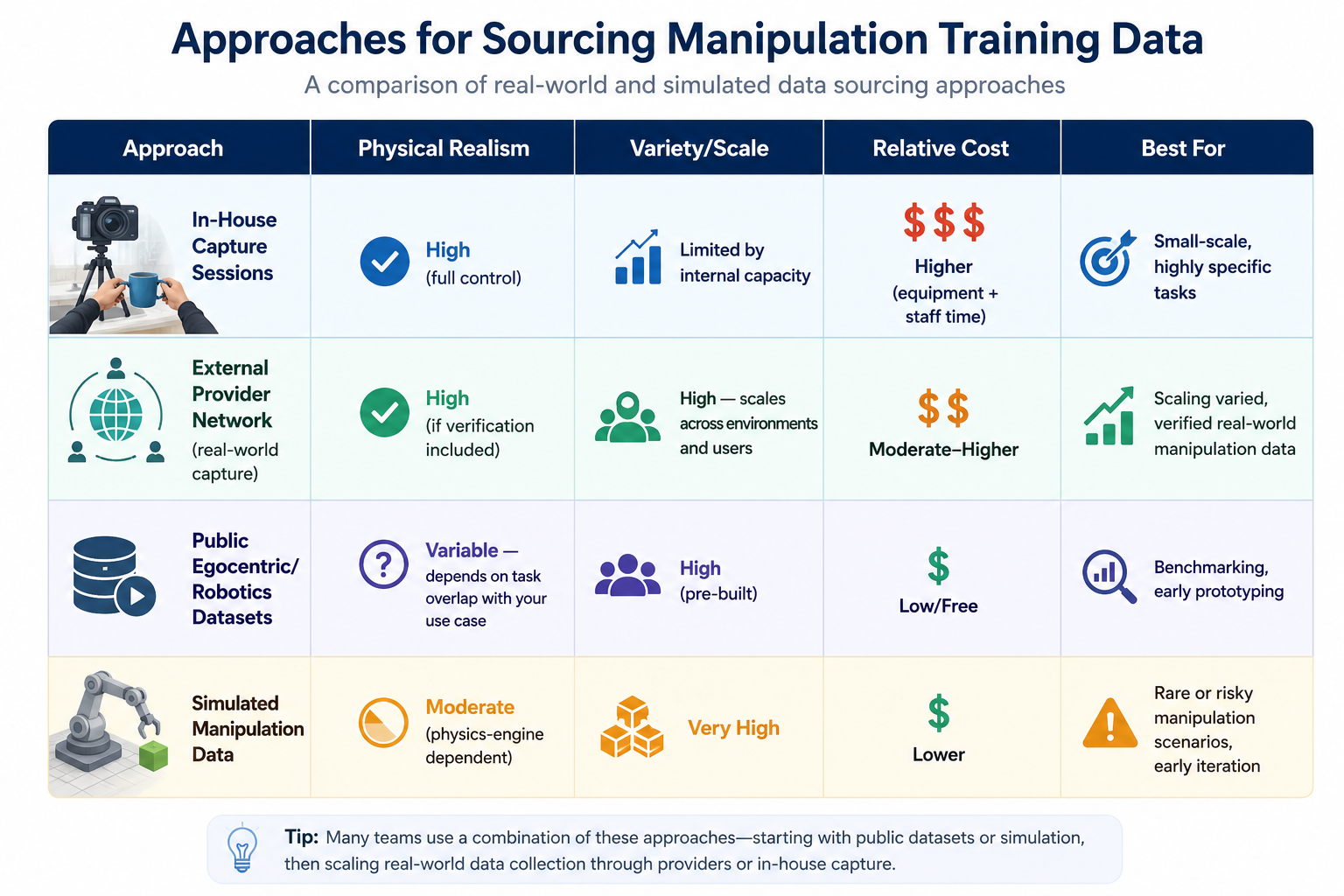
Public datasets and simulation are useful starting points, but most production robotics models eventually need real-world, verified interaction data reflecting the specific objects and environments the robot will actually operate in — general-purpose datasets rarely cover that level of task-specific variety.
Robotics data has more ways to be subtly wrong than a simple image classification dataset. A contact point labeled a few frames early or late, a grip type mislabeled, or an interaction outcome marked "successful" when the object actually slipped — these are the kinds of errors that don't just reduce accuracy, they can teach a manipulation model to replicate a failure mode.
This is why structured metadata (object state, grip type, environment, outcome) and human verification of physical plausibility matter more here than in many other data collection contexts — automated checks can confirm a label exists, but confirming that a labeled grip type or outcome actually matches what happened in the footage generally requires human judgment.
Research in robot learning from demonstration has consistently shown that the quality and consistency of demonstration data have a significant impact on manipulation performance and generalization. Recent work has further demonstrated that measuring and improving demonstration consistency before training can substantially improve learning outcomes. Source: https://arxiv.org/abs/2412.14309
For teams scaling a verified robotics data pipeline, our robotics AI training data collection services page covers how structured metadata and human verification are typically layered into a production workflow for this kind of data.
Demand for high-quality manipulation and interaction data has grown alongside rapid advances in robotics and embodied AI. According to Grand View Research, adoption of industrial and service robotics continues to expand across manufacturing, logistics, healthcare, and other industries, reflecting broader investment in robotic automation and AI-enabled systems.
First-person data captures video from a viewpoint near the point of interaction — similar to what a robot's onboard camera would see — showing natural hand-object contact, grip, and manipulation sequences. It's used to train robots to perceive and manipulate objects from a realistic operating perspective, rather than from a fixed third-person camera angle.
Standard image datasets typically label what's in a static frame — object identity, bounding boxes. Object interaction datasets go further, capturing the sequence of an interaction over time, including grip type, contact points, and outcome (success or failure), which is what manipulation models actually need to learn from.
Because errors in robotics data are often subtle and physical — a mislabeled contact point or an incorrectly marked outcome can teach a model an incorrect physical behavior, not just reduce classification accuracy. Human verification helps catch these physically-grounded errors that automated checks typically miss.
Simulated data is useful for generating rare or risky manipulation scenarios quickly, but it depends heavily on the fidelity of the underlying physics engine. Most production robotics models still rely on real-world captured data, often supplemented with simulation for edge cases rather than replaced by it.
There's no fixed number — it depends on the variety of objects, environments, and manipulation tasks the model needs to generalize across. Models trained on well-labeled, verified data with broad object and environment variety generally need less raw volume than those trained on narrower or noisier datasets.
Whether your team needs first-person capture, object interaction labeling, or human-verified manipulation datasets at scale, getting this data right shapes how reliably your robot performs outside the lab. Visit our robotics AI training data collection services page to see how a scalable, verified provider network can support your robotics data needs.


Compact, ready to go anywhere
Interchangeable lens that’s upgradeable
Dual 1-inch sensors for improved clarity and low light performance
Dynamic range and 6K 360° capture
360° photo resolution at 21MP

8K 360° video recording for ultra-detailed visuals.
4K single-lens mode for traditional wide-angle shots.
Invisible selfie stick effect for drone-like perspectives.
2.5-inch touchscreen with Gorilla Glass protection.
Waterproof up to 33ft for underwater shooting.

360° photo resolution in 23MP
Slim design at 24 mm thick
Built-in image stabilization for smooth video capture.
Internal 19GB storage for photo and video storage.
Wireless connectivity for remote control and sharing.

60MP 360° still images for high-resolution photography.
5.7K 360° video recording at 30fps.
2.25-inch touchscreen for intuitive control.
USB Type-C port for fast charging and data transfer.
MicroSD card slot for expandable storage.
.png)

.png)

Try it free. No credit card required. Instant set-up.






.svg)


.svg)