


.png)


Multimodal training data sourcing is the process of collecting and aligning multiple data types — typically video, images, audio, and text — so a single model can learn from all of them together rather than from one data type in isolation. It's harder than sourcing single-modality data because each data type needs to be captured, labeled, and synchronized in a way that preserves the relationships between them (a spoken word matched to a lip movement, an object in a frame matched to its text label). Done well, it's what allows models to understand context the way humans naturally do — by combining what they see, hear, and read.
For ML teams scaling beyond single-modality models — vision-language models, multimodal assistants, robotics systems that combine vision and sensor data — sourcing strategy becomes a bigger bottleneck than model architecture. This guide walks through what multimodal data actually requires, where teams get stuck, and how to scale sourcing without losing data quality along the way.
Single-modality data collection is comparatively straightforward: capture images, label them, done. Multimodal data adds a layer of complexity because the modalities have to relate to each other correctly. A video clip paired with the wrong transcript, or an image paired with a mismatched caption, doesn't just fail to help the model — it actively teaches it the wrong association.
This is why multimodal sourcing pipelines need tighter coordination across capture, labeling, and verification than single-modality pipelines do. According to NIST's AI Risk Management Framework, data provenance and traceability are highlighted as key risk areas for complex AI systems — and multimodal datasets, with their multiple interlocking data streams, are a clear example of where that traceability becomes harder to maintain without a deliberate process.
For a broader foundation on how data collection works before diving into the multimodal-specific challenges, see our guide to AI data collection, which covers single-modality methods this article builds on.
Multimodal datasets combine two or more of the following, aligned to the same underlying moment or object:
The key difference from single-modality collection isn't just gathering more data types — it's making sure they're time-aligned, contextually consistent, and jointly verified, so the model learns correct cross-modal relationships rather than coincidental ones.

Sourcing multimodal data at scale typically follows this sequence:
Step 6 — cross-modal verification — is where most home-grown pipelines fall short. It's relatively easy to verify that an image is labeled correctly in isolation; it's much harder to catch that a caption technically describes the image but misses the specific detail the model actually needs to learn from that pairing.
Teams generally source multimodal data through one of a few paths, each with different tradeoffs for scale and quality.
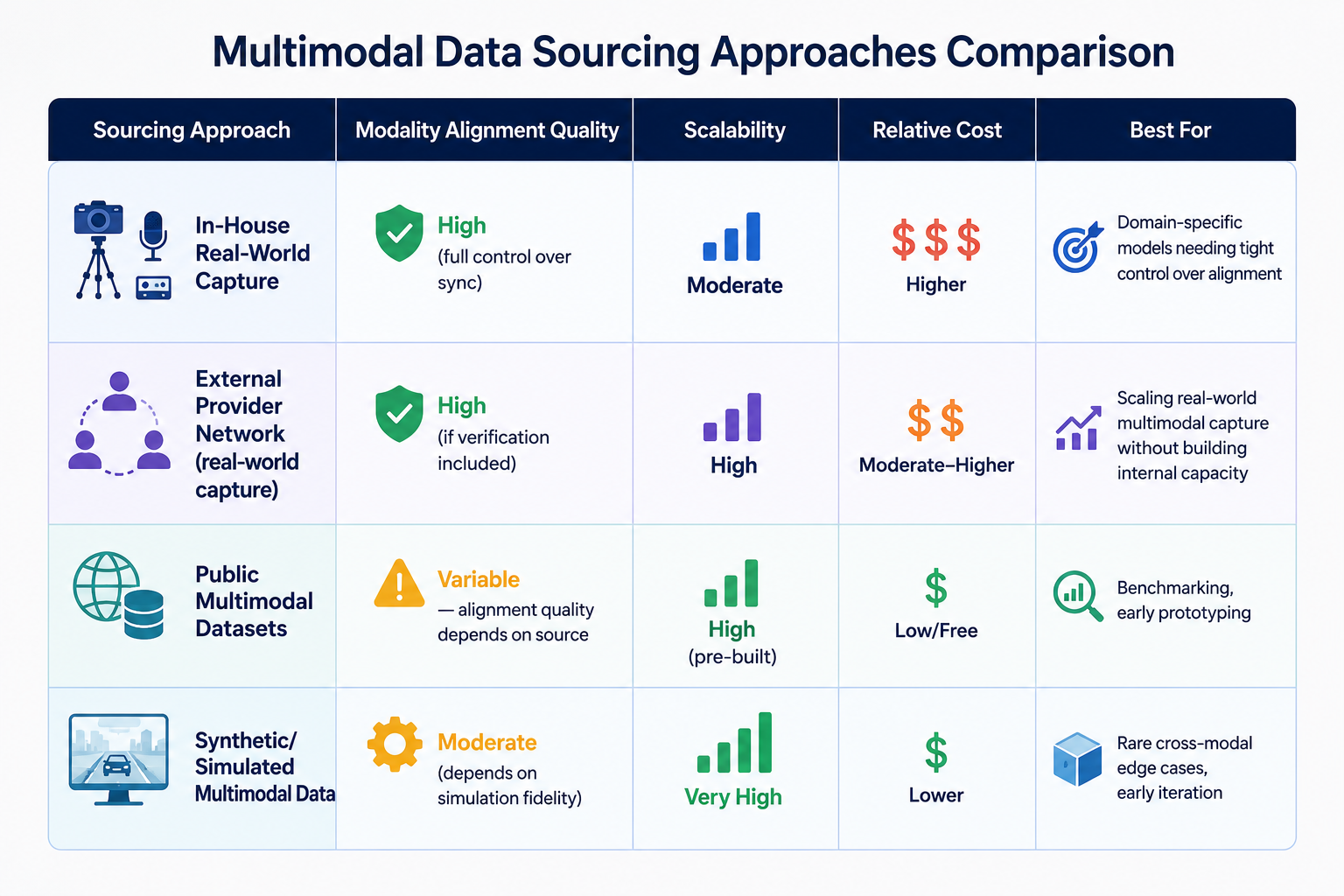
A scalable provider network is often the practical middle ground for teams that need real-world alignment quality but don't have the internal capacity to run capture, sync, and verification pipelines across multiple modalities themselves.
With single-modality data, metadata is useful. With multimodal data, it's close to essential. Structured metadata — timestamps, environmental tags, modality source, alignment confidence scores — is what allows an ML team to later query a multimodal dataset meaningfully: "show me all clips where the audio-visual sync confidence is below a certain threshold" or "pull every sample captured in low-light conditions across all modalities."
Without this layer, multimodal datasets tend to become difficult to audit or debug once something goes wrong post-deployment — teams end up unable to trace whether a failure originated from a specific modality, a bad alignment, or a labeling error, because the underlying data was never tagged richly enough to distinguish between those causes.
Automated quality checks can catch some issues — a caption with no words, an audio clip with no waveform — but they routinely miss subtler cross-modal mismatches, like a transcript that's technically accurate but out of sync by a few hundred milliseconds, or a caption that describes the wrong object in a cluttered scene. This is where human-in-the-loop verification becomes particularly important for multimodal data specifically, since the failure modes are often about relationships between modalities rather than errors within a single one.
A major survey of data-centric AI research highlights data quality, consistency, and representativeness as fundamental factors in machine learning performance, emphasizing that improving data is often as important as improving model architecture. These principles become especially important in multimodal AI, where inconsistencies or errors in any data modality can affect overall model performance. Source: Zha, D., et al. "Data-centric Artificial Intelligence: A Survey." ACM Computing Surveys, vol. 57, no. 5, 2025.
For teams building or scaling a verified multimodal sourcing pipeline, our AI training data services page covers how structured metadata and human verification are typically layered into a production-grade workflow.
Multimodal AI has moved from research into production across vision-language models, robotics, and AI assistants, increasing demand for datasets that combine text, images, video, and audio in a coordinated way. According to MarketsandMarkets, multimodal data is one of the fastest-growing segments of the AI training dataset market, driven by the increasing adoption of AI applications that require cross-modal understanding.
Multimodal training data combines two or more data types — such as video, audio, text, and sensor data — aligned to the same moment or context, so a model can learn relationships between what it sees, hears, and reads rather than learning from a single data type in isolation.
Because each modality has to be captured, labeled, and time-aligned correctly in relation to the others. A mismatch between modalities — like a caption that doesn't match the frame it's paired with — can actively teach a model incorrect associations, not just leave gaps in its knowledge.
Verification for multimodal data needs to check both individual modality quality (is the caption itself accurate) and cross-modal consistency (does the caption match what's actually happening in the paired video or audio). Human-in-the-loop review is generally required to catch subtler alignment issues that automated checks miss.
Yes, particularly for generating rare cross-modal edge cases quickly. However, the "reality gap" common to single-modality synthetic data can compound in multimodal settings, since simulation has to get multiple related data types right simultaneously rather than just one.
Most teams that scale successfully rely on a combination of structured metadata (to keep the growing dataset organized and auditable), human verification focused specifically on cross-modal consistency, and often an external provider network capable of capturing real-world multimodal data at a scale that's difficult to replicate in-house.
Whether you need real-world video and audio capture, structured metadata across modalities, or human-verified cross-modal alignment, getting the sourcing strategy right early prevents costly rework later. Visit our AI Data Collection Services page to see how a scalable, verified provider network can support your multimodal data needs.


Compact, ready to go anywhere
Interchangeable lens that’s upgradeable
Dual 1-inch sensors for improved clarity and low light performance
Dynamic range and 6K 360° capture
360° photo resolution at 21MP

8K 360° video recording for ultra-detailed visuals.
4K single-lens mode for traditional wide-angle shots.
Invisible selfie stick effect for drone-like perspectives.
2.5-inch touchscreen with Gorilla Glass protection.
Waterproof up to 33ft for underwater shooting.

360° photo resolution in 23MP
Slim design at 24 mm thick
Built-in image stabilization for smooth video capture.
Internal 19GB storage for photo and video storage.
Wireless connectivity for remote control and sharing.

60MP 360° still images for high-resolution photography.
5.7K 360° video recording at 30fps.
2.25-inch touchscreen for intuitive control.
USB Type-C port for fast charging and data transfer.
MicroSD card slot for expandable storage.
.png)

.png)

Try it free. No credit card required. Instant set-up.






.svg)


.svg)