


.png)


AI data collection compliance refers to the privacy laws, consent requirements, and licensing rules that govern how training data is gathered, stored, and used — covering everything from whether a person needs to be told they're being recorded, to whether a dataset's license actually permits commercial model training. Getting this wrong doesn't just create legal exposure; it can force a team to discard an entire dataset late in a project if the data turns out to have been collected or licensed improperly.
This isn't a substitute for legal advice — compliance requirements vary by jurisdiction, data type, and use case, and a qualified attorney should review any data collection program before it scales. What follows is a practical overview to help ML teams and procurement buyers know what questions to ask and what risk areas to watch for.
Compliance is often treated as a legal team's problem to solve after a dataset is already built. In practice, the earlier compliance is considered, the cheaper it is to address — a dataset built without proper consent or licensing can become unusable, or worse, a liability, well after significant time and budget have already gone into it.
This is particularly true for real-world data capture involving people, since privacy and biometric laws frequently impose specific notice and consent requirements that don't apply to purely synthetic or already-licensed data. For a broader look at how different data collection methods work before diving into the compliance layer specifically, see our AI data collection compliance overview and full methods guide, which covers the range of collection approaches this article builds on.
Several major privacy frameworks shape what's permissible when collecting data that includes or could identify real people:
The EU's GDPR applies to the collection and processing of personal data of individuals in the EU, regardless of where the company collecting the data is based. It requires a lawful basis for processing (often consent), transparency about how data will be used, and specific protections for biometric data — which can include facial imagery captured in video, depending on how it's processed.
California's CCPA, as amended by the CPRA, gives California residents rights over their personal information, including the right to know what data is collected about them and to opt out of certain uses. It applies to many companies collecting data from California residents, even if the company itself isn't based there.
Some jurisdictions have laws that specifically regulate biometric data. For example, Illinois's Biometric Information Privacy Act (BIPA) imposes requirements beyond many general privacy laws, including providing notice, establishing a publicly available retention schedule, and obtaining informed written consent before collecting certain biometric identifiers such as scans of face geometry or voiceprints. Organizations collecting biometric data should evaluate applicable legal requirements in every jurisdiction where they operate.

Real-world video and image capture — recording people in stores, warehouses, vehicles, or public spaces — typically triggers consent obligations that don't apply to synthetic or purely object-focused data. Key questions any compliant data collection program should be able to answer:
This is where structured metadata becomes more than a data-quality convenience — tagging consent status, capture location, and participant notice alongside the raw footage creates the audit trail that compliance review actually depends on. A dataset without this kind of documentation is difficult to defend later, even if consent was properly obtained at the time.
Beyond privacy, licensing governs whether a dataset can legally be used to train a commercial model at all. This applies both to data a team captures itself and to third-party or public datasets it sources.
Key licensing questions to ask before using any dataset:
Ambiguous or undocumented licensing has become an increasingly important concern as AI training data practices face greater legal and regulatory scrutiny. The Data Provenance Initiative's large-scale audit of more than 1,800 AI training datasets found widespread gaps in licensing documentation, frequent license omissions, and license misclassification, highlighting how incomplete provenance makes it difficult for practitioners to determine whether datasets are being used in accordance with their licensing terms. Source: https://arxiv.org/abs/2310.16787
Different ways of sourcing training data carry meaningfully different compliance profiles.
Note that synthetic data isn't automatically compliance-free — if a generative model was itself trained on data with unclear licensing or consent, that risk can carry through to the synthetic output, even though no real individuals appear in the final dataset.
A defensible data collection program generally follows a consistent process, regardless of sourcing method:
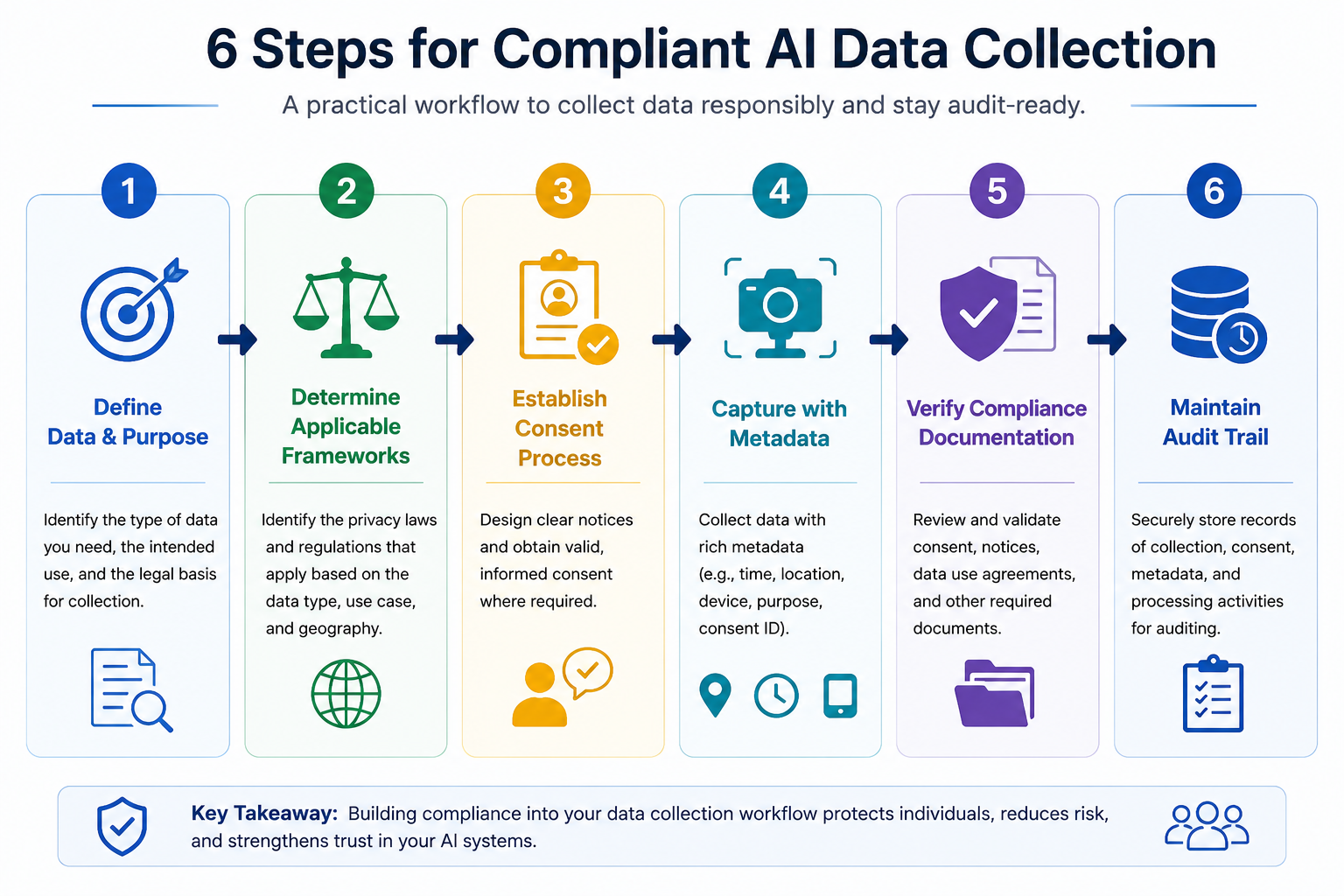
For teams building or scaling a compliant data collection pipeline, our AI training data services and compliance-aware collection page covers how consent documentation and structured metadata typically fit into a production-grade workflow.
In many jurisdictions, yes — particularly if the video includes identifiable people. Requirements vary significantly by location and data type (general privacy law vs. biometric-specific law), so this should be confirmed with legal counsel for your specific data collection context rather than assumed.
No. Public availability does not automatically mean a dataset is properly licensed for commercial AI model training. Licensing terms, provenance, and consent status should be documented and verified regardless of how easily the data was accessible.
Often, yes, for the synthetic output itself, since it typically doesn't depict real individuals. However, if the generative model used to create the synthetic data was trained on data with unclear consent or licensing, that underlying risk can still be relevant.
GDPR applies to personal data of individuals in the EU and generally requires a lawful basis such as consent, with specific protections for biometric data. CCPA/CPRA applies to California residents and focuses more on consumer rights to know about and opt out of data collection. Both can apply simultaneously depending on where your data subjects are located.
Structured metadata is key — tagging consent status, capture location, licensing terms, and collection date alongside the raw data creates a documented trail that can be reviewed later, rather than requiring the compliance status to be reconstructed after the fact.
Whether you need real-world capture with documented consent, structured metadata for audit readiness, or a provider network that treats compliance as part of the collection process rather than an afterthought, getting this right early protects your model and your budget. Visit our AI training data services and compliance-aware collection page to see how a scalable, verified provider network builds compliance into the collection process itself.


Compact, ready to go anywhere
Interchangeable lens that’s upgradeable
Dual 1-inch sensors for improved clarity and low light performance
Dynamic range and 6K 360° capture
360° photo resolution at 21MP

8K 360° video recording for ultra-detailed visuals.
4K single-lens mode for traditional wide-angle shots.
Invisible selfie stick effect for drone-like perspectives.
2.5-inch touchscreen with Gorilla Glass protection.
Waterproof up to 33ft for underwater shooting.

360° photo resolution in 23MP
Slim design at 24 mm thick
Built-in image stabilization for smooth video capture.
Internal 19GB storage for photo and video storage.
Wireless connectivity for remote control and sharing.

60MP 360° still images for high-resolution photography.
5.7K 360° video recording at 30fps.
2.25-inch touchscreen for intuitive control.
USB Type-C port for fast charging and data transfer.
MicroSD card slot for expandable storage.
.png)

.png)

Try it free. No credit card required. Instant set-up.






.svg)


.svg)