How to Choose a Data Annotation Partner (Buyer's Checklist)
Cloudpano
September 25, 2026
•
5 min read
Share this post
How do you choose the right data annotation partner for an AI or machine learning project?
Choose a data annotation partner based on annotation quality, domain expertise, QA processes, data security, workflow compatibility, and scalability—not price alone. Before committing, define your requirements, test the provider on representative project data, measure results against validated ground truth, review security practices, and confirm the vendor can maintain quality as volume increases.
Key Takeaways
Quality should come before price. Low-cost annotation can become expensive when inconsistent labels create rework, retraining, or additional QA.
Domain expertise matters. Healthcare, robotics, autonomous driving, LLMs, and other specialized projects can require different annotator skills and workflows.
Ask for a measurable QA process. Look for label verification, multiple-reviewer workflows, ground-truth testing, disagreement resolution, and documented quality metrics.
Evaluate security before sharing sensitive data. Review access controls, authentication, encryption, data retention, workforce management, and relevant compliance requirements.
Test before scaling. A representative pilot evaluated against your own validated examples can reveal whether a provider's quality, communication, tooling, and capacity fit your production requirements.
How to Choose a Data Annotation Company: A Buyer's Checklist
Most vendor evaluations start with a price sheet and a turnaround estimate, which is exactly why so many annotation partnerships underperform. Learning how to choose a data annotation company means looking past those two numbers to the factors that actually determine whether a dataset holds up under production use.
This guide breaks down what to evaluate, in what order, and which red flags tend to show up only after a pilot has already gone sideways — so you can catch them during vendor selection instead.
Why It Matters
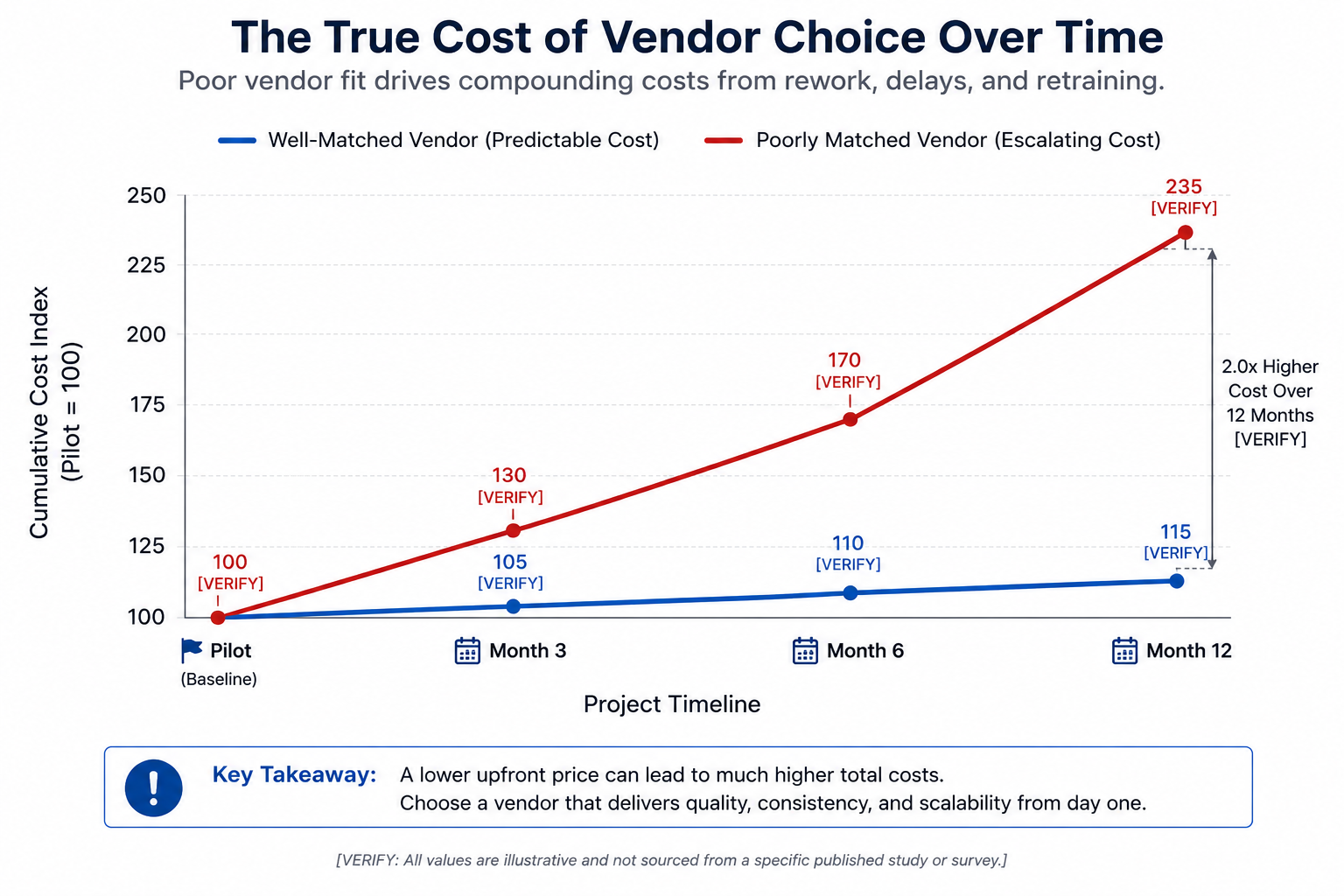
A cheap per-label rate that produces inconsistent labels isn't actually cheap — it's a hidden cost that surfaces later as model rework, retraining cycles, and delayed launches. The vendor decision is one of the few places in an AI project where a bad choice compounds quietly for months before it becomes visible in model performance.
McKinsey's research on AI deployment consistently points to data quality — not model architecture — as the most common bottleneck between a working prototype and a production-ready system. Choosing the right AI training data provider is one of the highest-leverage decisions in that pipeline, because it determines the ceiling on data quality before a single model iteration begins.
This decision matters more in some contexts than others:
Regulated industries (healthcare, defense) where labeling provenance may need to be audited
High-stakes accuracy domains (autonomous vehicles, medical imaging) where a labeling error has real downstream consequences
Long-term programs where switching vendors mid-project is costly, making the initial evaluation worth extra diligence
How It Works
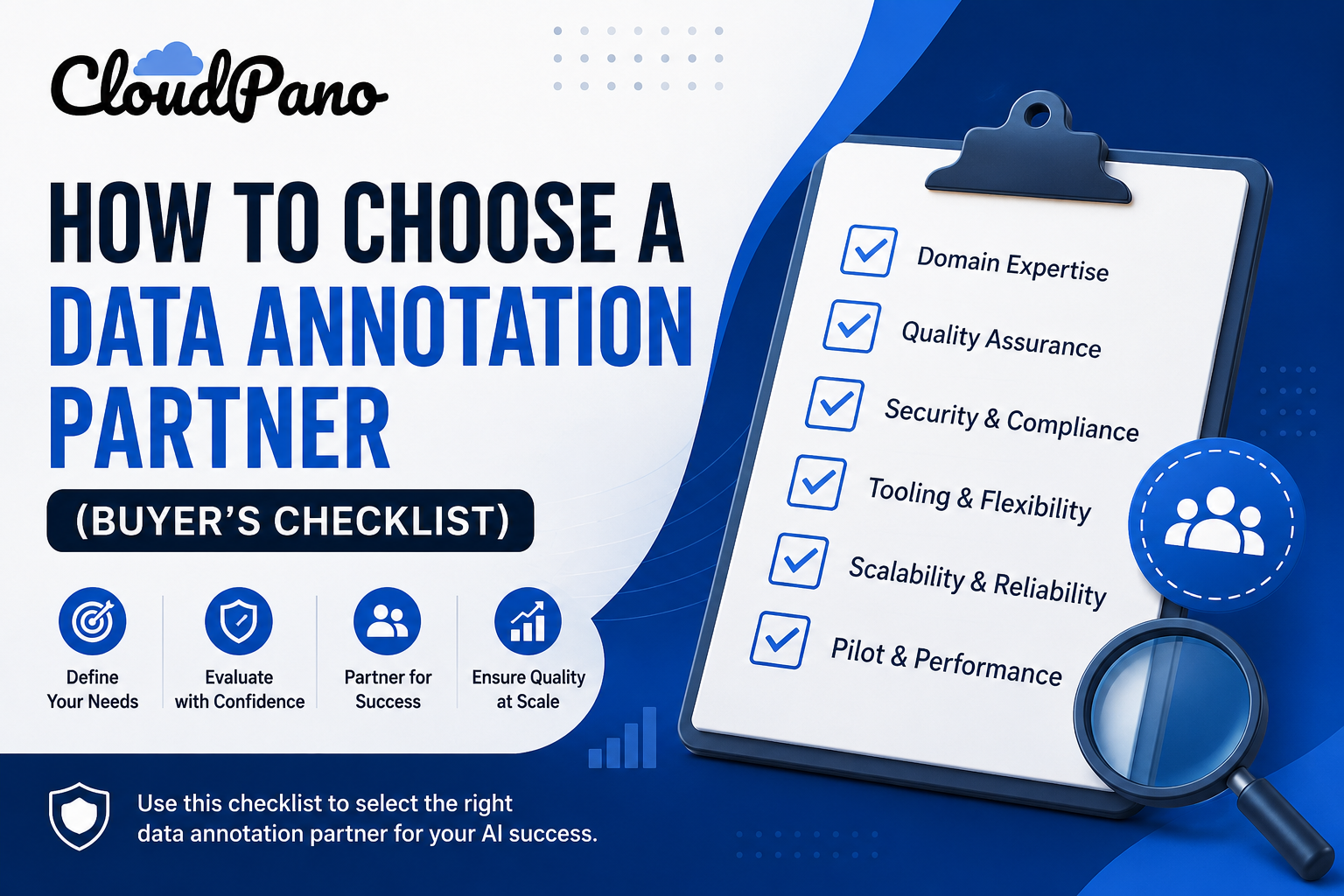
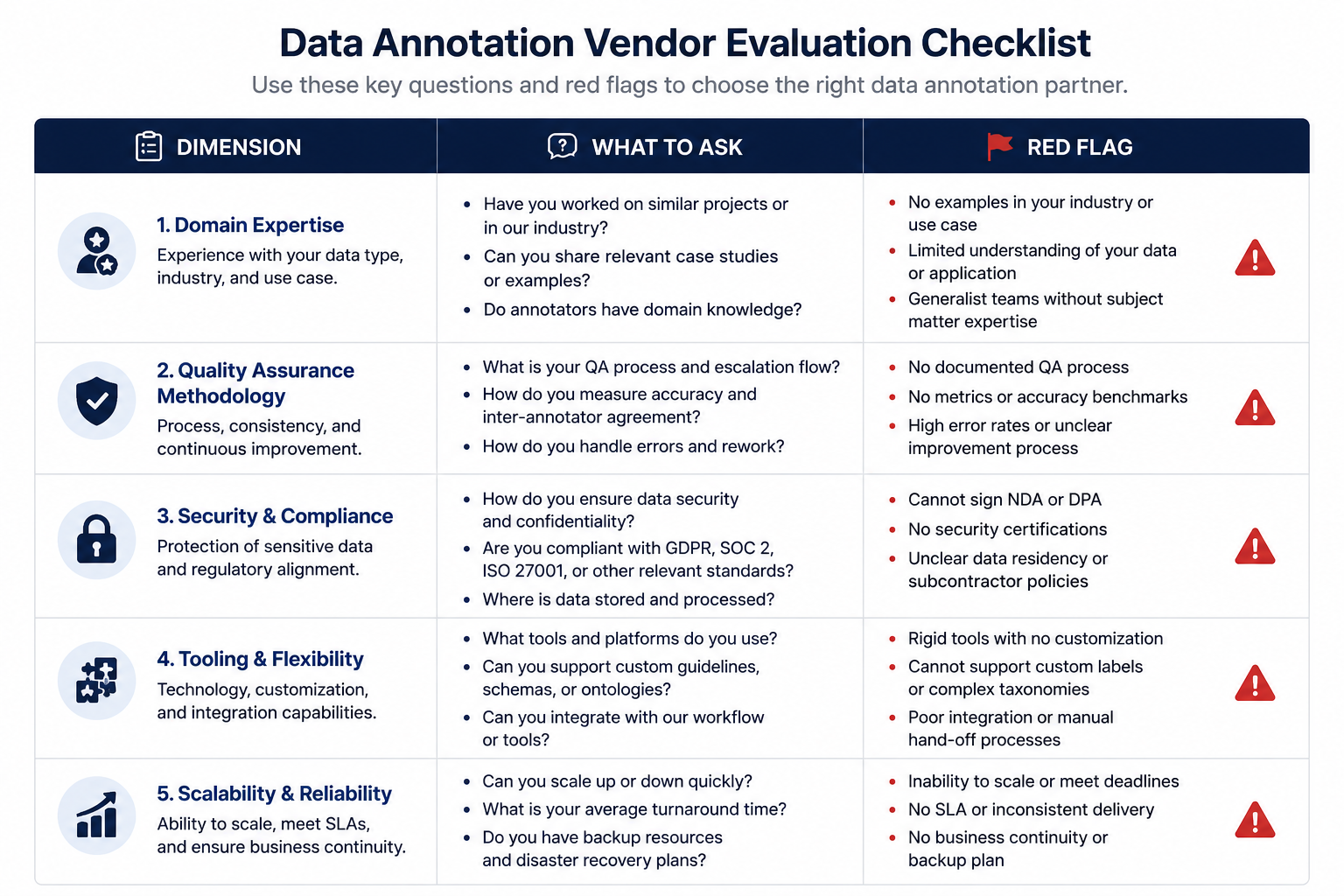
Vendor evaluation for data annotation services for enterprise typically covers five dimensions, and skipping any one of them tends to be where problems originate:
Domain expertise — does the vendor have annotators with relevant background for your data (medical, legal, technical, multilingual)?
QA methodology — what specific process catches labeling errors before they reach you (consensus scoring, gold-standard test sets, tiered review)?
Security and compliance — how is your data stored, who has access, and what certifications does the vendor hold?
Tooling and format flexibility — can the vendor work within your existing pipeline, or does adopting them require rebuilding your data infrastructure?
Scalability — can the vendor's annotator pool and QA process hold up if your volume grows 5x or 10x?
None of these dimensions substitute for the others. A vendor with excellent security but no domain expertise in your data type will still produce unreliable labels; a vendor with strong QA but no capacity to scale will become a bottleneck as your program grows.
📋 Evaluation Dimensions at a Glance
Checklist
Five key dimensions to assess — with specific questions to ask and red flags to watch for.
Dimension
What to Ask
🚩 Red Flag
🧠 Domain expertise
💡 Do annotators have relevant background for our data type?
⚠️ Generic "we can label anything" positioning
🔍 QA methodology
💡 What specific process catches errors before delivery?
⚠️ Vague answers like "we double-check everything"
🛡️ Security & compliance
💡 What certifications and data handling policies exist?
⚠️ Reluctance to share security documentation upfront
🔧 Tooling flexibility
💡 Can you work within our existing pipeline and formats?
⚠️ Requiring a full pipeline rebuild to adopt their tool
📈 Scalability
💡 What happens to quality if volume increases significantly?
⚠️ No clear answer about annotator pool depth
Step-by-Step Workflow
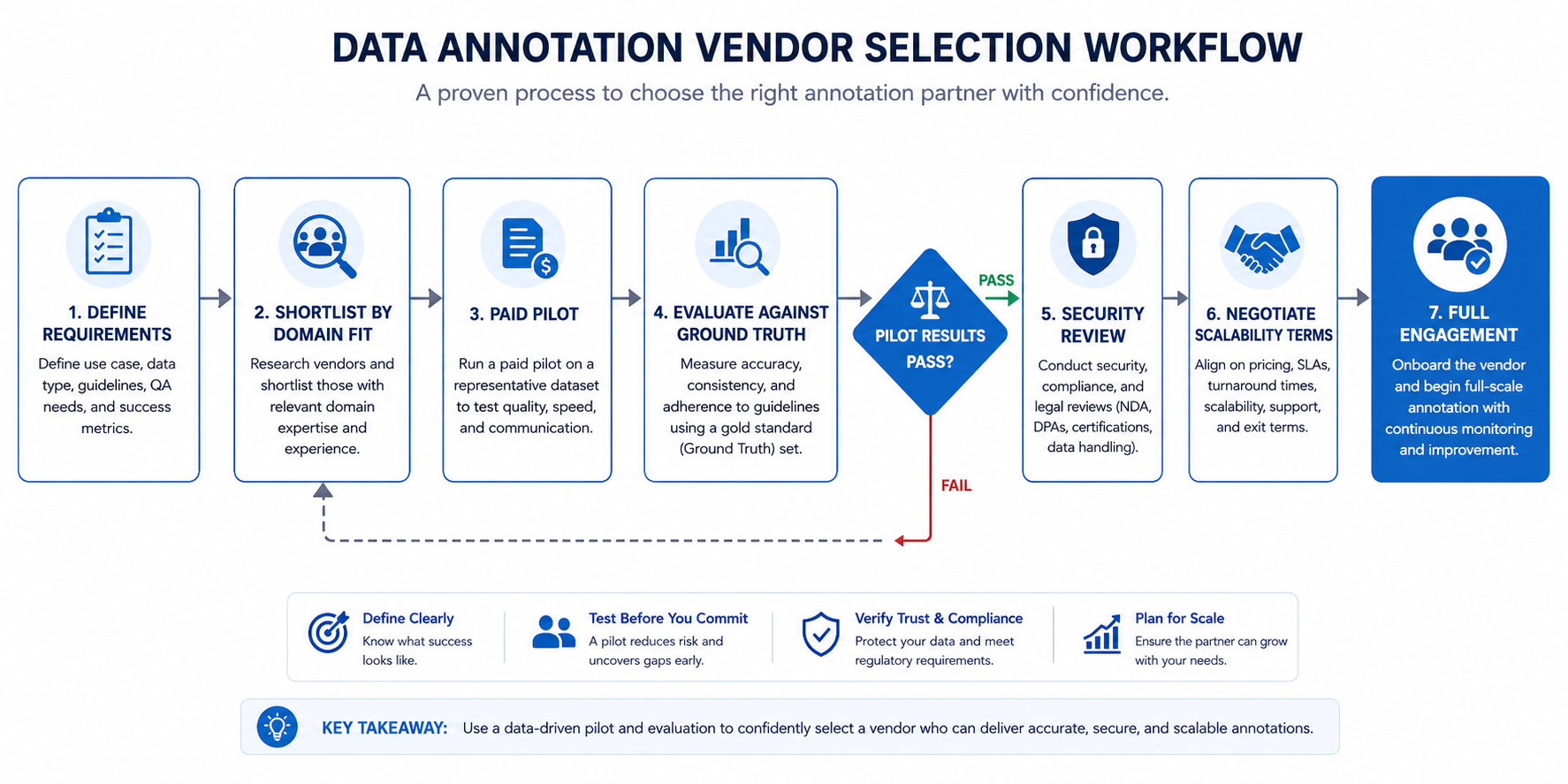
A structured vendor evaluation process generally looks like this:
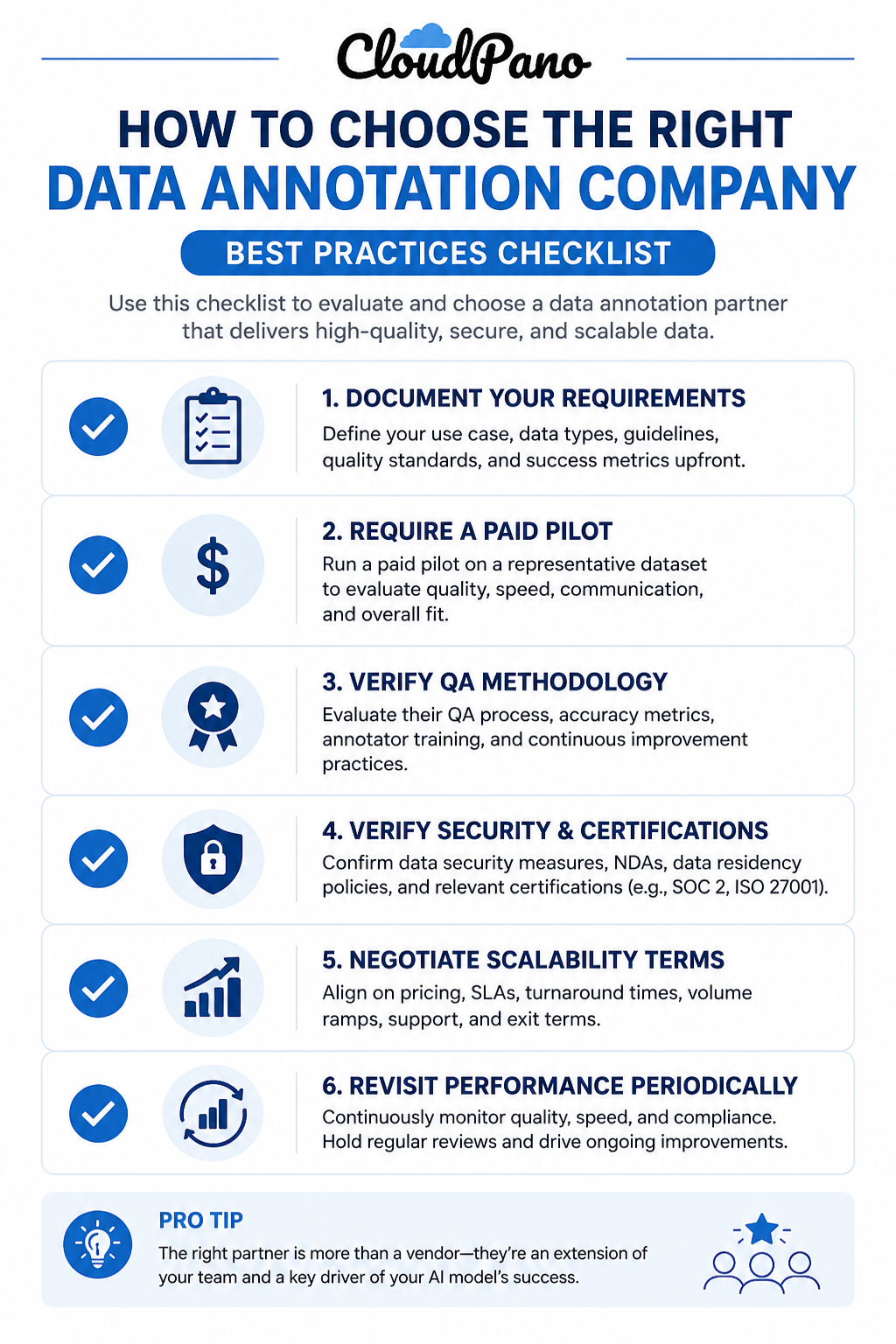
Define your requirements first. Document annotation type, volume, accuracy threshold, and compliance needs before contacting any vendor — this prevents being sold on capabilities you don't actually need.
Shortlist based on domain fit. Narrow to vendors with demonstrated experience in your specific data type and industry, not just AI annotation broadly.
Request a paid pilot, not a free sample. A small paid pilot on your actual data reveals far more about quality and communication than a demo using the vendor's own showcase dataset.
Evaluate the pilot against a ground-truth set. Measure the vendor's labels against a set you've already validated internally, rather than relying on the vendor's self-reported accuracy.
Review security documentation before scaling. Confirm certifications, data retention policies, and access controls before committing to larger volume.
Negotiate a scalability clause. Clarify pricing and quality guarantees at higher volume tiers before you need them, not after you're locked into a growing program.
Industry Use Cases
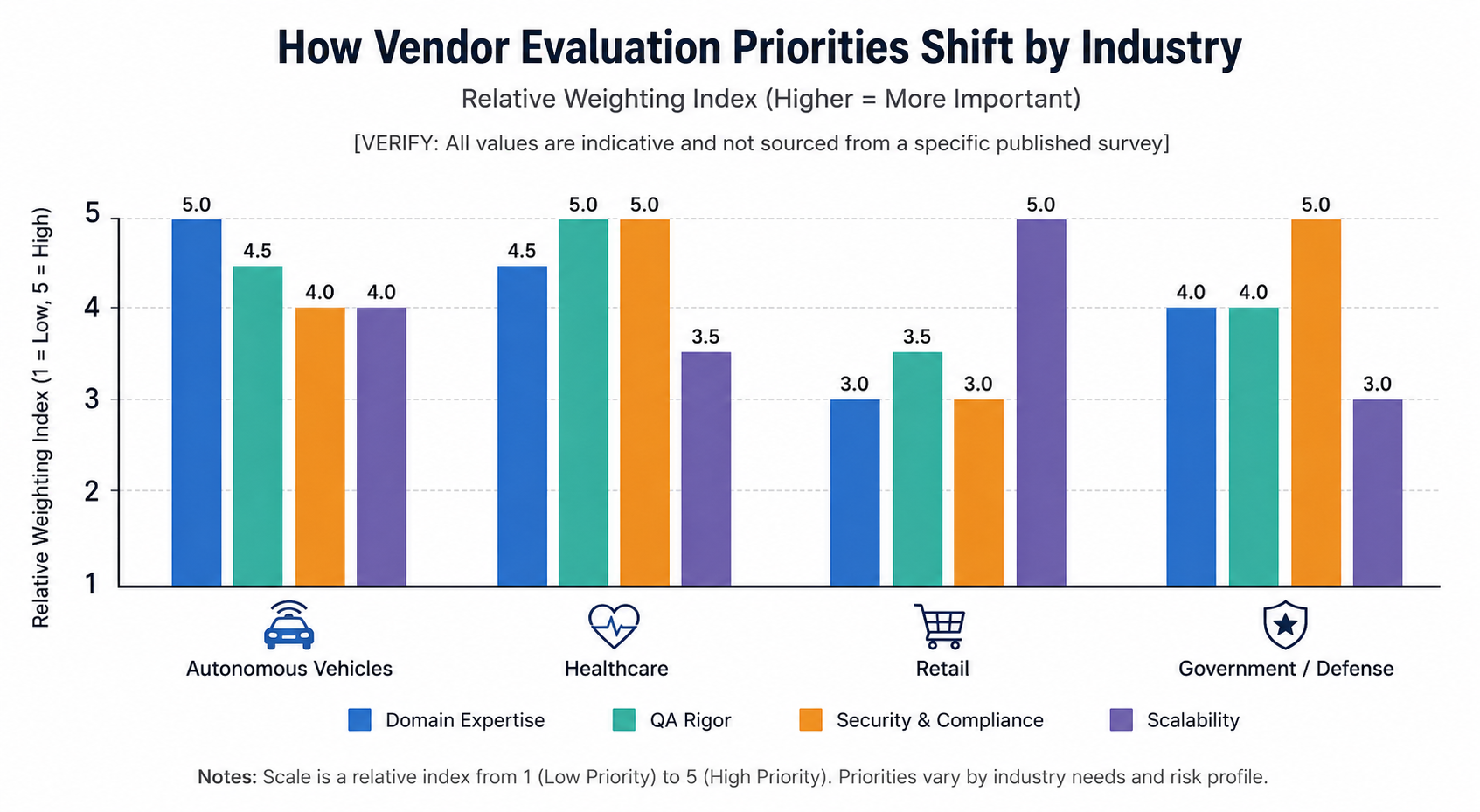
Autonomous vehicles: Vendors need demonstrated experience with 3D point cloud and sensor fusion annotation, plus a QA process built for safety-critical labeling standards.
Healthcare AI: Vendor selection often hinges on access to clinically trained annotators and compliance with health data handling requirements, more than on price per label.
Retail AI: High-volume, lower-complexity annotation (shelf audits, product classification) makes scalability and turnaround time the dominant selection criteria.
Robotics: Vendors need flexibility to handle evolving taxonomies, since robotics annotation tasks often shift as the underlying model and use case mature.
LLM development: Selection criteria shift toward annotator judgment quality for preference and comparison labeling, where consistency across annotators matters more than raw speed.
Government & defense: Vendor selection is often constrained by clearance requirements and audit-ready documentation, narrowing the field before quality comparisons even begin.
Grand View Research has covered the growing market of specialized annotation providers as enterprise AI adoption has scaled — reinforcing that vendor differentiation increasingly happens on QA rigor and domain fit rather than on generic labeling capacity.
Benefits
Choosing the right partner pays off well beyond the initial project:
Lower total cost once rework and retraining cycles from poor-quality labels are factored in, not just the initial per-label rate
Faster time to production, since a vendor with strong domain fit needs less upfront training and correction on your specific data
Reduced compliance risk when working with a vendor whose security posture matches your industry's requirements from day one
Smoother scaling, since a vendor evaluated for capacity upfront won't become a bottleneck as volume grows
Common Mistakes
Leading with price instead of accuracy requirements. Comparing vendors on cost per label before defining your accuracy threshold leads to comparing incompatible offers.
Skipping the paid pilot. Free samples using a vendor's own showcase data don't reveal how they perform on your actual, messier production data.
Assuming security compliance without verification. Taking a vendor's word on certifications rather than requesting documentation is a common gap that surfaces during audits, not before them.
Not testing for scale during evaluation. A vendor that performs well at pilot volume can degrade in quality once annotator pools are stretched — this is rarely visible until volume actually increases.
Treating tooling flexibility as a minor detail. Choosing a vendor whose tooling doesn't match your pipeline format often means costly conversion work that wasn't part of the original cost estimate.
Best Practices
Document accuracy requirements and compliance needs before requesting quotes, so vendor comparisons are apples-to-apples
Require a paid pilot evaluated against your own ground-truth set, not the vendor's self-reported metrics
Ask for specific QA methodology details, not general reassurances — a vendor that can't describe its process concretely is a signal worth noting
Verify security certifications and data handling policies directly, especially for regulated data
Negotiate scalability and pricing terms for higher volume tiers upfront, before you're dependent on the vendor at scale
Treat vendor selection as an ongoing relationship decision, not a one-time transaction — revisit performance against your ground-truth set periodically, even after the initial pilot
Gartner's guidance on vendor evaluation for AI data services has emphasized structured proof-of-concept testing over vendor self-reporting as the more reliable predictor of long-term partnership success — a pattern that holds consistently across enterprise annotation procurement.
Conclusion
Choosing a data annotation company well means evaluating domain expertise, QA methodology, security posture, tooling fit, and scalability together — not defaulting to whichever vendor quotes the lowest price per label. The vendors that look most similar on a pricing sheet often differ the most on the dimensions that actually determine dataset quality months into a project.
What's the most important factor in choosing a data annotation company?
There isn't a single universal factor — it depends on your data type and stakes. For regulated or high-accuracy domains, domain expertise and QA methodology tend to matter more than price. For high-volume, lower-complexity work, scalability and turnaround time often matter more.
How is "best data annotation company" different for different industries?
The best data annotation company for autonomous vehicle sensor data is unlikely to be the best fit for retail product classification — domain expertise, QA rigor, and required certifications differ significantly by data type and industry.
Should I request a free trial or a paid pilot?
A paid pilot on your actual data is more reliable. Free trials often use the vendor's own showcase dataset, which doesn't reveal how the vendor performs on your specific data's edge cases.
What's a reasonable timeline for evaluating a data annotation services for enterprise vendor?
This varies by project complexity, but rushing straight from proposal to full-scale contract without a paid pilot phase is one of the most common sources of downstream quality issues.
Is it better to work with one vendor or split annotation across multiple vendors?
This depends on volume and risk tolerance. A single vendor simplifies management and consistency, while splitting across vendors can reduce dependency risk but requires more effort to maintain labeling consistency across teams.
Create an interactive virtual showroom and engage affluent digital buyers with live 360º video calls, all through the CloudPano mobile app for a complete automotive sales solution.
Create 2D and 3D floor plans with measurements in 4 minutes or less, all from your phone. Download the Floor Plan Scanner app and get your first scan free.
Explore 47 open egocentric and robotics datasets for AI, computer vision, embodied AI, and robot learning. This guide compares each dataset’s primary focus and license or access terms to help researchers identify suitable training data and understand what to verify before commercial use.
AI teams are training models on huge amounts of everyday footage, from cooking to laundry. This guide explains what a daily activity video dataset is, how models use it, which public datasets exist, and what to check before using one..
Robots and vision models learn manipulation by watching hands grasp, move and use objects. This guide explains what an object interaction dataset contains, compares seven well-known datasets and their licenses, and covers what to check before training a commercial model.


.png)




.png)

.png)





.svg)


.svg)